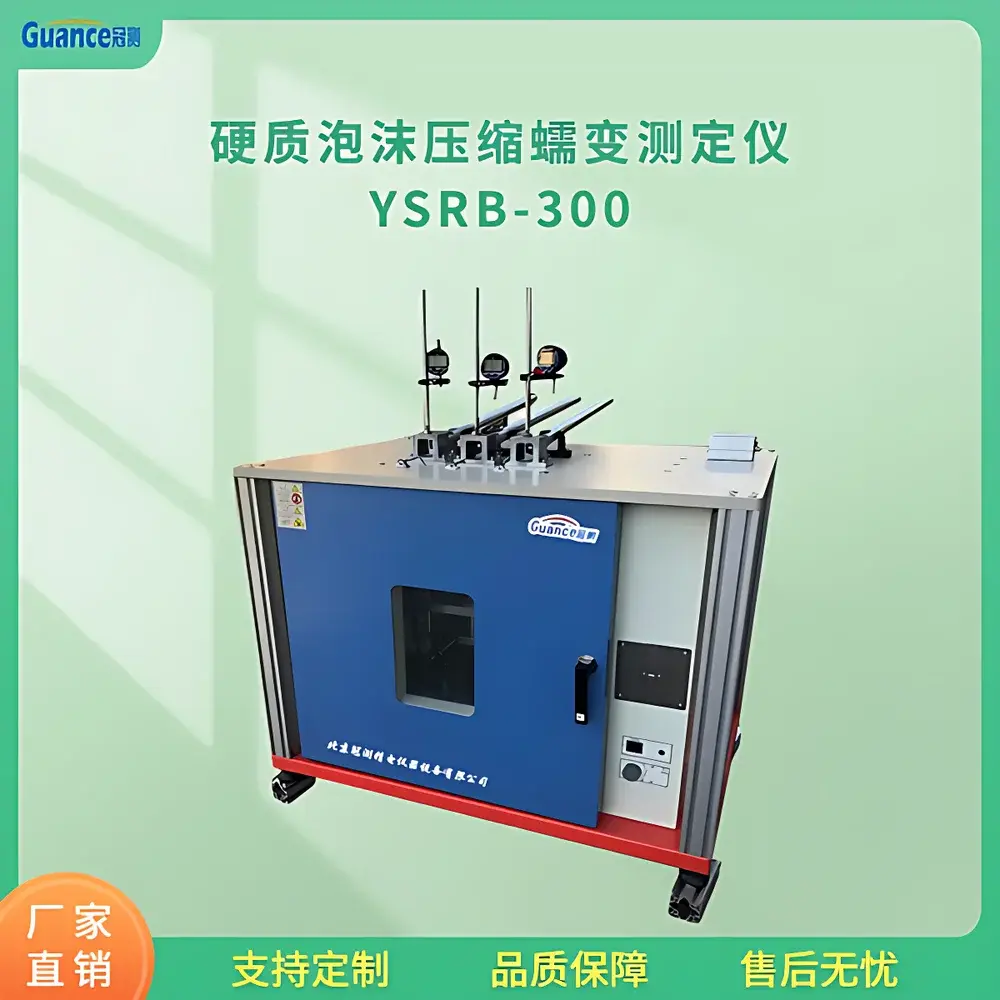
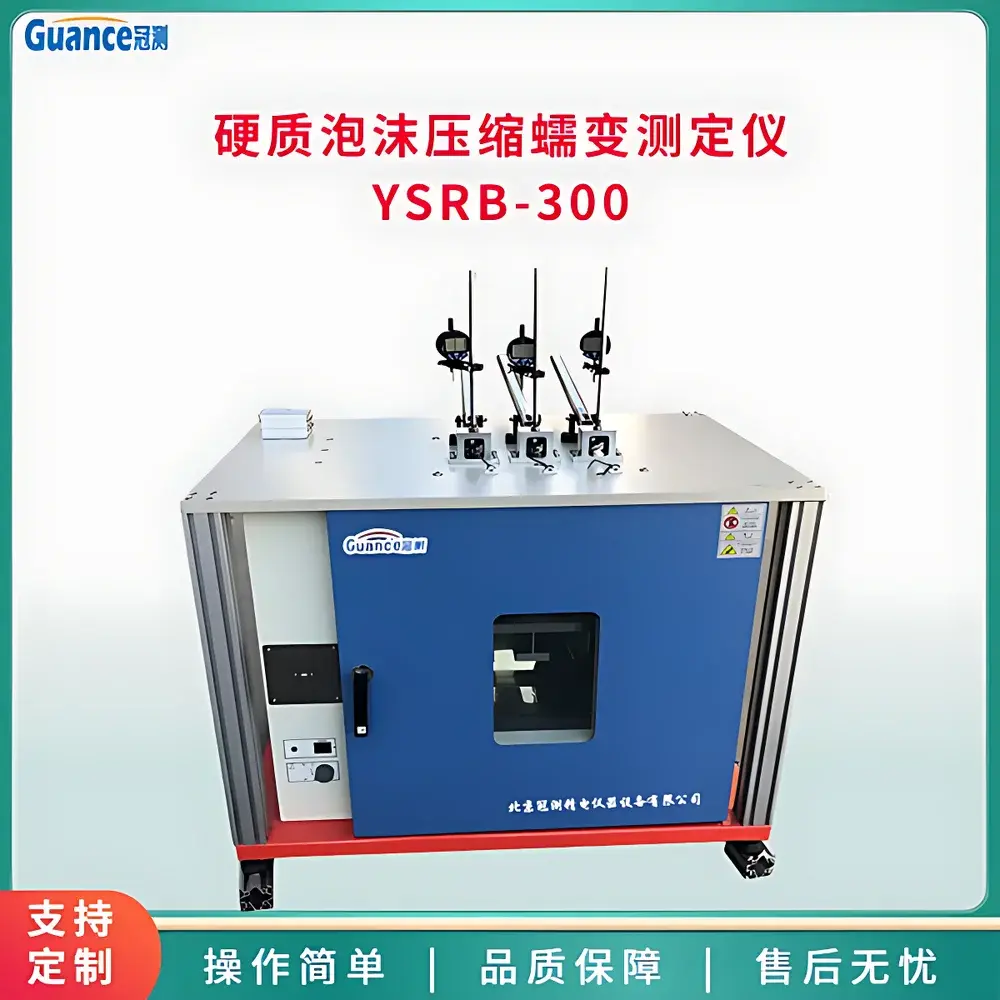
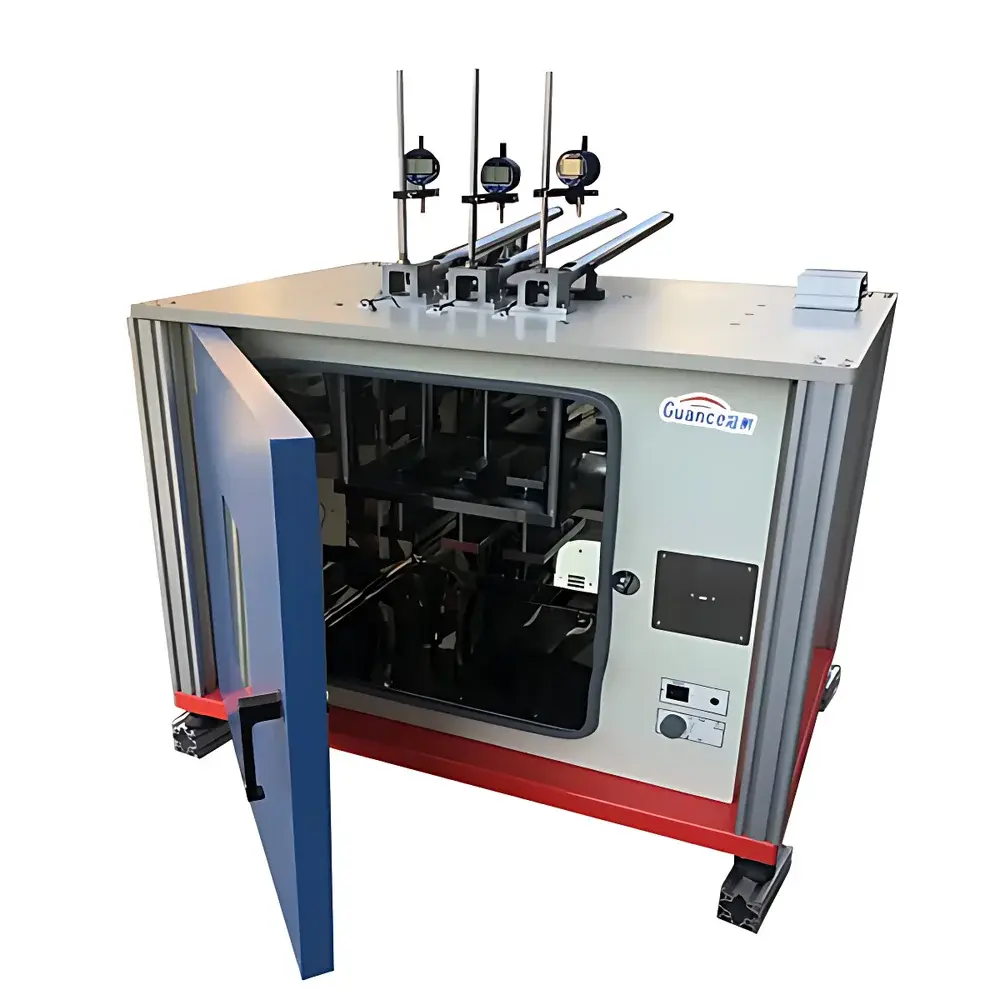
GuanCe Instruments YSRB-300.4 Hard Foam Creep Compression Tester
| Brand | GuanCe Instruments |
|---|---|
| Origin | Beijing, China |
| Manufacturer Type | Authorized Distributor |
| Country of Origin | China |
| Model | YSRB-300.4 |
| Price | USD 1,550 (approx.) |
| Heating Method | Air-bath |
| Test Channels | 3 |
| Temperature Range | Ambient to 300 °C |
| Temp. Stability | ±2 °C |
| Heating Rate | 50±3 °C/h or 10±2 °C/12 min |
| Temp. Resolution | 0.1 °C |
| Deformation Resolution | 0.002 mm |
| Specimen Dimensions | 50×50×50 mm or 40×40×20 mm |
| Platen Size | 50×50 mm (×3) |
| Recommended Load Range | 0–1 MPa |
| Chamber Internal Dimensions | 350×400×400 mm |
| Lever Compression Ratio | 1:32 |
| Loading Configuration | Lever-weighted compression + direct-weighted bending |
| Deformation Sensor | High-precision optical grating micrometer |
Overview
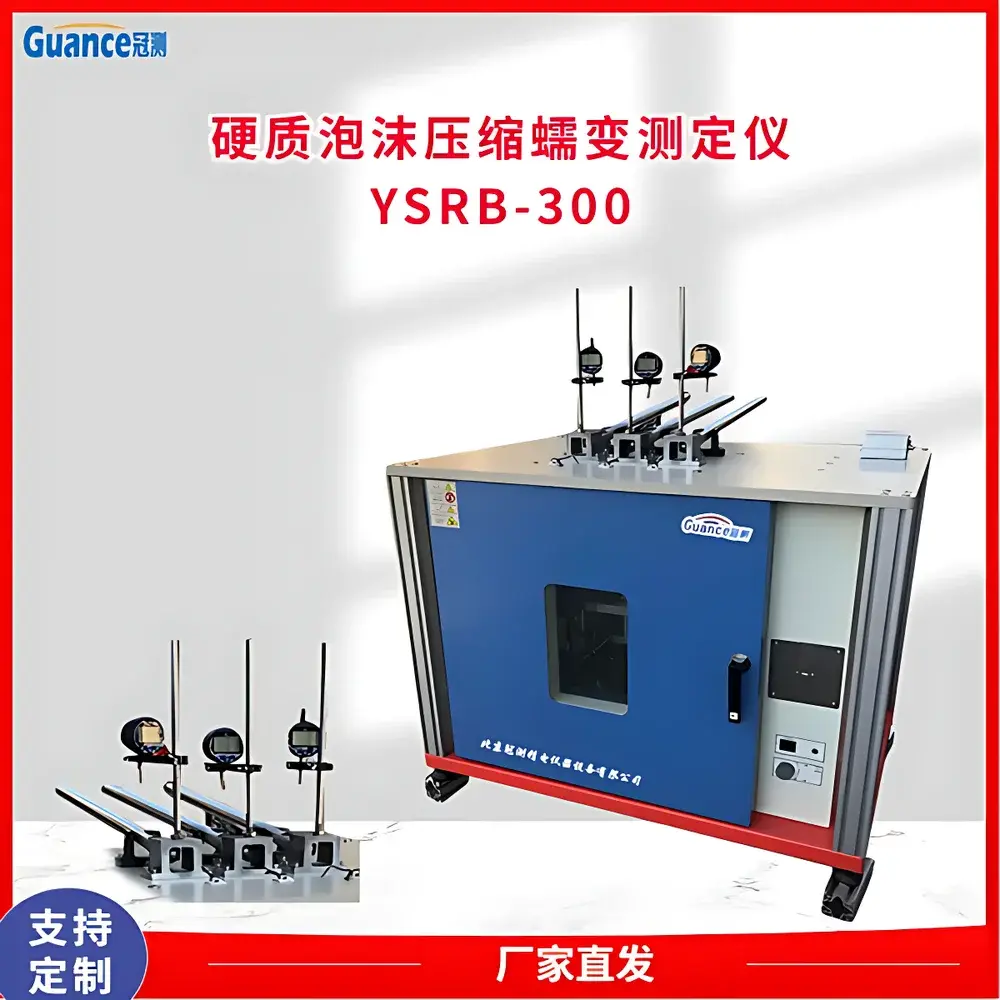
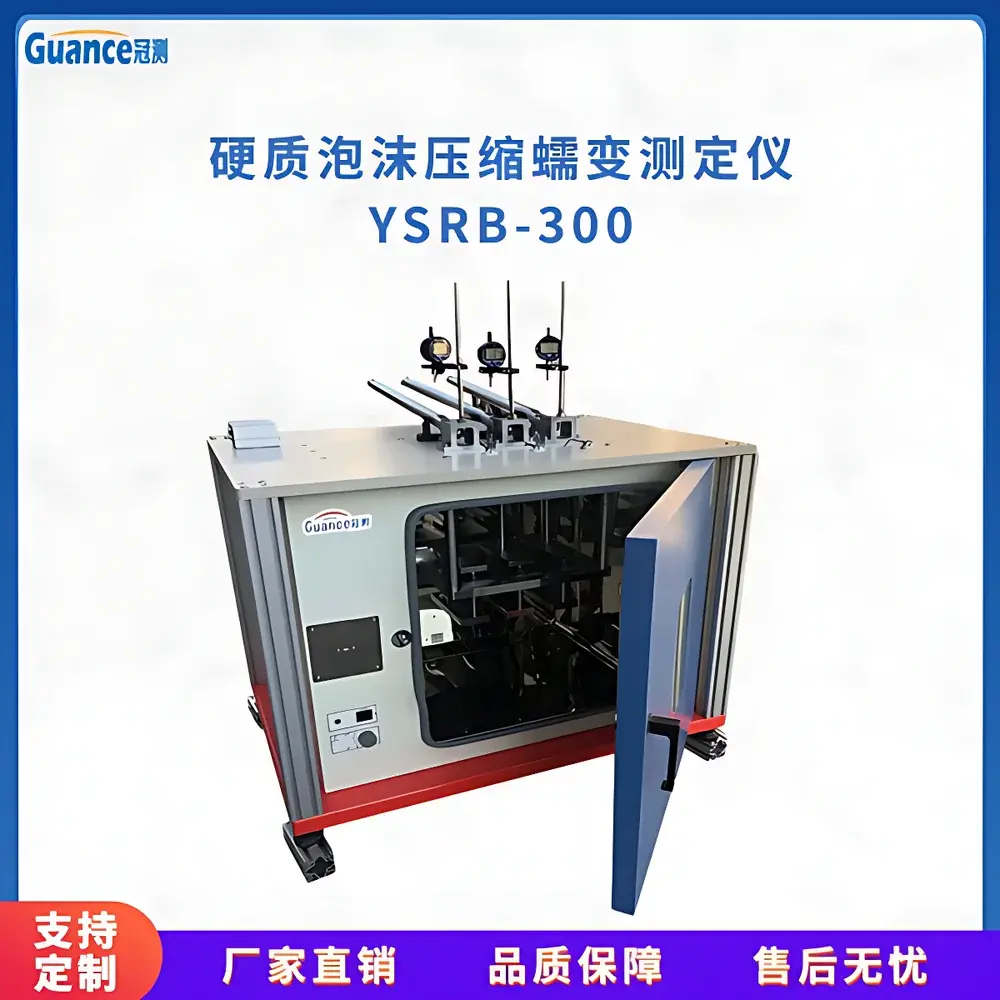
The GuanCe Instruments YSRB-300.4 Hard Foam Creep Compression Tester is a thermomechanical testing system engineered for the standardized evaluation of time-dependent compressive deformation in rigid polymeric foams under sustained mechanical load and elevated temperature conditions. It operates on the principle of controlled isothermal and isobaric creep testing—applying constant compressive stress while maintaining precise thermal profiles—and simultaneously measuring dimensional change over extended durations (up to 1,000 hours). Designed specifically for compliance with GB/T 20672–2006 (“Determination of compression creep of rigid cellular plastics under specified load and temperature”) and DIN 53424 (“High-temperature dimensional stability under bending and compressive stress”), the instrument enables laboratories to quantify critical parameters including creep strain, creep modulus, and time-to-failure under thermal-mechanical coupling. Its dual-mode loading architecture supports both lever-amplified compression and direct-weight bending configurations, facilitating comparative analysis of deformation mechanisms across different stress states.
Key Features
- Air-bath heating chamber with internal dimensions of 350 × 400 × 400 mm, enabling uniform thermal distribution and stable operation from ambient to 300 °C
- Three independent test channels—each equipped with dedicated temperature control, load application, and high-resolution deformation sensing—allowing parallel multi-specimen evaluation
- Optical grating-based micrometric displacement sensors (resolution: 0.002 mm) mounted directly on each test station, delivering traceable, low-drift measurement performance
- Intelligent PID temperature controller with 0.1 °C resolution and ±2 °C stability over full range; programmable heating rates (50±3 °C/h or 10±2 °C/12 min) support ISO-compliant thermal ramp protocols
- Lever-based mechanical amplification (1:32 ratio) for precise low-force compression loading (0–1 MPa), paired with direct-weight bending fixtures using calibrated stainless-steel weights (total mass per station: 5 kg, traceable to national standards)
- Real-time color graphical interface displaying synchronized temperature, load, and deformation curves; automatic data logging at user-defined intervals (1 s to 60 min)
- Integrated electronic control cabinet housing isolated I/O modules, EMI-shielded signal conditioning, and fail-safe thermal cut-off circuits compliant with IEC 61000-6-2 and EN 61326-1
Sample Compatibility & Compliance
The YSRB-300.4 accommodates standard specimen geometries defined in GB/T 20672–2006 and DIN 53424: cubes of 50 × 50 × 50 mm or 40 × 40 × 20 mm, suitable for rigid polyurethane (PUR), phenolic, melamine, and polystyrene (PS) foams used in aerospace insulation, building envelope systems, and transportation packaging. Each test station includes interchangeable platens (50 × 50 mm square, hardened stainless steel) and dual-purpose test heads—three configured for compression, three for bending—to ensure geometric fidelity and load alignment per ASTM D3574 and ISO 844 requirements. The system meets essential regulatory expectations for materials testing in quality-controlled environments: full audit trail capability (time-stamped raw data, operator ID, calibration logs), electronic signature readiness, and compatibility with GLP/GMP documentation workflows. While not FDA 21 CFR Part 11–certified out-of-the-box, its data export format (CSV, XML) and metadata structure align with laboratory information management systems (LIMS) requiring ALCOA+ data integrity principles.
Software & Data Management
The embedded Windows-based control software provides full lifecycle test management—from method setup (predefined templates for GB/T 20672 and DIN 53424) to automated report generation. All sensor inputs (temperature, displacement, elapsed time) are sampled synchronously at 10 Hz and stored in a relational database with cryptographic hash verification. Export options include PDF reports with embedded graphs, CSV for statistical post-processing (e.g., linear regression of log–log creep curves), and XML files compatible with enterprise LIMS platforms. Calibration records—including date, technician ID, reference standard ID, and uncertainty values—are stored alongside test data and cannot be modified without administrative override. Software updates are delivered via secure HTTPS channel with SHA-256 signature validation; no cloud connectivity is enabled by default, preserving network isolation in regulated facilities.
Applications
- Creep resistance qualification of structural foam cores in sandwich panels for railcar and wind turbine blade applications
- Thermal compression stability assessment of flame-retardant insulation foams under fire-test simulation conditions (e.g., UL 94, EN 13501-1)
- Long-term load-bearing behavior prediction for cold-chain packaging solutions exposed to warehouse temperature cycling
- Comparative evaluation of crosslink density effects on viscoelastic recovery in thermoset foams
- Validation of accelerated aging models linking short-term creep data to 10-year service life projections
- Supporting ISO 11357-6 (creep testing of plastics) and ASTM D2990 (tensile/compressive creep of plastics) method adaptations
FAQ
What standards does the YSRB-300.4 fully support out-of-the-box?
It natively implements test sequences, reporting formats, and pass/fail criteria for GB/T 20672–2006 and DIN 53424. Custom method creation is supported for ASTM D2990, ISO 11357-6, and internal corporate specifications.
Is the deformation measurement system traceably calibrated?
Yes—each optical grating sensor is supplied with a manufacturer’s calibration certificate referencing NIM (National Institute of Metrology, China) standards; annual recalibration is recommended per ISO/IEC 17025 guidelines.
Can the system operate unattended for multi-day tests?
Yes—the controller maintains thermal and mechanical setpoints autonomously for up to 168 hours; power-loss recovery resumes from last valid data point upon reboot.
What is the maximum allowable specimen height deviation for valid test results?
Per GB/T 20672–2006, specimen height tolerance must be within ±0.5 mm; the system’s auto-zero routine compensates for minor surface irregularities prior to load application.
Does the software support multi-user role-based access control?
Yes—administrator, operator, and reviewer roles are enforced with password protection, session logging, and configurable permissions for method editing, data export, and calibration management.