
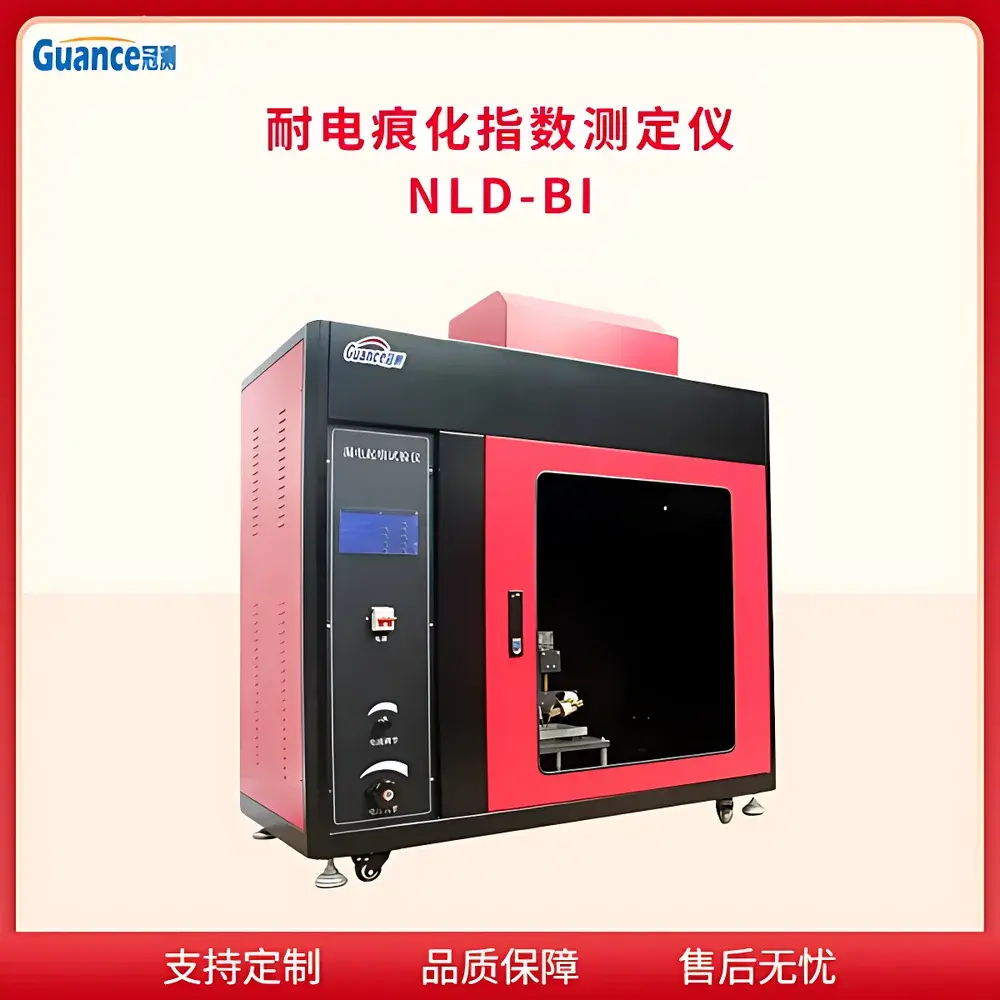
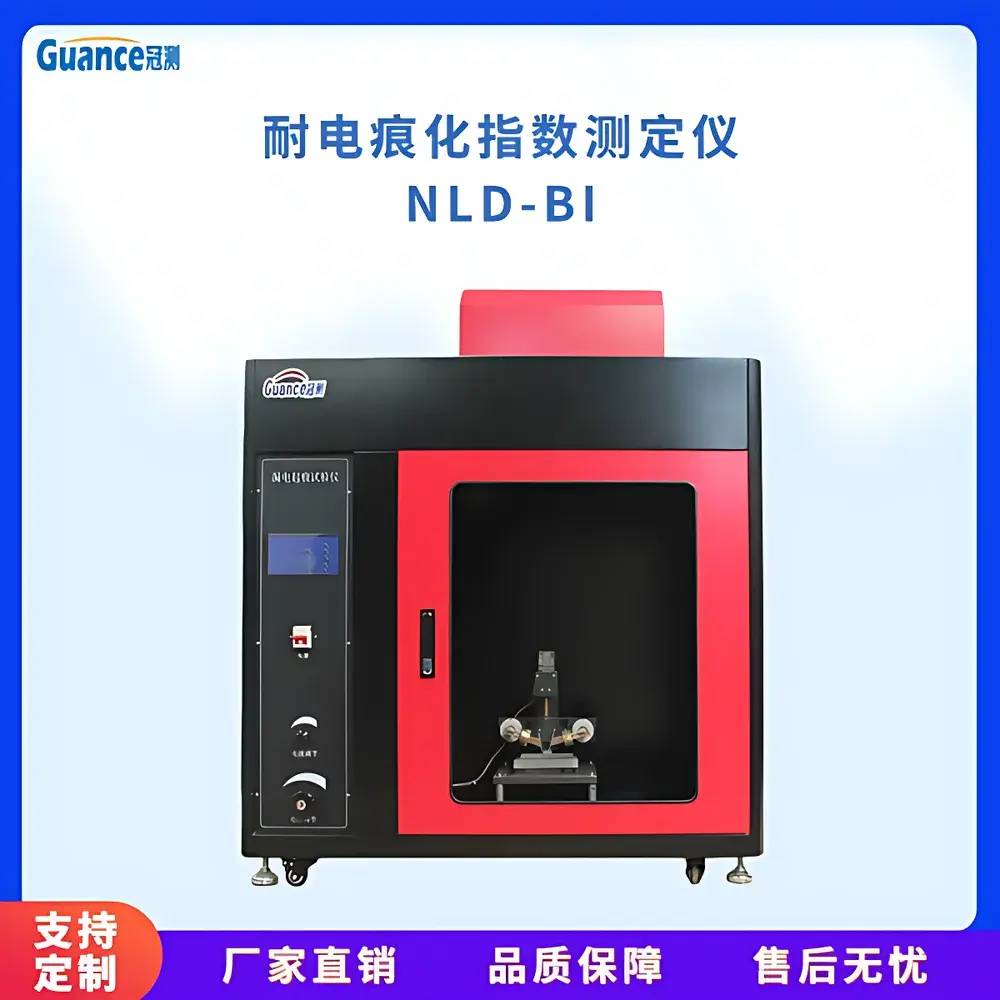
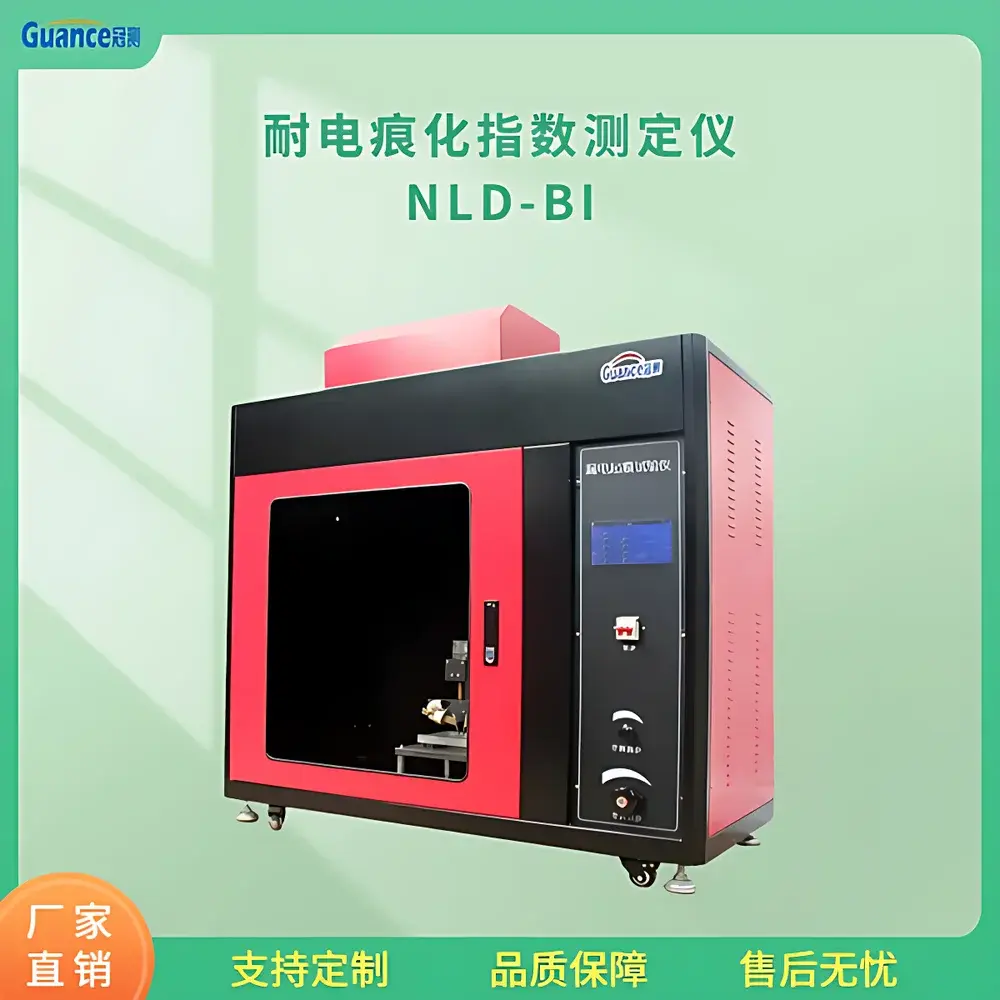
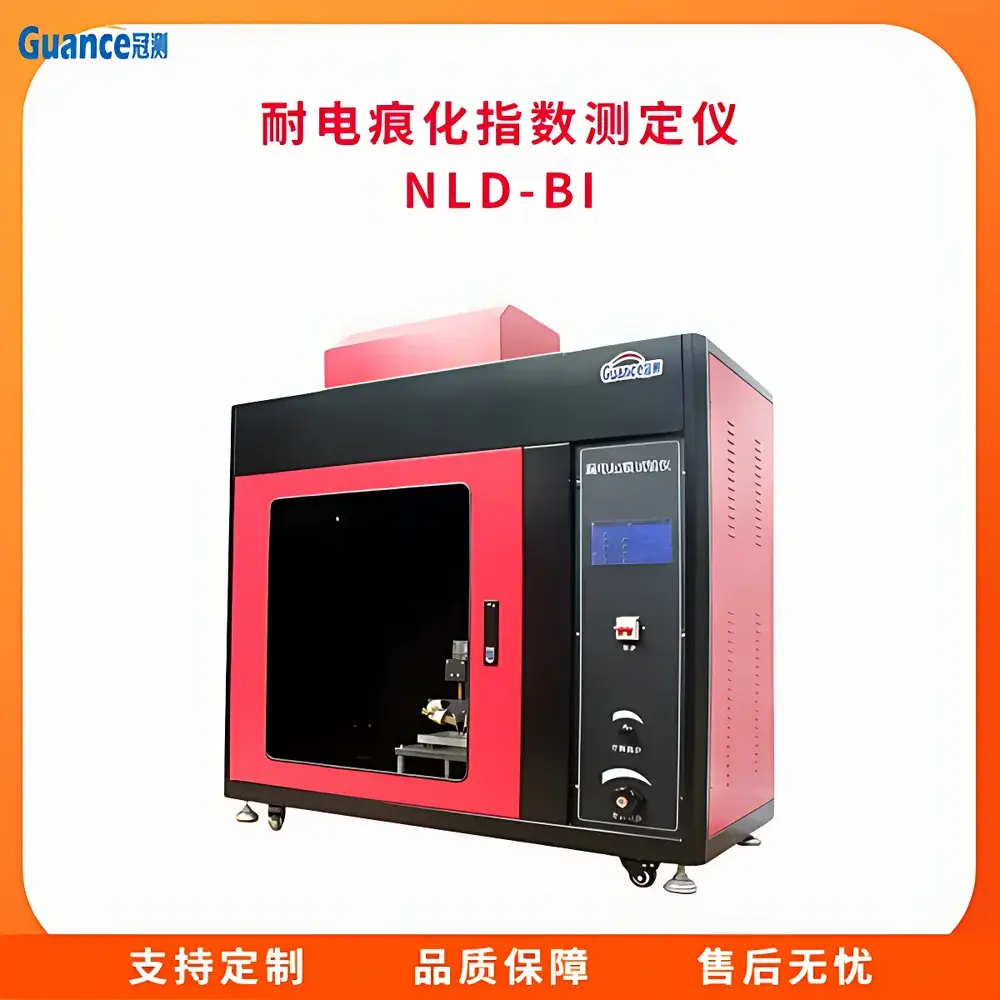
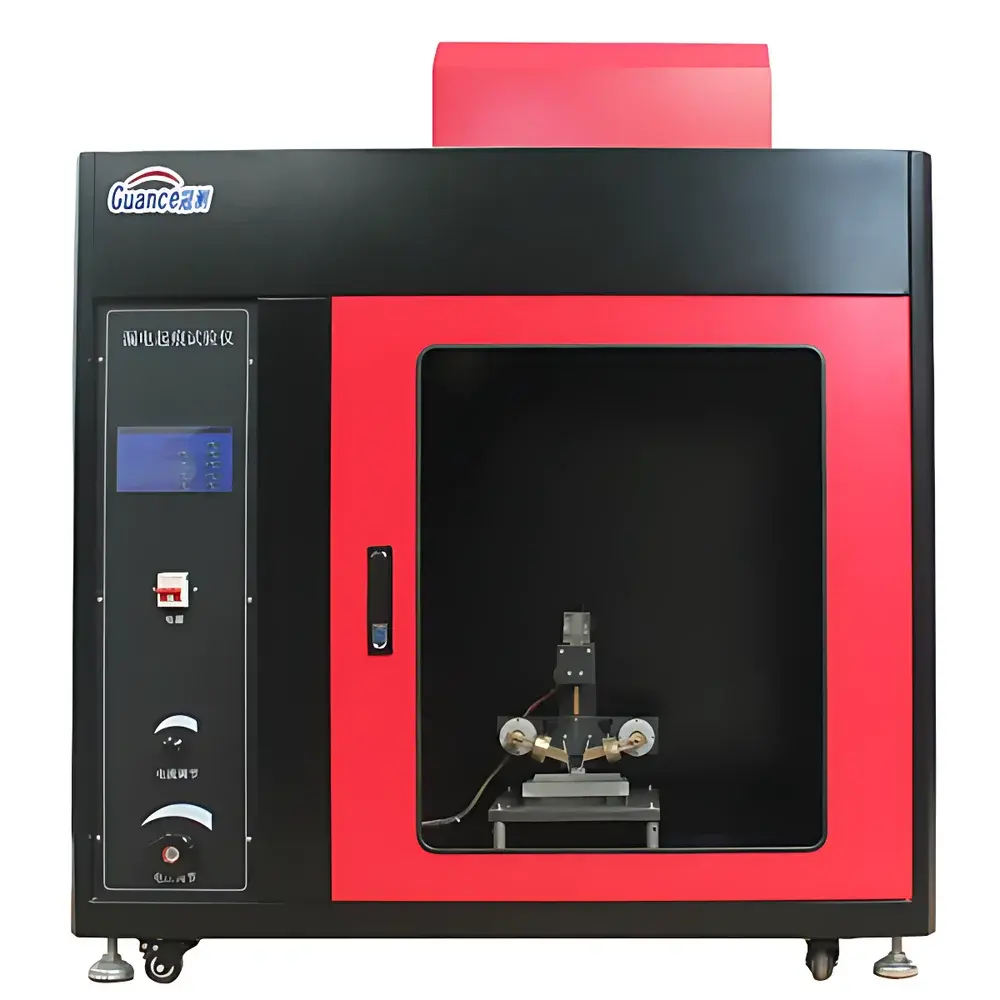
Guance Instruments NLD-BI5 Comparative Tracking Index (CTI) and Proof Tracking Index (PTI) Tester for Electrical Insulating Materials
| Brand | Guance Instruments |
|---|---|
| Origin | Beijing, China |
| Manufacturer Type | Authorized Distributor |
| Product Type | Electronic CTI/PTI Tester |
| Model | NLD-BI5 |
| Voltage Range | 100–600 V AC (48–60 Hz), 25 V increments |
| Electrode Material | 99% pure platinum (tips), copper (electrode rods) |
| Electrode Dimensions | (2.0 ± 0.1) mm × (5.0 ± 0.1) mm × (40 ± 5) mm |
| Pt tip | 12 mm long, 30° ± 2° bevel |
| Electrode Spacing | 4.00 ± 0.01 mm, 60° ± 5° included angle |
| Electrode Force | 1.00 ± 0.01 N |
| Test Solution Resistivity | Solution A: 3.95 ± 0.05 Ω·m (0.1% NH₄Cl) |
| Solution B | 1.98 ± 0.05 Ω·m |
| Droplet Height | 35 ± 5 mm (adjustable) |
| Droplet Interval | 30.00 ± 0.01 s (digital preset, 50-droplet time: 24.5 ± 2 min) |
| Droplet Count Range | 1–9999 (digital display & preset) |
| Airflow Velocity | 0.2 m/s (per IEC 60695-11-5) |
| Current Trip Threshold | 0.50 A ± 10%, sustained for 2.00 ± 0.2 s |
| Short-Circuit Current Stability | ≤10% voltage drop at 1.0 ± 0.0001 A |
| Power Supply | 220 V, 0.6 kVA, 50–60 Hz |
| Ambient Conditions | 0–40 °C, RH ≤80%, non-corrosive, low-vibration environment |
| Combustion Chamber Volume | >0.5 m³ (approx. 900 × 590 × 1050 mm), black matte background, illuminance ≤20 lux |
| Exhaust Port Diameter | Ø100 mm |
| Touchscreen | 7-inch color HMI with PLC-based control architecture |
| Compliance | GB/T 4207–2003, IEC 60695-11-5, IEC 60695-11-10 |
Overview
The Guance Instruments NLD-BI5 Comparative Tracking Index (CTI) and Proof Tracking Index (PTI) Tester is a precision-engineered instrument designed to evaluate the electrical resistance of solid insulating materials to surface tracking under high-voltage, humid, and contaminant-exposed conditions. Based on the fundamental principle of electrochemical degradation under controlled electrolyte droplet exposure, the system applies an alternating voltage (100–600 V, 48–60 Hz) across two standardized platinum electrodes mounted on a specimen surface. Conductive solution—either 0.1% ammonium chloride (Solution A) or a higher-conductivity variant (Solution B)—is dispensed at precise intervals (30.00 ± 0.01 s) from a calibrated height (35 ± 5 mm). The number of droplets required to initiate a conductive carbonized path (tracking) or sustain a current ≥0.50 A for ≥2.00 s defines the CTI value; PTI is determined as the highest voltage at which no tracking occurs after 50 droplets. This method directly quantifies material performance in real-world applications such as connector housings, circuit breakers, and outdoor insulators exposed to pollution and moisture.
Key Features
- Integrated 7-inch color touchscreen HMI with PLC-based logic control, enabling full operational supervision without external PCs
- Digital voltage regulation with 25 V resolution and real-time monitoring of applied voltage, leakage current, droplet count, elapsed time, and chamber status
- Automated safety interlocks: door position sensing, overcurrent cutoff (0.50 A ±10% for 2.00 s), and voltage sag compensation (<10% drop at 1.0 A)
- Precision-machined platinum-tipped electrodes meeting IEC 60695 geometric tolerances: (2.0 ± 0.1) mm × (5.0 ± 0.1) mm × (40 ± 5) mm, 30° ± 2° bevel, 4.00 ± 0.01 mm spacing at 60° ± 5° included angle
- Calibrated droplet delivery system with adjustable height and digitally preset timing—fully compliant with IEC 60695-11-5 repeatability requirements
- Low-noise, anti-backflow exhaust system (Ø100 mm port) maintaining stable 0.2 m/s airflow during and post-test, critical for smoke dispersion and optical observation integrity
- Black-matte combustion chamber (>0.5 m³ volume) with ≤20 lux ambient illumination, optimized for unambiguous visual detection of tracking onset and char formation
Sample Compatibility & Compliance
The NLD-BI5 accommodates flat, rigid specimens up to 15 mm thick and 100 mm × 100 mm in planar dimension, compatible with thermoplastics (e.g., PBT, PA66), thermosets (e.g., epoxy, phenolic), and filled composites used in electrical enclosures and PCB substrates. All mechanical and electrical parameters strictly adhere to the dimensional, metrological, and procedural requirements of GB/T 4207–2003 and its harmonized international equivalents: IEC 60695-11-5 (method for CTI/PTI determination) and IEC 60695-11-10 (specification for test apparatus). The system supports audit-ready operation under GLP environments, with timestamped test logs stored locally on the HMI—including voltage setpoint, actual current waveform snapshots (via analog input sampling), droplet counter, and pass/fail flags per IEC-defined failure criteria.
Software & Data Management
Test data—including voltage, current trace (sampled at 100 Hz), droplet count, duration, and final classification (CTI/PTI value or “no tracking”)—are logged internally with ISO 8601 timestamps and retained for ≥1,000 test cycles. Export is supported via USB interface to CSV format, preserving traceability for internal QA records or regulatory submissions. While the embedded HMI does not implement FDA 21 CFR Part 11 electronic signature functionality, all user actions (parameter changes, start/stop commands, reset events) are immutably recorded with operator ID (if configured via external authentication) and system clock sync. Data integrity is ensured by EEPROM-backed storage resistant to power loss during extended burn tests.
Applications
This tester serves laboratories engaged in material qualification for UL 746A, IEC 60695-2-12/13 (fire hazard testing), and automotive OEM specifications (e.g., VW 80101, GMW15635) requiring CTI validation. It supports R&D screening of flame-retardant additives, comparative studies of halogen-free vs. brominated systems, and QC release testing of injection-molded components prior to high-voltage assembly. In certification bodies, it fulfills mandatory pre-testing for CB Scheme reports and supports evidence generation for EN 60695-1-10 risk assessment documentation. Its robust construction and repeatable electrode alignment minimize inter-laboratory variability—critical for multi-site supply chain validation.
FAQ
What standards does the NLD-BI5 fully comply with?
It meets the apparatus requirements and test methodology of GB/T 4207–2003, IEC 60695-11-5, and IEC 60695-11-10, including electrode geometry, solution resistivity, droplet timing, airflow, and failure criteria.
Can the system store and export test reports?
Yes—test metadata and real-time current/voltage logs are stored onboard and exportable to USB as timestamped CSV files for archival or analysis.
Is calibration support provided for electrodes and droplet system?
Platinum electrodes are supplied with dimensional certification; droplet timing and height are factory-verified using traceable metrology tools (NIST-traceable timers and calipers), and routine verification protocols are documented in the user manual.
What safety protections prevent operator exposure during flaming events?
The chamber features interlocked access doors, automatic exhaust activation upon test initiation, and thermal cutoffs that disable high-voltage output if internal temperature exceeds 80 °C.
Does the unit support both Solution A and Solution B per IEC 60695?
Yes—the resistivity tolerance (±0.05 Ω·m) and conductivity verification procedure for both solutions are integrated into the standard operating protocol.



