
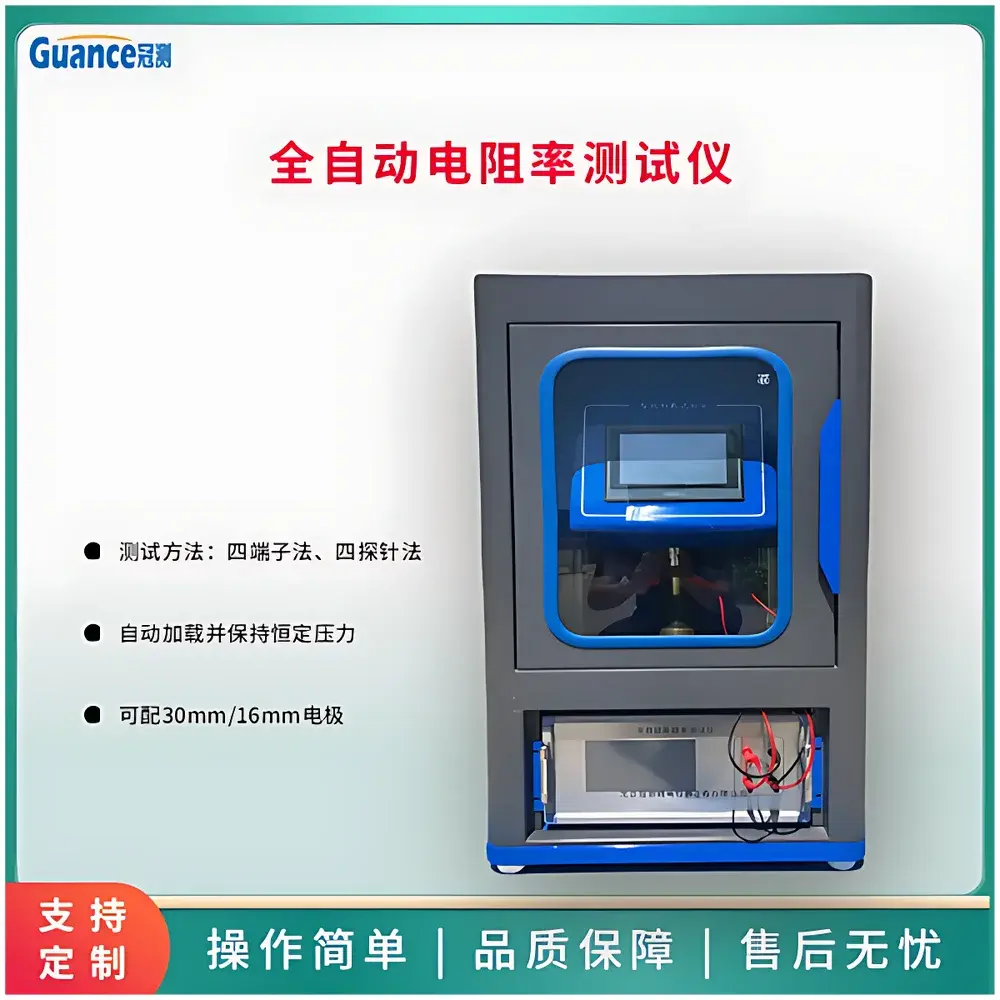
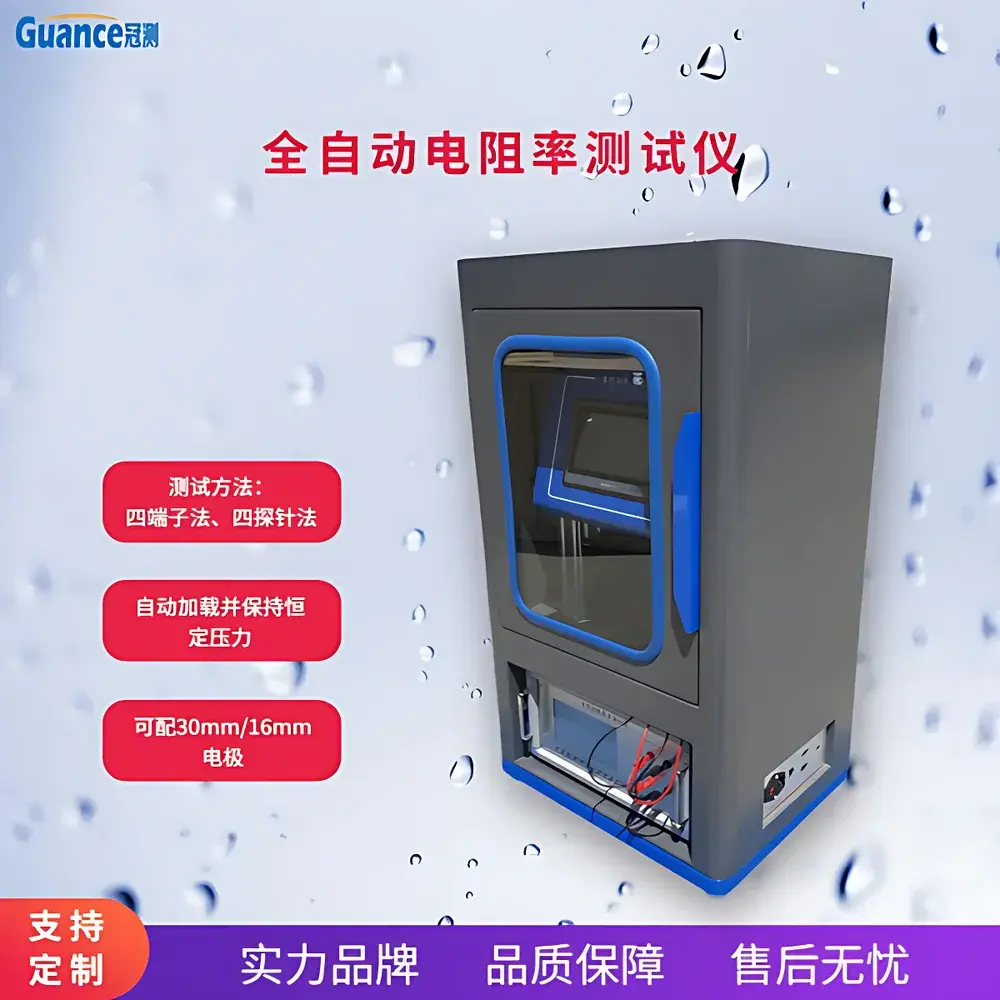
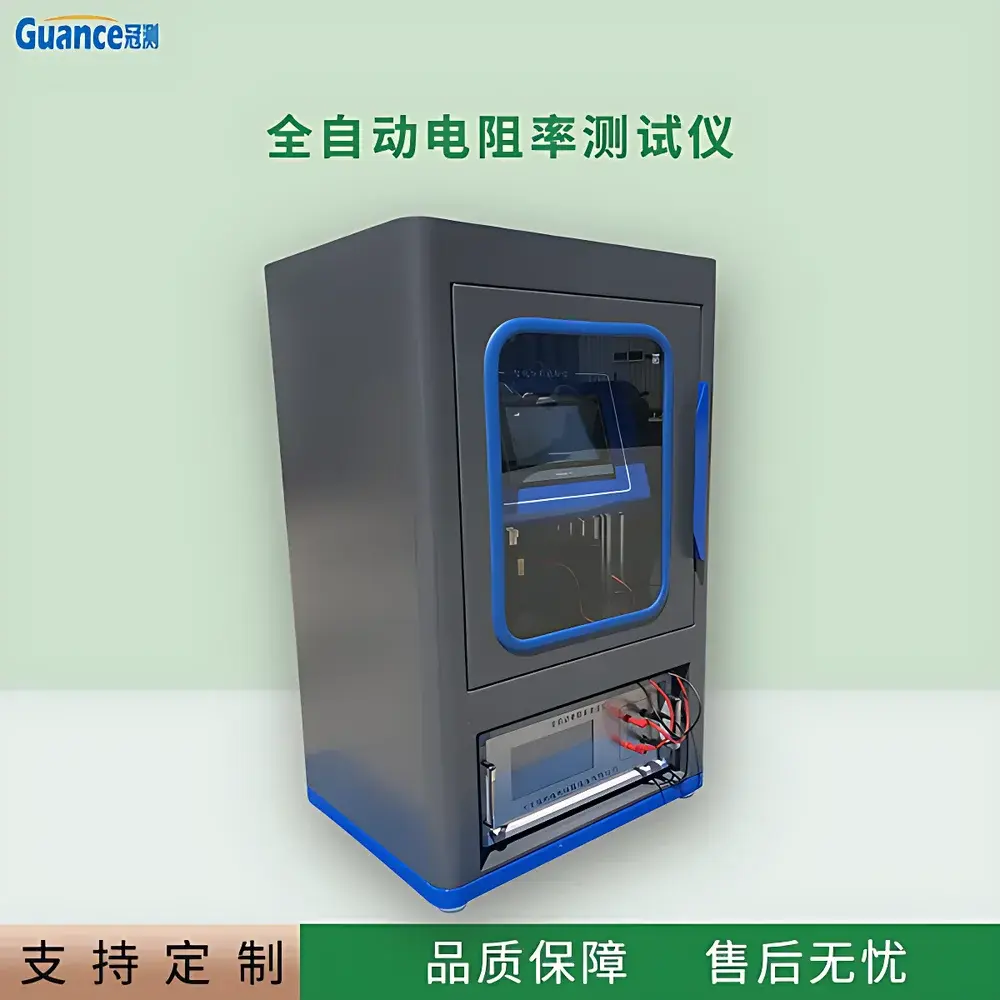
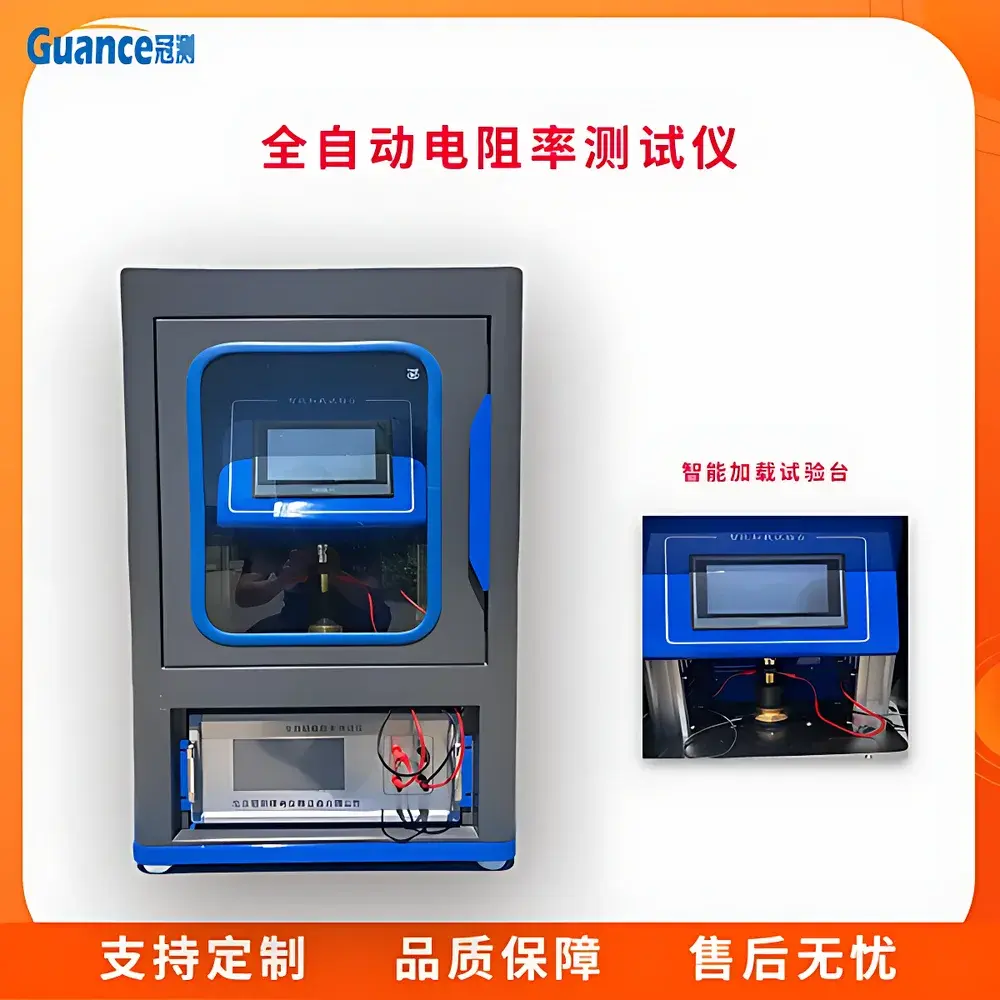
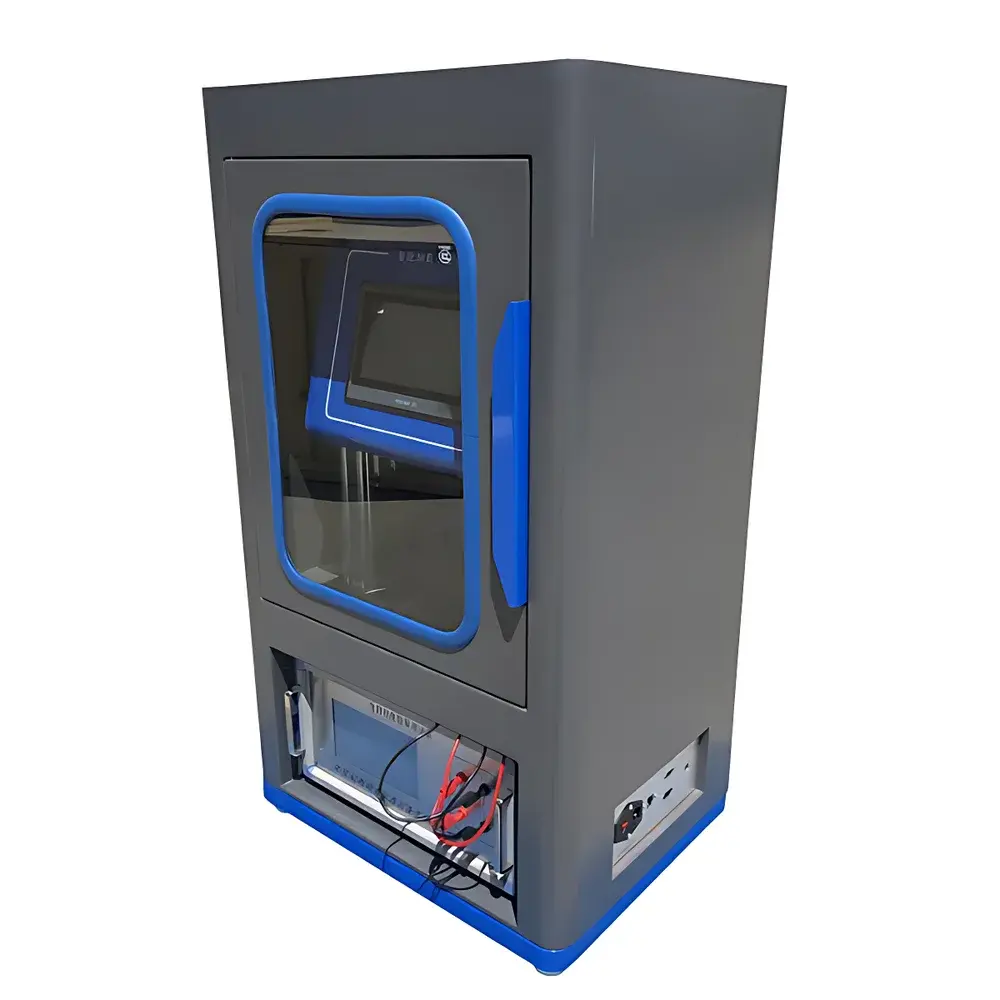
Guance GEST-126 Fully Automated Powder Resistivity Tester
| Brand | Guance |
|---|---|
| Model | GEST-126 |
| Measurement Principle | Four-Terminal (Kelvin) DC Resistivity Method |
| Resistivity Range | 10⁻⁶–10⁵ Ω·cm |
| Resolution | 10⁻⁸ Ω·cm |
| Voltage Ranges | 2 mV / 20 mV / 200 mV / 2 V |
| Current Output | 10 μA–10 A (8 ranges) |
| Compliance | YS/T 587.6–2006, GB/T 24525–2009, GB/T 24521–2009, GB/T 3782–2016 |
| Display | 4½-digit touchscreen interface with auto-polarity and overload indication |
| Data Output | Built-in thermal printer |
| Construction | Integrated mainframe + precision test fixture with controlled compaction mechanism |
| Origin | Beijing, China |
Overview
The Guance GEST-126 Fully Automated Powder Resistivity Tester is an engineered solution for precise, repeatable DC resistivity characterization of granular and powdered materials under standardized mechanical compaction conditions. It operates on the four-terminal (Kelvin) measurement principle, eliminating lead and contact resistance errors to ensure traceable accuracy in low- to medium-resistivity regimes. Designed specifically for industries where powder conductivity correlates directly with processing behavior and end-product performance—including carbon anode manufacturing, battery electrode material development, metallurgical powders, and conductive polymer composites—the instrument applies programmable axial pressure during sample consolidation to replicate industrial handling conditions. Its architecture conforms to internationally recognized test protocols, including YS/T 587.6–2006 (calcined petroleum coke), GB/T 24525–2009 (carbonaceous materials), GB/T 24521–2009 (coke), and GB/T 3782–2016 (acetylene black), ensuring data compatibility across global R&D, QC, and certification workflows.
Key Features
- Four-terminal DC resistivity measurement with automatic current reversal to minimize thermoelectric offset errors
- Eight-step programmable constant-current source (10 μA to 10 A) with ±(0.5% reading + 2 digits) accuracy across all ranges
- High-resolution 4½-digit digital voltmeter with auto-ranging (2 mV–2 V), ±(0.5% reading + 8 digits at 2 mA range; ±2 digits elsewhere)
- Integrated electromechanical compaction system enabling reproducible sample density control—critical for distinguishing intrinsic resistivity from porosity-dependent effects
- Touchscreen HMI with intuitive workflow navigation, parameter presets for common standards, and real-time feedback on contact integrity and measurement stability
- Built-in thermal printer supporting GLP-compliant hardcopy output with timestamp, operator ID field, and test condition metadata
- Modular design: Mainframe unit houses electronics and power supply; dedicated test fixture includes calibrated piston, precision load cell, and interchangeable die sets for 13 mm and 25 mm sample diameters
Sample Compatibility & Compliance
The GEST-126 accommodates free-flowing and cohesive powders with particle sizes ranging from submicron to 500 µm, provided they exhibit sufficient mechanical stability under compaction. It supports both loose-fill and vibration-assisted densification modes per ASTM D6383 (for reference) and aligns structurally with ISO 3252 and IEC 60404-16 requirements for magnetic powder resistivity assessment. All electrical safety and EMC design elements comply with GB/T 18268.1–2010 (IEC 61326-1). The instrument’s measurement uncertainty budget has been validated against NIM-traceable shunt standards and is documented per ISO/IEC 17025:2017 clause 7.6. Calibration certificates include as-found/as-left data, drift analysis over 24 h, and temperature coefficient verification at 23 ± 2 °C.
Software & Data Management
While the GEST-126 operates autonomously via its embedded touchscreen controller, optional USB-to-PC connectivity enables export of CSV-formatted datasets (resistivity, applied pressure, temperature, timestamp) for post-processing in MATLAB, Python (NumPy/Pandas), or LIMS environments. Audit trail functionality records all parameter changes, measurement triggers, and calibration events with user attribution—supporting FDA 21 CFR Part 11 readiness when deployed in regulated GMP/QbD settings. Firmware updates are delivered via secure signed binaries; configuration backups can be stored on removable microSD cards with SHA-256 checksum validation.
Applications
- Quality control of calcined petroleum coke and graphite powders for aluminum smelting anodes
- Development and batch release testing of cathode/anode active materials (e.g., LiFePO₄, NMC, silicon-carbon blends) in lithium-ion battery production
- Resistivity mapping of metal injection molding (MIM) feedstocks to predict sintering uniformity
- Characterization of conductive fillers (carbon black, graphene, nickel-coated graphite) in EMI shielding compounds
- Research into percolation thresholds and electron transport mechanisms in disordered particulate systems
- Verification of electrostatic discharge (ESD) safety parameters in pharmaceutical powder handling systems
FAQ
What compaction force range does the GEST-126 support?
The integrated mechanical actuator delivers controllable axial loads from 0.5 kN to 20 kN, corresponding to pressures up to 15 MPa for a 13 mm diameter die—fully covering ASTM D7810 and GB/T 24525 requirements.
Can the instrument measure anisotropic resistivity?
No—it performs isotropic bulk resistivity measurements only. For directional conductivity analysis (e.g., layered electrodes), complementary techniques such as van der Pauw or micro-four-point probe are recommended.
Is third-party calibration available?
Yes. Accredited calibration services per ISO/IEC 17025 are offered by CNAS-certified laboratories in Beijing and Shanghai, with full uncertainty budgets reported to CMC codes 10.02.01 and 10.02.03.
Does the system meet GLP documentation requirements?
All printed reports include mandatory GLP fields: test ID, analyst initials, equipment ID, environmental conditions (temperature/humidity), raw voltage/current values, calculated resistivity, and pass/fail status against method-defined tolerances.
How is electrode contact resistance compensated?
Through true four-terminal sensing: two outer electrodes inject current while two inner electrodes sense voltage gradient across a defined sample length—eliminating lead and interfacial resistance contributions without software correction.



