
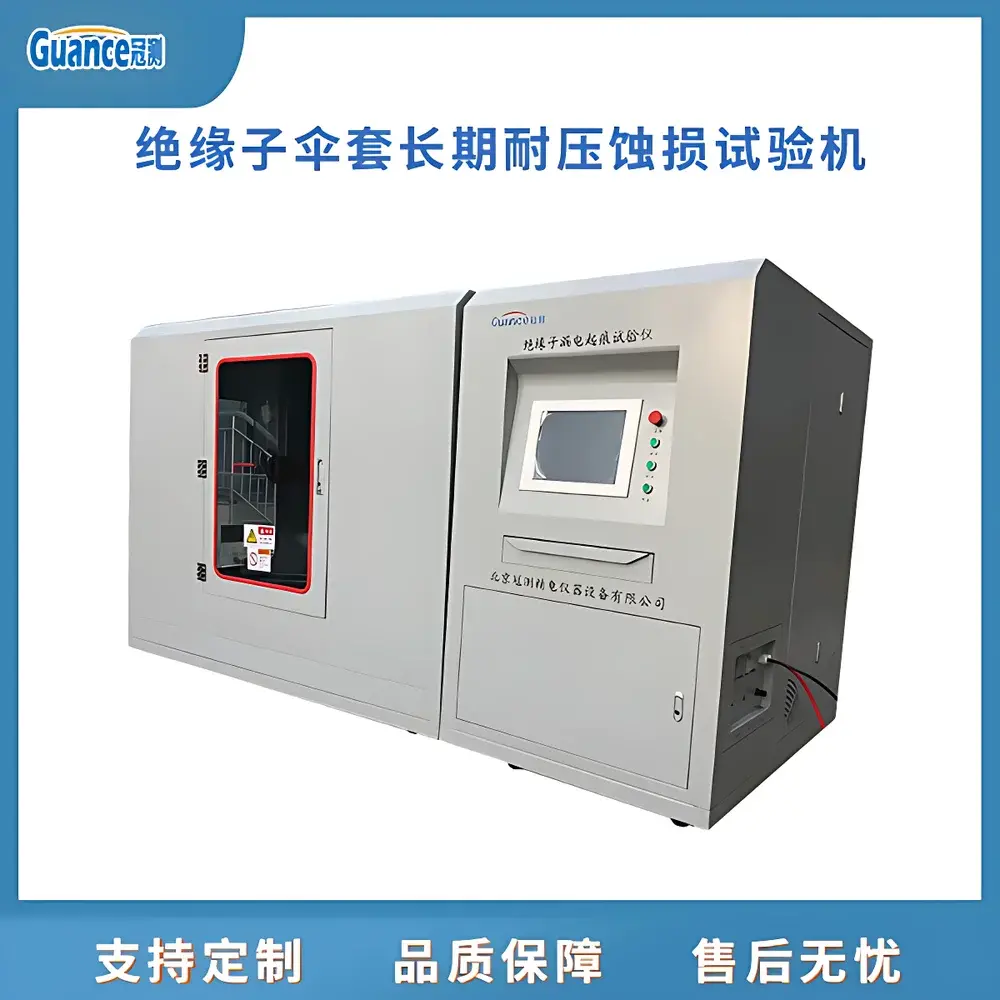
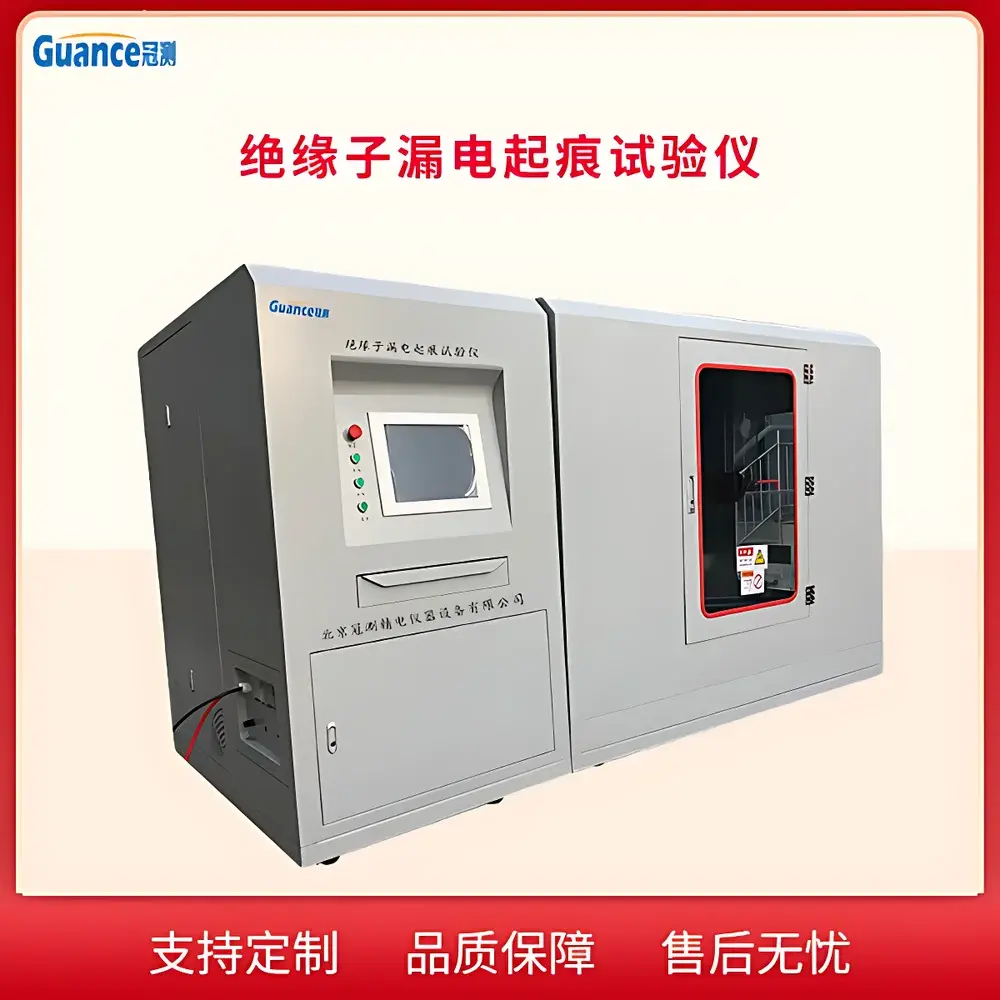
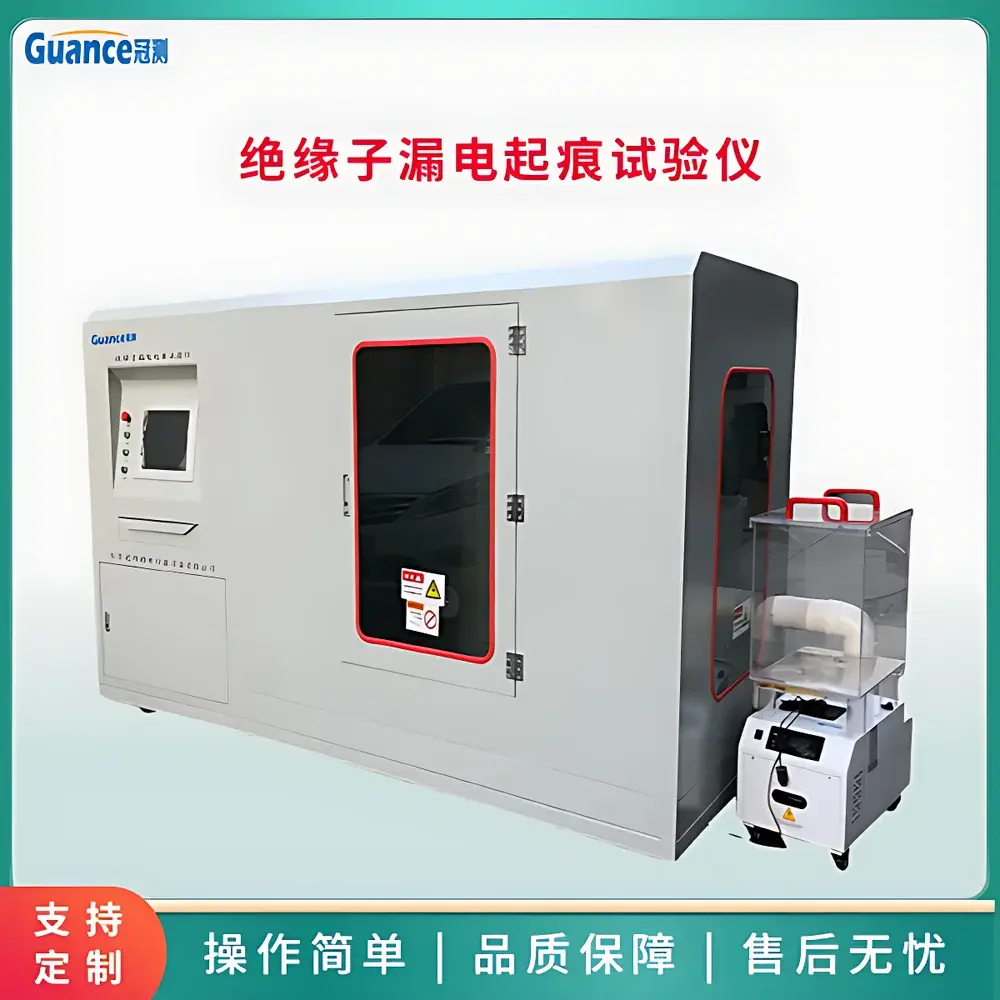
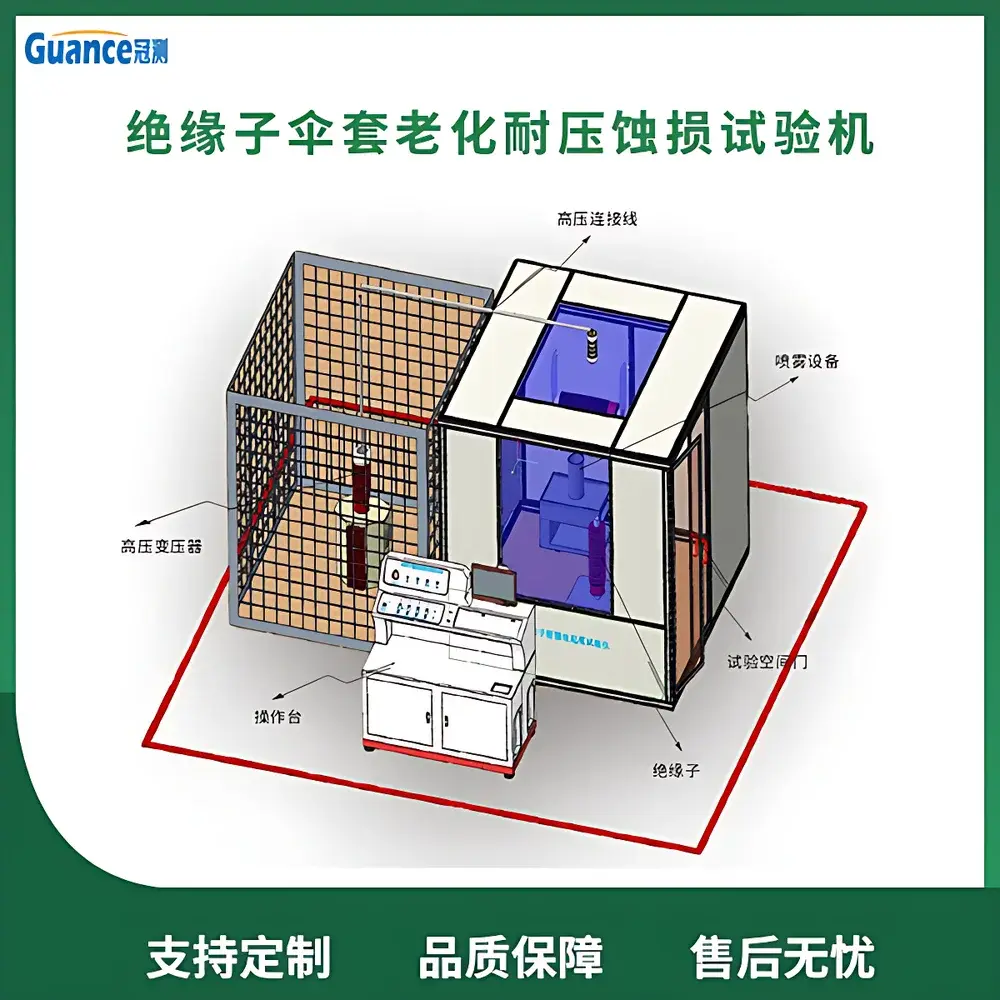
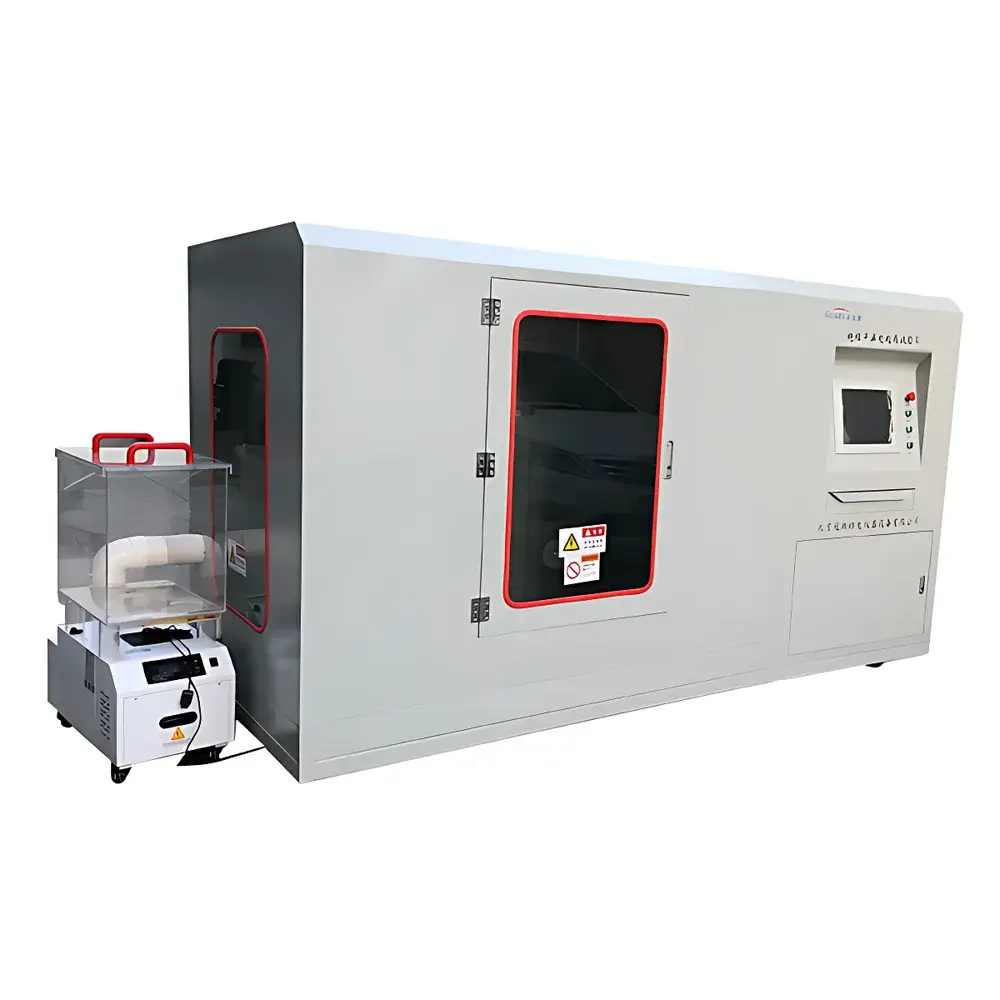
GuanCe Instruments NLD-AII.3 Universal Insulator Leakage Current Test System
| Brand | GuanCe Instruments |
|---|---|
| Origin | Beijing, China |
| Manufacturer Type | Authorized Distributor |
| Country of Origin | China |
| Model | NLD-AII.3 |
| Instrument Type | Electronic Universal Testing Machine |
| Input Voltage | AC 220 V |
| Output Voltage Range | AC 0–50 kV / DC −50–0 kV (adjustable) |
| Electrical Capacity | 50 kVA |
| Voltage Accuracy | < ±2% |
| High-Voltage Output Current | ≥1 A |
| Current Measurement Accuracy | < ±1% |
| 雾室容积 | 4 m³ (L×W×H = 2000 × 1200 × 1700 mm) |
| Spray Velocity at Specimen | 3 m/s |
| Salt Fog Generation | Ultrasonic atomizer |
| Fog Density | (0.4 ± 0.1) L/m³·h |
| Droplet Size Distribution | 5–10 µm |
| Specimen Configuration | 1 horizontal + 1 vertical |
| Minimum Clearance | ≥400 mm (to ceiling and walls) |
| Test Duration | 1000 h (continuous) |
| Safety Interlock | Door-activated high-voltage cutoff and automatic zeroing |
| Control System | Embedded industrial computer |
| Dimensions (L×W×H) | 3400 × 1300 × 1800 mm |
| Weight | 300 kg |
Overview
The GuanCe Instruments NLD-AII.3 Universal Insulator Leakage Current Test System is a purpose-built, standards-compliant evaluation platform engineered for accelerated aging and electrical endurance testing of polymeric and composite insulators used in high-voltage AC transmission and distribution systems (≥1 kV). It operates on the principle of combined electrical stress and environmental corrosion simulation—specifically, applying sustained AC or DC high voltage across insulator specimens while simultaneously exposing them to a controlled, reproducible salt fog environment. This dual-stress methodology replicates field conditions associated with coastal, industrial, or desert-dust-contaminated service environments where surface conductivity, dry-band arcing, and electrochemical degradation drive long-term insulation failure. The system conforms to key international and national test protocols including GB/T 20142–2006 (for overhead line post-type composite insulators) and GB/T 22079–2008 (for indoor/outdoor polymer insulators), ensuring data traceability and regulatory acceptability in quality assurance and type-testing workflows.
Key Features
- Integrated dual-mode high-voltage source: Continuously adjustable AC output (0–50 kV RMS) and DC output (−50 to 0 kV), both with ≤±2% voltage regulation accuracy and real-time feedback control.
- Ultrasonic salt fog generation system delivering precise fog density (0.4 ± 0.1 L/m³·h) and narrow droplet size distribution (5–10 µm), meeting ISO 9223 and IEC 60587 requirements for standardized contamination severity levels.
- Dual-specimen orientation capability: Independent horizontal and vertical mounting fixtures accommodate standard post-type and suspension-type insulators per IEC 60383 and GB/T 19519.
- Robust safety architecture: Electromechanical door interlock cuts HV output and forces zero-voltage reset upon access; overcurrent protection with user-defined trip thresholds; dual mechanical limit switches for motion safety.
- Embedded industrial control unit with deterministic real-time OS ensures uninterrupted 1000-hour continuous operation with sub-second logging resolution and hardware watchdog supervision.
- Compliance-ready calibration infrastructure: Onboard voltage and current sensor calibration routines support metrological traceability to national standards (e.g., CNAS-accredited labs).
Sample Compatibility & Compliance
The NLD-AII.3 accommodates standard porcelain, glass, and polymeric insulators up to 1.5 m in height and 30 kg in mass. Mounting interfaces comply with IEC 61109 and GB/T 1001.1 dimensional tolerances. All test procedures align with the pass/fail criteria defined in GB/T 20142–2006 (Section 8: Electrical Endurance Test) and GB/T 22079–2008 (Clause 9: Tracking and Erosion Resistance Test). The fog chamber’s internal geometry (4 m³ volume, ≥400 mm clearance from walls/ceiling) satisfies spatial uniformity requirements specified in ASTM D2247 and IEC 60068-2-52 for salt mist exposure chambers. Material compatibility assessments confirm non-reactivity of chamber lining (PP-H and stainless-316) with 5% NaCl solution under prolonged thermal-humidity cycling.
Software & Data Management
The embedded control software provides full lifecycle test management without external PC dependency. Real-time oscillographic display overlays voltage, leakage current, and chamber humidity/temperature on synchronized time axes. All measurements are timestamped with microsecond precision and stored in binary-encoded, CRC-protected files. Audit trail functionality logs operator ID, parameter changes, pause/resume events, and system faults—supporting GLP/GMP-aligned documentation per ISO/IEC 17025 and FDA 21 CFR Part 11 (when paired with digital signature module). Historical data queries support filtering by date range, specimen ID, or test status. Export formats include CSV (for Excel/Python analysis) and PDF (for electronic reports with embedded metadata and digital signatures). USB 2.0 host interface enables secure offline data transfer without network connectivity.
Applications
- Type qualification testing of composite station post insulators per IEEE C29.11 and GB/T 26218.
- Comparative tracking resistance (CTR) evaluation of housing materials under severe pollution classes (ESDD/NSDD up to 0.1 mg/cm²).
- Validation of hydrophobicity recovery kinetics in silicone rubber formulations after artificial aging.
- R&D screening of RTV coatings, fillers, and nano-additives for enhanced erosion resistance.
- Third-party certification testing for manufacturers seeking CCC, KEMA, or CESI approval.
- Quality conformance verification in incoming inspection for grid operators (e.g., State Grid Corporation of China).
FAQ
What standards does the NLD-AII.3 explicitly support?
It is configured and validated for GB/T 20142–2006, GB/T 22079–2008, IEC 60587, and ASTM D2303—covering leakage current monitoring, flashover performance, and material erosion assessment.
Can the system perform DC-only tests?
Yes. The HV source delivers regulated negative-polarity DC up to −50 kV with ripple <3% and load regulation ≤1% across 0–1 A output range.
Is remote monitoring supported?
Local Ethernet port enables read-only SCADA integration via Modbus TCP; no cloud connectivity or vendor telemetry is implemented by default.
How is fog uniformity verified during qualification?
Chamber mapping per IEC 60068-2-52 Annex B is performed using calibrated fog collectors at nine predefined locations; uniformity tolerance is ±15% of nominal density.
Does the system include calibration certificates?
A factory-issued calibration report (traceable to NIM, China) is supplied for HV sensors, current shunts, and fog density meters—valid for 12 months under normal use.



