
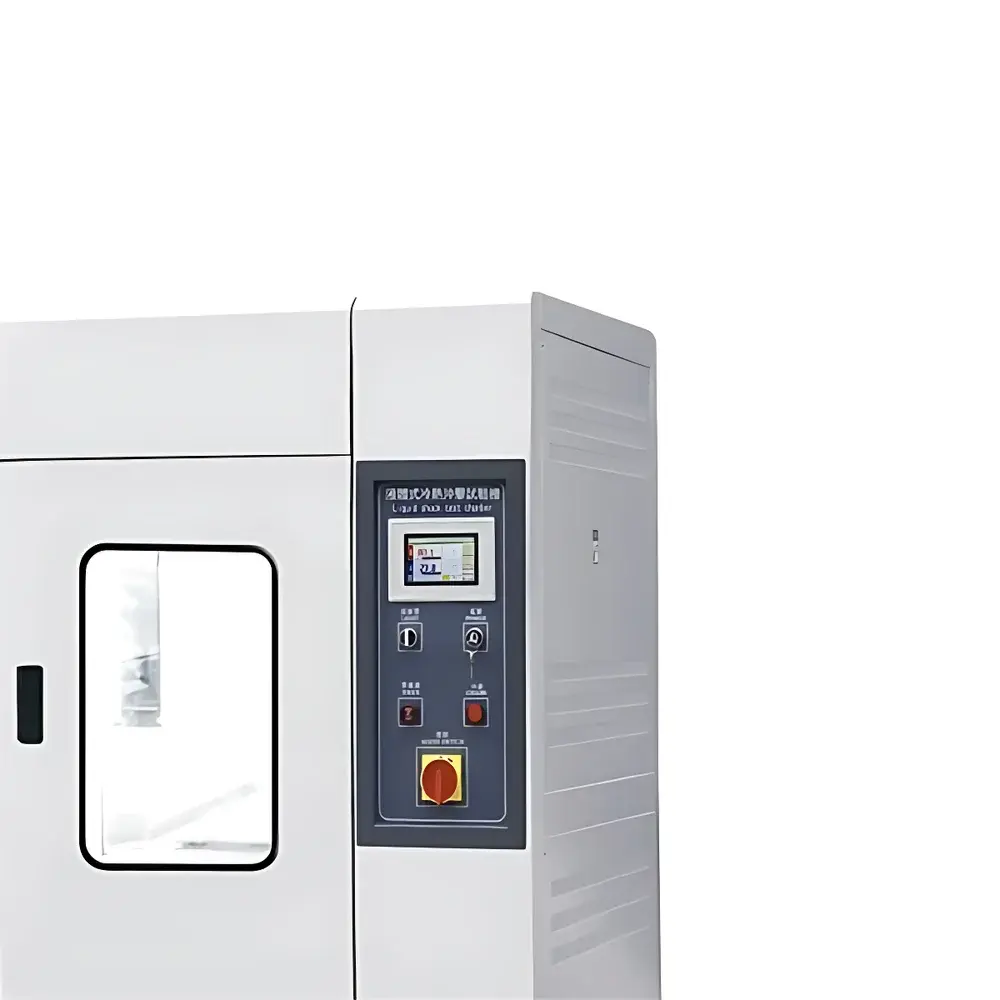
English Product Name
| Brand | Other Brands |
|---|---|
| Origin | Imported |
| Manufacturer Type | General Distributor |
| Price | USD 12,500 (FOB) |
| Internal Dimensions (W×H×D) | 40×35×30 cm to 70×60×60 cm |
| External Dimensions (W×H×D) | 145×180×140 cm to 190×170×270 cm |
| Hot Zone Temperature Range | RT to +200 °C |
| Cold Zone Temperature Range | RT to −70 °C |
| Test Zone Temperature Range | +60 °C to +150 °C (hot shock) |
| Temperature Control Accuracy | ±0.5 °C |
| Temperature Uniformity | ±2.0 °C |
| Refrigeration System | Hermetic or Semi-Hermetic Compressor with R404A/R23 Refrigerant |
| Interior Material | SUS#304 Mirror-Finish Stainless Steel |
| Exterior Material | SUS#304 Stainless Steel or Powder-Coated Steel |
| Insulation | High-Density Fire-Retardant PU Foam |
| Power Supply | AC 380 V ±5%, 50 Hz ±0.5 Hz, 3-Phase 5-Wire |
Overview
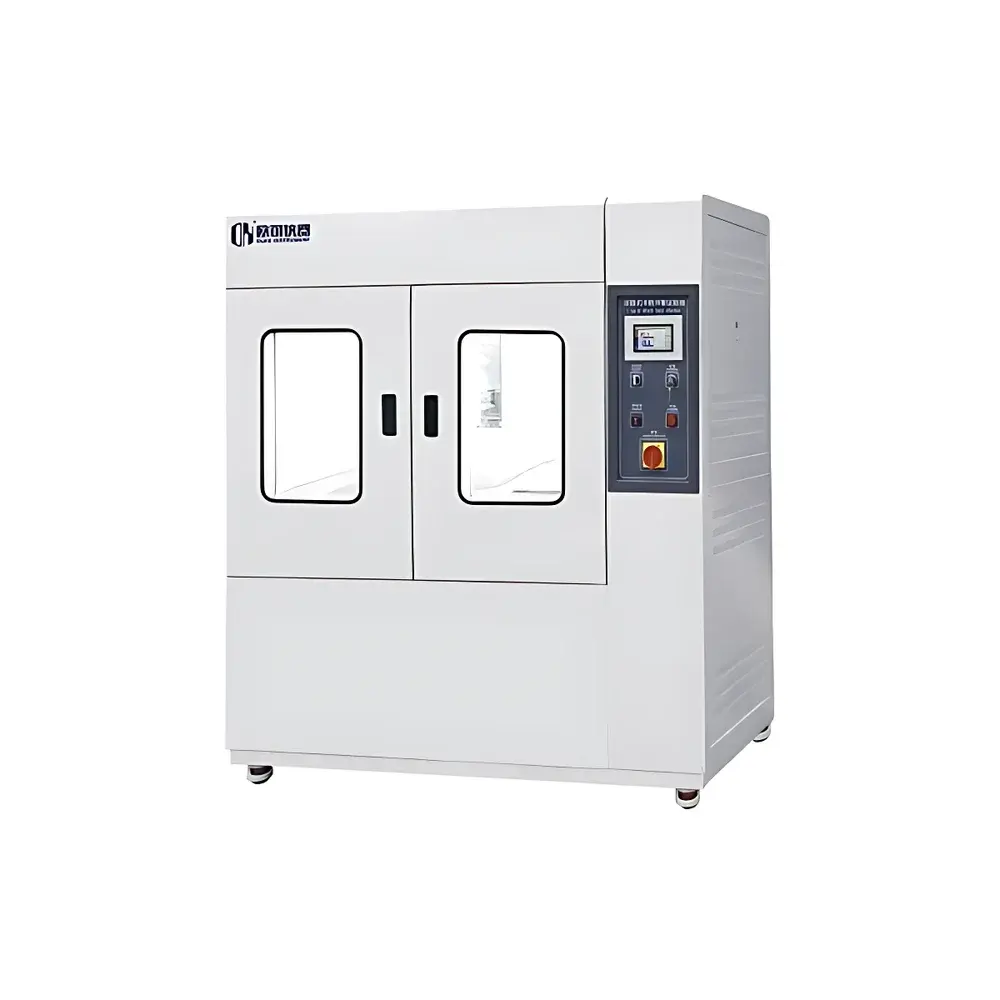
The OK-YT Series Liquid-Bath Thermal Shock Test Chamber is an engineered environmental test system designed for rapid, high-fidelity thermal cycling of materials and components under controlled, repeatable conditions. Unlike air-based thermal shock chambers, this system employs dual liquid-immersion reservoirs — one heated, one cryogenically cooled — to deliver abrupt temperature transitions via a pneumatically actuated sample carrier. The test principle relies on convective heat transfer within thermally stabilized baths, enabling superior thermal mass stability and minimized overshoot during shock transitions. This architecture ensures compliance with rigorous aerospace, defense, and electronics qualification standards where material integrity under extreme thermal transients is mission-critical. The chamber supports both single-cycle and programmable multi-cycle profiles, with precise dwell time, transition rate, and endpoint stabilization control — essential for evaluating solder joint fatigue, polymer embrittlement, seal integrity, and interfacial delamination in heterogeneous assemblies.
Key Features
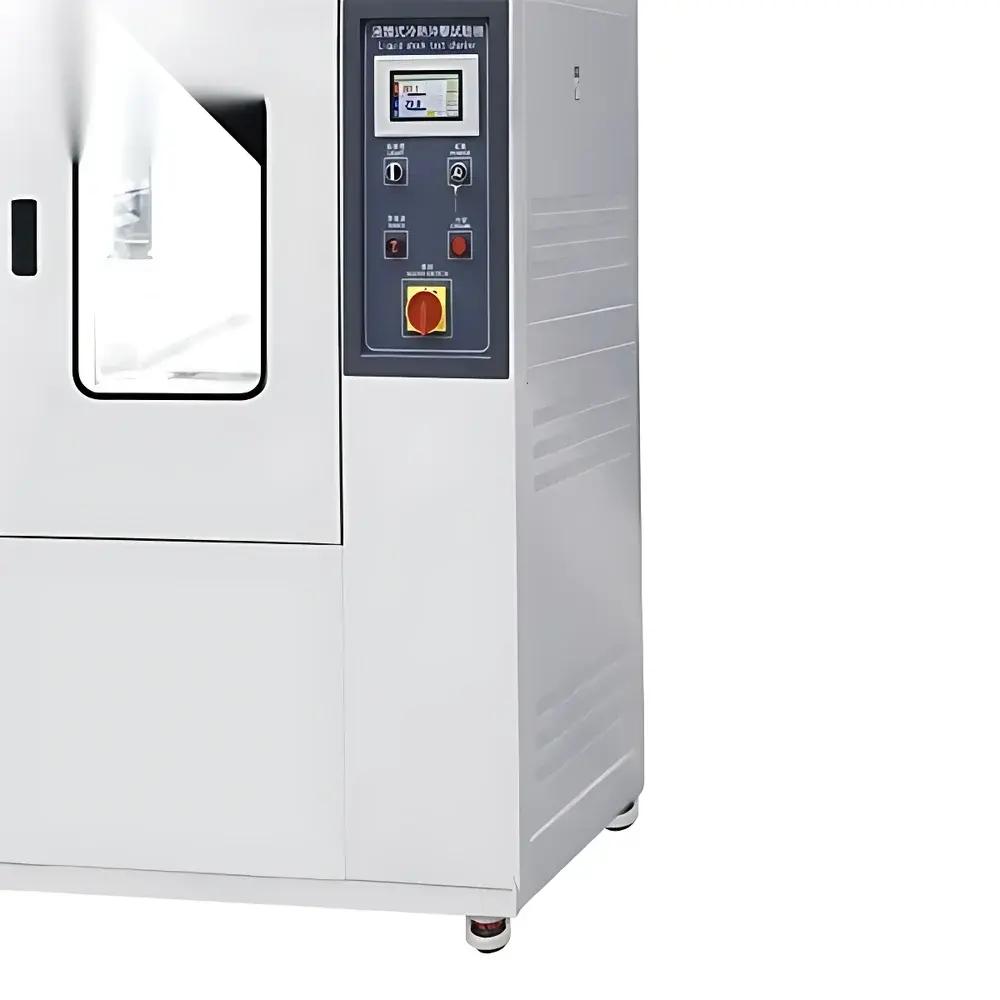
- Large-format color LCD touchscreen controller with intuitive HMI interface, real-time graphical display of chamber status, setpoints, and deviation trends
- Dual-zone thermal storage architecture: independent hot bath (RT to +200 °C) and cold bath (RT to −70 °C), minimizing thermal inertia and enabling sub-5-minute transition recovery
- Hermetic or semi-hermetic refrigeration system using environmentally compliant R404A/R23 refrigerant blend, integrated with plate-type heat exchangers and binary-stage ultra-low-temperature cooling circuit
- Liquid-immersed sample handling via stainless-steel basket mounted on precision pneumatic cylinder — eliminates airflow turbulence and ensures uniform thermal exposure across complex geometries
- LAN-enabled Ethernet interface supporting remote monitoring, parameter upload/download, and integration into centralized lab management systems (e.g., LabVIEW, SCADA)
- Programmable pre-conditioning modes: automatic pre-cooling and pre-heating prior to scheduled test initiation, reducing cycle latency and improving repeatability
- Configurable auto-defrost cycles with manual override; full diagnostic logging of compressor run time, pressure differentials, and sensor fault history
Sample Compatibility & Compliance
The OK-YT chamber accommodates solid-state samples up to 70 cm × 60 cm × 60 cm (internal volume), including printed circuit boards, hermetically sealed sensors, composite laminates, metallic housings, and medical device enclosures. Its liquid-bath design ensures minimal thermal gradients across irregular surfaces and eliminates convective boundary-layer effects common in forced-air systems. The chamber meets structural and procedural requirements of multiple international test standards, including ISO 16750-4 (road vehicles), IEC 60068-2-14 (change of temperature), MIL-STD-810H Method 503.5 (temperature shock), and ASTM D6988 (thermal cycling of polymeric films). It also supports GLP-compliant operation through audit-trail-capable data logging, user-access controls, and electronic signature-ready reporting when paired with validated software packages.
Software & Data Management
The embedded controller firmware supports CSV export of time-stamped temperature traces (hot zone, cold zone, and test zone), cycle counters, alarm logs, and calibration metadata. Optional PC-based software provides advanced profile editing, statistical process control (SPC) charting, and automated report generation compliant with FDA 21 CFR Part 11 requirements — including electronic signatures, audit trails, and role-based permissions. All data files are timestamped with UTC synchronization and stored redundantly on internal flash memory and external network drives. Firmware updates are delivered via secure HTTPS download with SHA-256 signature verification to ensure traceability and integrity.
Applications
This thermal shock chamber is routinely deployed in failure analysis laboratories for root-cause investigation of field returns, particularly in automotive electronics (ECU modules, battery management systems), avionics (flight control actuators, radar housings), and implantable medical devices (pacemaker casings, neurostimulator leads). It supports accelerated life testing per JEDEC JESD22-A104 and IPC-9701, enabling quantification of thermal expansion coefficient mismatch in multilayer ceramic capacitors (MLCCs) and die-attach reliability in power semiconductors. Universities and national metrology institutes use it for inter-laboratory round-robin studies validating thermal shock test methodology across material classes — from aluminum alloys and carbon-fiber-reinforced polymers to silicon carbide substrates and piezoelectric ceramics.
FAQ
What distinguishes liquid-bath thermal shock testing from air-based systems?
Liquid immersion delivers higher heat transfer coefficients and tighter temperature uniformity than forced convection, resulting in more consistent shock severity and reduced test-to-test variability — especially critical for small, high-aspect-ratio components.
Can the chamber operate in standalone high-temperature or low-temperature mode?
Yes. The controller supports independent operation as a high-temperature oven (RT to +200 °C) or ultra-low-temperature chamber (RT to −70 °C), with full PID regulation and over-temperature/under-temperature safety cutoffs.
Is the system compatible with GMP/GLP documentation workflows?
When configured with optional validation package (IQ/OQ/PQ protocols, calibration certificates, and 21 CFR Part 11–compliant software), the chamber meets regulatory expectations for quality-controlled environments.
How is thermal uniformity verified and maintained?
Each unit undergoes factory mapping using NIST-traceable PT100 probes at nine spatial locations per zone; annual recalibration is recommended per ISO/IEC 17025 guidelines.
What maintenance intervals are specified for the refrigeration system?
Compressor oil and filter replacement every 12 months or 4,000 operating hours; refrigerant leak checks quarterly; heat exchanger cleaning biannually using non-corrosive solvents.



