
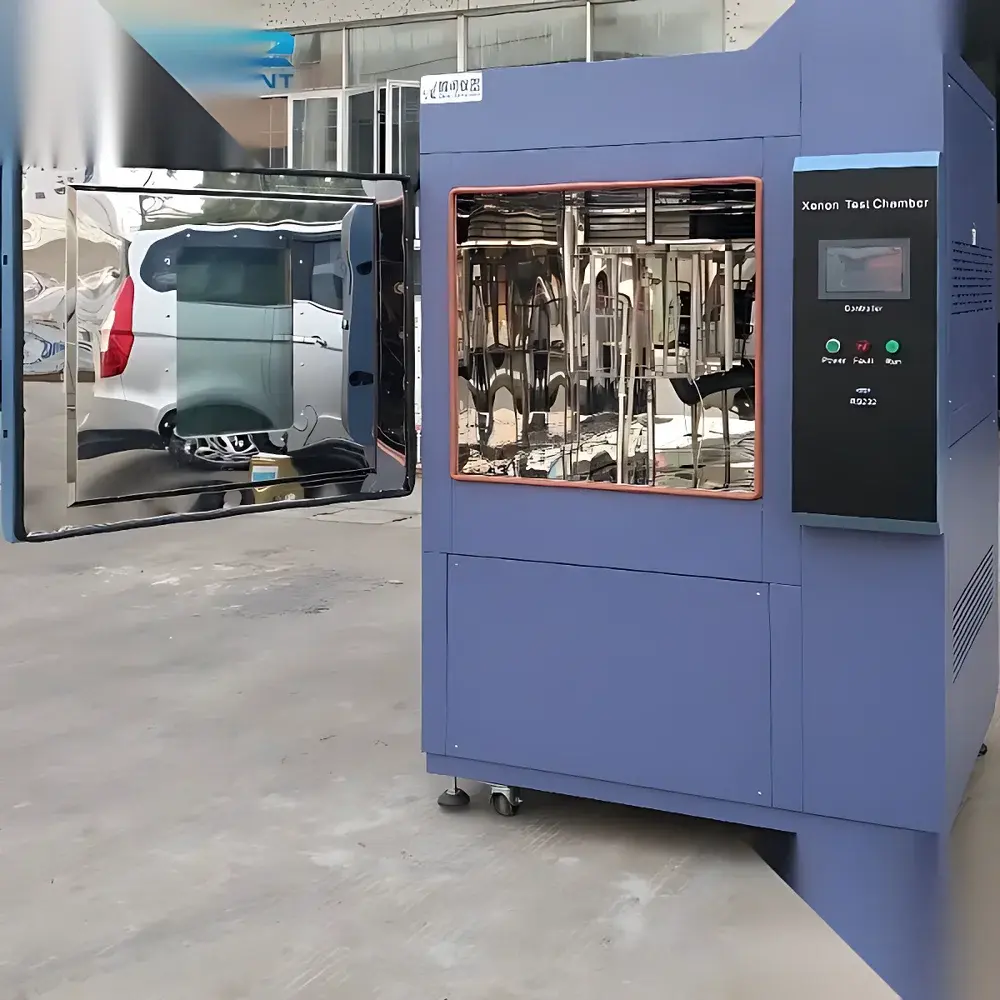
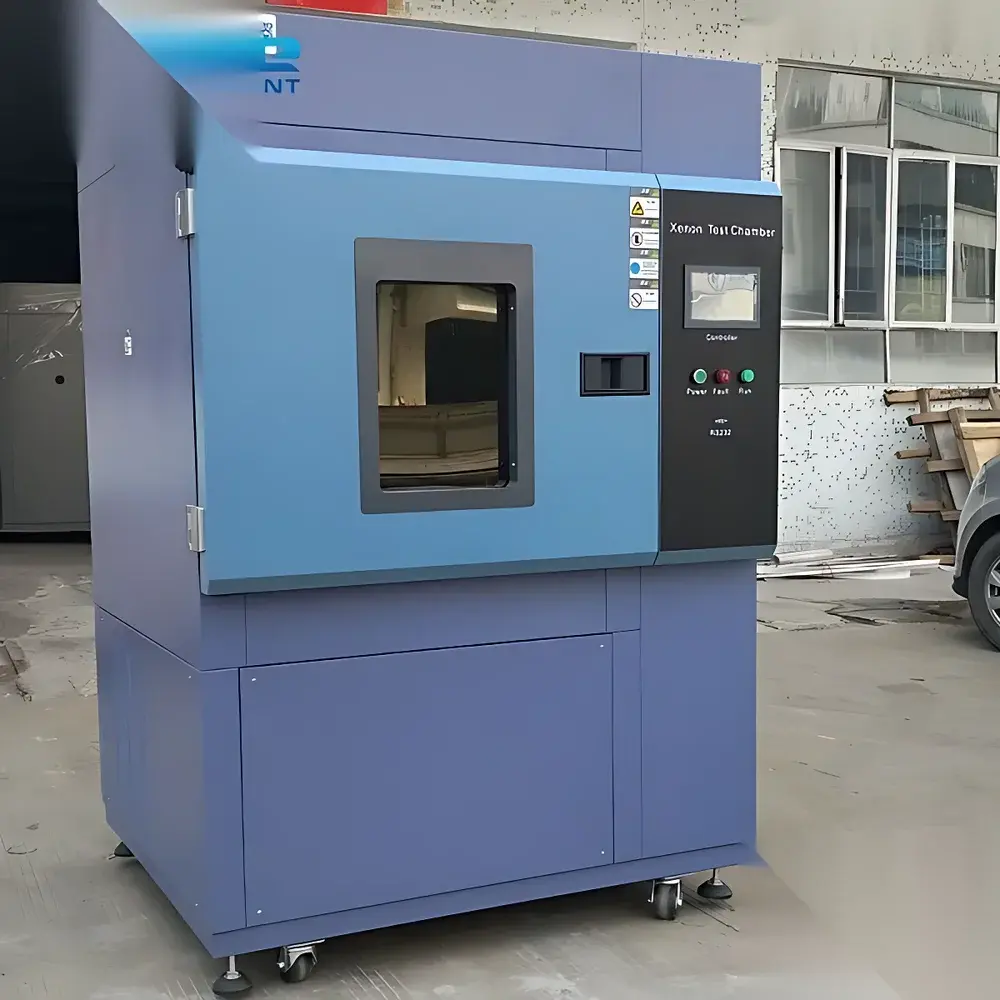
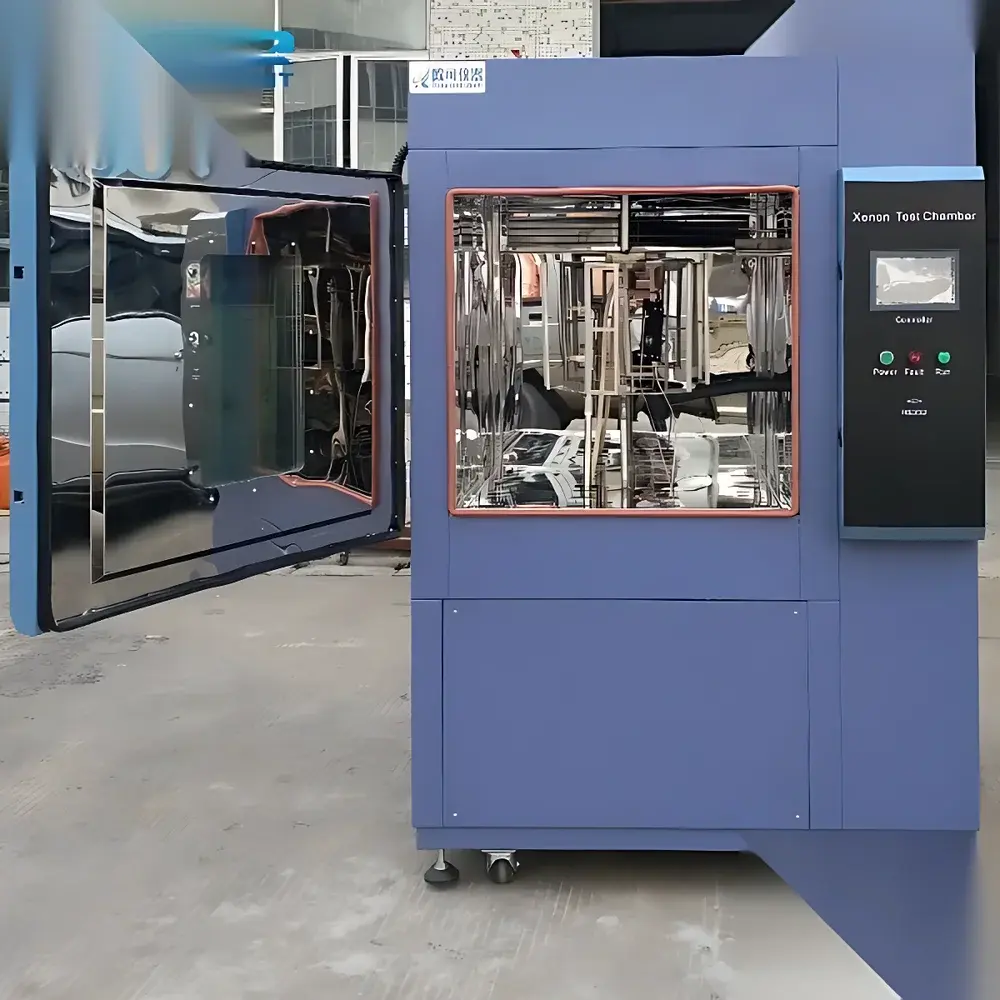
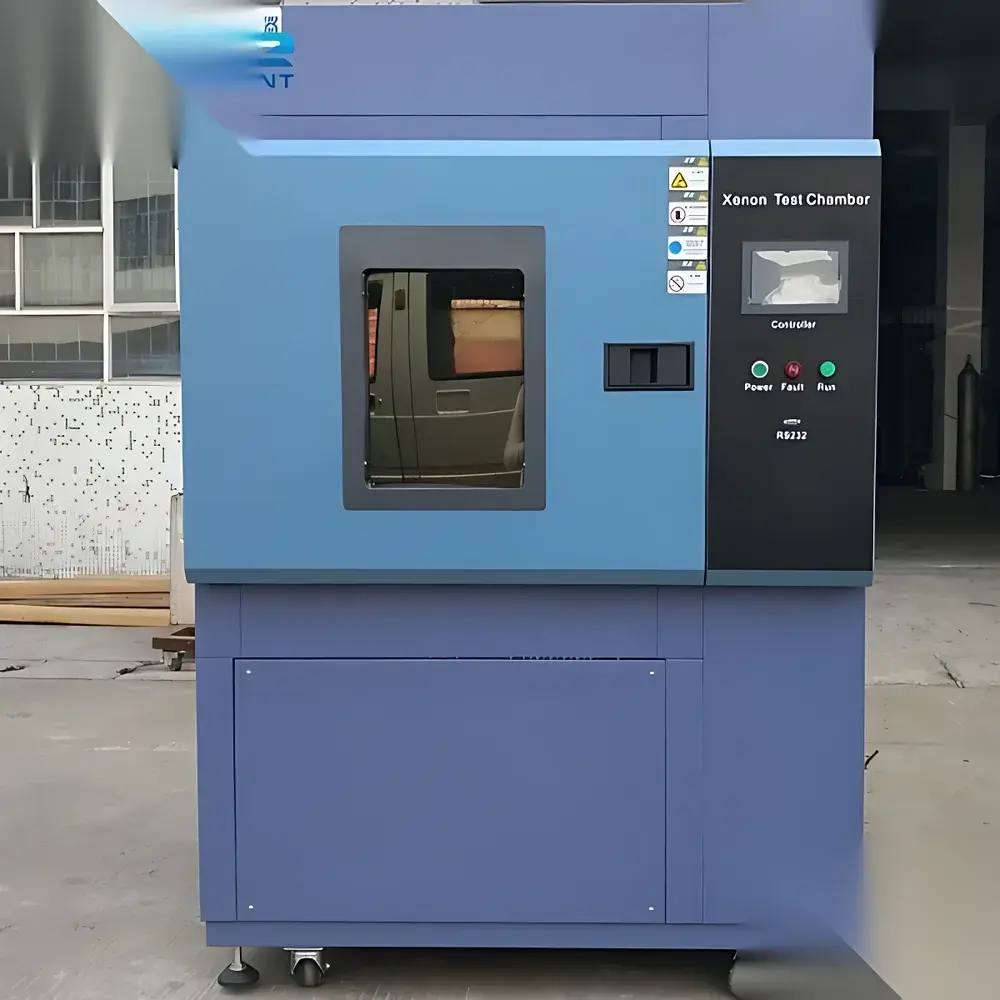
OK-XD-1000 Wind-Cooled Xenon Arc Weathering Test Chamber
| Brand | OEM / Custom Brand |
|---|---|
| Origin | Imported |
| Manufacturer Type | Authorized Distributor |
| Price Reference | USD 5,200 (excl. tax & freight) |
| Internal Chamber Dimensions | 1000 × 1000 × 1000 mm (D×W×H) |
| External Dimensions | 1350 × 1850 × 1550 mm (D×W×H) |
| UV-A Spectral Range | 320–380 nm |
| Irradiance Control | Adjustable up to 0.7 W/m² @ 340 nm |
| Humidity Range (Irradiation Mode) | 45–80 %RH |
| Condensation Humidity | ≥95 %RH |
| Black Panel Temperature Range | 30–60 °C (±1 °C tolerance) |
| Irradiation Temperature Range | 50–60 °C (±3 °C tolerance) |
| Condensation Temperature Range | 40–60 °C (±3 °C tolerance) |
| Temperature Resolution | 0.1 °C |
| Condensation Water Depth | ≤30 mm with Auto-Fill Controller |
| Control System | PID Self-Tuning Temperature Regulation |
| UV Radiometer | Fixed-position, high-accuracy broadband sensor |
| Cycle Programming | Dual-mode alternating irradiation/condensation cycles, programmable up to 999 hours per phase |
| Electrical Components | Schneider Electric contactors & circuit breakers |
Overview
The OK-XD-1000 Wind-Cooled Xenon Arc Weathering Test Chamber is an engineered environmental simulation system designed for accelerated weathering evaluation of polymeric materials, coatings, textiles, automotive interiors, and outdoor signage under controlled xenon arc irradiation. It replicates key degradation drivers—UV radiation, temperature cycling, and moisture exposure—using a filtered xenon lamp source that closely matches terrestrial solar spectral distribution (ISO 4892-2, ASTM G155). Unlike water-cooled configurations, the wind-cooled architecture eliminates dependency on external chilled water supply, enabling flexible laboratory integration while maintaining stable irradiance output and thermal uniformity across the test chamber. The system operates on the principle of photochemical degradation kinetics, where photon energy in the UV-A band (320–380 nm) initiates bond scission and oxidation pathways in organic substrates. Its black panel temperature control strategy ensures surface-relevant thermal loading during irradiation, aligning with ISO 11341 and SAE J2527 requirements for realistic material response assessment.
Key Features
- Wind-cooled xenon lamp system with integrated axial fan array and optimized reflector geometry for uniform irradiance distribution (±15% across specimen plane)
- Dual-mode exposure control: independent programming of irradiation duration, condensation duration, and transition intervals (0–999 h per segment)
- Black panel temperature sensor mounted directly on aluminum substrate, coupled with PID self-tuning algorithm for ±1 °C stability
- Fixed-position broadband UV radiometer calibrated traceably to NIST standards, eliminating operator-induced measurement drift from manual probe repositioning
- Auto-fill water reservoir with level sensing and overflow protection; maintains consistent condensate depth ≤30 mm per ISO 4892-2 Annex B
- Industrial-grade electrical architecture featuring Schneider Electric power management components and Philips electronic ballasts ensuring >99.8% lamp ignition reliability over 5,000 start cycles
- Corrosion-resistant stainless-steel interior chamber with non-reflective matte finish to minimize stray light interference
Sample Compatibility & Compliance
The OK-XD-1000 accommodates standard specimen holders conforming to ISO 4892-2 (100 × 100 mm or 75 × 150 mm formats), ASTM D7869 multi-angle mounting fixtures, and custom jigs for 3D automotive parts. It supports simultaneous testing of up to 24 flat specimens or 12 vertically oriented panels. All operational parameters meet the minimum performance criteria defined in ISO 4892-2:2013, ASTM G155-22, and IEC 60068-2-5. The controller logs timestamped irradiance, temperature, and humidity data at 10-second intervals, supporting GLP-compliant audit trails when paired with optional secure data export modules. While not pre-certified to FDA 21 CFR Part 11, the system architecture permits validation of electronic records through third-party IQ/OQ protocols.
Software & Data Management
The embedded microprocessor controller provides local touchscreen operation with intuitive icon-based navigation. Real-time graphs display irradiance (W/m² @ 340 nm), black panel temperature (°C), chamber humidity (%RH), and elapsed cycle time. All measurement channels are sampled at 10 Hz and averaged over 60-second windows to suppress transient noise. Data export is supported via USB 2.0 port in CSV format, compatible with MATLAB, JMP, and Minitab for statistical lifetime modeling (e.g., Arrhenius-Weibull analysis). Optional Ethernet connectivity enables remote monitoring via Modbus TCP or OPC UA, facilitating integration into centralized lab information management systems (LIMS).
Applications
- Accelerated durability qualification of automotive clearcoats per SAE J2527 and GMW14124
- UV resistance validation of architectural sealants and elastomeric roof membranes (ASTM C1135, ASTM D6695)
- Colorfastness and gloss retention testing of textile dyes and pigment dispersions (AATCC TM16, ISO 105-B02)
- Photostability assessment of medical device packaging polymers under ICH Q1B guidelines
- Outdoor exposure correlation studies for PV backsheet materials (IEC 61215-2 MQT10)
FAQ
What spectral filter configuration does the OK-XD-1000 use?
It employs a borosilicate inner filter (Q/B) combined with a quartz outer filter to deliver a daylight-spectrum match meeting ISO 4892-2’s “Daylight Filter” specification.
Is calibration documentation included with shipment?
Yes—each unit ships with a factory-issued irradiance calibration certificate valid for 12 months, referencing NIST-traceable spectroradiometric measurements.
Can the chamber operate unattended for extended cycles?
Yes—the system includes hardware-level safety interlocks (overtemperature cutoff, lamp current monitoring, door switch detection) and automatic shutdown upon critical fault detection.
What maintenance intervals are recommended?
Lamp replacement every 1,500 hours; air filter cleaning every 200 hours; radiometer verification annually or after 500 lamp-hours.
Does the controller support multi-step test profiles?
Yes—up to 99 programmable segments per test sequence, each defining irradiance setpoint, temperature target, humidity setpoint, and duration.



