
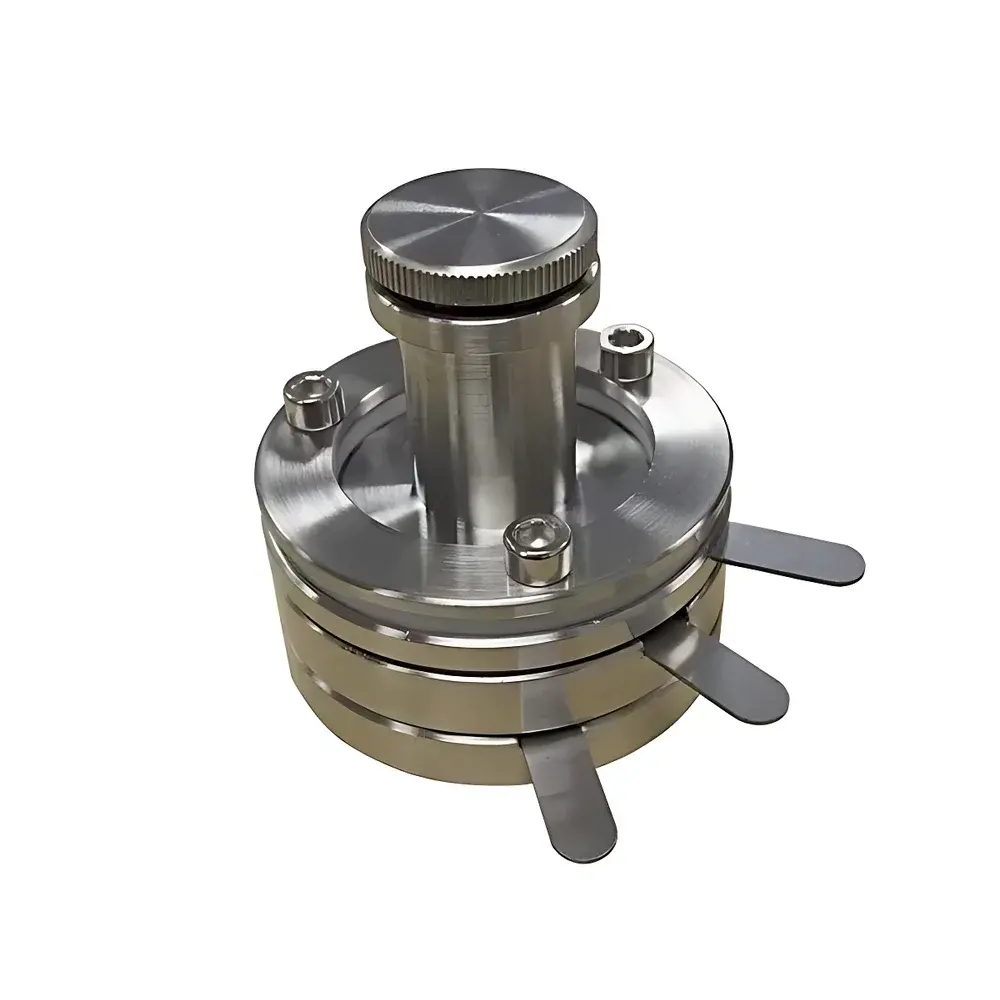
Hefei Kejing 3ESTC15 Removable Three-Electrode Coin-Cell Test Fixture
| Brand | Hefei Kejing |
|---|---|
| Origin | Anhui, China |
| Model | 3ESTC15 |
| Electrode Type | Three-electrode electrochemical test fixture |
| Maximum Electrode Diameter | 15 mm |
| Separator Diameter Capacity | 24 mm |
| Body Material | 316 Stainless Steel |
| Internal Bore Diameter | 24 mm |
| Insulating Ring Material | PTFE |
| Sealing Ring Material | Fluoroelastomer (FKM) |
| Max Operating Temperature | 250 °C |
| Compliant With | Standard CR2032-style cell assembly geometry |
Overview
The Hefei Kejing 3ESTC15 is a precision-engineered, removable three-electrode coin-cell test fixture designed for fundamental and applied research in battery electrochemistry. Unlike conventional two-electrode configurations, this fixture enables independent potential control and monitoring of working and counter electrodes relative to a stable reference electrode—critical for deconvoluting interfacial kinetics, quantifying overpotentials, and isolating half-cell reactions during galvanostatic or potentiostatic cycling. Its mechanical architecture replicates the physical constraints and contact mechanics of commercial CR2032-type cells, ensuring experimental relevance to practical battery design while supporting rigorous electrochemical characterization under inert atmosphere conditions. The device operates on a spring-loaded compression principle, allowing tunable electrode stack pressure to optimize interfacial contact resistance without mechanical deformation of fragile active materials or solid electrolytes. Its compact form factor (diameter < 30 mm, height < 12 mm) facilitates seamless integration into standard argon-filled gloveboxes (O₂/H₂O < 0.1 ppm), minimizing ambient contamination during cell assembly.
Key Features
- Three-electrode configuration with dedicated cavity for reference electrode insertion—enabling accurate measurement of anode and cathode potentials versus a quasi-reference (e.g., Li/Li⁺ or Ag/AgCl)
- Modular, tool-free disassembly: top cap, middle spacer (reference electrode housing), and base plate separate cleanly for rapid electrode replacement and contamination-free cleaning
- 316 stainless steel body with electropolished interior surfaces—resistant to corrosion from LiPF₆-based electrolytes, ether-based solvents, and high-voltage catholytes (up to 5 V vs. Li/Li⁺)
- PTFE insulating ring and dual FKM O-rings ensure dielectric isolation between electrodes and hermetic sealing up to 250 °C—suitable for elevated-temperature testing of solid-state batteries and thermal runaway studies
- Adjustable spring preload mechanism (via threaded top cap) permits fine-tuning of stack pressure from 0.5 MPa to 8 MPa—optimized for soft Li-metal anodes, brittle sulfide electrolytes, or composite cathodes
- Standardized 15 mm electrode compatibility aligns with common slurry-coated disk protocols; 24 mm separator aperture accommodates standard polyolefin or ceramic-coated separators
Sample Compatibility & Compliance
The 3ESTC15 supports a broad range of battery material systems, including lithium-ion, lithium-metal, sodium-ion, and solid-state configurations. It accommodates freestanding electrodes, slurry-cast films on Cu/Al foil, Li-metal foils (≥25 µm), and thin-film solid electrolytes (e.g., LLZO, LATP, PEO-LiTFSI). All wetted components comply with ASTM D3960-20 (low-VOC materials) and ISO 10993-5 (biocompatibility screening of metallic leachables). While not certified to IEC 62133 or UL 1642, its mechanical design adheres to the dimensional tolerances and compression profiles specified in IEEE 1625-2018 for laboratory-scale cell evaluation. For GLP-compliant workflows, traceability is maintained via engraved serial number and optional calibration certificate documenting dimensional verification per ISO/IEC 17025-accredited metrology.
Software & Data Management
As a passive hardware fixture, the 3ESTC15 interfaces directly with industry-standard potentiostats (e.g., BioLogic VMP-3, Gamry Interface 5000E, or CH Instruments 660E) via standard banana-jack or alligator-clip connections. No proprietary firmware or drivers are required. When used with potentiostat software supporting three-electrode mode (e.g., EC-Lab®, Framework™, or GPES), users can configure independent WE/RE and CE/RE voltage channels, apply multi-step protocols (GITT, PITT, EIS), and export time-stamped current/voltage/potential datasets in .txt or .mpt format. Audit trails—including operator ID, timestamped assembly logs, and environmental chamber parameters—can be manually appended to raw data files to satisfy FDA 21 CFR Part 11 documentation requirements for preclinical battery R&D.
Applications
- Half-cell characterization of novel cathode materials (e.g., Ni-rich NMC, Li-rich layered oxides) against Li metal reference
- Quantification of solid-electrolyte interphase (SEI) growth kinetics via cyclic voltammetry and coulombic efficiency tracking
- Reference-electrode-enabled impedance spectroscopy to decouple anode and cathode contributions in full-cell mimics
- Pressure-dependent Li dendrite nucleation studies using in situ optical microscopy-compatible variants
- Compatibility with in situ XRD/XAS sample holders when mounted on custom goniometer stages
FAQ
Can the 3ESTC15 be used with aqueous electrolytes?
Yes—provided the reference electrode (e.g., SCE or Ag/AgCl) and sealing materials are chemically compatible; however, prolonged exposure to water may degrade FKM seals above 80 °C.
Is the fixture compatible with automated cell cappers?
No—it requires manual spring compression; however, its standardized geometry allows integration with semi-automated torque-controlled press fixtures (e.g., MSK-110A) for batch consistency.
What reference electrodes are recommended?
Lithium wire (Li/Li⁺) for non-aqueous systems; Ag/AgCl (3 M KCl) for aqueous testing; miniaturized quasi-reference electrodes (QREs) with fritted tips for micro-volume electrolytes.
Does the device include electrical feedthroughs for in situ measurements?
No—external wiring must be routed through the glovebox antechamber; optional feedthrough adapters (e.g., Swagelok® CF-10 vacuum flanges) are available separately.





