
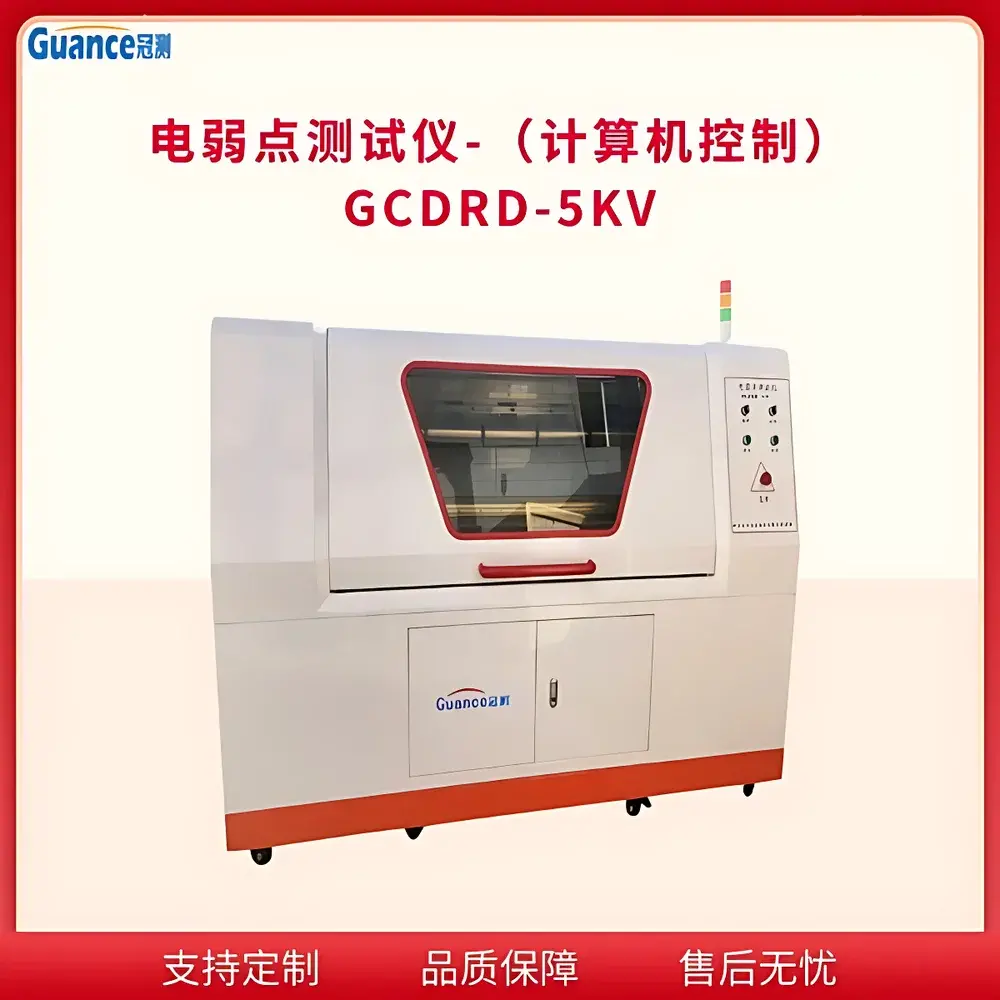
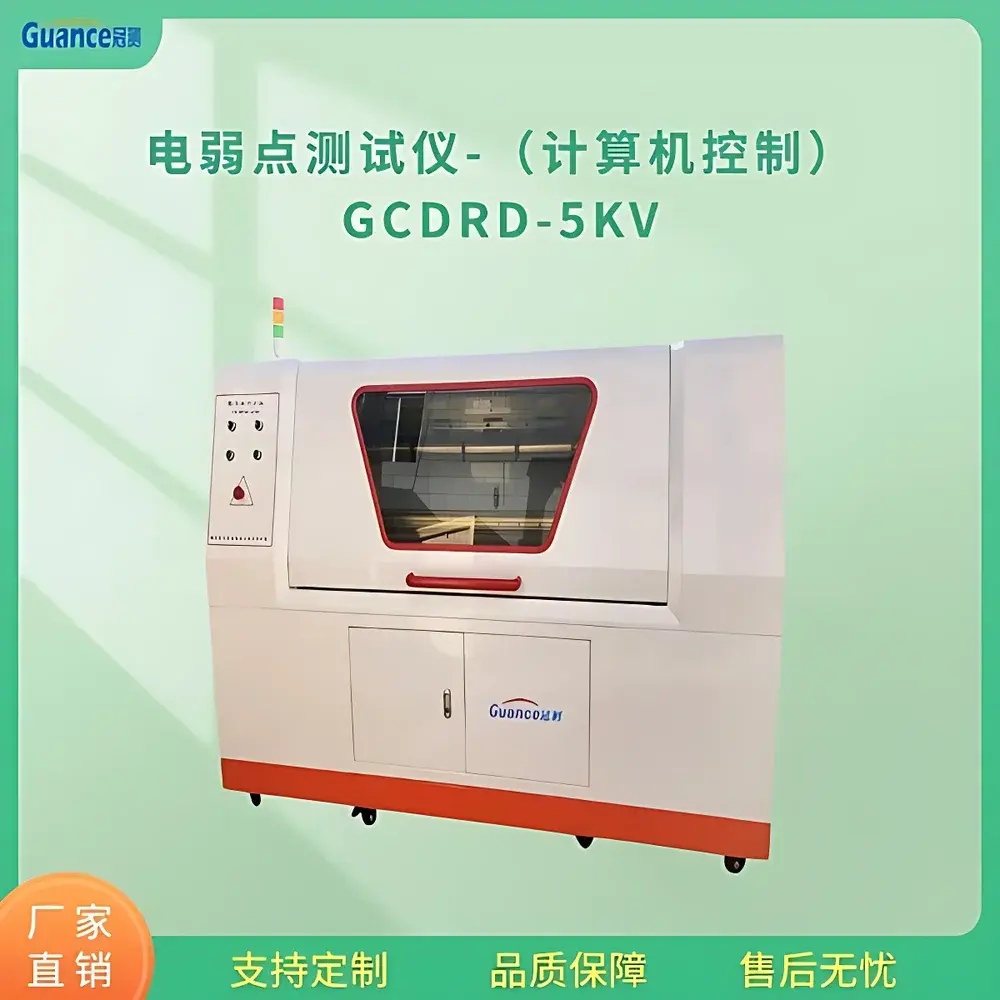
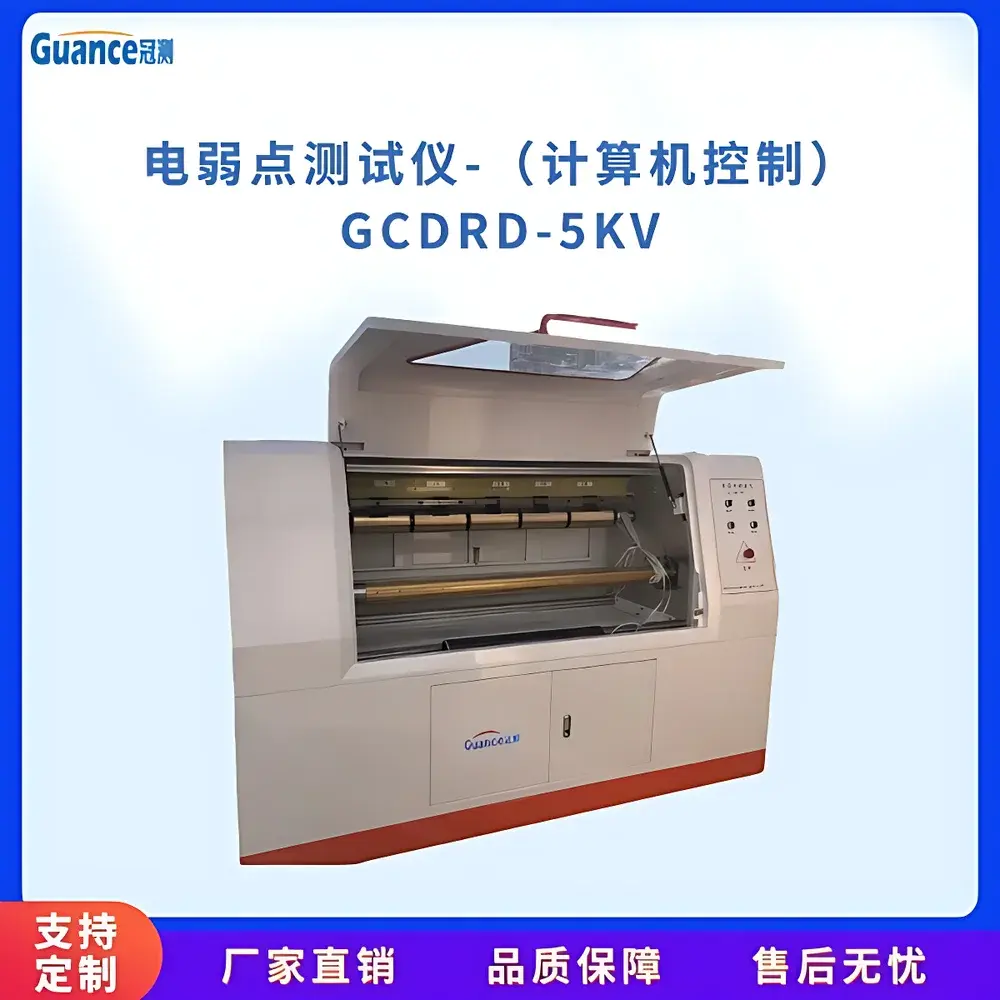
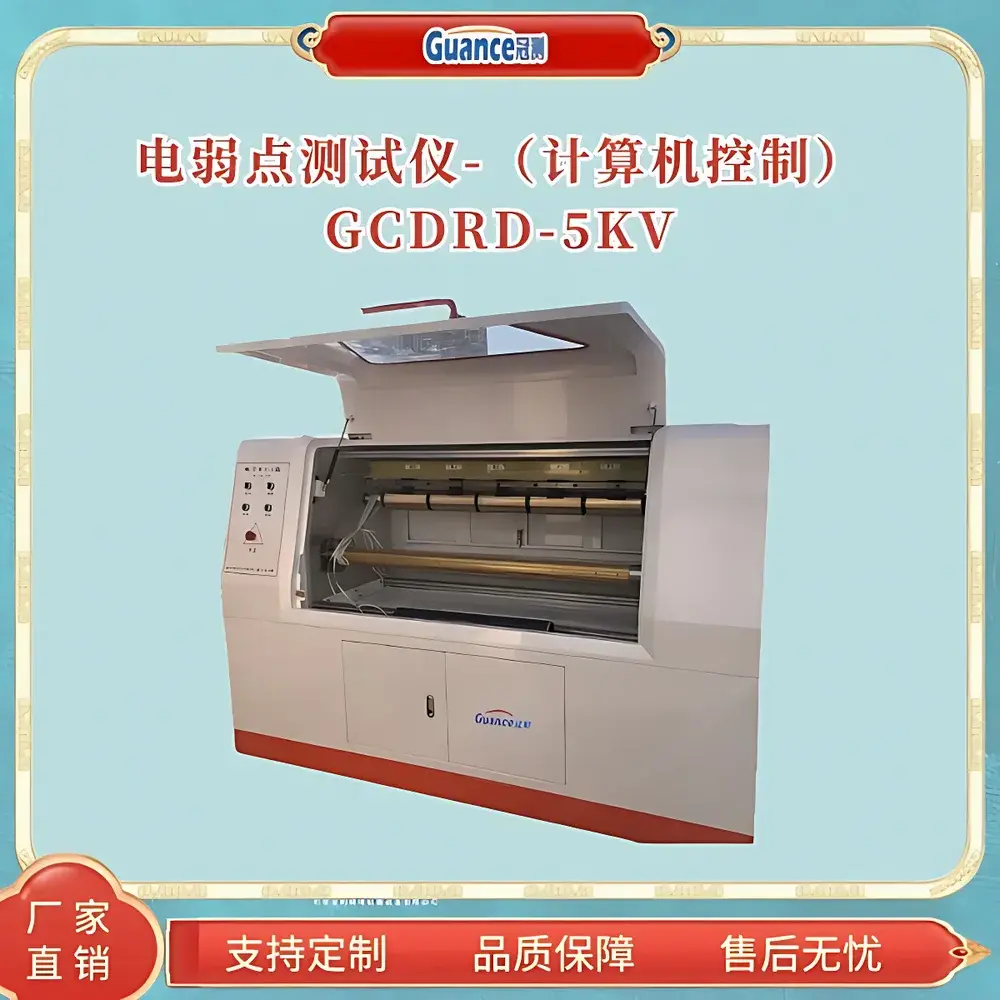
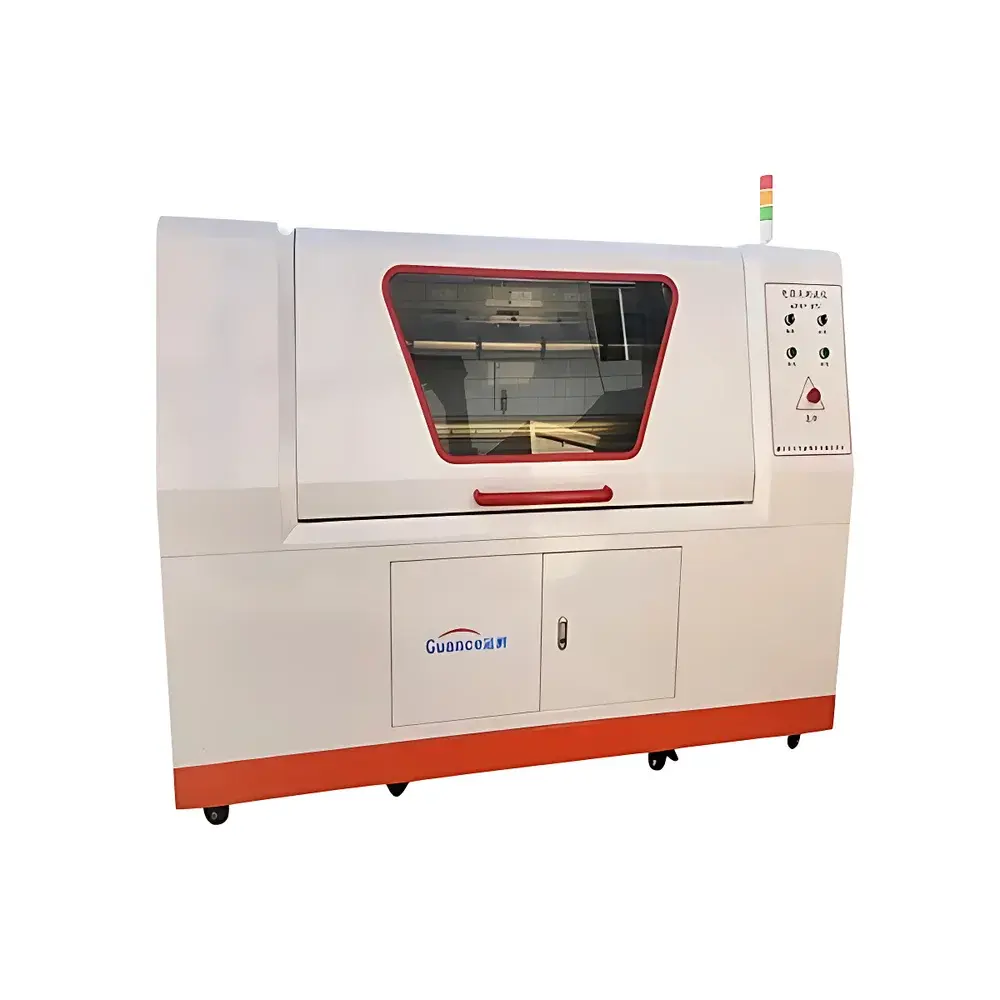
GuanCe Instruments GCDRD-5KV2 Electrical Weak Point Tester for Polymeric Insulating Films
| Brand | GuanCe Instruments |
|---|---|
| Origin | Beijing, China |
| Manufacturer Type | Authorized Distributor |
| Country of Origin | China |
| Model | GCDRD-5KV2 |
| Voltage Range | 0–5 kV DC |
| Test Mode | Automated Ramp-up with Real-time Breakdown Detection |
| Sample Handling | Motorized Unwind/Re-wind System |
| Compliance | GB/T 13542.2–2009, IEC 60674-2:1988 |
| Reporting Output | Weak Point Count per m², Weak Line Count, Automatic Zero Reset, Statistical Summary |
Overview
The GuanCe Instruments GCDRD-5KV2 Electrical Weak Point Tester is a dedicated high-voltage DC test system engineered for quantitative evaluation of dielectric integrity in thin polymeric insulating films—particularly polyurethane, polypropylene, polyester, and other flexible electrical insulation materials used in capacitors, transformers, and printed circuit board substrates. Operating on the principle of controlled voltage ramping under constant DC stress, the instrument identifies localized dielectric failures (electrical weak points) by detecting micro-discharge events or current surges exceeding preset thresholds during continuous voltage application. Unlike conventional breakdown testers that terminate at first failure, the GCDRD-5KV2 maintains applied voltage while logging each discrete breakdown event across the moving film surface—enabling statistical assessment of defect density per unit area (weak points/m²), a critical quality metric defined in GB/T 13542.2–2009 and harmonized with IEC 60674-2:1988. Its design prioritizes repeatability in industrial QC environments, supporting standardized evaluation of roll-to-roll manufactured films where spatial uniformity and defect clustering directly impact end-product reliability.
Key Features
- Programmable DC voltage ramp: 0–5 kV range with adjustable ramp rate (V/s), enabling compliance with standardized test profiles per GB/T 13542.2–2009 Section 6.3.
- Motor-driven film transport system: Precision-controlled unwind/re-wind mechanism with adjustable linear speed (mm/min), ensuring consistent electrode contact and uniform field exposure across sample width.
- Real-time breakdown detection: High-speed analog signal acquisition (≥10 kHz sampling) coupled with adaptive threshold triggering to distinguish true dielectric breakdown from transient noise or surface discharge.
- Automated data annotation: Timestamped logging of voltage, leakage current, and spatial coordinates (via encoder-synchronized position tracking) for each detected weak point.
- Integrated statistical engine: On-board calculation of weak point density (points/m²), weak line count (continuous conductive paths), and cumulative failure distribution—exportable as CSV or PDF reports.
- Self-calibrating zero-reset function: Automatic discharge and grounding sequence post-test to ensure baseline stability between consecutive runs.
Sample Compatibility & Compliance
The GCDRD-5KV2 accommodates standard-width insulating film rolls (up to 300 mm wide) with thicknesses ranging from 6 µm to 250 µm. It supports both single-layer and metallized films, provided surface resistivity exceeds 10⁹ Ω/sq and dielectric strength remains within measurable range under 5 kV DC. The system meets mechanical and electrical safety requirements outlined in GB 4793.1–2019 (IEC 61010-1) for laboratory electrical equipment. Test methodology aligns with Clause 6 of GB/T 13542.2–2009 (“Determination of electrical weak points”) and its international counterpart IEC 60674-2:1988, which specify electrode geometry (circular, 25 mm diameter), dwell time, and pass/fail criteria for weak point classification. While not inherently 21 CFR Part 11 compliant, audit trails and raw data logs can be exported for integration into validated LIMS or QMS platforms supporting GLP/GMP workflows.
Software & Data Management
The proprietary Windows-based control software provides intuitive configuration of test parameters—including target voltage, ramp slope, current trip threshold (1–100 µA), and film speed—and enables real-time visualization of voltage-current curves with overlay of breakdown markers. All acquired data—including raw ADC values, encoder position stamps, and timestamped event logs—are stored in a structured SQLite database with immutable records. Export options include ISO/IEC 17025-compatible test certificates (PDF), tabular summaries (CSV), and XY scatter plots mapping weak point spatial distribution. Software architecture supports user-level access control (admin/operator roles) and optional digital signature logging for traceability in regulated environments.
Applications
- Quality assurance of capacitor-grade polypropylene (PP) and polyethylene terephthalate (PET) films during production line release testing.
- Process validation of corona or plasma surface treatment efficacy—quantifying reduction in weak point density pre- vs. post-treatment.
- R&D screening of novel nanocomposite dielectrics for electric vehicle traction inverters and renewable energy converters.
- Failure analysis of field-failed film capacitors by correlating lab-measured weak point maps with actual service-life degradation patterns.
- Supplier qualification audits requiring third-party verifiable weak point density metrics per IEC 60384-14 Annex D.
FAQ
What voltage accuracy does the GCDRD-5KV2 achieve over its full 0–5 kV range?
The high-voltage output is calibrated to ±1.5% of reading (±75 V at 5 kV) traceable to national standards, verified annually using certified HV dividers.
Can the system test non-rolled films, such as cut sheets or laminated structures?
Yes—manual electrode fixtures are available for static sheet testing; however, weak point density calculations assume continuous web geometry and require manual area normalization.
Is firmware upgrade capability supported remotely?
Firmware updates are delivered via encrypted USB key with version-locked checksum verification; remote network connectivity is intentionally omitted to maintain electromagnetic compatibility and cybersecurity integrity.
How is electrode wear managed during extended testing?
Tungsten-carbide electrodes with replaceable tips are supplied; wear calibration is performed automatically before each test cycle using open-circuit impedance measurement.
Does the instrument support multi-step voltage hold protocols?
No—the GCDRD-5KV2 implements strictly linear ramp testing per GB/T 13542.2; step-stress or time-lag protocols require external programmable HV sources and custom scripting via API interface.



