
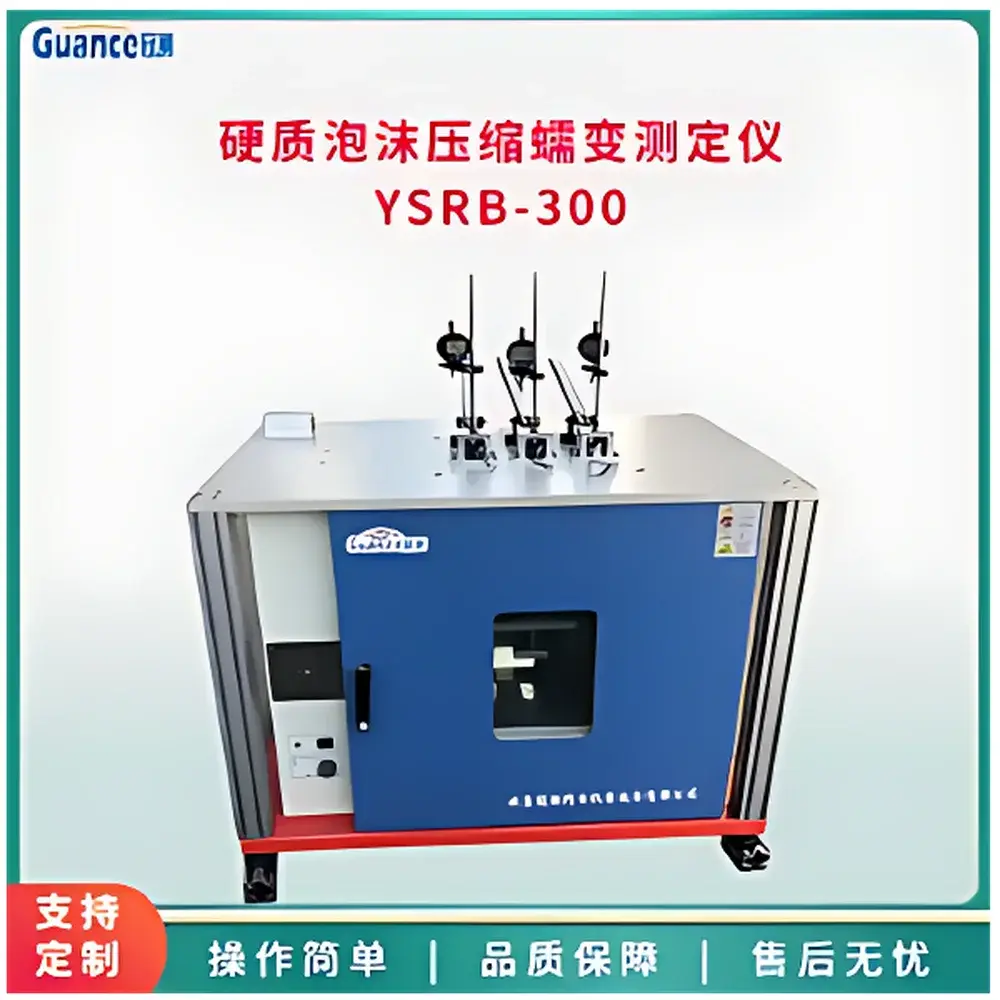
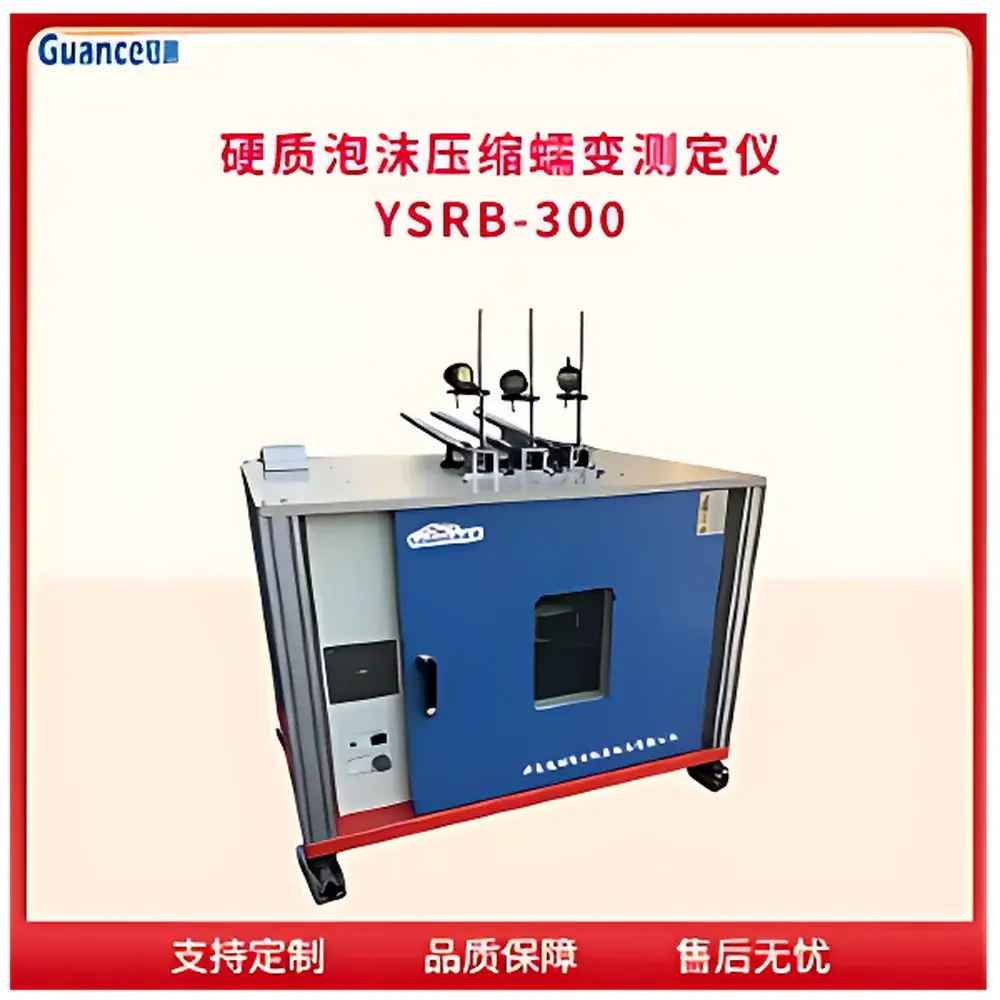
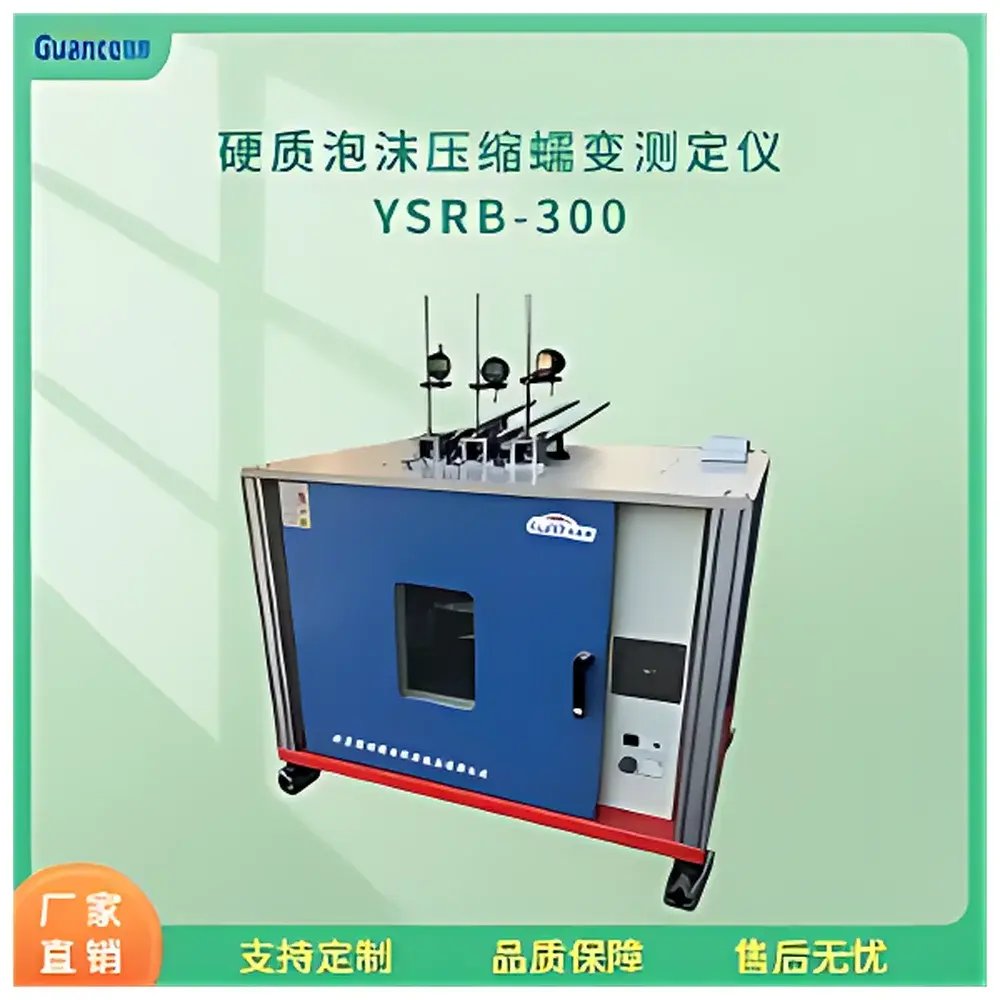
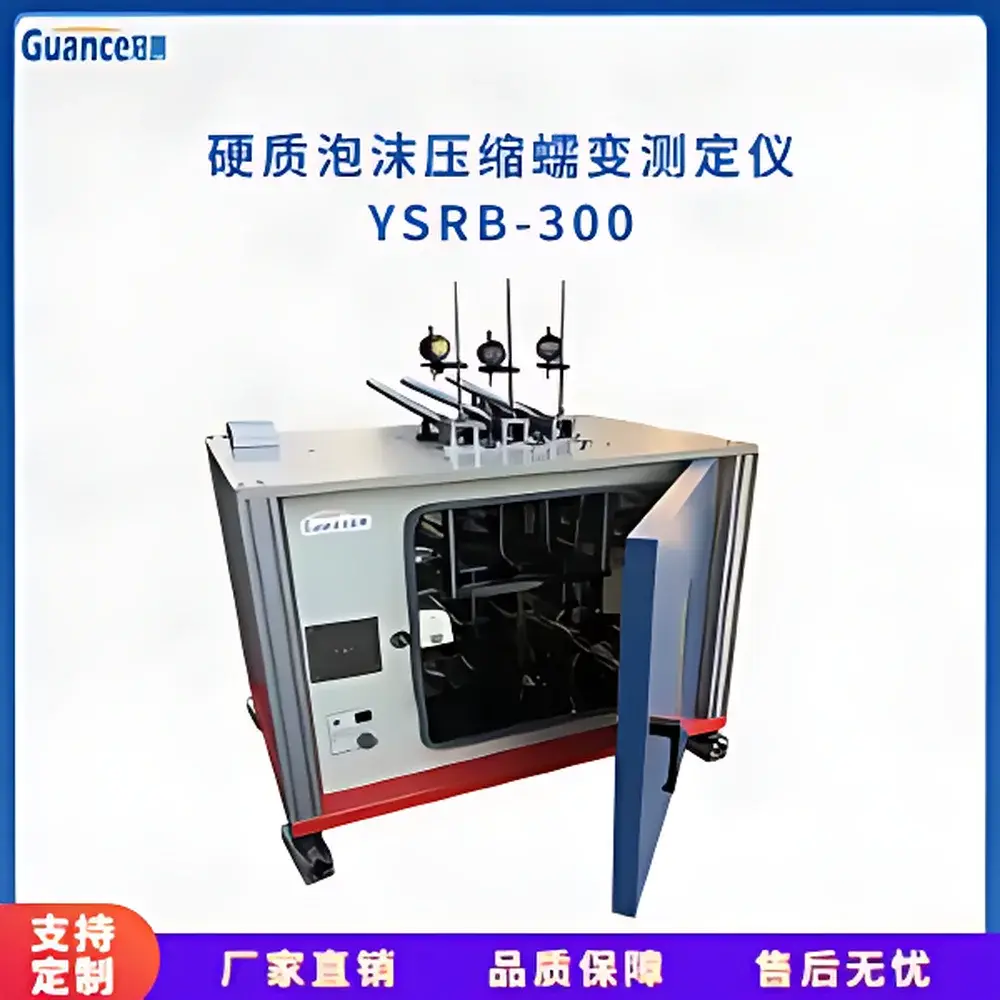
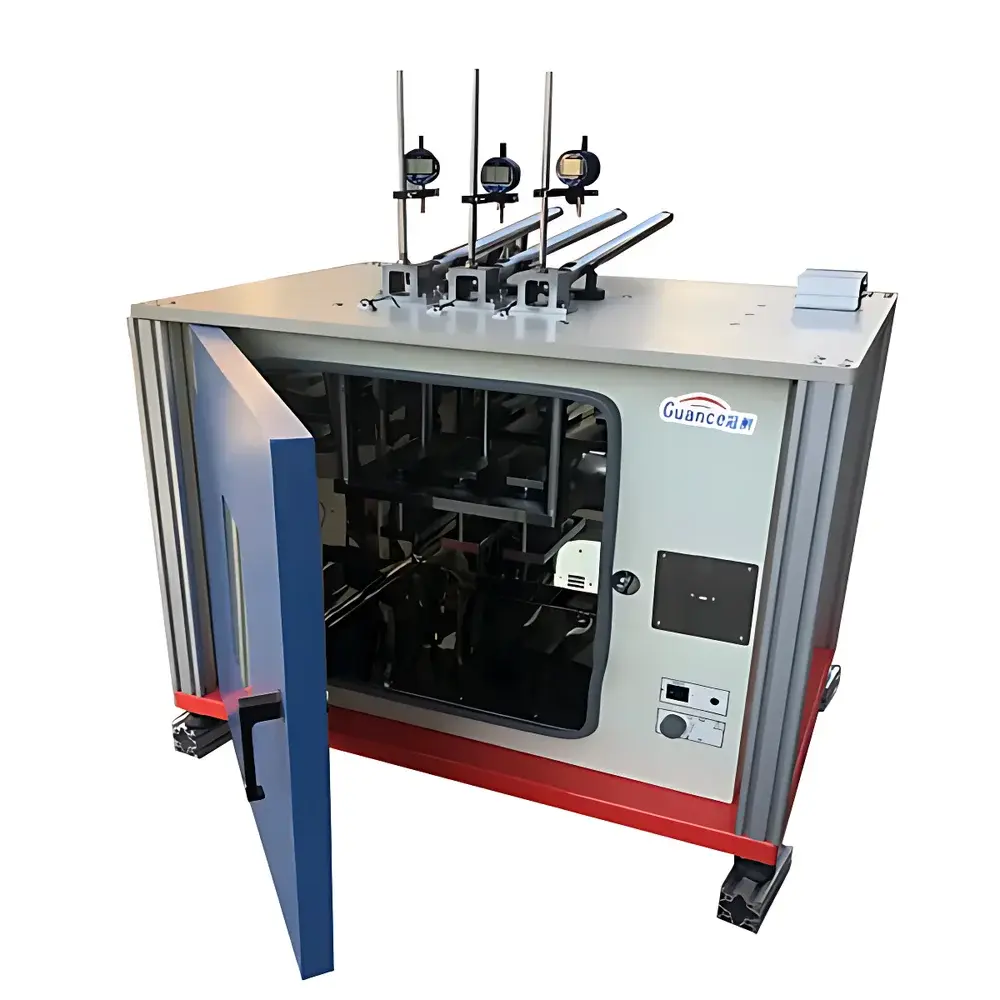
GuanCe YSRB-300 Hard Foam Compression Creep Tester
| Brand | GuanCe Instruments |
|---|---|
| Origin | Beijing, China |
| Manufacturer Type | Authorized Distributor |
| Country of Origin | China |
| Model | YSRB-300 |
| Instrument Type | Electromechanical Universal Testing Machine |
| Heating Method | Air-bath |
| Test Channels | 3 |
| Temperature Range | Ambient to 300 °C |
| Temperature Stability | ±2 °C |
| Heating Rate | 50±3 °C/h or 10±2 °C/12 min |
| Temperature Resolution | 0.1 °C |
| Deformation Resolution | 0.002 mm |
| Specimen Dimensions | 50×50×50 mm or 40×40×20 mm |
| Compression Platen Size | 50×50 mm (×3) |
| Recommended Load Range | 0–1 MPa |
| Heating Chamber Volume | 350×400×400 mm |
| Lever Compression Ratio | 1:32 |
| Loading Configuration | Lever-based dead-weight compression (3 stations), direct dead-weight bending (3 stations) |
| Standard Compliance | GB/T 20672–2006, DIN 53424 |
Overview
The GuanCe YSRB-300 Hard Foam Compression Creep Tester is a specialized electromechanical universal testing system engineered for the standardized evaluation of time-dependent compressive deformation in rigid polymeric foams under controlled thermal and mechanical loading conditions. It operates on the principle of sustained-load creep measurement—applying constant compressive or bending stress via calibrated dead weights while simultaneously monitoring dimensional change over time within a precisely regulated air-bath furnace environment. Designed in strict accordance with GB/T 20672–2006 (“Determination of Compression Creep of Rigid Cellular Plastics Under Specified Load and Temperature”) and DIN 53424 (“High-Temperature Dimensional Stability Under Bending and Compressive Stress”), the YSRB-300 enables laboratories to quantify critical viscoelastic parameters—including creep strain, creep compliance, and thermal distortion onset—under ISO-aligned test protocols. Its dual-mode capability (compression and bending) supports both structural integrity assessment and comparative material qualification across automotive insulation, building envelope systems, aerospace core materials, and packaging applications.
Key Features
- Air-bath heating chamber (350 × 400 × 400 mm) with programmable ramp rates (50 ± 3 °C/h or 10 ± 2 °C/12 min) and high-stability temperature control (±2 °C deviation, 0.1 °C resolution).
- Triple independent test channels, each equipped with dedicated load application mechanisms: lever-amplified dead-weight compression (1:32 ratio) and direct dead-weight bending configurations.
- High-precision optical grating micrometer transducers (0.002 mm resolution) for real-time displacement acquisition during thermal exposure up to 300 °C.
- Integrated intelligent controller synchronizing temperature ramping, load application timing, and deformation sampling at user-defined intervals.
- Full-color real-time curve visualization displaying creep strain vs. time and temperature vs. time overlays, with automatic data logging and timestamped metadata tagging.
- Modular weight sets (15 kg total per channel) comprising traceable stainless-steel masses (1 g to 2000 g) compliant with OIML R111 Class M2 tolerances for force calibration traceability.
- Robust mechanical architecture featuring rigid steel frame construction, thermally isolated load train, and low-drift thermal expansion compensation in sensor mounting.
Sample Compatibility & Compliance
The YSRB-300 accommodates standard specimen geometries defined in GB/T 20672–2006 and DIN 53424: cubic specimens (50 × 50 × 50 mm) and rectangular prisms (40 × 40 × 20 mm). The 50 mm × 50 mm compression platens ensure uniform stress distribution across foam surfaces, minimizing edge effects. All test procedures support full audit trails compatible with GLP and GMP documentation requirements. Raw data files are stored in CSV and XML formats with embedded instrument ID, operator ID, calibration certificate references, and environmental timestamps—enabling alignment with FDA 21 CFR Part 11 electronic record integrity guidelines when paired with validated laboratory information management systems (LIMS).
Software & Data Management
Bundled Windows-based acquisition software provides intuitive test method setup, including multi-step thermal profiles (hold/ramp/soak), load sequencing, and configurable alarm thresholds for excessive deformation or temperature deviation. All measurements are recorded with ≥1 Hz sampling frequency and automatically annotated with ISO 8601 timestamps. Export functions support ASTM E1447-compliant reporting templates, including summary tables of initial strain, asymptotic creep strain, and time-to-0.5% deformation. Data archives include digital signatures for operator verification and optional encryption for secure network transfer. Software validation documentation (IQ/OQ/PQ summaries) is available upon request for regulated environments.
Applications
- Creep resistance evaluation of polyisocyanurate (PIR), polyurethane (PUR), phenolic, and melamine foams used in building insulation panels.
- Thermal distortion analysis of sandwich core materials under simulated service temperatures in rail and marine composites.
- Comparative qualification of flame-retardant formulations where elevated-temperature dimensional stability correlates with fire performance.
- Accelerated aging studies linking long-term compression set behavior to polymer crosslink density and cell wall morphology.
- Supporting ASTM D3574 Annex C and ISO 18562-2 biocompatibility assessments for medical device packaging foams.
FAQ
What standards does the YSRB-300 directly support?
GB/T 20672–2006 and DIN 53424 are fully implemented; test methods for ASTM D3574 (Section C), ISO 1856, and EN 1606 may be configured via custom protocol scripting.
Is calibration certification included with shipment?
Yes—each unit ships with factory calibration certificates for temperature sensors (traceable to NIM, China) and deformation transducers (NIST-traceable reference gauge), valid for 12 months.
Can the system operate unattended for extended tests?
Yes—the controller supports continuous 96-hour operation with automated shutdown on completion or fault detection (e.g., temperature excursion > ±5 °C, load loss > 5%).
What is the maximum allowable specimen height variation across the three test stations?
Specimens must be parallel-ground to ≤0.1 mm flatness tolerance; height variation between samples should not exceed ±0.2 mm to ensure consistent stress distribution.
Does the software support multi-user access with role-based permissions?
Yes—administrator, technician, and reviewer roles are configurable, with password-protected method editing and electronic signature capture for report finalization.



