
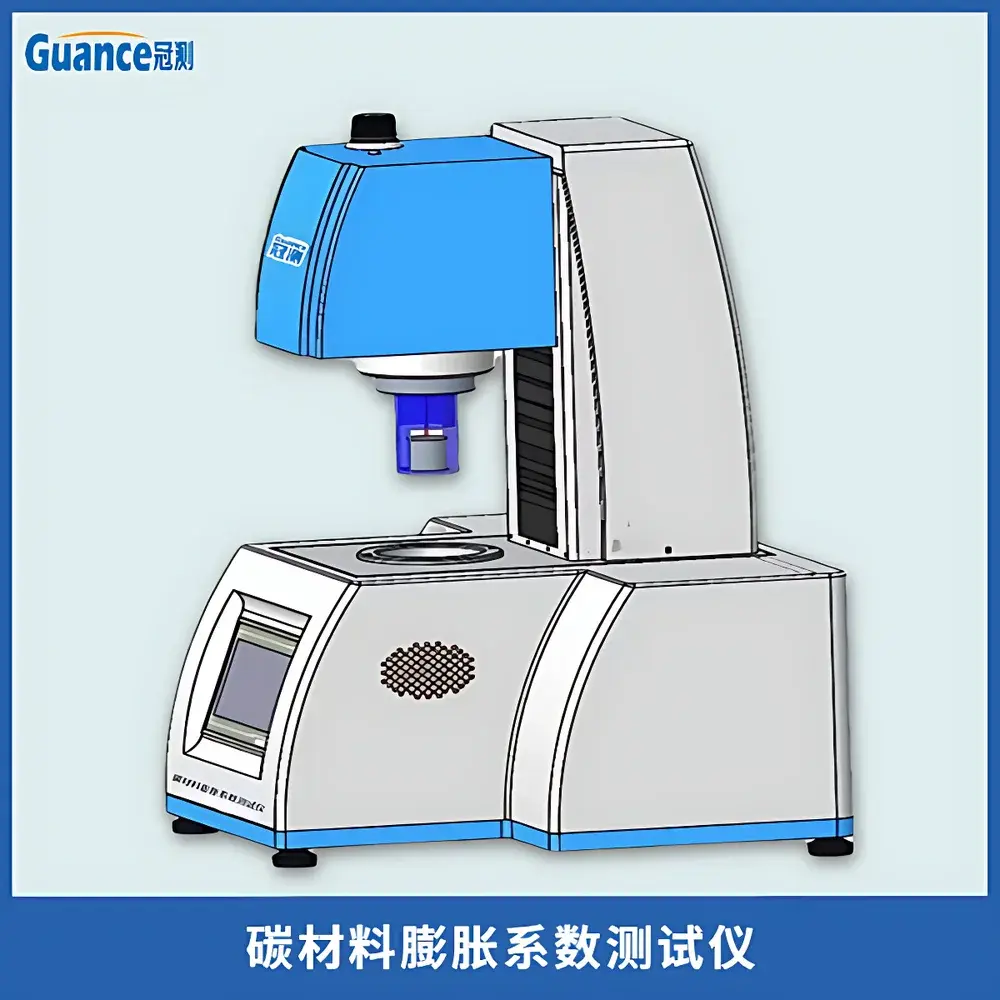
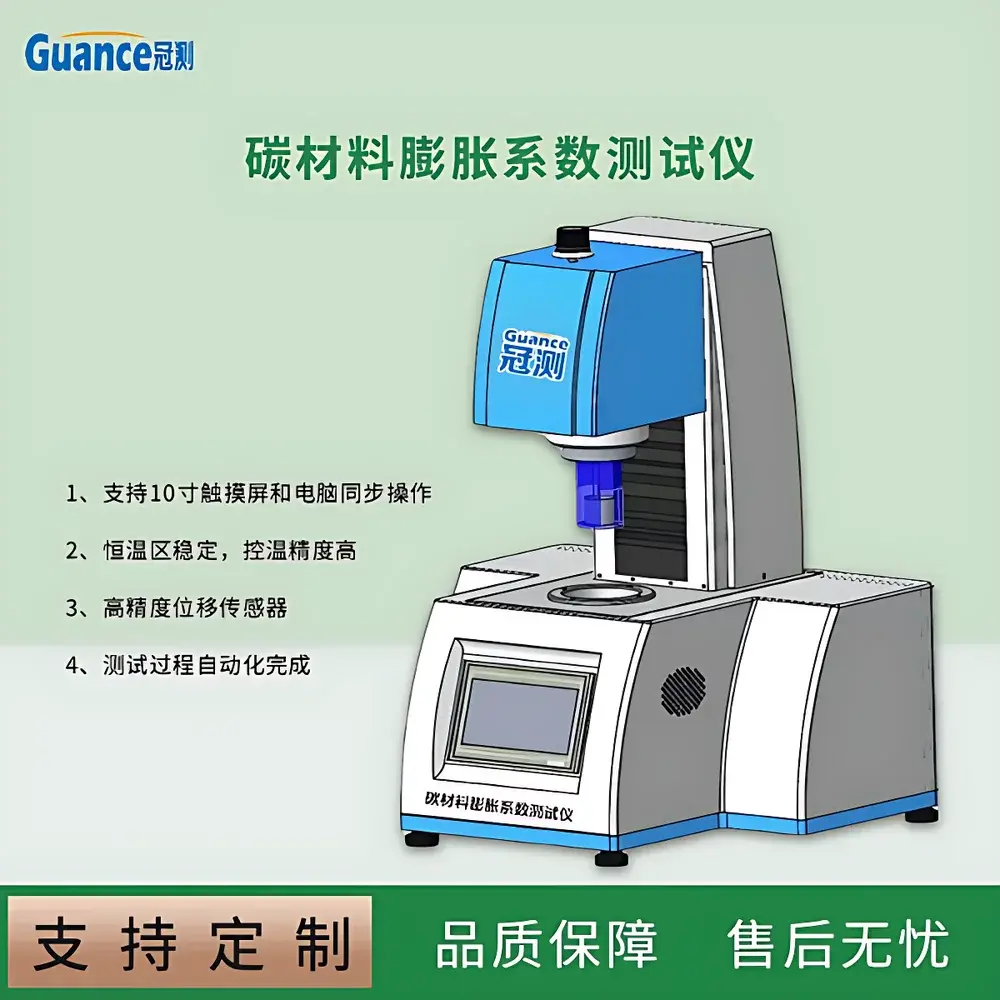
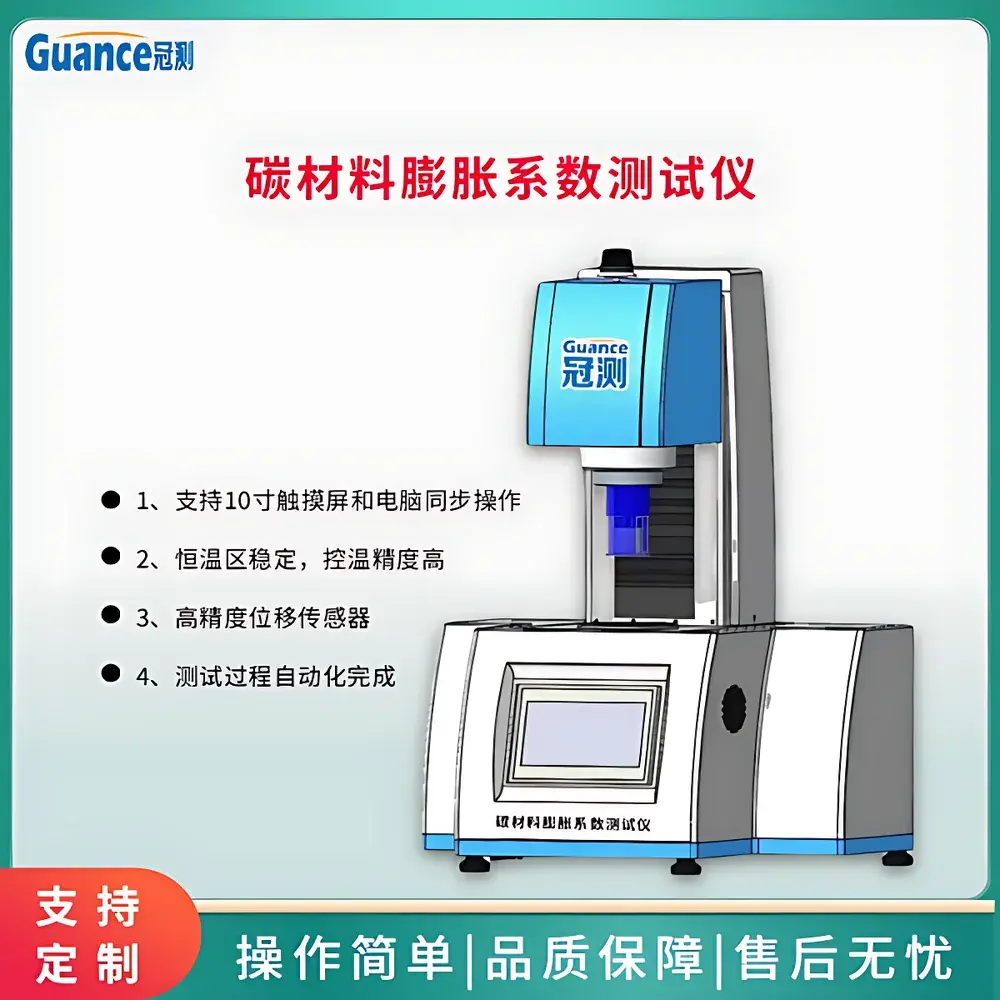
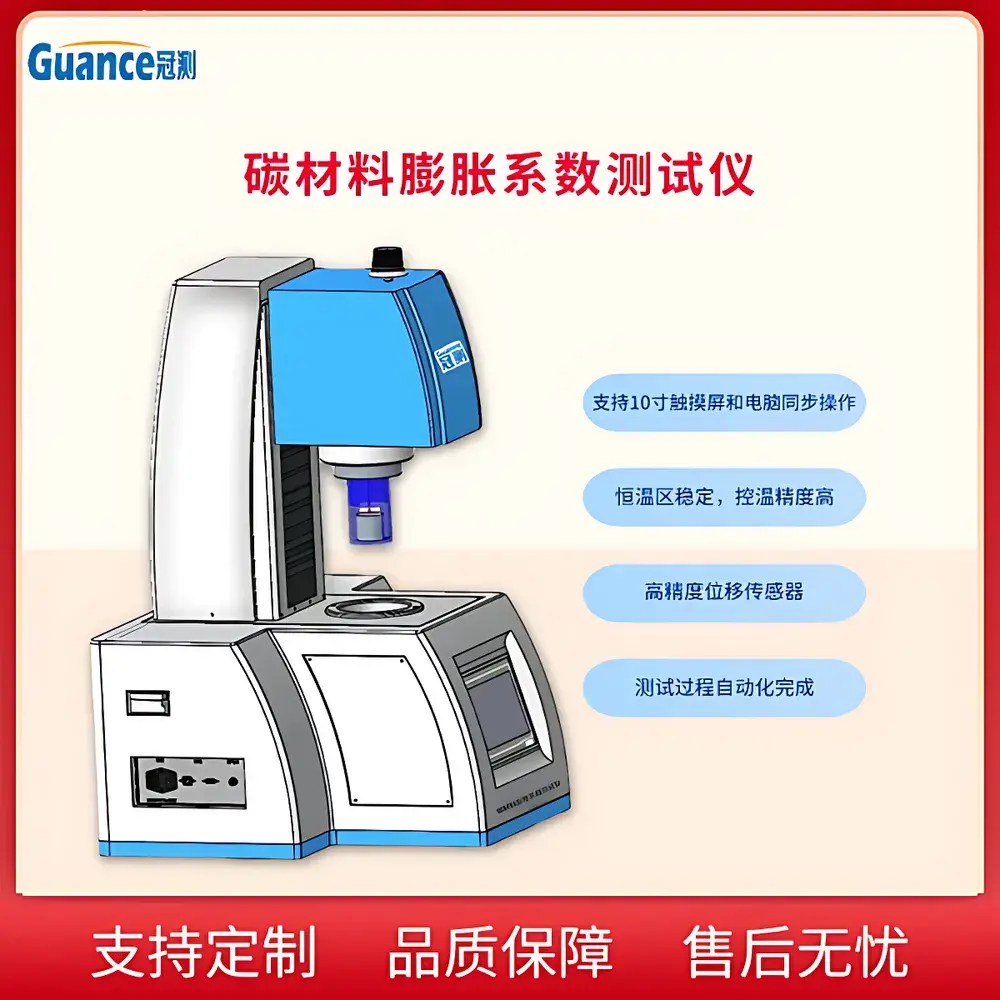
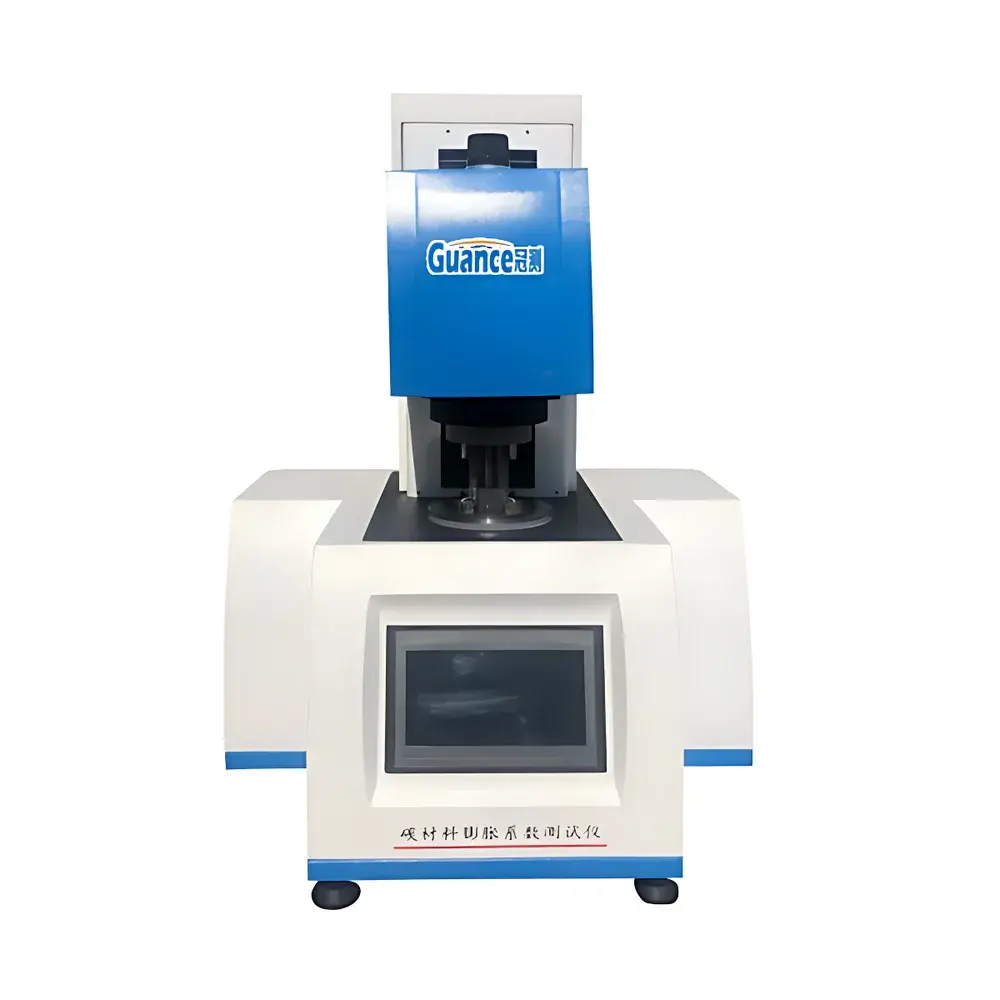
GuanCe Instruments GCTKP-700 High-Precision Horizontal Thermal Dilatometer for Graphite Electrode CTE Measurement
| Brand | GuanCe Instruments |
|---|---|
| Origin | Beijing, China |
| Manufacturer Type | Authorized Distributor |
| Country of Origin | China |
| Model | GCTKP-700 |
| Temperature Range | Ambient to 700 °C |
| Heating Rate | Programmable, up to 10 °C/min (typical) |
| Temperature Accuracy | ±1 °C (after thermal equilibrium) |
| Displacement Range | 0–1 mm |
| Displacement Resolution | ±0.001 mm |
| Sample Dimensions | (i) Ø50 mm × 60 mm |
| Atmosphere Control | Pressure range 0–50 kPa (gauge), compatible with inert, reducing, or vacuum environments |
| Power Supply | 220 V / 50 Hz |
| Rated Power | 1.7 kW |
| Thermal Sensor | K-type thermocouple (0–1000 °C, Class 0.1 accuracy) |
| Gas Flow Control | 0–80 L/min (mass flow controller) |
| Instrument Dimensions | 700 × 810 × 1150 mm (W × D × H) |
| Net Weight | 150 kg |
Overview
The GuanCe Instruments GCTKP-700 is a horizontally configured, high-stability thermal dilatometer engineered for precise determination of the coefficient of linear thermal expansion (CTE) in carbon-based refractory materials—particularly graphite electrodes and aluminum-grade carbon anodes, cathodes, and baked carbon products. It operates on the principle of contact-based linear displacement measurement under controlled thermal ramping, using a high-resolution micro-displacement transducer coupled with a calibrated K-type thermocouple array. The instrument conforms to ISO 14420:2005, GB/T 3074.4–2016, YS/T 63.4–2006, and YS/T 764–2011, supporting both average CTE (αavg) and instantaneous CTE (αinst) calculations over defined temperature intervals (e.g., 20–300 °C for carbon anodes; ambient to 600 °C for graphite electrodes). Its horizontal furnace architecture minimizes gravitational sag effects during expansion measurement, ensuring metrological integrity for low-expansion materials (ΔL ≤ 1 mm at 600 °C).
Key Features
- Horizontally mounted, double-zone ceramic fiber furnace with vacuum-formed resistive heating elements—provides uniform temperature distribution and stable isothermal zones (±1 °C over 50 mm axial length).
- High-stability, low-drift linear variable differential transformer (LVDT)-type displacement sensor with 1 mm full-scale range and ±0.001 mm resolution—traceable to NIST-calibrated standards.
- Integrated programmable logic controller (PLC) with dual-control interface: 7-inch industrial touchscreen (local operation) and Ethernet-enabled PC software (remote monitoring, real-time curve overlay, and multi-sample batch management).
- Atmosphere management system featuring digital pressure regulation (0–50 kPa gauge), mass flow control (0–80 L/min), and compatibility with N2, Ar, He, or forming gas—enabling oxidation-sensitive measurements per ASTM E228 and ISO 11359-1.
- Rugged enclosure fabricated from powder-coated steel with electrostatically applied corrosion-resistant finish—designed for long-term operation in QC laboratories compliant with ISO/IEC 17025 environmental requirements.
- Automated data logging with timestamped metadata (temperature, displacement, time, atmosphere pressure, flow rate), supporting audit-ready export in CSV, TXT, and XML formats.
Sample Compatibility & Compliance
The GCTKP-700 accommodates cylindrical or prismatic specimens conforming to standardized geometries: either Ø50 mm × 60 mm (for electrode-grade graphite per GB/T 3074.4), or minimum dimensions of 5 mm (cross-sectional diameter/edge) × 50 mm (length) for smaller carbon components. Specimen preparation follows GB/T 1427 (sampling), GB/T 8170 (numerical rounding), and YS/T 62.x series (aluminum carbon material sampling protocols). All measurement procedures align with GLP principles, and raw data files include embedded calibration certificates for sensor traceability. The system supports 21 CFR Part 11-compliant user authentication, electronic signatures, and audit trail generation when operated with validated software modules.
Software & Data Management
The proprietary DilataSoft v3.2 application provides full instrument control, real-time visualization of thermal expansion curves (ΔL vs. T), derivative analysis (dL/dT), and automated CTE computation (α = (1/L0)·(dL/dT)). It includes built-in templates for ISO 14420, GB/T 3074.4, and YS/T 63.4 test reports—with configurable pass/fail thresholds, statistical summaries (mean, SD, CV%), and PDF report generation. Data integrity is enforced via write-protected storage, cyclic redundancy check (CRC) validation, and optional network backup to NAS or LIMS integration via OPC UA or RESTful API.
Applications
- Determination of mean linear CTE of graphite electrodes (RP, HP, UHP grades) between ambient and 600 °C for electric arc furnace (EAF) performance modeling.
- Quality assurance testing of baked anodes and cathode blocks used in aluminum smelting—per ISO 14420 and YS/T 63.4 across 20–300 °C intervals.
- Thermal stability evaluation of carbon composite brake discs, nuclear graphite moderators, and EDM electrodes under controlled inert atmospheres.
- Research into microstructural evolution (e.g., pore closure, graphitization onset) via inflection point analysis in expansion curves.
- Validation of finite element method (FEM) thermal stress models requiring experimentally derived CTE inputs.
FAQ
What standards does the GCTKP-700 directly support?
It is fully aligned with ISO 14420:2005, GB/T 3074.4–2016, YS/T 63.4–2006, and YS/T 764–2011 for carbonaceous material CTE testing.
Can the instrument operate under vacuum or reducing atmospheres?
Yes—it supports pressure-controlled environments from vacuum (≤1 kPa) to 50 kPa gauge, with optional hydrogen-compatible fittings and leak-tested manifold assemblies.
Is the displacement sensor calibrated and traceable?
Yes—the LVDT sensor is factory-calibrated against NIST-traceable step gauges, with certificate of calibration included; annual recalibration is recommended per ISO/IEC 17025.
Does the system meet regulatory requirements for pharmaceutical or medical device labs?
While primarily designed for industrial materials QA, its 21 CFR Part 11-ready software module (optional) enables use in regulated environments requiring electronic records and signature compliance.
What maintenance is required for long-term accuracy?
Routine verification includes thermocouple drift check (biannual), displacement zero-point validation (pre-test), and ceramic insulation integrity inspection every 12 months—documented in the provided Maintenance Logbook.



