
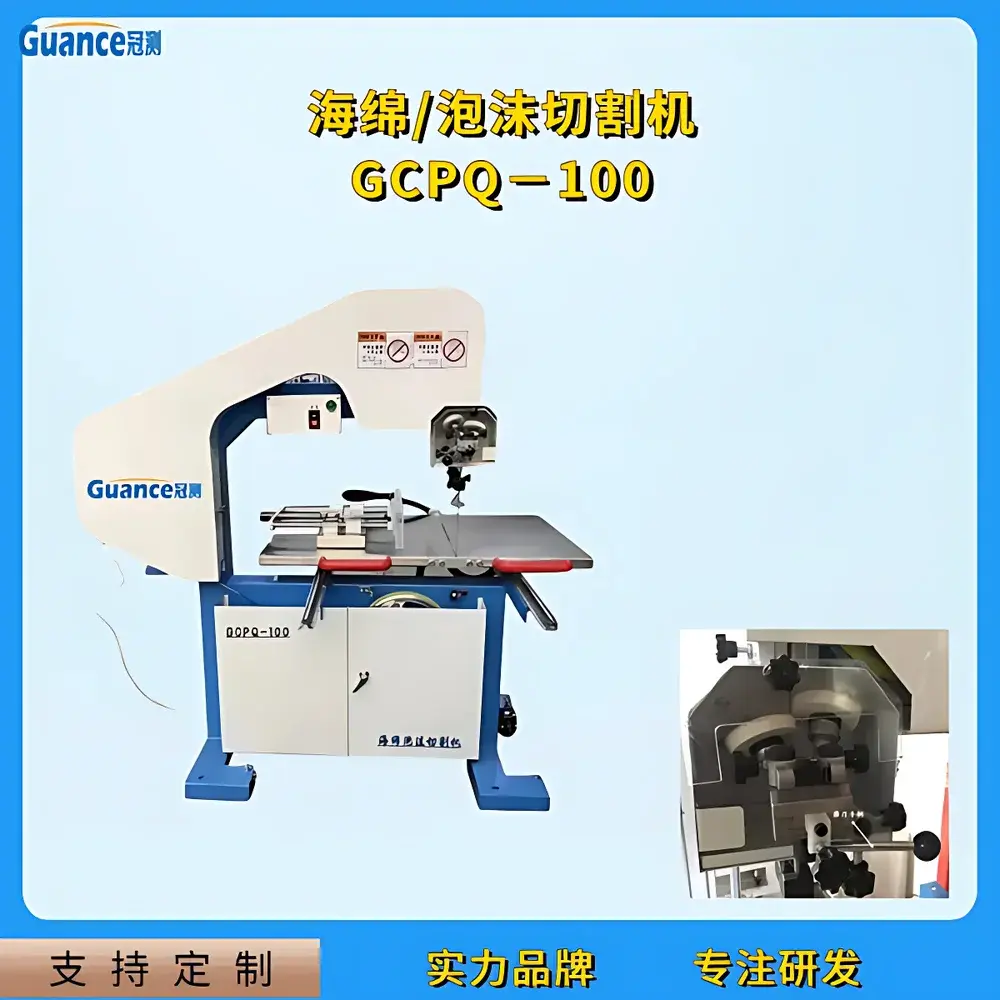
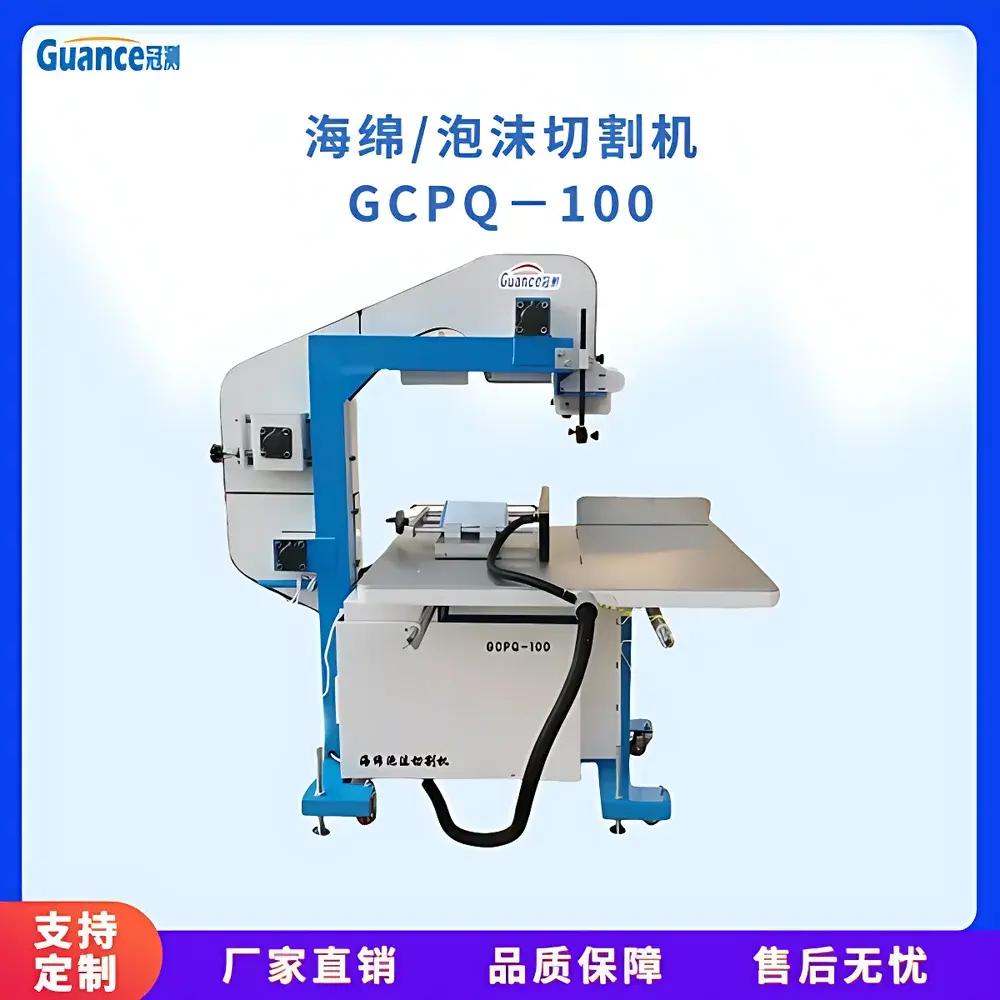
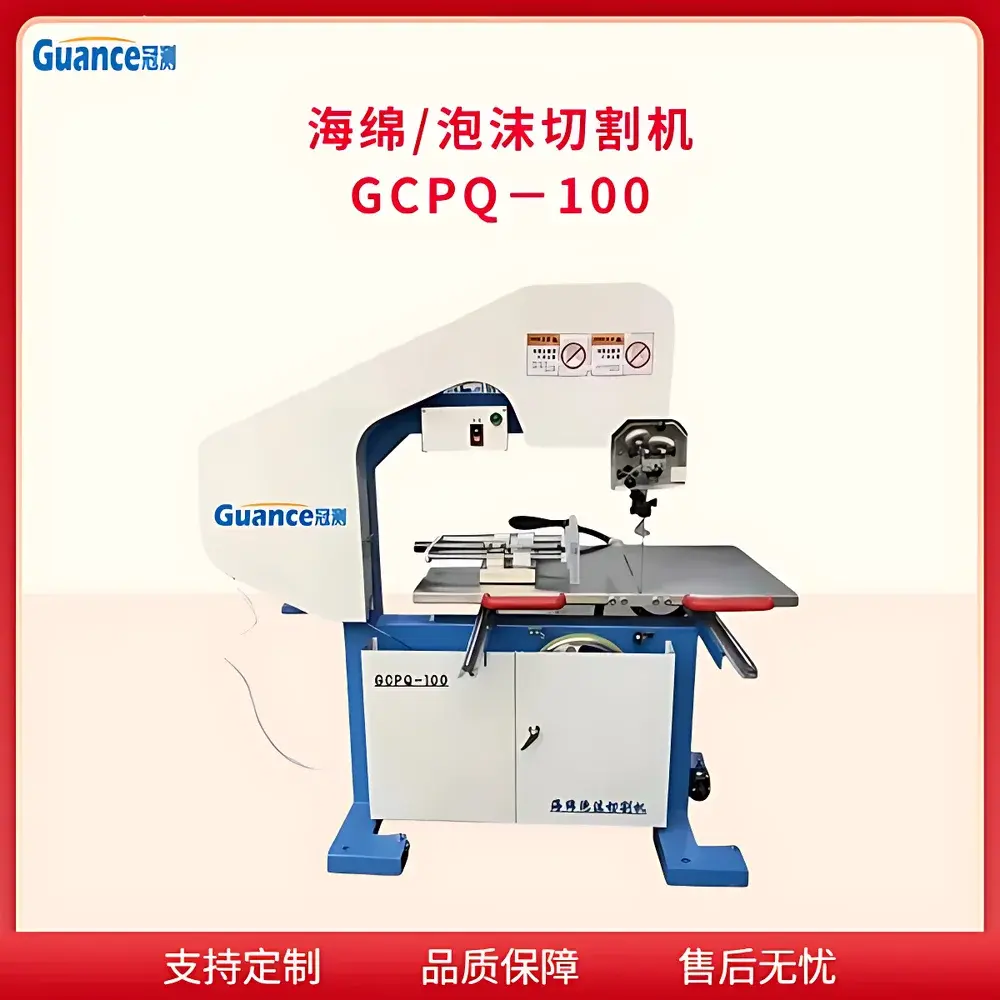
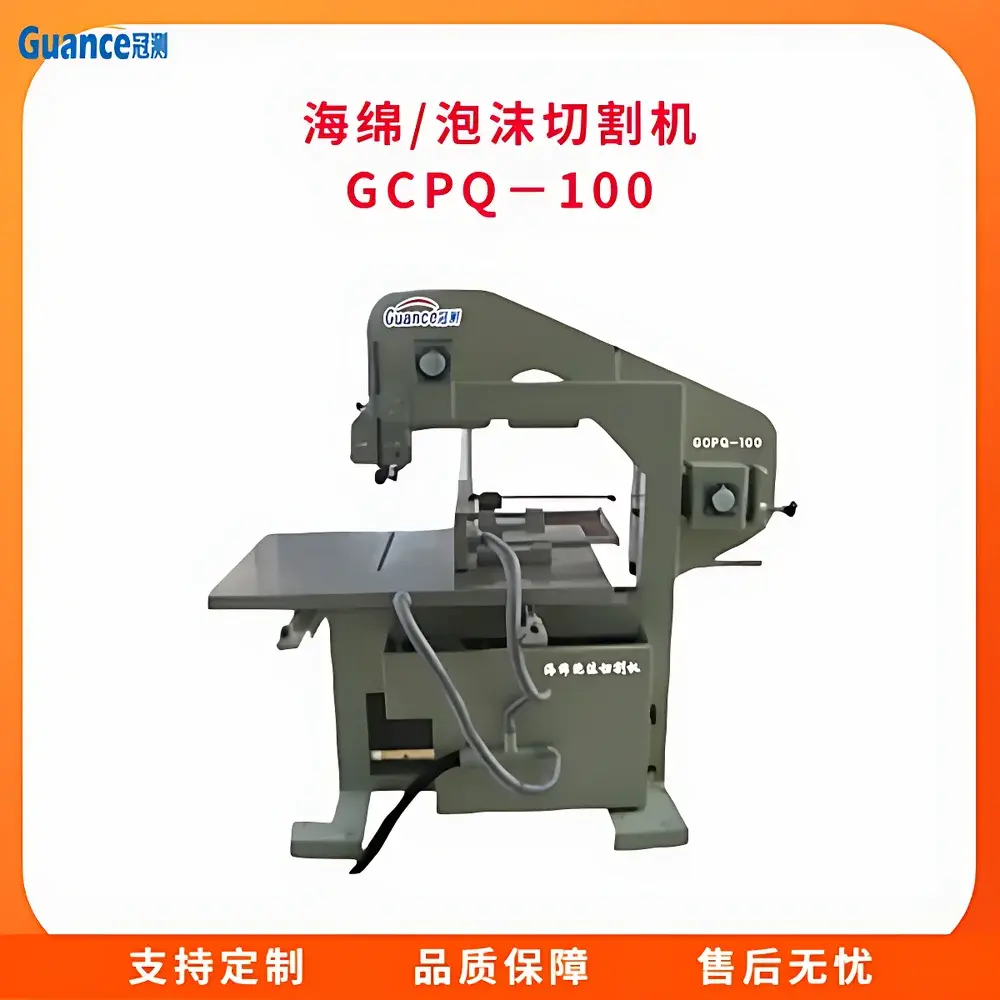
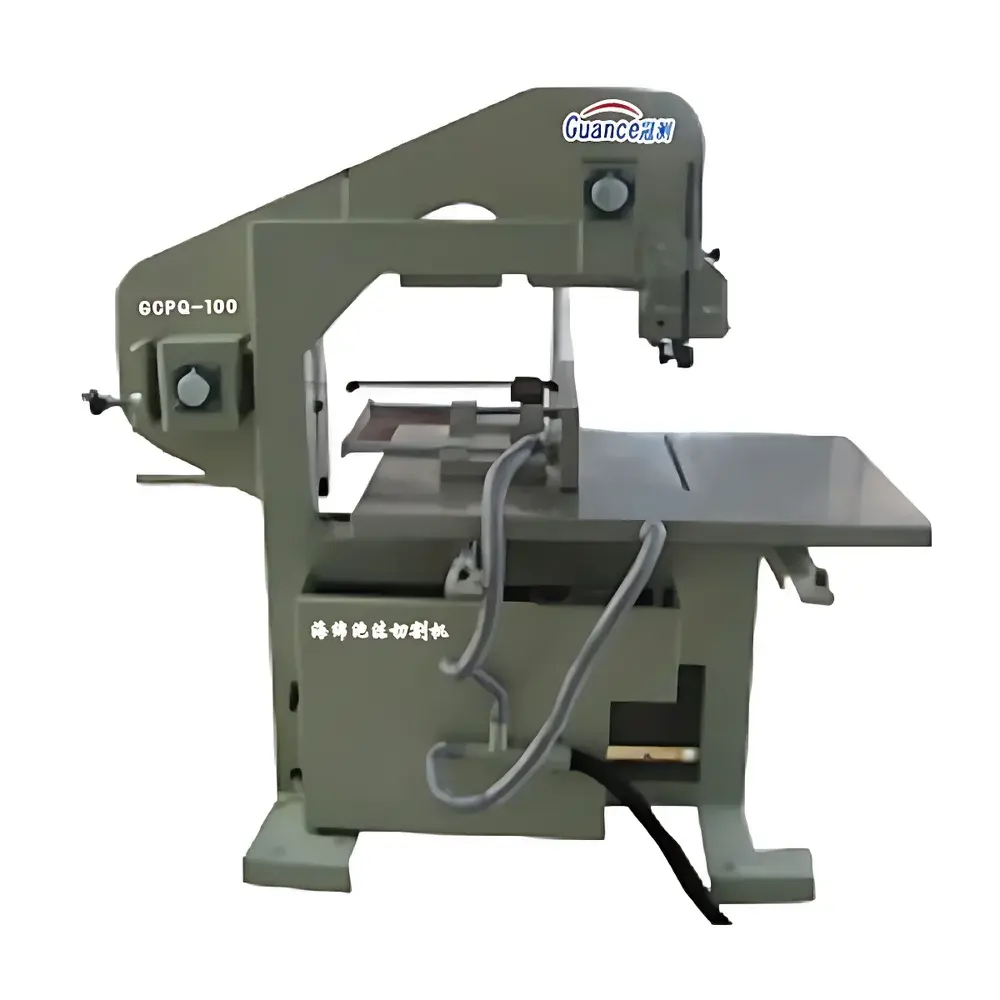
Guance Instruments GCPQ-100.2 Laboratory Foam & Sponge Cutting Machine
| Brand | Guance Instruments |
|---|---|
| Origin | Beijing, China |
| Manufacturer Type | Authorized Distributor |
| Country of Origin | China |
| Model | GCPQ-100.2 |
| Instrument Type | Precision Foam Cutting Machine |
| Digital Caliper Resolution | 0.01 mm |
| Cutting Accuracy | ±1 mm (material-dependent) |
| Worktable Dimensions | 1000 × 700 mm (customizable) |
| Worktable Material | Anodized Aluminum |
| Guard Material | Acrylic |
| Effective Travel Stroke | 500 mm |
| Maximum Cutting Thickness | 400 mm |
| Rated Voltage | 220 V / 50 Hz |
| Power Consumption | 1 kW |
| Blade Circumference | 3920 mm |
| Vacuum Fixturing | Yes |
| Noise Reduction | Rubber-damped drive rollers & shock absorbers |
Overview
The Guance Instruments GCPQ-100.2 Laboratory Foam & Sponge Cutting Machine is a precision-engineered benchtop system designed for reproducible, dimensionally controlled sectioning of low-density polymeric cellular materials—including flexible and rigid polyurethane foams, melamine sponges, ethylene-vinyl acetate (EVA), expanded polystyrene (EPS), and similar compressible substrates. Unlike abrasive or thermal cutting methods that induce edge deformation or melt zones, this machine employs a continuously tensioned, high-tensile resistance wire—electrically heated to precise operating temperature—operating under controlled linear motion across a vacuum-secured work surface. The system implements a constant-tension wire feed mechanism combined with a digitally indexed, motor-assisted translation stage, enabling consistent kerf width (<0.3 mm) and minimal thermal distortion. Its core architecture follows ISO 179-1 and ASTM D3574-compliant sample preparation principles for mechanical testing of foam resilience, compression set, and tensile strength—ensuring traceable, inter-laboratory comparable specimens.
Key Features
- Vacuum-adhered anodized aluminum worktable (1000 × 700 mm standard, customizable) with integrated negative-pressure channels for uniform substrate immobilization—eliminating lateral shift during cutting of low-modulus materials.
- Digital caliper with 0.01 mm resolution and real-time positional feedback, directly linked to the adjustable stop-gauge assembly for repeatable dimensional control of specimen length, width, and thickness.
- Modular acrylic safety guard system with multi-level physical interlocks and emergency stop circuitry compliant with IEC 61000-6-2 EMC standards and EN 60204-1 machinery safety directives.
- Direct-on-machine blade sharpening station—no disassembly required—featuring diamond-coated grinding wheel and angle-preserving jig for maintaining optimal wire geometry and thermal transfer efficiency.
- Low-noise drive train incorporating vibration-damping rubber couplings and precision-machined idler pulleys, reducing operational sound pressure level to ≤62 dB(A) at 1 m distance.
- Adjustable wire tensioning system with calibrated spring-loaded load cell, ensuring consistent cutting force across variable material densities (15–120 kg/m³).
Sample Compatibility & Compliance
The GCPQ-100.2 accommodates specimens ranging from soft open-cell sponges (density ≥15 kg/m³) to semi-rigid closed-cell foams (up to 120 kg/m³) and thermoplastic elastomers such as TPE and TPU sheets. It supports preparation of standardized test coupons per ASTM D3574 (flexibility, indentation load deflection), ISO 2439 (compression hardness), and GB/T 6342 (cellular plastics dimensional stability). All electrical components meet CE marking requirements; vacuum pump and heating circuit are certified to RoHS 2011/65/EU and REACH Annex XVII. The machine’s mechanical design adheres to GLP-relevant documentation practices—serial-numbered calibration logbook included, with optional audit-ready maintenance records.
Software & Data Management
While the GCPQ-100.2 operates via intuitive manual controls (point-to-start/stop, jog mode, preset depth lock), it integrates seamlessly with external laboratory information management systems (LIMS) through RS-232 serial output. Optional firmware upgrade enables timestamped digital logging of cut count, cumulative operating hours, and vacuum pressure thresholds—exportable as CSV for FDA 21 CFR Part 11–compliant electronic records when paired with validated third-party data acquisition software. Calibration verification reports include uncertainty budgets derived from NIST-traceable micrometer validation.
Applications
- Preparation of compression test specimens (e.g., 50 × 50 × 25 mm cubes per ISO 844) for automotive seating foam qualification.
- Cutting of acoustic absorption panels into ASTM C423-defined dimensions for impedance tube testing.
- Sectioning of medical-grade polyether-polyurethane wound dressings into USP -specified geometries for biocompatibility assay support.
- Production of standardized cores for ASTM D1622 density measurement in insulation foam R&D labs.
- High-throughput slicing of memory foam billets into 10 mm-thick layers for DMA temperature sweeps.
FAQ
What foam densities are compatible with the GCPQ-100.2?
Foams between 15 kg/m³ (ultra-soft open-cell sponges) and 120 kg/m³ (semi-rigid structural foams) can be cut with stable edge integrity and minimal compression set.
Is vacuum fixation mandatory for all materials?
Yes—vacuum hold-down is integral to dimensional repeatability; non-vacuum operation is not supported due to inherent material compliance and risk of specimen drift.
Can the machine cut non-foam polymers like silicone rubber or gel pads?
It is validated only for cellular polymeric materials; solid elastomers require alternative cutting methodologies (e.g., cryo-microtome) due to thermal conductivity mismatch and wire adhesion risks.
How often does the heating wire require replacement?
Under normal use (≤8 hrs/day, 5 days/week), the NiCr alloy wire lasts ≥18 months; wear indicators include inconsistent cut depth, localized discoloration, or increased power draw (>1.1 kW sustained).
Does the system support IQ/OQ documentation packages?
Yes—Guance Instruments provides vendor-validated Installation Qualification (IQ) and Operational Qualification (OQ) templates aligned with ISO/IEC 17025:2017 clause 6.4, including as-delivered metrology reports and functional test protocols.



