
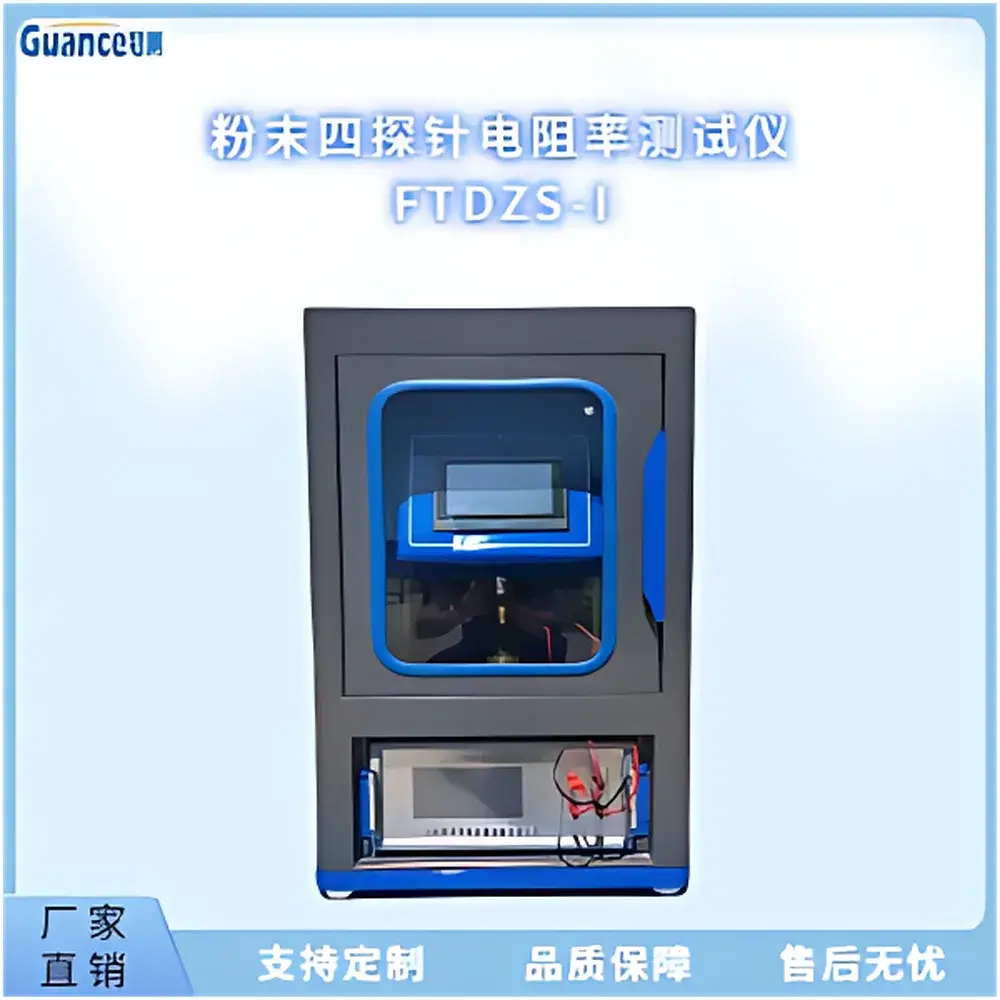
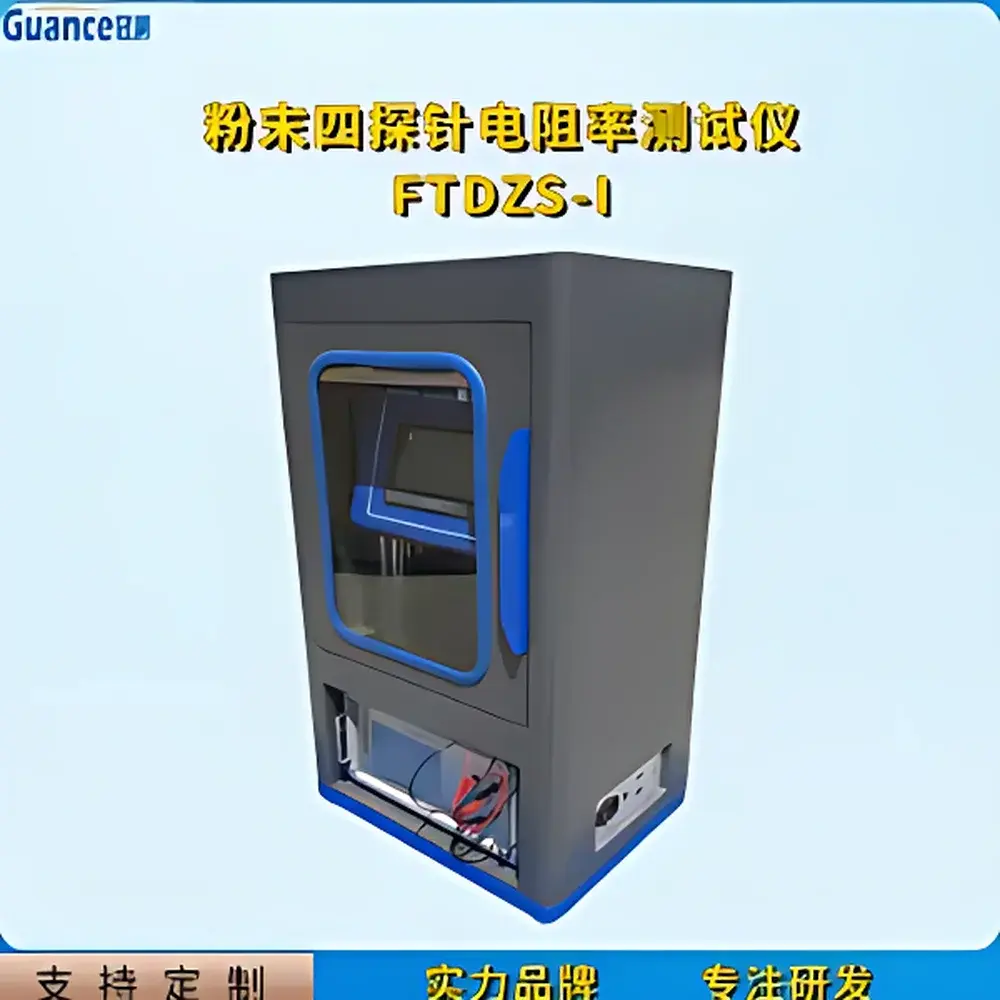
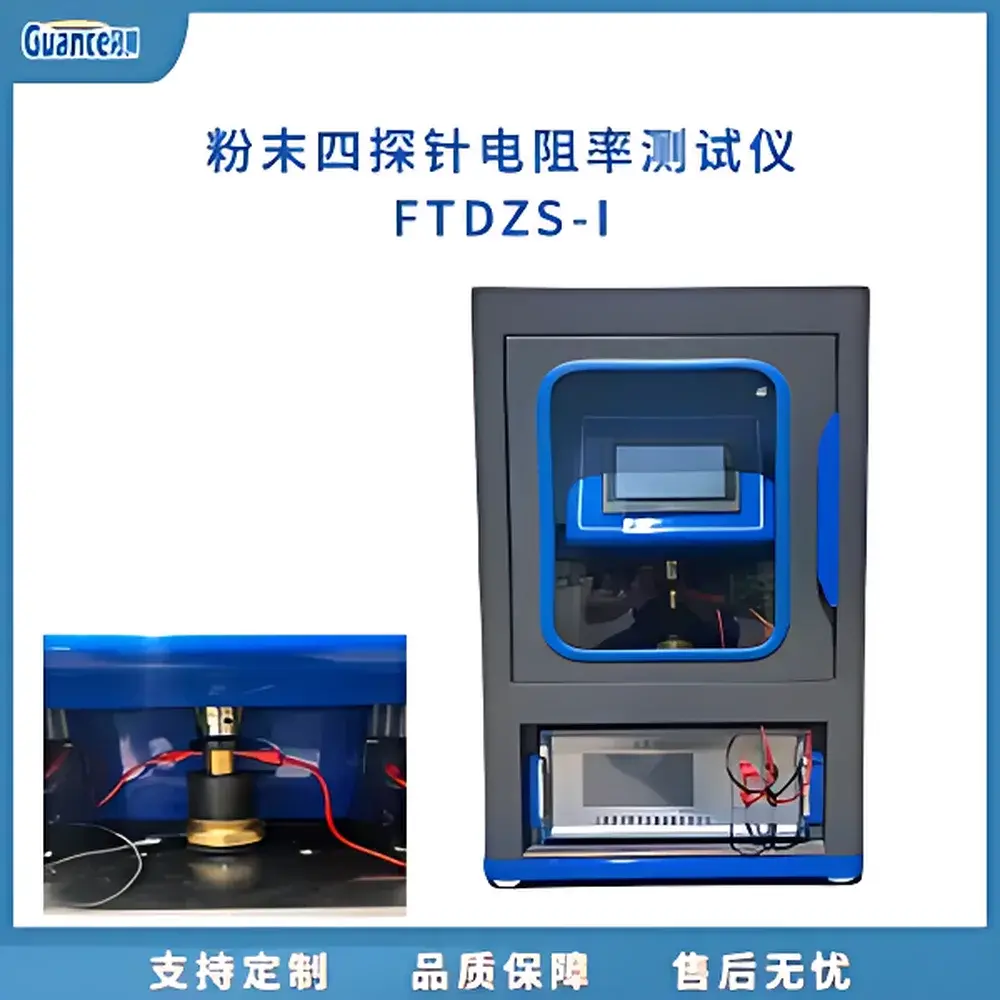
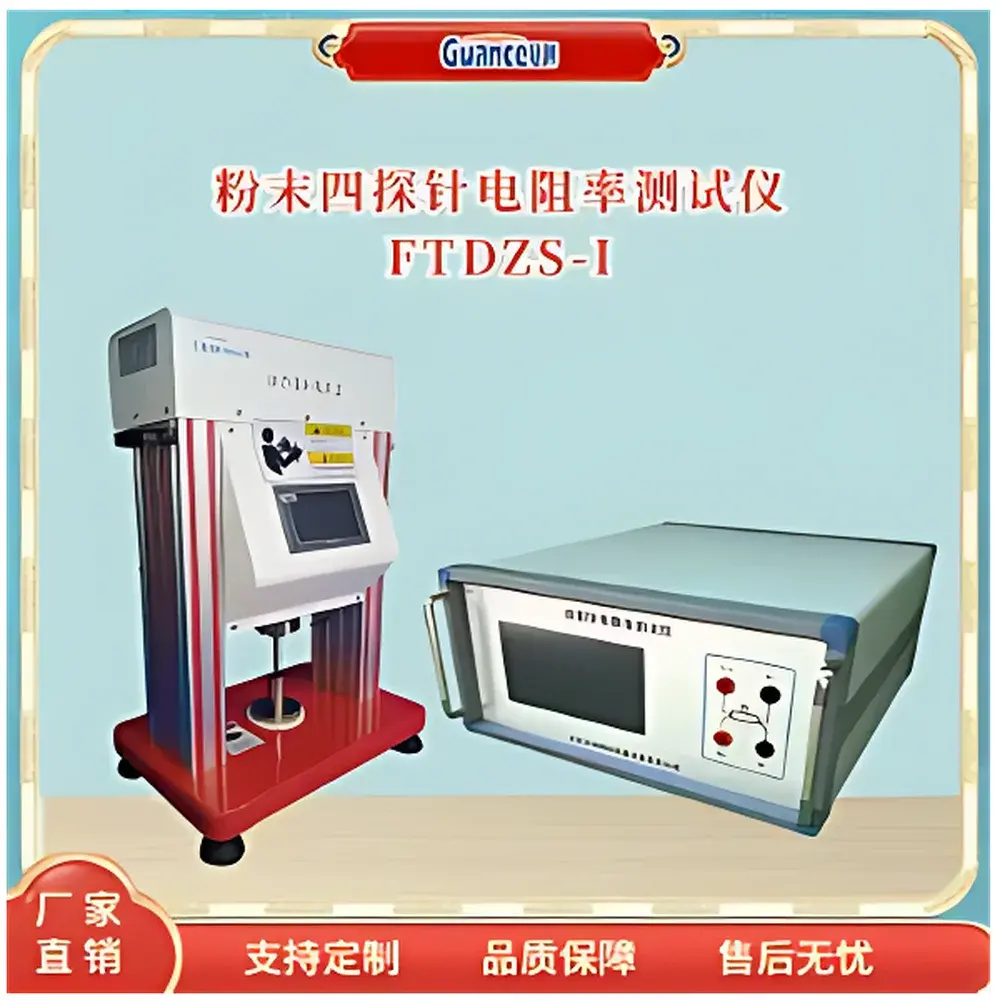
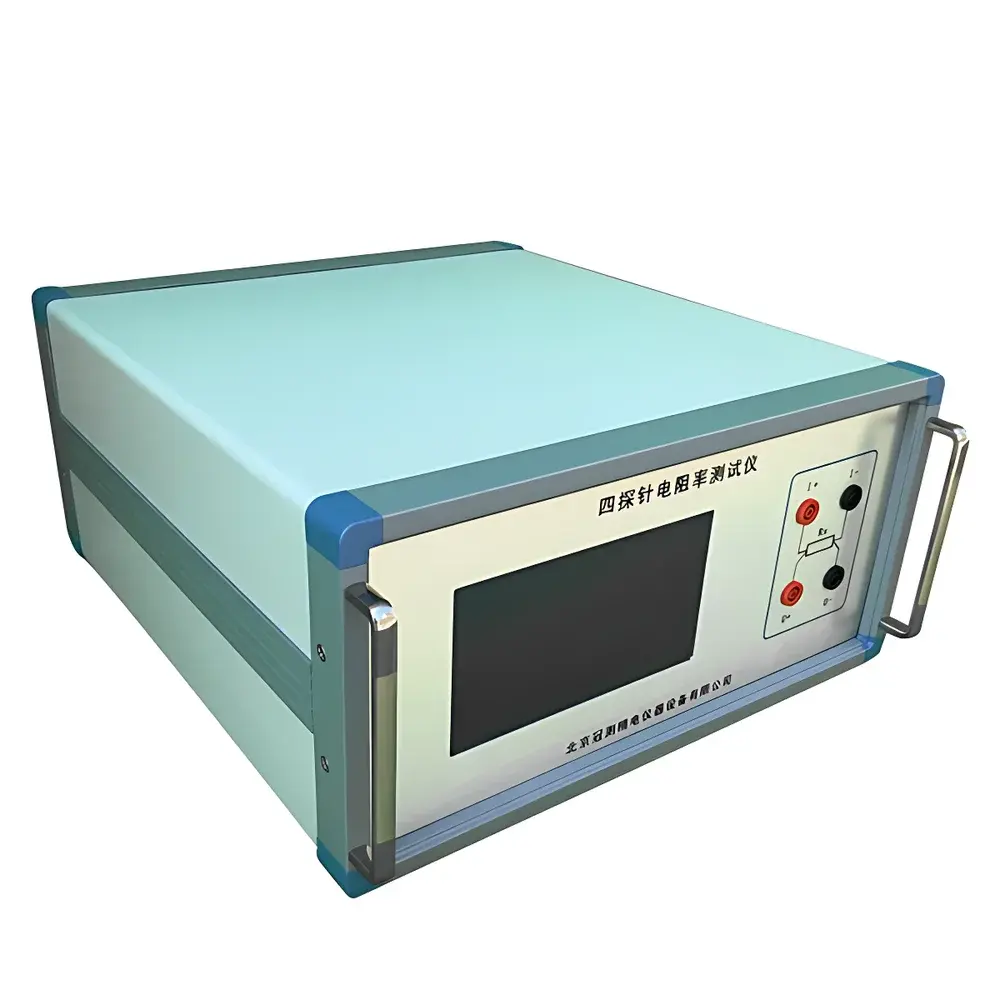
Guance Instruments FTDZS-I Four-Point Probe Powder Resistivity Tester
| Brand | Guance Instruments |
|---|---|
| Model | FTDZS-I |
| Measurement Principle | Four-Point Collinear Probe Method (Van der Pauw geometry compatible) |
| Resistivity Range | 10⁻⁵ – 10⁵ Ω·cm |
| Voltage Range | 2 mV – 2 V (4½-digit resolution, ±0.5% reading + 2 digits) |
| Current Sources | 1 μA – 100 mA (6 precision steps, ±0.5% reading + 2 digits) |
| Probe Spacing | 1.0 mm (tungsten carbide-tipped probes) |
| Sample Area | 3.142 cm² (20 mm diameter die) |
| Sample Mass Control | 2.501–2.5099 g (±0.005 g repeatability) |
| Electrode Loading | Dual-mode — manual pre-load + motorized servo-controlled compression (0–10 kN, integrated load cell) |
| Compliance Standards | YS/T 587.6–2006, GB/T 24525–2009, GB/T 30835–2014 |
| Interface | Touchscreen HMI with embedded data logging, USB export, and thermal printer support |
Overview
The Guance Instruments FTDZS-I Four-Point Probe Powder Resistivity Tester is an engineered solution for standardized, pressure-controlled resistivity characterization of granular and powdered conductive and semiconductive materials. It operates on the fundamental four-point collinear probe principle—where two outer electrodes inject a known DC current while two inner electrodes measure the resulting potential drop—eliminating contact resistance errors inherent in two-terminal measurements. Unlike bulk solid or thin-film configurations, powder resistivity is intrinsically density-dependent; therefore, the FTDZS-I integrates a dual-mode loading system to apply precise, reproducible compaction forces (0–10 kN) under controlled mass (2.501–2.5099 g) and geometric constraints (20 mm die, 3.142 cm² area). This ensures measurement consistency across loose, tapped, or isostatically pressed states—critical for QC/QA in electrode material development, carbon anode qualification, and battery cathode formulation.
Key Features
- Four-point collinear probe assembly with 1.0 mm fixed inter-probe spacing and tungsten carbide-tipped electrodes for high wear resistance and low thermal EMF
- Dual-mode mechanical loading: manual pre-compression followed by programmable servo-driven force application (0–10 kN, ±0.5% full-scale accuracy)
- High-stability DC current source with six selectable ranges (1 μA to 100 mA), each calibrated traceably to NIST-equivalent standards
- 4½-digit digital voltmeter with auto-ranging (2 mV–2 V), polarity detection, overload protection, and real-time error flagging
- Touchscreen HMI interface with intuitive workflow navigation, parameter locking, and on-device result review
- Integrated thermal printer for immediate hard-copy reporting with timestamp, sample ID, applied load, and calculated resistivity (Ω·cm)
- Compact benchtop architecture (W × D × H: 320 × 300 × 280 mm) designed for ISO 17025-accredited lab environments
Sample Compatibility & Compliance
The FTDZS-I is validated for use with powders exhibiting electrical behavior from metallic conductors (e.g., copper flake, nickel-coated graphite) through semiconductors (e.g., silicon carbide, LiFePO₄/C composites) to highly resistive carbon blacks and calcined petroleum coke. Its operational envelope aligns directly with industry-standard test protocols: YS/T 587.6–2006 (anode-grade coke), GB/T 24525–2009 (carbonaceous materials), and GB/T 30835–2014 (Li-ion cathode materials), where the four-probe method is specified as the arbitration technique. The instrument’s mechanical design accommodates ASTM D3764-compliant die geometry and supports GLP documentation requirements—including operator ID, date/time stamping, and force-resistivity correlation logs—enabling audit-ready traceability per ISO/IEC 17025 clause 7.7.
Software & Data Management
While the FTDZS-I operates autonomously via its embedded touchscreen controller, it supports USB mass storage export of CSV-formatted datasets containing raw voltage, current, applied load, temperature (optional external sensor input), and calculated resistivity. Each record includes metadata: test sequence ID, operator code, calibration certificate expiry, and probe usage counter. No proprietary software installation is required; exported files are natively readable in Excel, Python (pandas), MATLAB, or LIMS platforms. For regulated environments, optional firmware upgrade enables 21 CFR Part 11-compliant electronic signatures, audit trails, and user-role-based access control (admin/operator/viewer)—fully supporting GMP and pharmaceutical-grade material release workflows.
Applications
- Quality control of lithium-ion battery cathode precursors (e.g., LiCoO₂, NMC, LiFePO₄/C blends) per GB/T 30835–2014 Section 6.3
- Resistivity grading of calcined petroleum coke and needle coke used in aluminum smelting anodes (YS/T 587.6–2006)
- R&D screening of conductive additives (carbon nanotubes, graphene, acetylene black) in polymer composites
- Process validation of powder metallurgy feedstocks (e.g., tungsten, molybdenum, stainless steel powders)
- Teaching laboratories for solid-state physics and materials science courses covering charge transport in disordered media
FAQ
What standards does the FTDZS-I comply with?
It meets the technical and procedural requirements of YS/T 587.6–2006, GB/T 24525–2009, and GB/T 30835–2014—specifically referencing the four-probe method as the primary or arbitration technique for powder resistivity determination.
Can the instrument measure anisotropic or layered powder compacts?
No—the FTDZS-I assumes isotropic conduction within the compressed cylindrical volume defined by the 20 mm die and 1 mm probe spacing. For directional resistivity (e.g., vertical vs. horizontal), orthogonal probe configurations or custom fixtures are required beyond standard operation.
Is calibration traceable to national metrology institutes?
Yes—factory calibration uses reference resistors certified to ISO/IEC 17025-accredited laboratories, with full uncertainty budgets provided in the Certificate of Conformance shipped with each unit.
How is sample mass controlled during testing?
The protocol mandates gravimetric dosing between 2.501 g and 2.5099 g using a Class I analytical balance (not included); this narrow tolerance ensures consistent particle packing density across replicate tests.
Does the system support automated data archiving to a network server?
Standard configuration supports local USB export only. Network-enabled data forwarding (SFTP, OPC UA) is available via optional firmware module and industrial Ethernet interface (order code: FTDZS-I-NET).



