
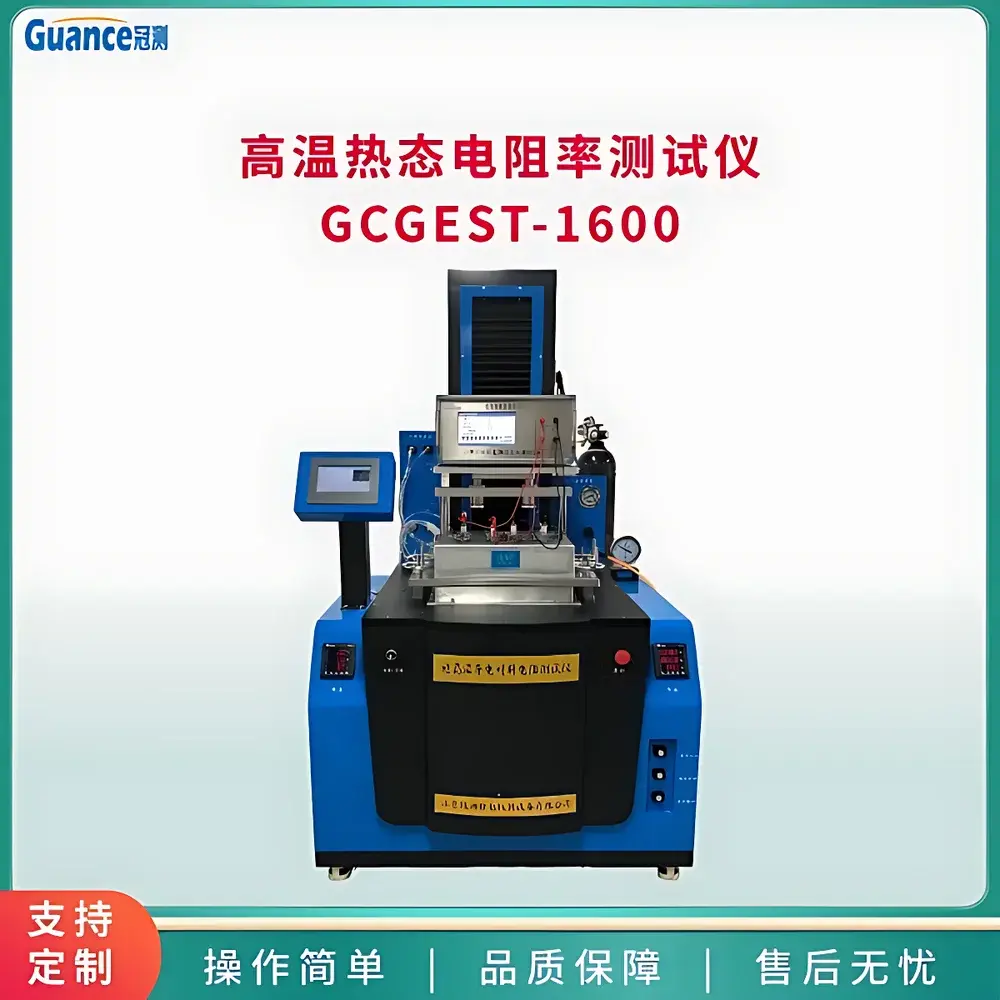
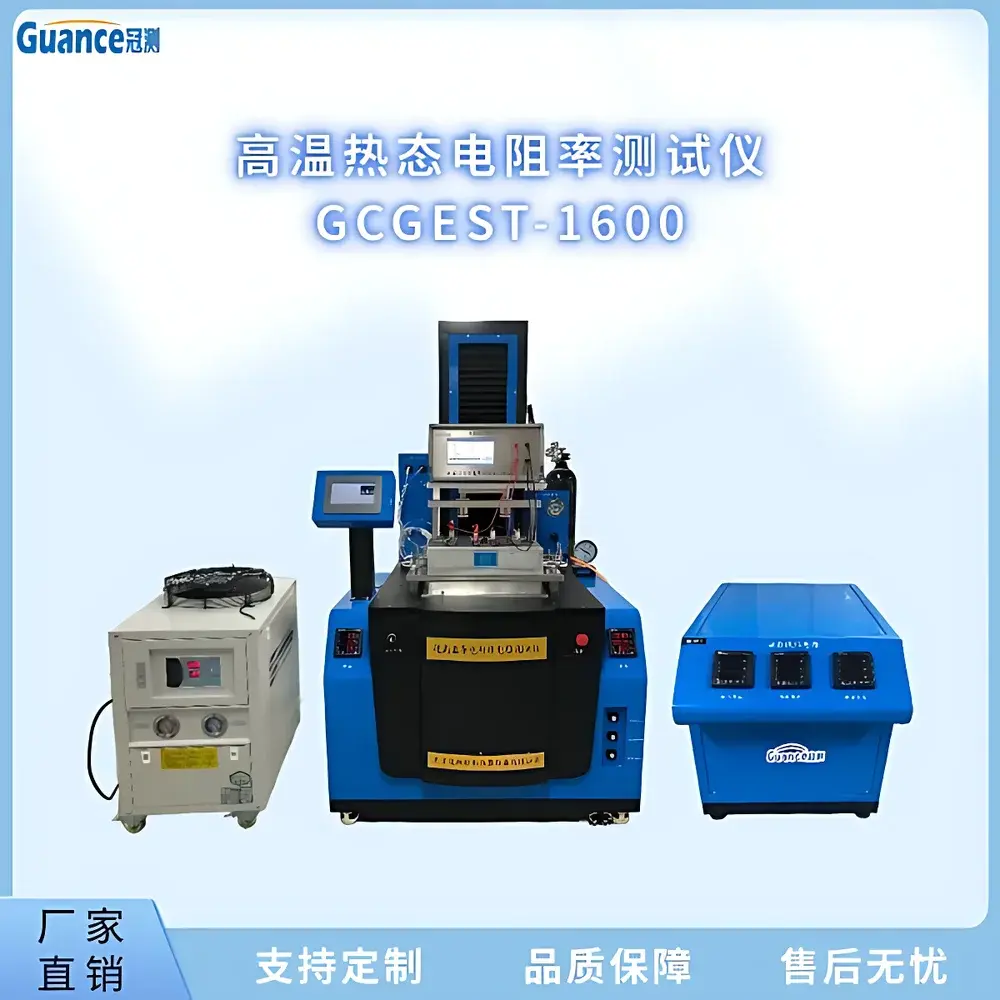
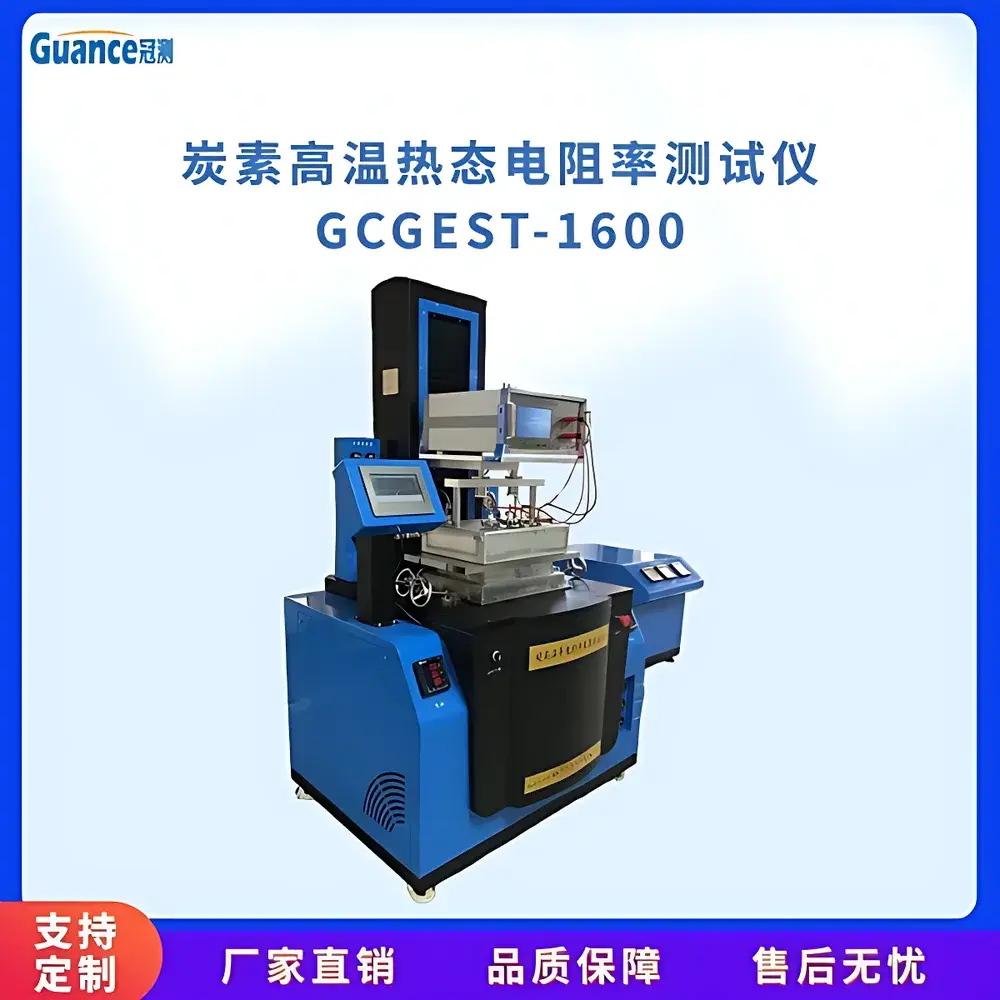
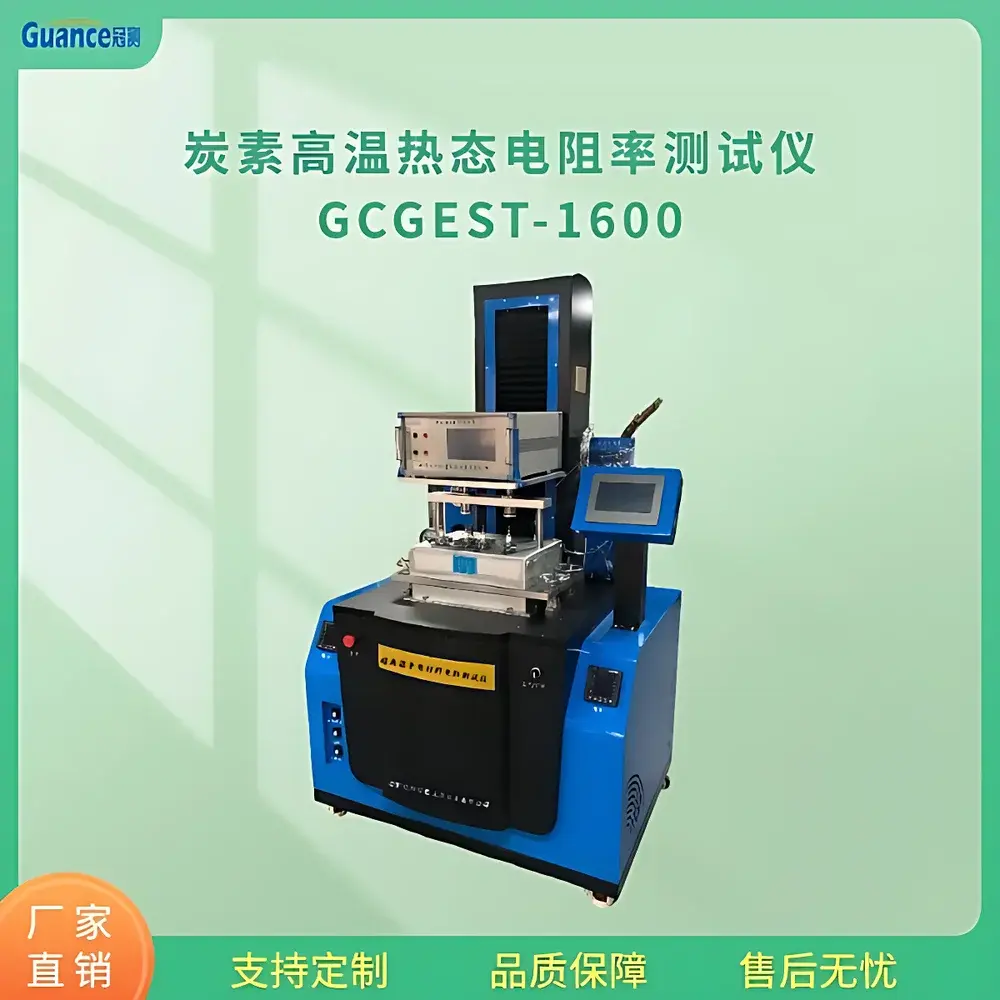
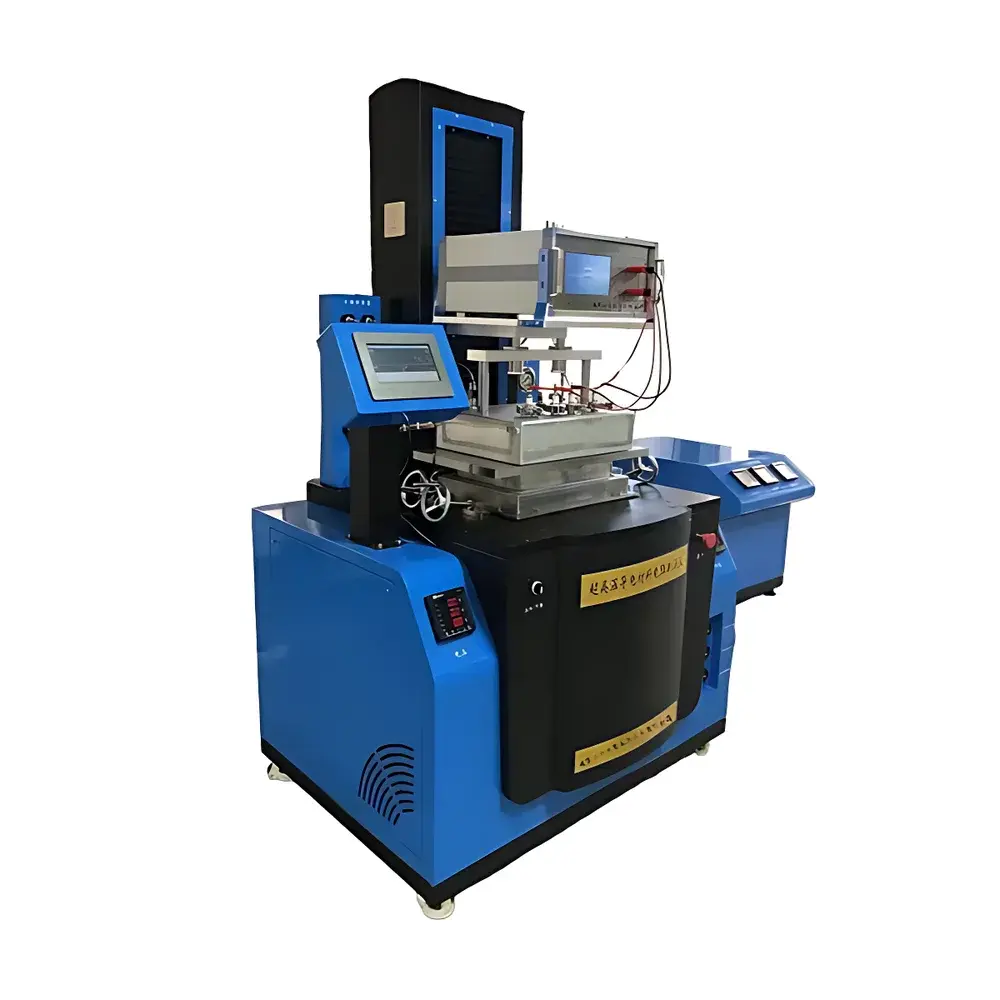
GuanCe GCGEST-1600 High-Temperature Resistivity Tester for Carbonaceous Materials
| Brand | GuanCe |
|---|---|
| Origin | Beijing, China |
| Manufacturer Type | Authorized Distributor |
| Country of Origin | China |
| Model | GCGEST-1600 |
| Temperature Range | Ambient to 1650 °C |
| Heating Rate | 15 °C/min ±5 °C (adjustable) |
| Temperature Control Accuracy | ±2 °C |
| Atmosphere Control | Vacuum-compatible & gas-purged chamber |
| Sample Dimensions | Ø10 mm × 80 mm |
| Sample Capacity | 1–4 specimens (configurable) |
| Electrode Actuation | Motorized in-situ vertical positioning |
| Test Current Ranges | 10 μA to 10 A (9 discrete steps) |
| Resistivity Measurement Accuracy | ±0.5% |
| Measurement Principle | Four-Point Probe (Van der Pauw compatible geometry) |
Overview
The GuanCe GCGEST-1600 is a purpose-engineered high-temperature resistivity measurement system designed specifically for carbon-based materials—including graphite electrodes, carbon composites, refractory carbons, and synthetic graphites—under controlled thermal and atmospheric conditions. It operates on the four-point probe (4PP) principle, eliminating contact resistance errors by separating current injection and voltage sensing pathways. This method ensures traceable, reproducible bulk resistivity quantification in accordance with ASTM D4292, ISO 18513, and GB/T 24522–2009 (Standard Test Method for Resistivity of Carbonaceous Materials at Elevated Temperatures). The instrument integrates a high-stability molybdenum disilicide (MoSi₂) heating furnace capable of sustained operation up to 1650 °C, coupled with a vacuum-tight or gas-purged reaction chamber (compatible with inert N₂, Ar, or reducing H₂/Ar mixtures). Real-time synchronization between temperature ramping, electrode positioning, current sourcing, and voltage acquisition enables continuous resistivity profiling across dynamic thermal cycles—critical for evaluating microstructural evolution, phase transitions, and oxidation kinetics in carbon systems.
Key Features
- Programmable temperature control from ambient to 1650 °C, with ramp rates adjustable from 1 to 15 °C/min (±5 °C linearity tolerance)
- Motor-driven, pneumatically sealed electrode assembly enabling precise in-chamber vertical actuation—ensuring consistent probe contact force and alignment without manual intervention
- Nine-step programmable constant-current source (10 μA to 10 A), optimized for low-resistance carbon specimens (sub-mΩ range) and high-resistivity pyrolytic carbons (up to kΩ·cm)
- Integrated digital nanovoltmeter and precision shunt-based current monitoring, delivering ±0.5% full-scale resistivity accuracy per IEC 60584 and NIST-traceable calibration protocols
- Modular sample holder configuration supporting 1–4 parallel specimens (Ø10 mm × 80 mm), facilitating statistical repeatability assessment or comparative multi-material screening
- Embedded PID controller with dual thermocouple inputs (Type S or B) and real-time thermal gradient compensation across the hot zone
Sample Compatibility & Compliance
The GCGEST-1600 accommodates standard cylindrical carbon specimens conforming to ISO 18513 Annex A and ASTM D4292 specimen geometry requirements. Its vacuum-rated chamber (base pressure ≤5×10⁻³ Pa) and mass-flow-controlled gas inlet system support testing under inert, reducing, or mildly oxidizing atmospheres—enabling studies aligned with ASTM C1171 (oxidation behavior of carbon-carbon composites) and IEC 60721-3-3 (environmental class for high-temperature electrical testing). All electrical isolation, grounding topology, and shielding meet EN 61326-1 (EMC for laboratory equipment) and UL 61010-1 safety standards. Data acquisition complies with ALCOA+ principles; audit trails, user access logs, and electronic signature capability are configurable to satisfy FDA 21 CFR Part 11 and EU Annex 11 requirements when integrated with validated LIMS environments.
Software & Data Management
The system ships with GuanCe ThermalResist™ v3.2—a Windows-based application supporting ISO/IEC 17025-compliant test method definition, sequence scripting, and automated report generation (PDF, CSV, XLSX). Real-time plotting displays resistivity vs. temperature, dρ/dT derivatives, and Arrhenius linearization overlays. Raw data streams include timestamped temperature, current, voltage, chamber pressure, and atmosphere composition—each tagged with unique test ID, operator credentials, and instrument calibration status. Exported datasets embed metadata compliant with ISA-95 and ASTM E2500-22 for seamless ingestion into enterprise quality management systems (QMS) or statistical process control (SPC) platforms. Optional API integration enables bidirectional communication with LabVantage, Thermo Fisher SampleManager, or custom MES deployments.
Applications
- Quality assurance of graphite anodes and cathodes in battery-grade carbon manufacturing
- Thermal stability evaluation of carbon fiber-reinforced composites (CFRCs) for aerospace structural components
- Resistivity mapping during sintering and graphitization of synthetic graphite powders (e.g., petroleum coke-derived grades)
- Correlation of electrical transport properties with microstructural parameters (crystallite size, interlayer spacing) via in situ XRD-resistivity coupling studies
- Development and validation of oxidation-resistant carbon coatings for nuclear moderator applications
- Process window definition for industrial carbonization furnaces based on empirical ρ(T) curves
FAQ
What standards does the GCGEST-1600 comply with for high-temperature resistivity testing?
It supports methodology alignment with ASTM D4292, ISO 18513, GB/T 24522–2009, and IEC 60721-3-3 through hardware design, calibration traceability, and software reporting templates.
Can the system operate under reducing atmospheres such as hydrogen?
Yes—the chamber is rated for H₂ concentrations up to 10% in argon, with leak-tightness verified per ISO 10648-2 and equipped with explosion-proof purge interlocks.
Is the four-point probe configuration suitable for anisotropic carbon samples?
The axial probe arrangement allows directional resistivity measurement along the specimen length; optional radial probe fixtures are available for transverse characterization upon request.
How is measurement uncertainty quantified and documented?
Uncertainty budgets are auto-generated per GUM (JCGM 100:2008), incorporating contributions from temperature drift, current source stability, voltage noise floor, and geometric correction factors—exportable as part of the final report.
Does the system support GLP/GMP audit readiness out of the box?
With optional 21 CFR Part 11 module enabled, it provides role-based access control, electronic signatures, immutable audit trails, and calibration certificate linking—validated per IQ/OQ protocols supplied with installation qualification.



