
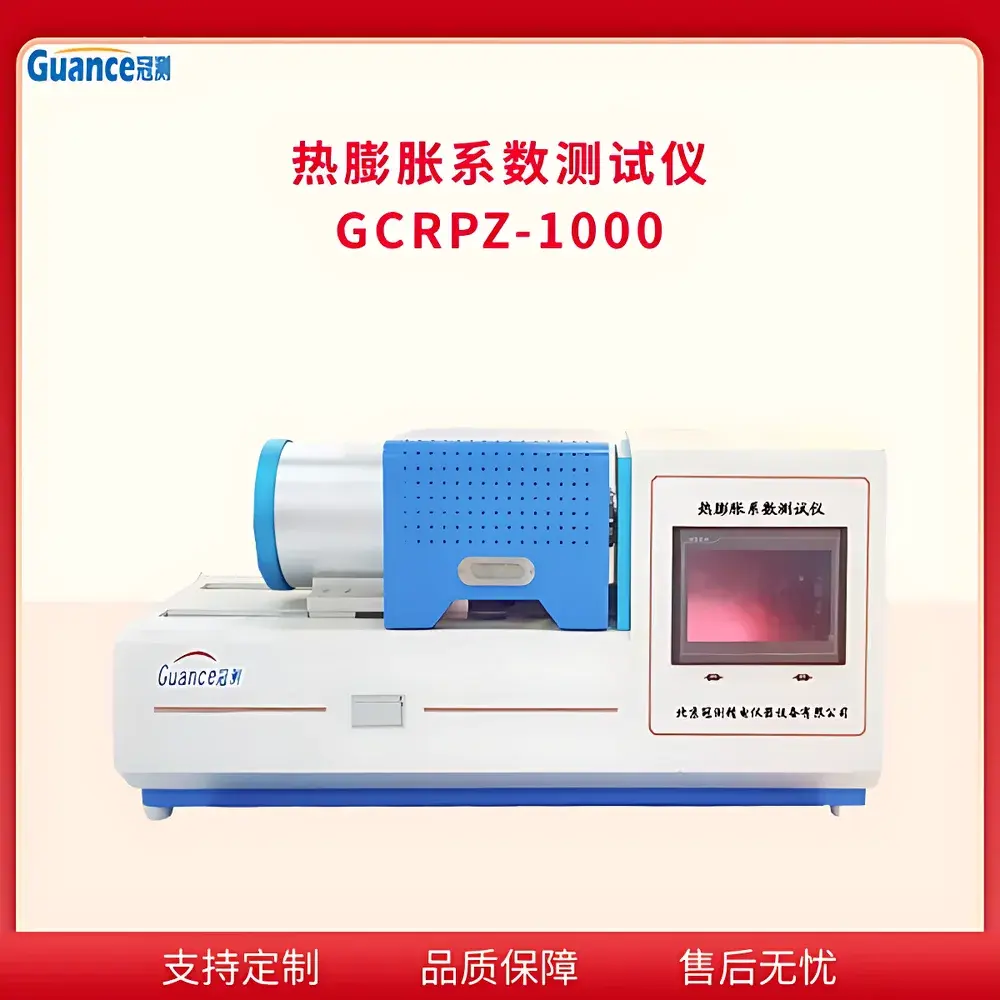
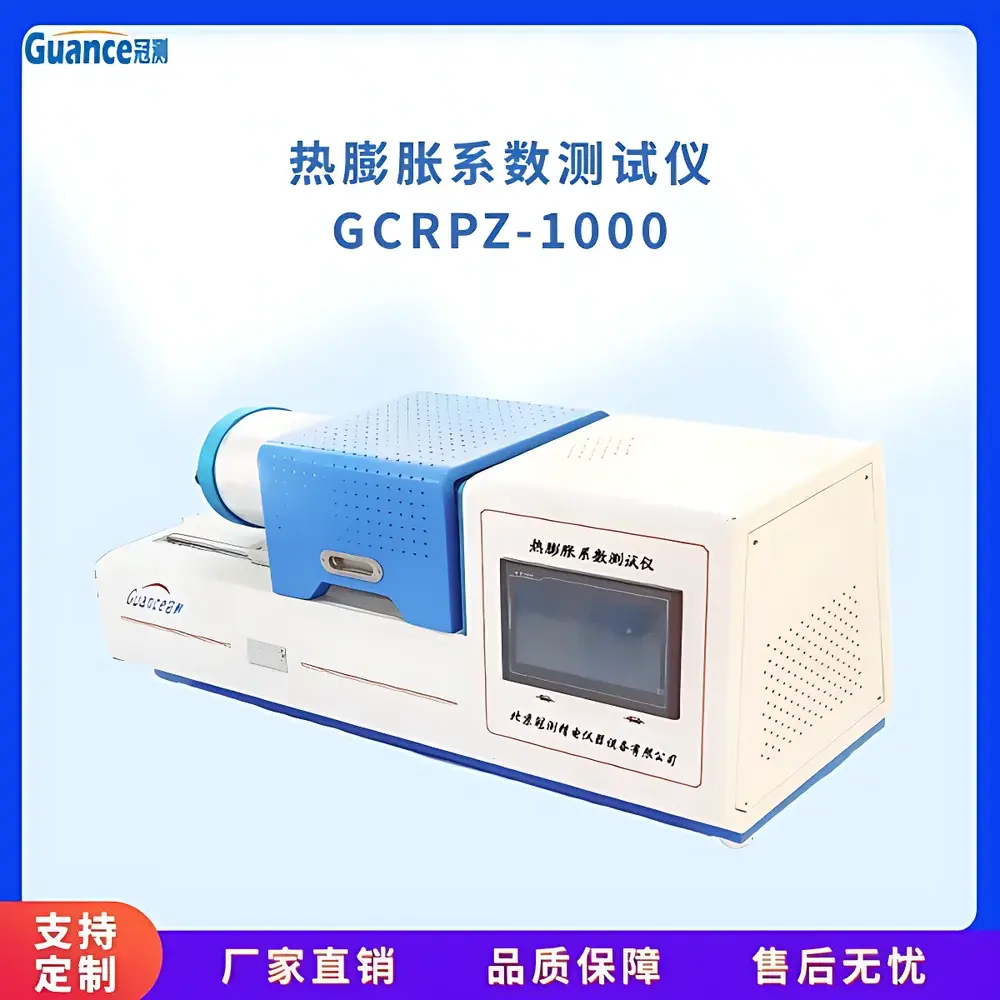
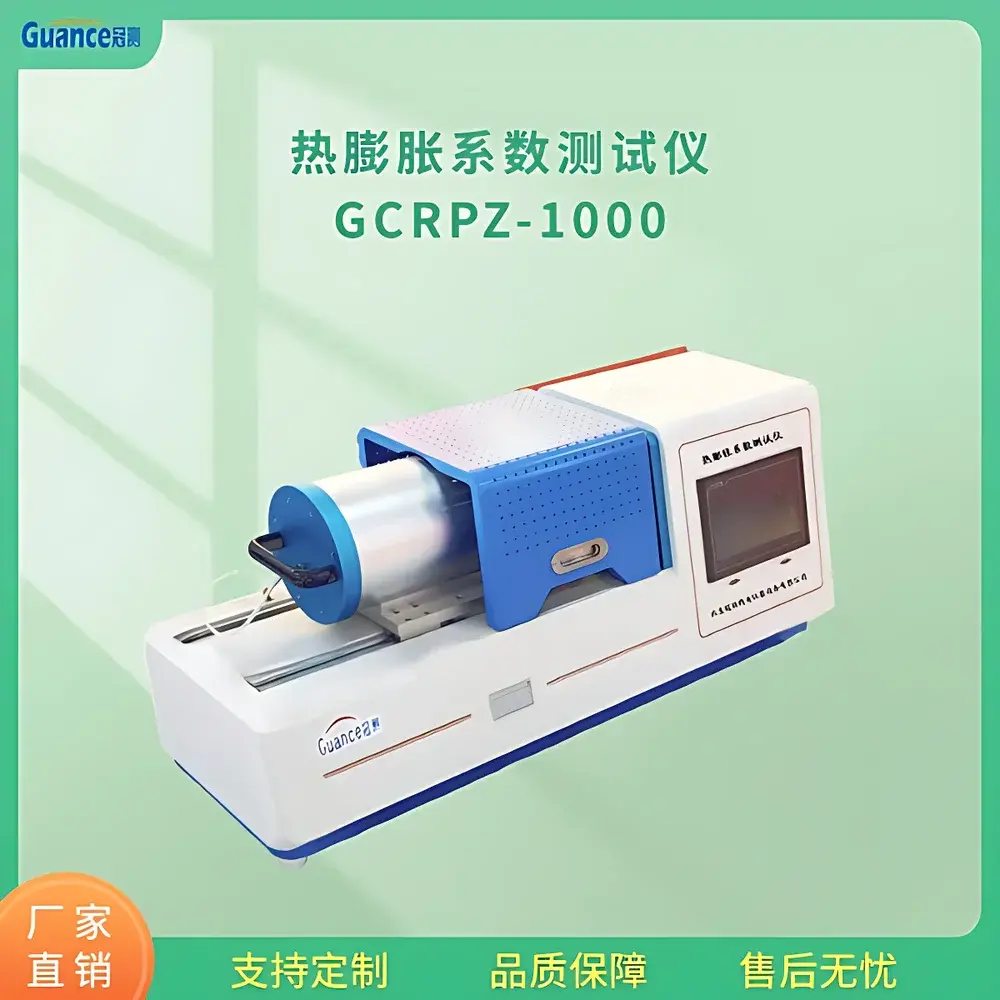
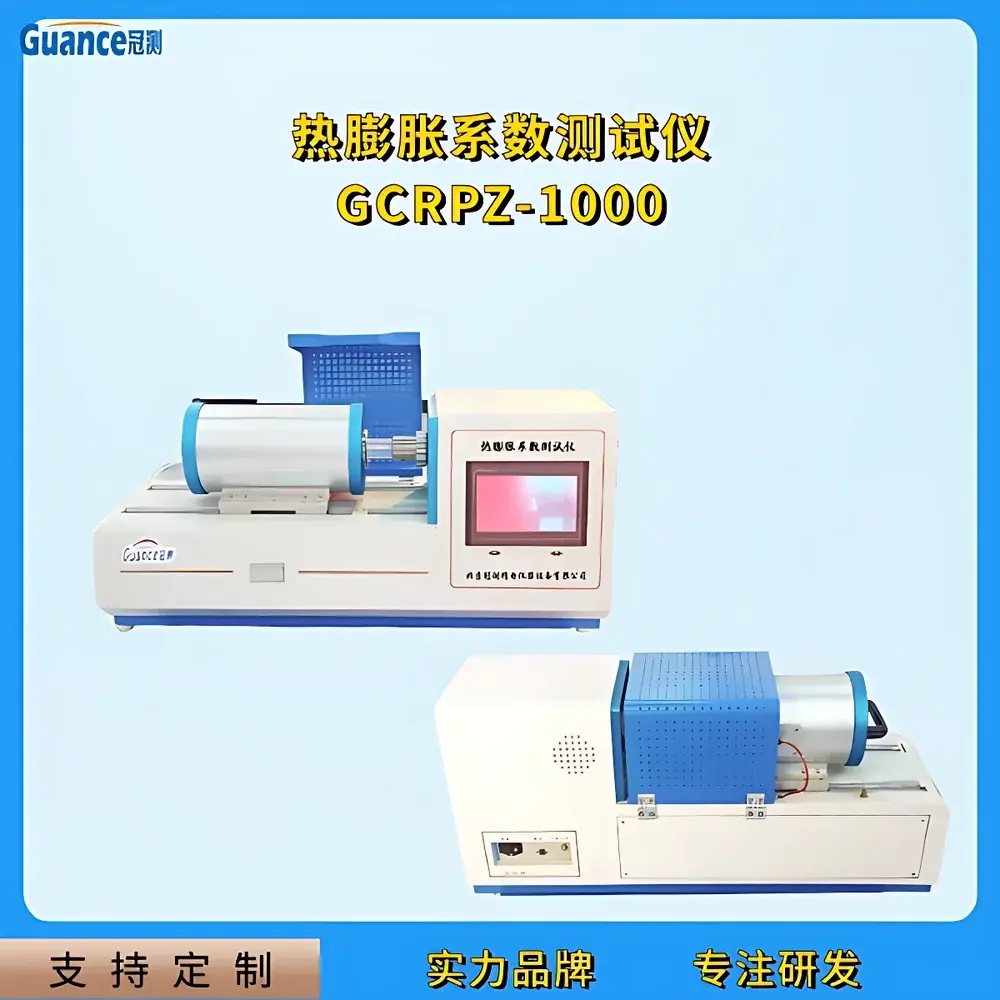
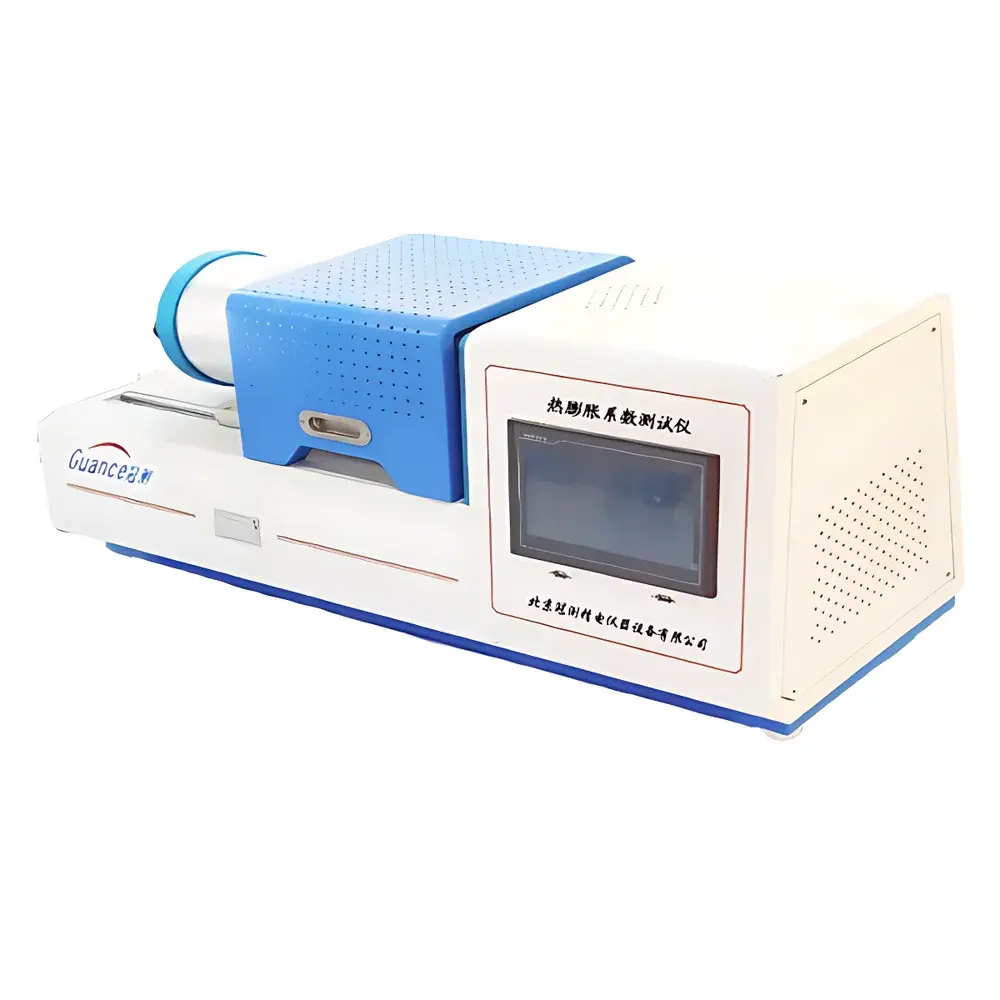
Guance Instruments GCRPZ-1000.2 High-Temperature Thermal Dilatometer
| Brand | Guance Instruments |
|---|---|
| Origin | Beijing, China |
| Manufacturer Type | Authorized Distributor |
| Country of Origin | China |
| Model | GCRPZ-1000.2 |
| Price | USD 1,700 (FOB) |
| Temperature Range | Ambient to 1000 °C |
| Heating Rate | 0.1–10 K/min (programmable) |
| Temperature Accuracy | ±1 °C |
| Sample Dimensions | Max. 50 mm length × 8 mm diameter |
| Measurement Range | ±5 mm |
| Resolution | 0.1 µm |
| Atmosphere Options | N₂, Ar, inert gas, vacuum (−0.1 MPa) |
| Sample Holder Material | Fused quartz |
| Power Supply | 220 V ±10%, 50 Hz |
| Cooling Requirement | External water chiller (max. 100 °C inlet, ≤2 kW heating power) |
Overview
The Guance Instruments GCRPZ-1000.2 High-Temperature Thermal Dilatometer is a precision-engineered instrument designed for the quantitative measurement of linear thermal expansion and contraction behavior of solid materials under controlled temperature profiles. Based on the principle of contact-based displacement sensing—using a high-stability optical grating transducer coupled with a fused quartz pushrod—the system delivers traceable, repeatable dimensional change data across a continuous temperature range from ambient to 1000 °C. The furnace employs dual-zone resistive heating elements with intelligent PID regulation, enabling stable thermal gradients and programmable ramp rates between 0.1 and 10 K/min. Its modular architecture supports both standalone operation via embedded controller and full PC-integrated automation, ensuring compliance with laboratory workflows requiring audit-ready data integrity and process reproducibility.
Key Features
- Optical grating displacement sensor with 0.1 µm resolution and ±5 mm full-scale range, calibrated against NIST-traceable standards
- Dual-zone furnace with independent thermocouple feedback (Type K), achieving ±1 °C temperature accuracy across the full operating range
- Programmable heating/cooling profiles with ramp rate control from 0.1 to 10 K/min; standard testing conducted at ≤5 K/min for optimal thermal equilibrium
- Fused quartz sample holder and pushrod assembly, minimizing parasitic expansion and ensuring mechanical stability up to 1000 °C
- Atmosphere control capability: compatible with inert gas purging (N₂, Ar), vacuum operation (down to −0.1 MPa), and sealed ambient testing
- Embedded real-time controller enables unattended operation; optional USB/RS-232 interface for PC synchronization and remote parameter adjustment
- Integrated water-cooled base plate with external chiller support (inlet ≤100 °C), maintaining thermal isolation between furnace and measurement head
Sample Compatibility & Compliance
The GCRPZ-1000.2 accommodates cylindrical solid specimens up to 50 mm in length and 8 mm in diameter—including sintered ceramics, graphite electrodes, metallic alloys, oxide glasses, refractory bricks, carbon-fiber composites, and polymer-derived ceramics. All sample contact components are fabricated from high-purity fused quartz to eliminate interfacial thermal drift. The system conforms to ASTM E228, ISO 11359-1/-2, and GB/T 4339–2008 for coefficient of linear expansion (CTE) determination, as well as GB/T 3074.4–2016 for graphite electrode characterization. Data acquisition meets GLP documentation requirements, with timestamped raw displacement and temperature logs stored in CSV-compatible format for traceability.
Software & Data Management
The instrument operates under Windows-based software featuring intuitive graphical configuration of test protocols, real-time curve overlay, and automated CTE calculation per ASTM E228 Annex A1. Software modules support multi-step thermal cycles (heating–hold–cooling–reheat), derivative analysis (dL/dT), inflection point detection (e.g., glass transition, phase transformation), and comparative batch reporting. All user actions—including parameter edits, calibration events, and file exports—are logged with operator ID and timestamp. Export formats include CSV, XLSX, and PDF reports with embedded metadata (test ID, instrument serial number, calibration date). Optional 21 CFR Part 11 compliance package available upon request, including electronic signatures, audit trail encryption, and role-based access control.
Applications
This dilatometer is routinely deployed in R&D laboratories and quality control environments for evaluating thermal dimensional stability during material development and process validation. Typical use cases include: determination of average and instantaneous CTE over defined temperature intervals; identification of softening points in glass and glazes; detection of crystallization exotherms or polymorphic transitions in ceramics; monitoring of sintering kinetics (RCS—Rate-Controlled Sintering); assessment of thermal mismatch stresses in multilayer ceramic packages; and validation of thermal cycling reliability in aerospace-grade composites. It supports method development aligned with ISO 11359-2 for dynamic dilatometry and ASTM C372 for refractory materials.
FAQ
What standards does the GCRPZ-1000.2 comply with for CTE measurement?
It adheres to ASTM E228, ISO 11359-1/-2, GB/T 4339–2008, and GB/T 3074.4–2016 for graphite-specific applications.
Can the system operate under vacuum or reactive atmospheres?
Yes—it supports vacuum down to −0.1 MPa and inert gas purging (N₂, Ar) via standardized flange-mounted gas inlets.
Is the displacement sensor calibrated, and what is its long-term stability?
The optical grating transducer is factory-calibrated with documented uncertainty; drift is <0.05 µm/month under routine maintenance conditions.
Does the software support automated CTE calculation and report generation?
Yes—CTE is computed automatically using least-squares linear regression over user-defined temperature ranges, with customizable report templates and export options.
What sample preparation requirements apply?
Specimens must be cylindrical, parallel-ended, and free of surface defects; recommended aspect ratio is ≥3:1 (length:diameter) to minimize end-effect errors.



