
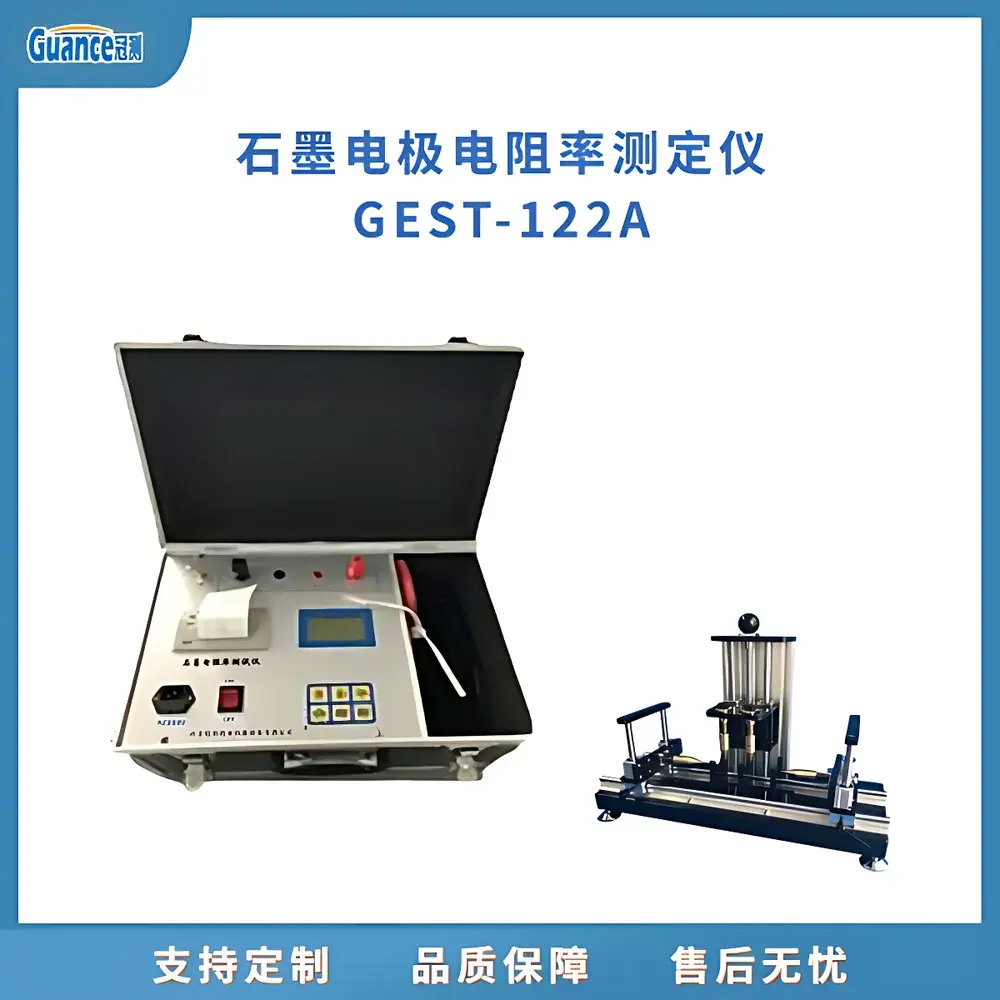
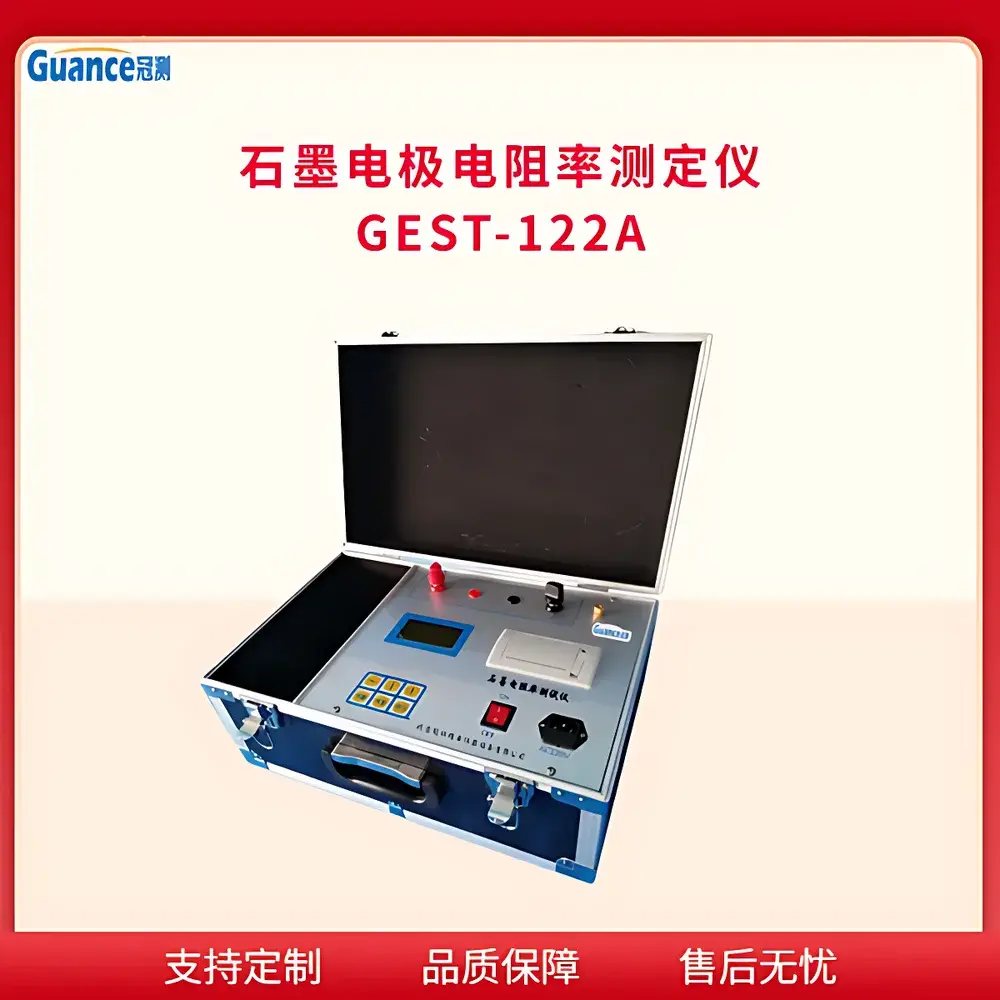
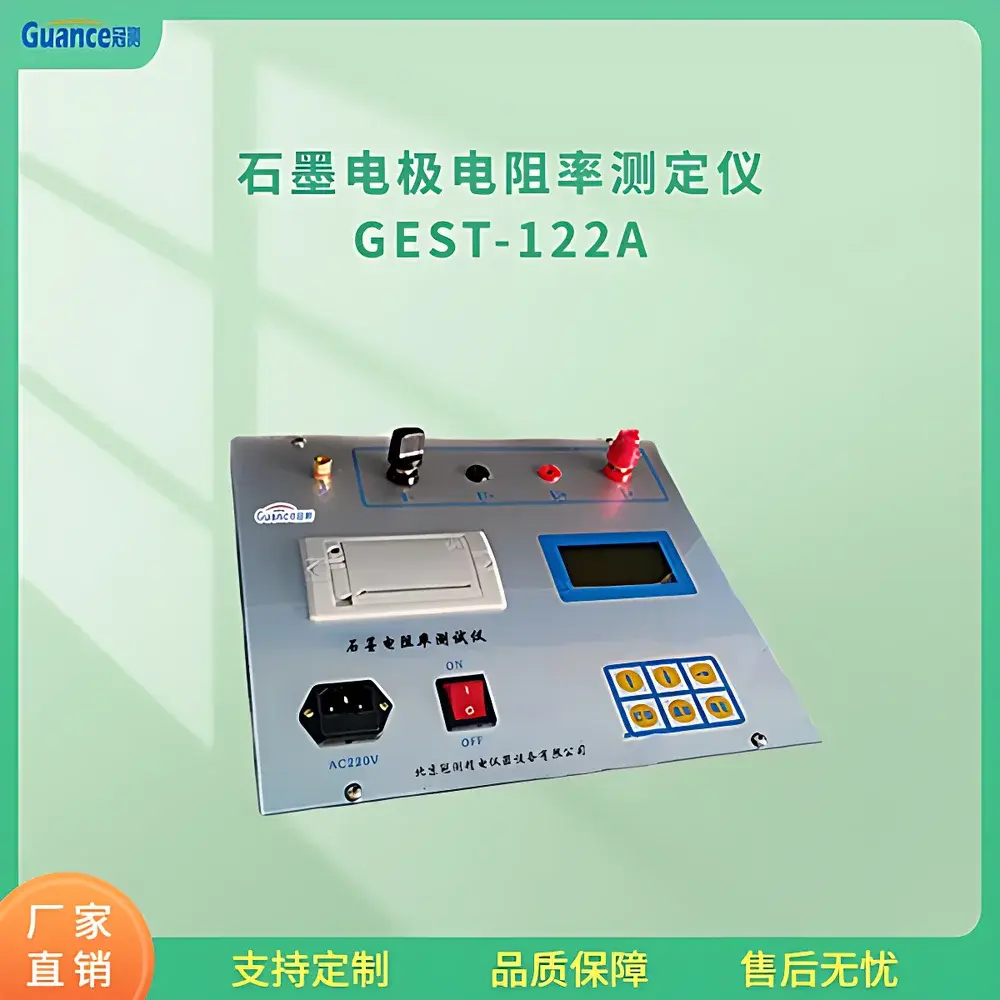
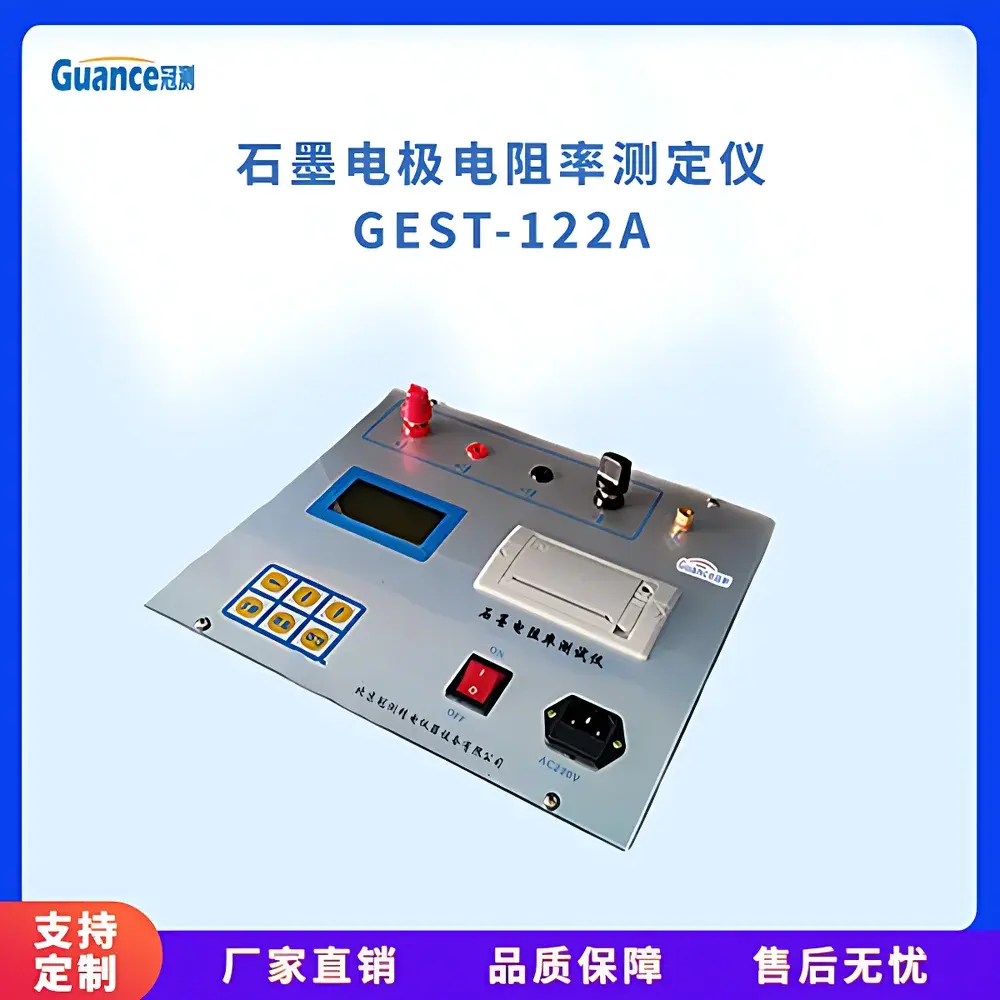
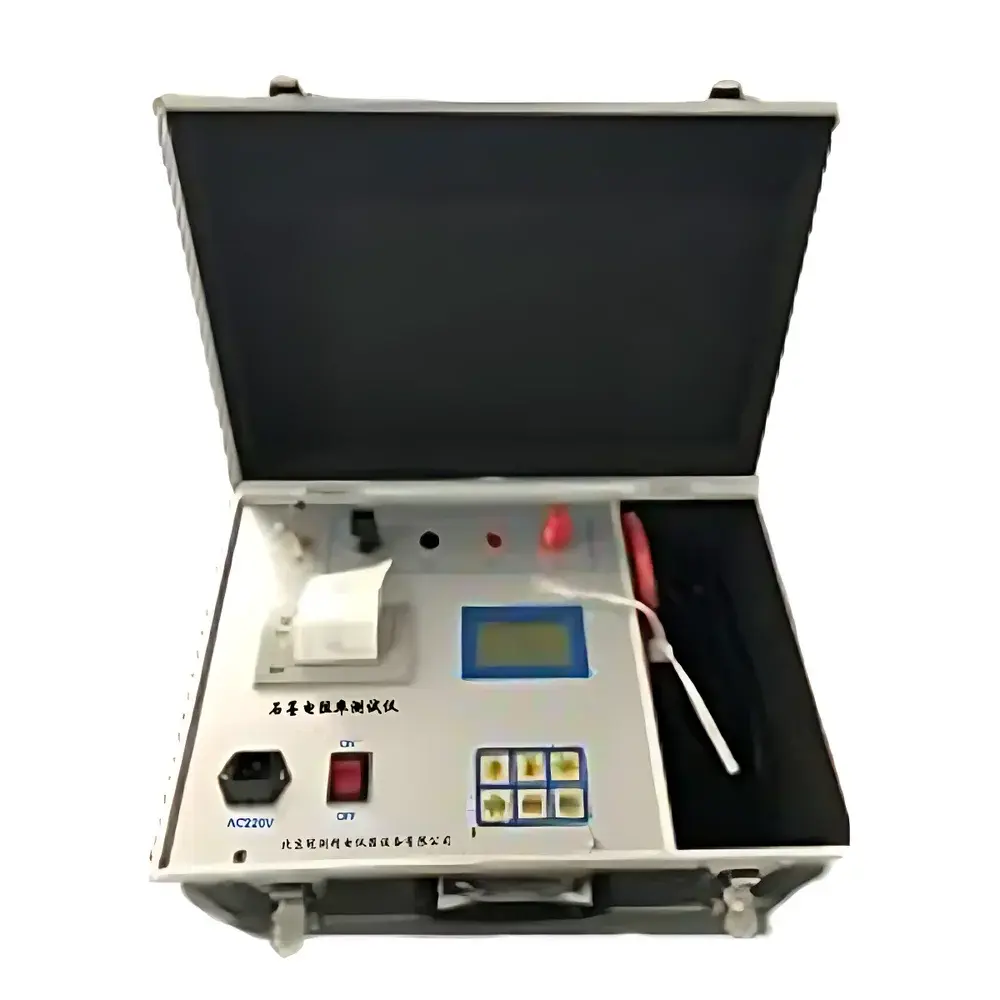
GuanCe GEST-122A Portable Graphite Electrode Resistivity Tester
| Brand | GuanCe Instruments |
|---|---|
| Origin | Beijing, China |
| Manufacturer Type | Authorized Distributor |
| Origin Category | Domestic (China) |
| Model | GEST-122A |
| Output Current | 35 A |
| Resistance Measurement Range | 0.2 µΩ to 200 mΩ |
| Resolution | 0.1 µΩ |
| Accuracy Class | 0.5 |
| Operating Temperature | −10 °C to +50 °C |
| Operating Humidity | 0–80 % RH (non-condensing) |
| Power Supply | AC 220 V ±10 %, 50 Hz ±1 Hz |
| Weight | 4 kg |
Overview
The GuanCe GEST-122A Portable Graphite Electrode Resistivity Tester is a micro-ohmmeter engineered for high-precision, direct-current (DC) four-terminal resistance and resistivity measurements of graphite electrodes used in electric arc furnaces, aluminum smelting, and silicon carbide production. Based on the Kelvin (four-wire) measurement principle, the instrument eliminates lead and contact resistance errors by separating current excitation and voltage sensing paths—ensuring traceable accuracy under field or laboratory conditions. Designed to comply with ASTM D4292 (Standard Test Method for Resistivity of Carbon and Graphite Materials), ISO 11713:2016 (Carbonaceous materials — Determination of electrical resistivity of graphitized carbon and graphite), and Chinese national standards GB/T 24525–2009 and GB/T 24521–2009, the GEST-122A delivers repeatable, low-resistance characterization essential for quality control in electrode manufacturing, incoming material inspection, and process validation.
Key Features
- High-current DC excitation up to 35 A enables stable measurement of ultra-low resistances down to 0.2 µΩ—critical for evaluating bulk conductivity of large-diameter graphite electrodes (e.g., Ø300–700 mm).
- Integrated microprocessor-controlled timing and auto-zero compensation minimize thermal EMF drift and thermoelectric noise during multi-point testing.
- Backlit LCD display with dual-unit readout (µΩ/mΩ and Ω·cm after geometric correction) supports real-time resistivity calculation using pre-configured cross-sectional area and length inputs.
- Portable architecture (4 kg net weight) with ruggedized ABS housing, integrated handle, and reinforced test leads allows operation in foundry floors, warehouse loading docks, or mobile QC labs without external cooling or vibration isolation.
- Compliance with IEC 61000-4-30 Class S power quality requirements ensures stable performance under fluctuating industrial AC supply (220 V ±10 %, 50 Hz ±1 Hz).
Sample Compatibility & Compliance
The GEST-122A is optimized for solid cylindrical or rectangular graphite electrodes ranging from 100 mm to 800 mm in length and up to 750 mm in diameter. It accommodates standard electrode geometries per ISO 8006-1 and YB/T 120–1997, including nipple-threaded and plain-end configurations. Contact force is maintained via spring-loaded copper alloy probes with gold-plated tips (included), ensuring consistent surface penetration and minimizing oxide-layer interference. All measurement protocols align with GLP documentation requirements: timestamped results include operator ID, sample ID, ambient temperature/humidity, and calibration certificate traceability (NIST-traceable shunt resistor optional). The system meets electromagnetic compatibility (EMC) requirements per GB/T 18268.1–2010 (IEC 61326-1) for industrial environments.
Software & Data Management
While the GEST-122A operates as a standalone instrument, its RS-232 serial interface supports bidirectional communication with Windows-based data acquisition software (optional). Exported CSV files contain raw resistance values, calculated resistivity (ρ = R × A / L), test duration, and environmental metadata—structured for import into LIMS platforms compliant with FDA 21 CFR Part 11 (audit trail, electronic signature, and data integrity controls available via licensed software module). Firmware updates preserve backward compatibility and include enhanced temperature compensation algorithms calibrated across the full −10 °C to +50 °C operating range.
Applications
- Quality assurance of monolithic graphite electrodes prior to furnace installation in steelmaking and ferroalloy production.
- In-process verification of graphitization uniformity in rotary kiln or Acheson furnace batches.
- Comparative analysis of electrode aging effects—including oxidation-induced surface degradation and internal microcrack propagation—via longitudinal resistivity profiling.
- Supplier qualification testing per ISO/IEC 17025-accredited laboratories conducting third-party certification of electrode grade conformity (e.g., RP, HP, UHP classifications).
- Research applications in carbon material science, including correlation studies between resistivity, bulk density, and grain size distribution measured via SEM/EDS.
FAQ
What standards does the GEST-122A support for resistivity reporting?
It fully implements GB/T 24525–2009, GB/T 24521–2009, YB/T 120–1997, and is functionally aligned with ISO 11713:2016 and ASTM D4292.
Can the instrument measure resistivity directly—or only resistance?
It calculates volume resistivity (Ω·cm) in real time when users input sample geometry; raw resistance (µΩ) is always displayed and logged.
Is calibration required before each use?
No—factory calibration is retained for 12 months; however, daily zero-check using the shorting bar is recommended per ISO/IEC 17025 clause 7.7.
Does it support automated temperature compensation?
Yes—the built-in thermistor monitors ambient temperature and applies linear α-coefficient correction (default α = 0.0005 /°C for graphite) unless overridden manually.
What safety certifications apply to field deployment?
It carries CE marking per EN 61010-1:2010 (Measurement Category II, Pollution Degree 2) and meets IP20 ingress protection for indoor industrial use.



