
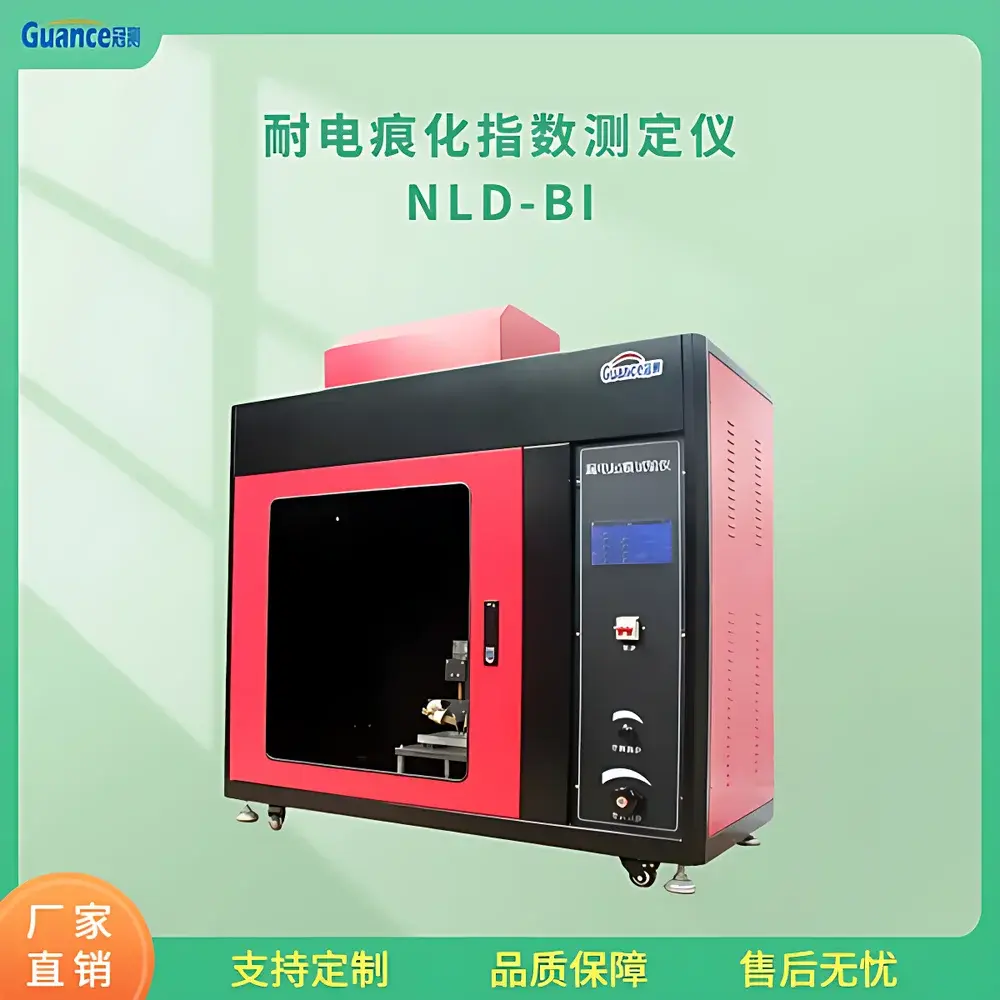
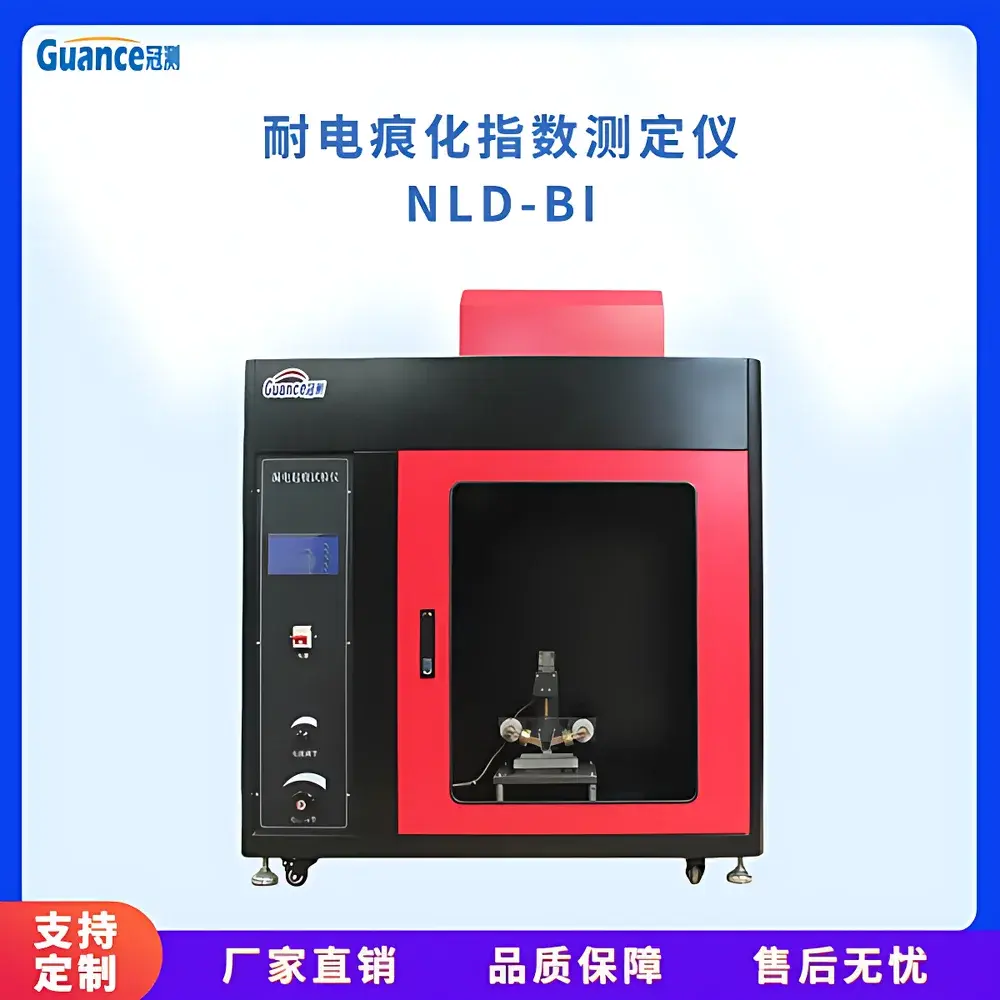
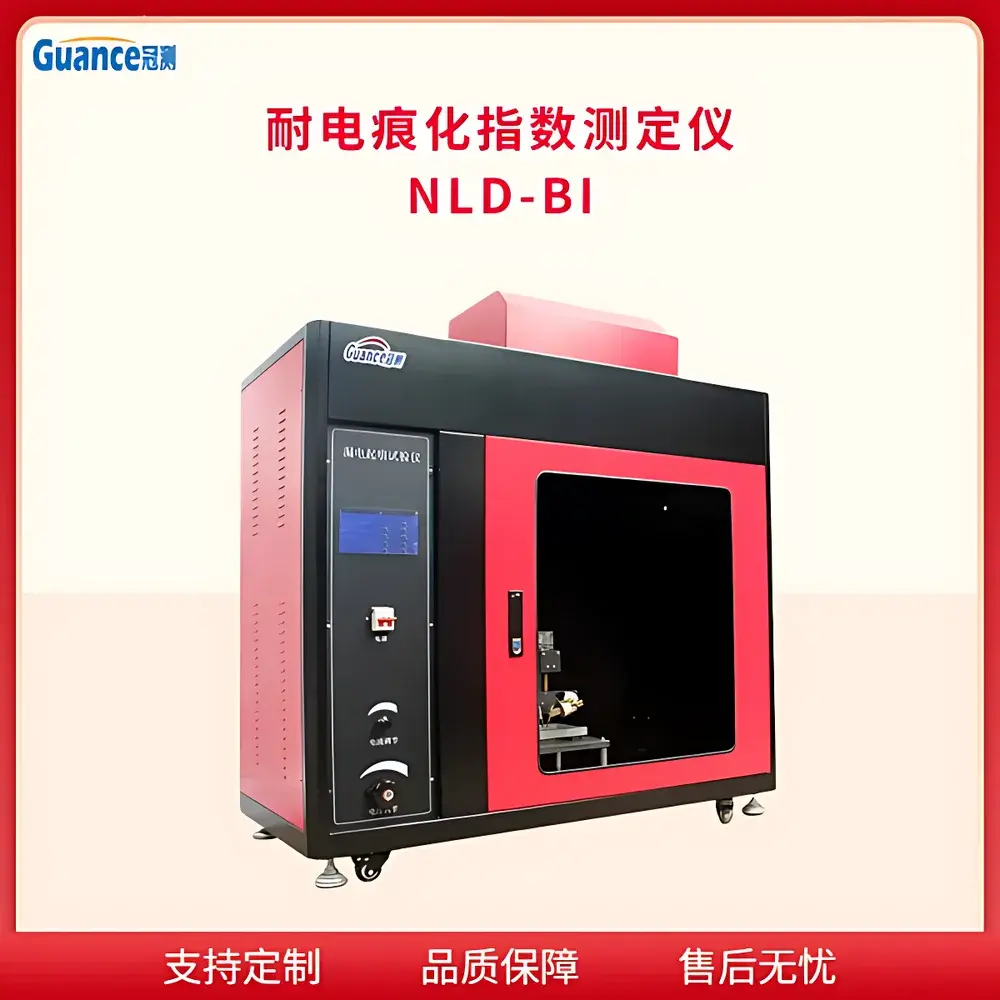
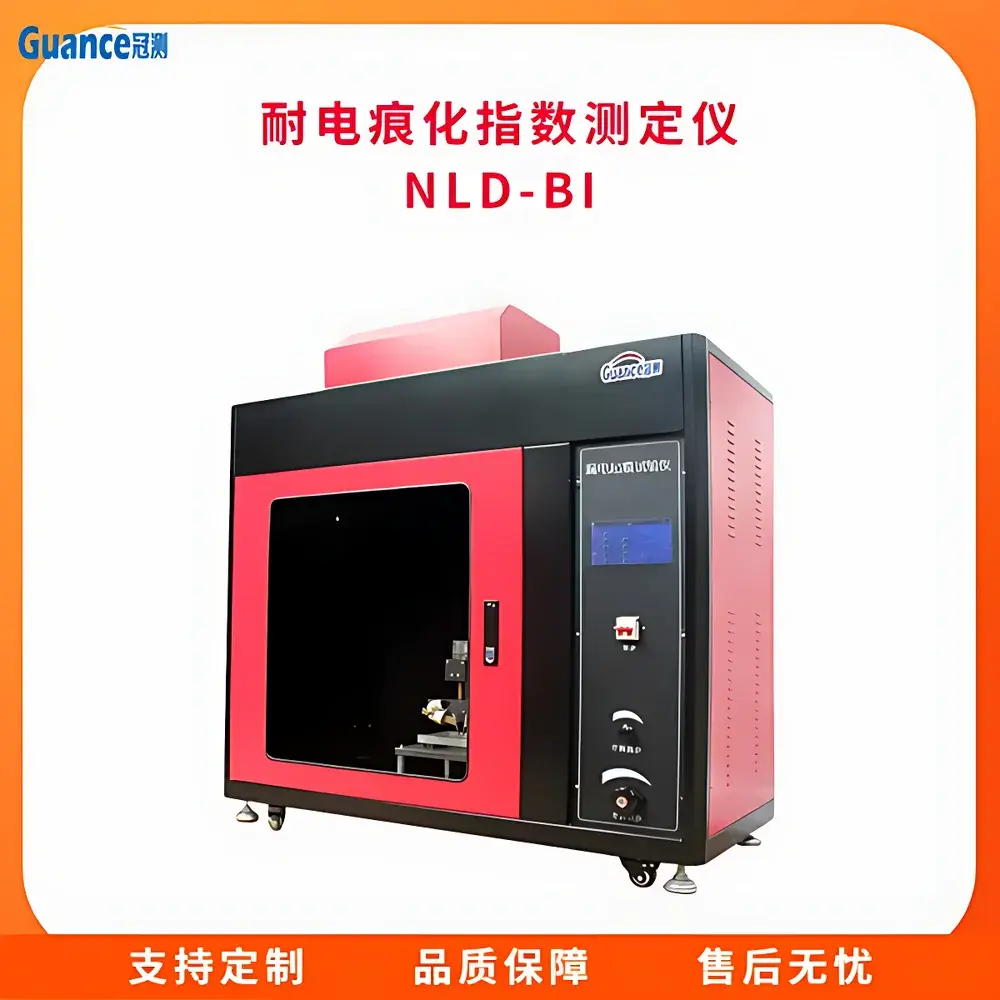
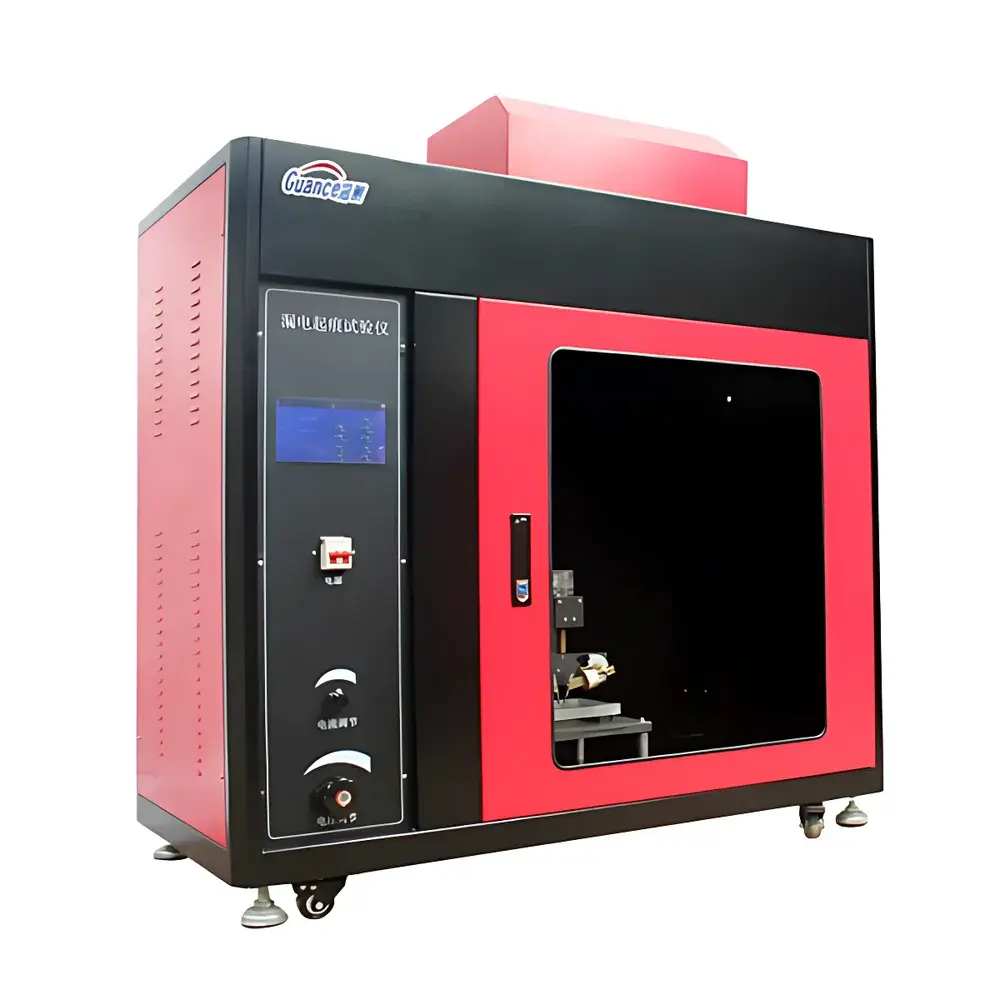
Guance Instruments NLD-BI6 Universal Tracking Resistance Tester
| Brand | Guance Instruments |
|---|---|
| Origin | Beijing, China |
| Manufacturer Type | Authorized Distributor |
| Product Type | Electronic Universal Testing Machine |
| Model | NLD-BI6 |
| Voltage Range | 100–600 V AC (48–60 Hz) |
| Electrode Material | 99% Pure Platinum (tips), Copper (electrode rods) |
| Electrode Dimensions | (2.0 ± 0.1) mm × (5.0 ± 0.1) mm × (40 ± 5) mm |
| Electrode Tip Geometry | 12 mm length, 30° ± 2° bevel |
| Electrode Spacing | 4.00 ± 0.01 mm, included angle 60° ± 5° |
| Electrode Force | 1.00 ± 0.01 N |
| Test Solution Resistivity | Solution A: 3.95 ± 0.05 Ω·m (0.1% NH₄Cl) |
| Solution B | 1.98 ± 0.05 Ω·m |
| Droplet Height | 35 ± 5 mm (adjustable) |
| Droplet Interval | 30.00 ± 0.01 s (digital presettable) |
| 50-droplet duration | 24.5 ± 2 min |
| Droplet Count Range | 1–9999 (digital display & preset) |
| Airflow Velocity | 0.2 m/s (per IEC 60695-11-5) |
| Short-Circuit Current Threshold | 0.50 A ± 10%, sustained for 2.00 ± 0.2 s |
| Voltage Drop Limit | ≤8% at 1.0 A ± 0.1 A |
| Power Supply | 220 V, 0.6 kVA, 50–60 Hz |
| Test Chamber Volume | >0.5 m³ (L×W×H ≈ 900 × 590 × 1050 mm) |
| Operating Environment | 0–40 °C, RH ≤80%, non-corrosive, low-vibration |
| Compliance | GB/T 4207–2003, IEC 60695-11-5, IEC 60695-11-10 |
Overview
The Guance Instruments NLD-BI6 Universal Tracking Resistance Tester is an engineered solution for evaluating the comparative tracking index (CTI) and proof tracking index (PTI) of solid electrical insulating materials under controlled electrotchemical stress. Based on the principle of electrolytic surface tracking—where conductive liquid droplets bridge platinum electrodes under applied AC voltage—the instrument quantifies material resistance to progressive carbonization, erosion, and eventual conductive path formation. This test method replicates real-world degradation mechanisms observed in high-humidity, contaminated environments (e.g., outdoor switchgear, EV battery enclosures, or industrial control housings). The NLD-BI6 strictly adheres to the electrodynamic boundary conditions defined in IEC 60695-11-5 and GB/T 4207–2003, enabling standardized determination of CTI/PTI values used in insulation coordination, safety certification (e.g., UL 746A, EN 60695), and material qualification for Class II equipment per IEC 61000-4-11. Its architecture integrates metrological traceability with operational repeatability, supporting both R&D validation and production-line quality assurance workflows.
Key Features
- Integrated 7-inch full-color HMI touchscreen with PLC-based control logic—enabling one-touch operation for voltage ramping, droplet initiation, airflow activation, lighting, and emergency stop.
- Real-time digital monitoring of critical parameters: applied voltage (100–600 V, 25 V increments), droplet count (1–9999), elapsed time, leakage current, chamber door status, and pass/fail outcome.
- Precision-machined platinum-tipped electrodes (99% purity) mounted on copper support rods; electrode geometry conforms exactly to IEC-specified dimensions and angular tolerances (30° ± 2° bevel, 4.00 ± 0.01 mm spacing, 60° ± 5° included angle).
- Automated, maintenance-free droplet dispensing system with adjustable height (35 ± 5 mm) and programmable interval (30.00 ± 0.01 s), eliminating manual calibration drift and operator-induced variability.
- Dual-stage safety interlock: (1) instantaneous relay cutoff upon detection of ≥0.50 A current sustained for ≥2.00 s; (2) mechanical door switch disabling high-voltage output when open.
- Quiet, backflow-prevented exhaust system (Ø100 mm duct) with regulated airflow (0.2 m/s) meeting updated IEC 60695-11-5 environmental requirements for consistent thermal and vapor removal during combustion events.
- Test chamber constructed with non-reflective black interior (illuminance ≤20 lux), volume >0.5 m³, and corrosion-resistant stainless steel structure—ensuring optical fidelity for visual tracking assessment and compliance with background contrast standards.
Sample Compatibility & Compliance
The NLD-BI6 accommodates flat, rigid specimens up to 15 mm thick and 100 mm × 100 mm in planar dimension. It supports both standardized test solutions (NH₄Cl-based Solution A and Solution B) with certified resistivity ranges (3.95 ± 0.05 Ω·m and 1.98 ± 0.05 Ω·m, respectively). All mechanical and electrical performance criteria—including electrode force (1.00 ± 0.01 N), voltage regulation stability (<8% drop at 1.0 A), and timing accuracy (±0.01 s)—are verified against IEC 60695-11-10 Annex A metrological requirements. The system satisfies audit-ready documentation needs for GLP-compliant laboratories and supports traceable calibration via supplied stainless-steel gauge blocks and certified platinum electrodes. It is routinely deployed in third-party testing labs accredited to ISO/IEC 17025 for electrical safety certification of polymeric insulators, PCB substrates, and molded connectors.
Software & Data Management
No external PC or proprietary software is required: all test protocols, parameter presets, and result logs are stored internally on the embedded HMI’s non-volatile memory (≥10,000 test records). Each entry includes timestamp, voltage setpoint, droplet count at failure, observed failure mode (tracking, erosion, ignition), and operator ID. Data export is supported via USB flash drive in CSV format for integration into LIMS or statistical process control (SPC) platforms. Audit trails comply with FDA 21 CFR Part 11 principles—user authentication, electronic signatures, and immutable record retention are enforced at firmware level. No cloud connectivity or remote access functionality is implemented, preserving data sovereignty and network isolation per industrial cybersecurity best practices.
Applications
- CTI/PTI classification of thermoplastics (e.g., PBT, PA66-GF, PPS) and thermosets (e.g., epoxy molding compounds, phenolics) for UL recognition and IEC 60664-1 insulation coordination.
- Comparative evaluation of flame-retardant additives (e.g., phosphinates, melamine cyanurate) on tracking resistance without compromising mechanical performance.
- Quality conformance testing of injection-molded housings, terminal blocks, and busbar supports in renewable energy inverters and EV power distribution units.
- Failure analysis of field-failed insulators where surface contamination and moisture ingress are suspected root causes.
- Material screening during polymer formulation development—correlating filler dispersion homogeneity, surface hydrophobicity, and CTI performance.
FAQ
What standards does the NLD-BI6 fully support?
It implements IEC 60695-11-5 (method for determining CTI/PTI), IEC 60695-11-10 (requirements for test apparatus), and GB/T 4207–2003 (Chinese national standard equivalent). It also meets ancillary requirements of UL 746A, EN 60695-11-1, and ISO 23807 for tracking resistance instrumentation.
Can the instrument automatically determine CTI value?
No—CTI is a derived material property calculated from multiple tests at decreasing voltages per IEC 60695-11-5 Section 9. The NLD-BI6 provides all necessary raw data (voltage, droplet count to failure, failure mode) but requires post-test analysis per standard-defined interpolation rules.
Is calibration documentation provided with shipment?
Yes—each unit ships with a factory calibration certificate covering electrode geometry verification, voltage output accuracy (±1% of reading), timer deviation (<±0.01 s), and current threshold validation, traceable to CNAS-accredited reference standards.
What maintenance is required for long-term reliability?
Annual verification of electrode tip geometry using supplied stainless-steel gauges; periodic cleaning of platinum surfaces with analytical-grade ethanol; replacement of droplet needles every 500 tests or if clogging occurs; no lubrication or internal component servicing is needed.
Does the system support custom test sequences beyond IEC protocols?
Yes—the HMI allows user-defined voltage ramps, variable droplet intervals, and conditional termination logic (e.g., stop after 1000 drops regardless of failure), enabling research-mode investigations into non-standard aging mechanisms.



