
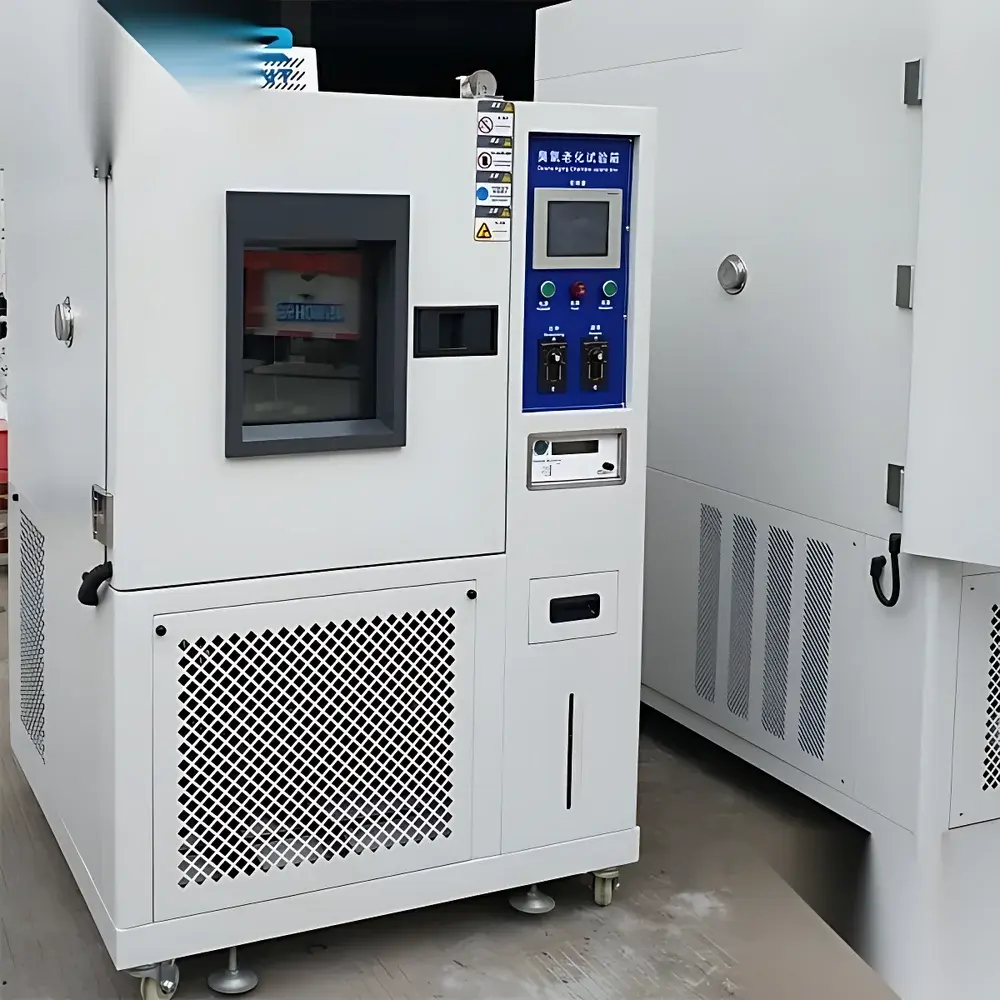
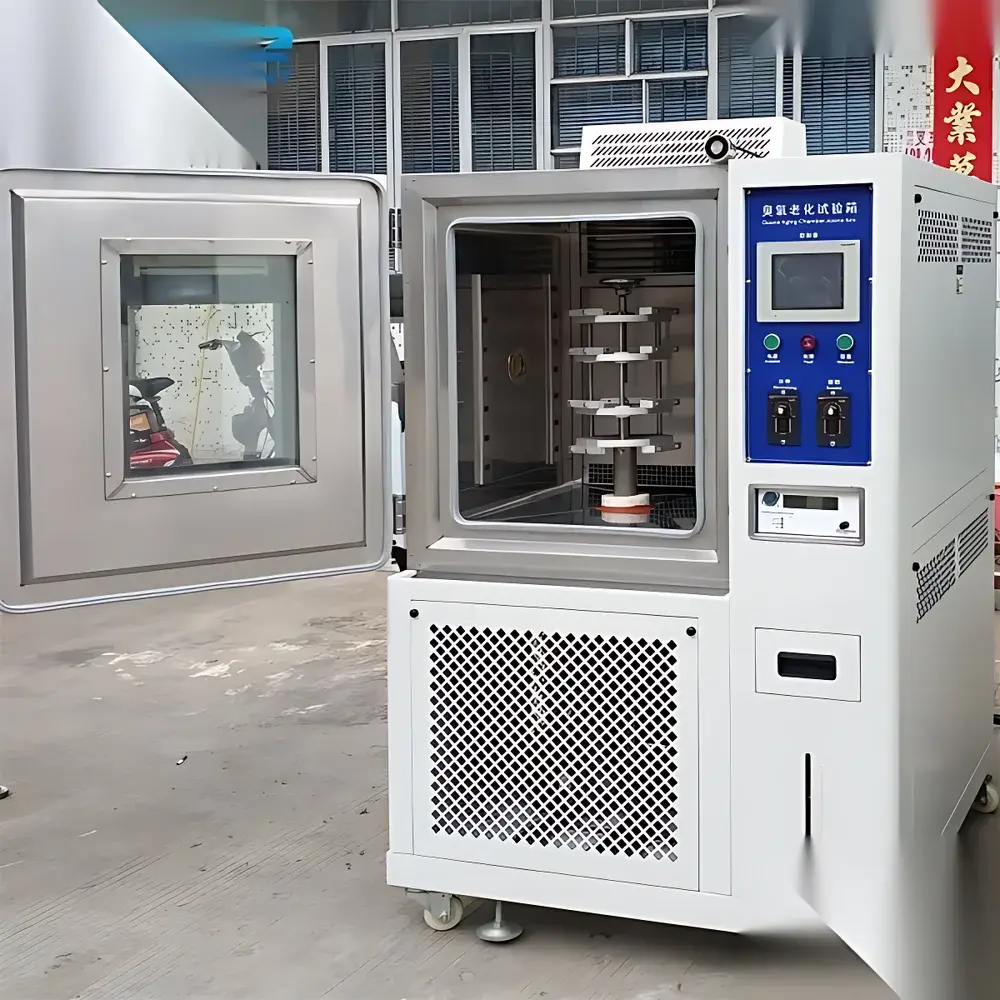
OK-QY-100 Ozone Aging Test Chamber
| Brand | OEM |
|---|---|
| Origin | Imported |
| Manufacturer Type | Authorized Distributor |
| Model | OK-QY-100 |
| Price | USD 6,300 (FOB) |
| Temperature Range | 25–40 °C |
| Humidity Range | 30–65 % RH |
| Ozone Concentration Range | 50–1500 pphm |
| Temperature Uniformity | ±0.5 °C |
| Sample Rack Rotation | 1 rpm (360° continuous) |
| Gas Flow Velocity | 8–16 mm/s |
| Control System | Siemens PLC + Weintek Color Touchscreen HMI |
| Ozone Generation | Silent Discharge Tube |
| Ozone Detection | Non-Dispersive UV Absorption Analyzer (≥5 yr lifespan) |
| Compliance | GB/T 7762–2003, GB/T 2951.21–2008, GB/T 11206–2009, ISO 1431-1:2004 |
Overview
The OK-QY-100 Ozone Aging Test Chamber is an engineered environmental test system designed to evaluate the ozone resistance of elastomeric materials—particularly natural rubber, SBR, NBR, CR, and EPDM compounds—under accelerated, controlled atmospheric conditions. Ozone-induced cracking remains a primary degradation mechanism in rubber components exposed to ambient air, especially under mechanical strain. This chamber replicates and intensifies real-world ozone exposure using silent discharge ozone generation and non-dispersive ultraviolet (UV) absorption measurement, enabling precise, repeatable aging studies in accordance with internationally recognized standards. Unlike general-purpose climate chambers, the OK-QY-100 integrates a fully sealed, recirculating gas loop with dynamic or static sample mounting options, ensuring operator safety, measurement integrity, and metrological traceability. Its architecture supports both qualitative failure assessment and quantitative lifetime prediction through standardized exposure protocols.
Key Features
- Sealed stainless-steel test chamber compliant with ISO 1431-1:2004 structural requirements, minimizing ozone leakage and cross-contamination.
- Adjustable ozone concentration control from 50 to 1500 pphm (parts per hundred million), digitally regulated via PID auto-tuning algorithm for stable setpoint maintenance.
- Motor-driven rotating sample rack (1 rpm, 360° continuous rotation) engineered to produce cycloidal motion—enabling dynamic tensile stress application per ASTM D1149 and GB/T 7762 static/dynamic test modes.
- Integrated non-dispersive UV ozone analyzer with ≥5-year service life, providing real-time, drift-compensated concentration monitoring and 4–20 mA analog output for external data logging.
- Dual-parameter environmental control: independent regulation of temperature (25–40 °C, ±0.5 °C stability) and relative humidity (30–65 % RH) via Siemens S7-1200 PLC and Weintek MT8071iE color touchscreen HMI.
- Calibration-ready design featuring dedicated metrology ports for third-party verification of ozone concentration, temperature, and humidity sensors—fully compatible with GLP audit requirements.
- Safety-critical protection circuitry including overtemperature cutoff, motor thermal overload detection, ozone leak interlock, short-circuit/ground-fault interruption, and emergency power-off activation.
Sample Compatibility & Compliance
The OK-QY-100 accommodates standard dumbbell-shaped, ring, or strip specimens per ISO 1431-1, GB/T 7762, and ASTM D1149. Custom internal dimensions (e.g., 100 × 100 × 100 cm W×H×D for OK-QY-100 variant) allow testing of assembled automotive seals, cable jackets, or industrial hoses without disassembly. All critical subsystems—including ozone generation, distribution, sampling, and destruction—are fully enclosed within a leak-tested recirculation loop, eliminating ambient venting and meeting OSHA PEL (0.1 ppm) and EU Directive 2004/10/EC occupational exposure limits. The system complies with national and international test method standards for rubber aging evaluation, and its control architecture supports 21 CFR Part 11–compliant electronic records when paired with validated data acquisition software.
Software & Data Management
While the base unit operates via embedded PLC logic and local HMI, optional RS232/RS485 serial interfaces enable integration with laboratory information management systems (LIMS) or SCADA platforms. Time-stamped ozone concentration, temperature, humidity, and runtime data are logged internally with ≥30-day buffer memory. Export formats include CSV and Modbus TCP for traceable reporting. Firmware supports user-defined test profiles, multi-step ramp/soak sequences, and alarm-triggered automatic shutdown—critical for unattended overnight operation in QA/QC labs conducting long-duration validation runs (e.g., 96–168 hr exposure per USP <1031> guidance).
Applications
- Evaluation of antioxidant and antiozonant efficacy in rubber formulations during R&D screening.
- Comparative aging studies across compound variants for automotive tire sidewalls, engine mounts, and suspension bushings.
- Quality assurance testing of incoming raw materials and finished goods per IATF 16949 clause 8.6.5.
- Regulatory submission support for medical device elastomer components (ISO 10993-12) and aerospace sealing systems (SAE AMS3320).
- Root cause analysis of field failures linked to ozone embrittlement in outdoor infrastructure gaskets and solar panel encapsulants.
FAQ
What ozone concentration accuracy does the OK-QY-100 achieve?
The UV absorption sensor maintains ±5 pphm accuracy across the 50–1500 pphm range after factory calibration; annual recalibration is recommended using NIST-traceable ozone standards.
Can the chamber operate continuously for extended test durations?
Yes—the silent discharge ozone generator and sealed-loop architecture support uninterrupted 24/7 operation up to 500 hours, with automated thermal management preventing component fatigue.
Is dynamic testing (rotating sample rack) mandatory for compliance with ISO 1431-1?
No—ISO 1431-1 permits both static (unstressed) and dynamic (cycloidal strain) exposure modes; the OK-QY-100 supports either configuration via parameter selection in the HMI.
Does the system meet requirements for FDA-regulated environments?
The hardware meets mechanical and electrical safety standards (IEC 61000-6-2/6-4); full 21 CFR Part 11 compliance requires optional audit-trail-enabled software and documented IQ/OQ/PQ validation packages.
What maintenance intervals are recommended for the ozone generator and sensor?
Ozone tubes require replacement every 12,000 operating hours; UV lamp and optical cell cleaning every 6 months; full system calibration annually or after any major component service.



