
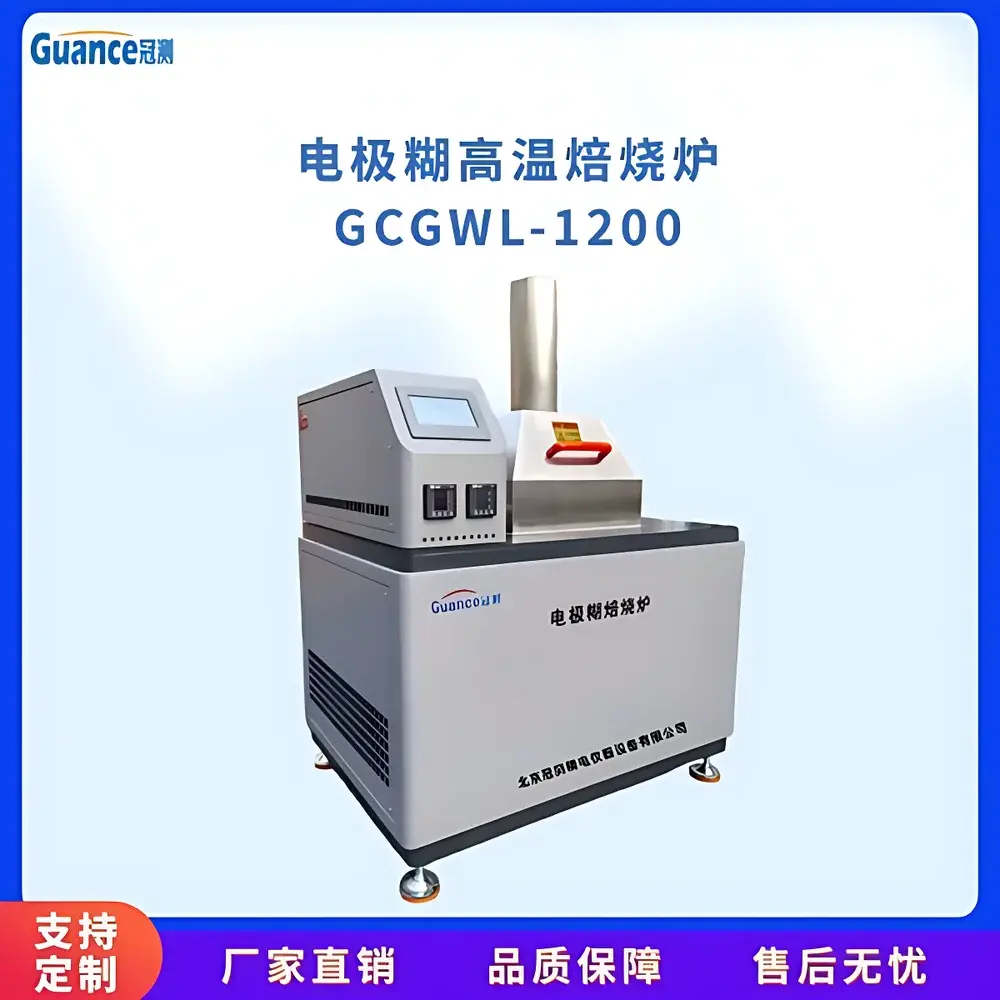
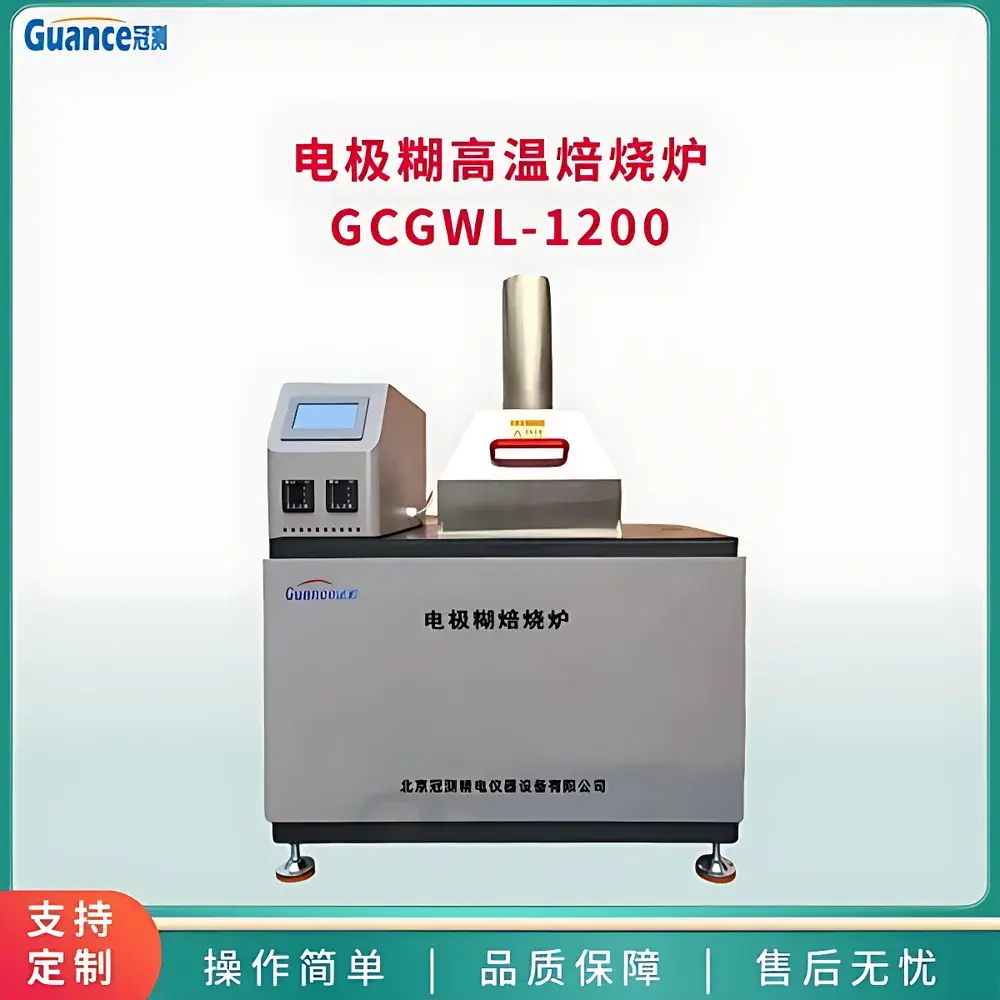
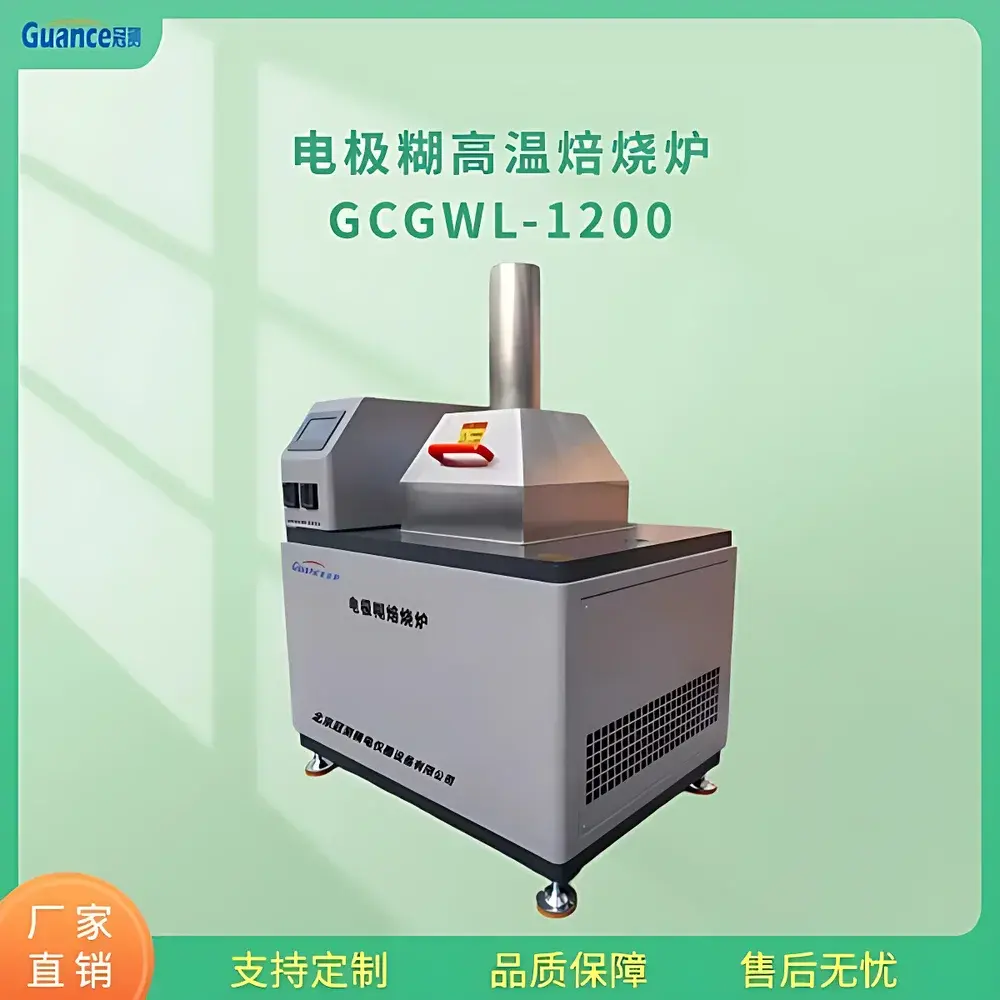
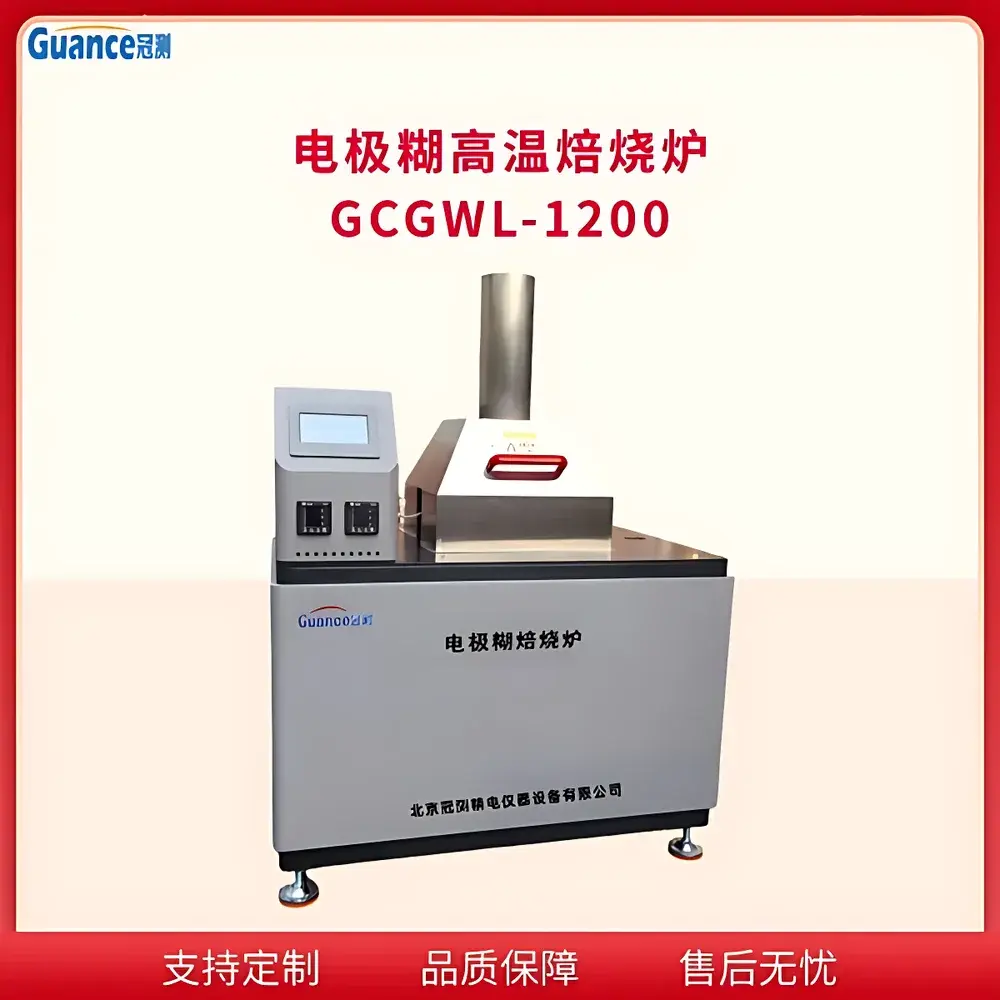
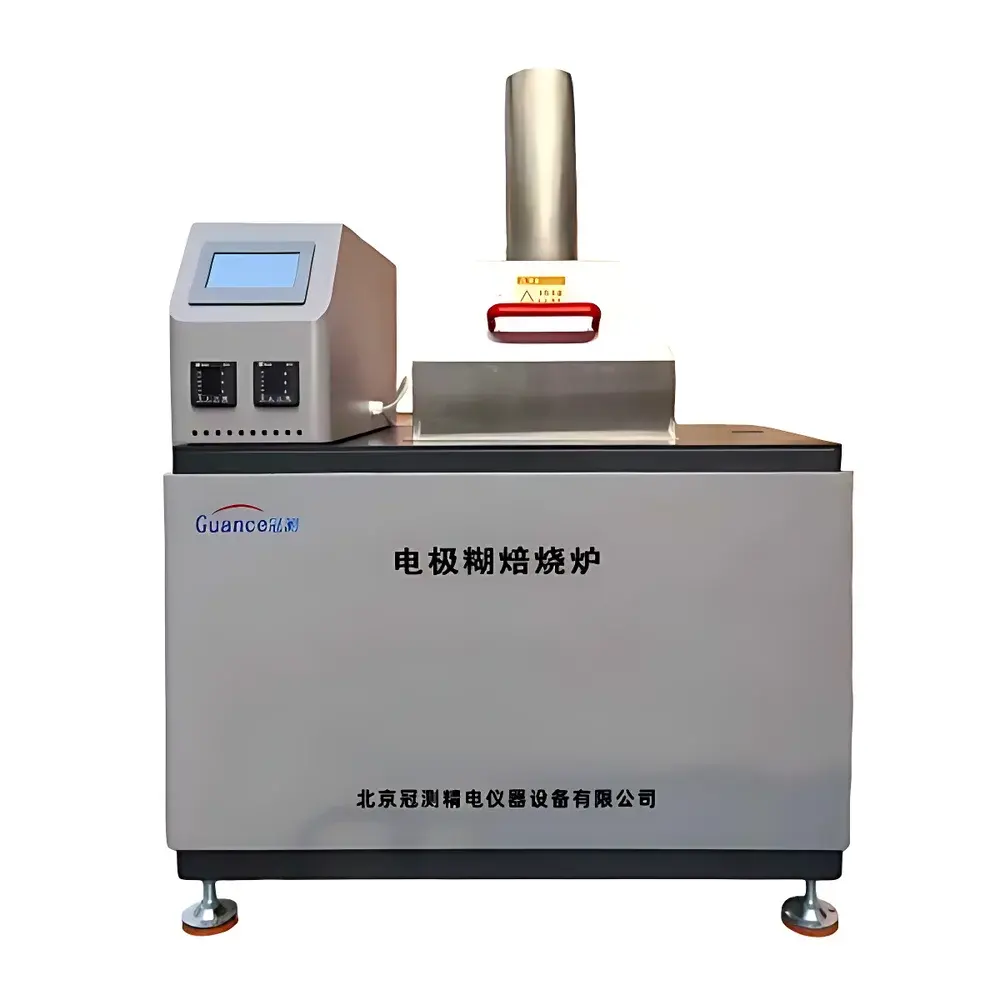
GuanCe GCGWL-1200 High-Temperature Calcination Furnace for Carbon Paste Sample Preparation
| Brand | GuanCe Instruments |
|---|---|
| Origin | Beijing, China |
| Manufacturer Type | Authorized Distributor |
| Country of Origin | China |
| Model | GCGWL-1200 |
| Quotation | Available Upon Request |
| Control Interface | Touchscreen with Multi-Stage Programmable Temperature Profile |
| Temperature Acquisition | Dual-channel (sample + furnace chamber) |
| Thermocouple | Type S (Platinum-Rhodium 10%–Platinum), Range: Ambient to 1600 °C, Length: 750 mm |
| Heating Rate | 50–300 °C/h |
| Operating Temperature Range | Ambient to 1250 °C |
| Long-Term Stable Operation | Up to 1200 °C |
| Temperature Uniformity & Stability | ±1 °C at setpoint |
| Heating Element | High-Purity Silicon Carbide (SiC) Rods |
| Chamber Dimensions (L×W×H) | 360 × 360 × 450 mm |
| External Dimensions (L×W×H) | 1200 × 880 × 1250 mm |
| Max. External Surface Temperature | ≤60 °C during operation |
| Power Supply | 3-phase AC 380 V, 50 Hz |
| Rated Power | 8 kW |
| Net Weight | 200 kg |
| Crucible | Iron crucible, OD 210 mm, ID 200 mm, wall thickness 5 mm, height 305 mm (1 pc) |
| Sample Cans | Smooth-gauge iron cans, two sizes — Ø55 × 400 mm and Ø80 × 400 mm, wall thickness 0.3–0.5 mm (20 pcs total) |
Overview
The GuanCe GCGWL-1200 is a precision-engineered high-temperature calcination furnace designed specifically for standardized sample preparation of carbon paste materials in accordance with YB/T 5054–2015, the Chinese industry standard for specimen preparation in carbonaceous material testing. It operates on the principle of controlled thermal decomposition under inert or ambient atmospheric conditions, enabling reproducible carbonization, binder volatilization, and structural densification critical to downstream physical property evaluation—including electrical resistivity, compressive strength, and bulk density measurements. The furnace features dual independent temperature acquisition channels—monitoring both the internal sample temperature and the furnace chamber ambient—ensuring accurate thermal profiling and preventing thermal overshoot during ramp-and-soak cycles. Its robust ceramic fiber insulation delivers rapid heating, low thermal mass, and minimal energy loss, while maintaining surface temperatures below 60 °C during continuous operation at 1200 °C—enhancing laboratory safety and reducing facility cooling loads.
Key Features
- Touchscreen-based human-machine interface (HMI) supporting up to 32 programmable temperature segments, each with individually adjustable ramp rates (50–300 °C/h), soak durations, and hold temperatures
- Dual-channel Type S platinum-rhodium thermocouples (ASTM E230-compliant) for simultaneous real-time measurement of sample core temperature and furnace cavity temperature
- High-stability silicon carbide (SiC) heating elements rated for continuous operation at 1200 °C, with proven longevity and resistance to thermal cycling fatigue
- Ceramic fiber chamber (density ~220 kg/m³) offering exceptional thermal insulation, uniform temperature distribution (<±3 °C across working zone), and low heat storage
- Integrated over-temperature protection circuitry with independent limit controller, automatically cutting power if furnace or sample temperature exceeds user-defined thresholds
- Structural design compliant with IEC 61000-6-2 (EMC immunity) and IEC 61000-6-4 (EMC emissions), suitable for shared analytical laboratory environments
Sample Compatibility & Compliance
The GCGWL-1200 is validated for use with carbon paste formulations containing pitch, coal tar, petroleum coke, graphite powder, and synthetic binders—materials commonly processed in electrode, anode, and refractory manufacturing. Its standardized iron crucibles and sample cans (supplied per YB/T 5054–2015 specifications) ensure dimensional repeatability and minimize edge effects during thermal treatment. The furnace supports GLP-aligned workflows: all temperature profiles, ramp parameters, and soak durations are logged with timestamped metadata. While not FDA 21 CFR Part 11-certified out-of-the-box, the system architecture permits integration with validated LIMS or ELN platforms via Modbus RTU/ASCII protocol for audit-trail-enabled data capture. Calibration procedures align with ISO/IEC 17025 requirements for thermal instrumentation, and thermocouple verification follows ASTM E220 practices using traceable reference standards.
Software & Data Management
The embedded control firmware records full thermal history—including ramp rate, actual vs. setpoint deviation, dwell time, and dual-channel temperature differentials—at user-configurable intervals (1–60 seconds). Data export is supported via USB 2.0 port in CSV format, compatible with Excel, MATLAB, and statistical process control (SPC) software. Optional RS-485 communication enables remote monitoring and centralized fleet management in multi-furnace labs. No proprietary software installation is required; raw logs contain no encryption or vendor lock-in. All parameter changes are logged with operator ID (if enabled via external authentication), date/time stamp, and reason-for-change field—supporting basic change control documentation per ISO 9001 Clause 8.5.6.
Applications
- Preparation of carbon paste specimens for resistivity testing (ASTM D3764, GB/T 24526)
- Thermal conditioning of green anodes prior to graphitization simulation
- Binder pyrolysis studies in metallurgical carbon research
- Calibration and validation of thermogravimetric analyzers (TGA) using reference carbon samples
- Quality control of batch-to-batch consistency in carbon composite manufacturing
- Development of low-volatility binder systems for high-temperature forming processes
FAQ
What standards does the GCGWL-1200 comply with for carbon paste preparation?
It is engineered to meet the procedural and dimensional requirements of YB/T 5054–2015 and supports test methods referenced in ASTM D3417 (heat of fusion), ASTM D5630 (ash content), and GB/T 24525 (carbon anode resistivity).
Can the furnace operate continuously at 1200 °C?
Yes—the SiC heating elements and ceramic fiber insulation are rated for uninterrupted operation at 1200 °C for periods exceeding 100 hours, provided ambient cooling airflow meets minimum 0.5 m/s requirements.
Is third-party calibration support available?
GuanCe provides NIST-traceable calibration certificates upon request; users may also engage ISO/IEC 17025-accredited calibration laboratories using the furnace’s accessible thermocouple terminals and documented uncertainty budget.
How is temperature uniformity verified across the chamber?
Uniformity mapping is performed per ASTM E2203 using a 9-point grid (3×3) at 1200 °C; typical results show ±2.5 °C deviation within the central 70% volume of the chamber.
Are replacement heating elements and ceramic fiber parts stocked internationally?
Standard SiC rods (14 mm Ø, 300 mm active length) and modular ceramic fiber linings are available through GuanCe’s global distributor network with lead times under 4 weeks.



