
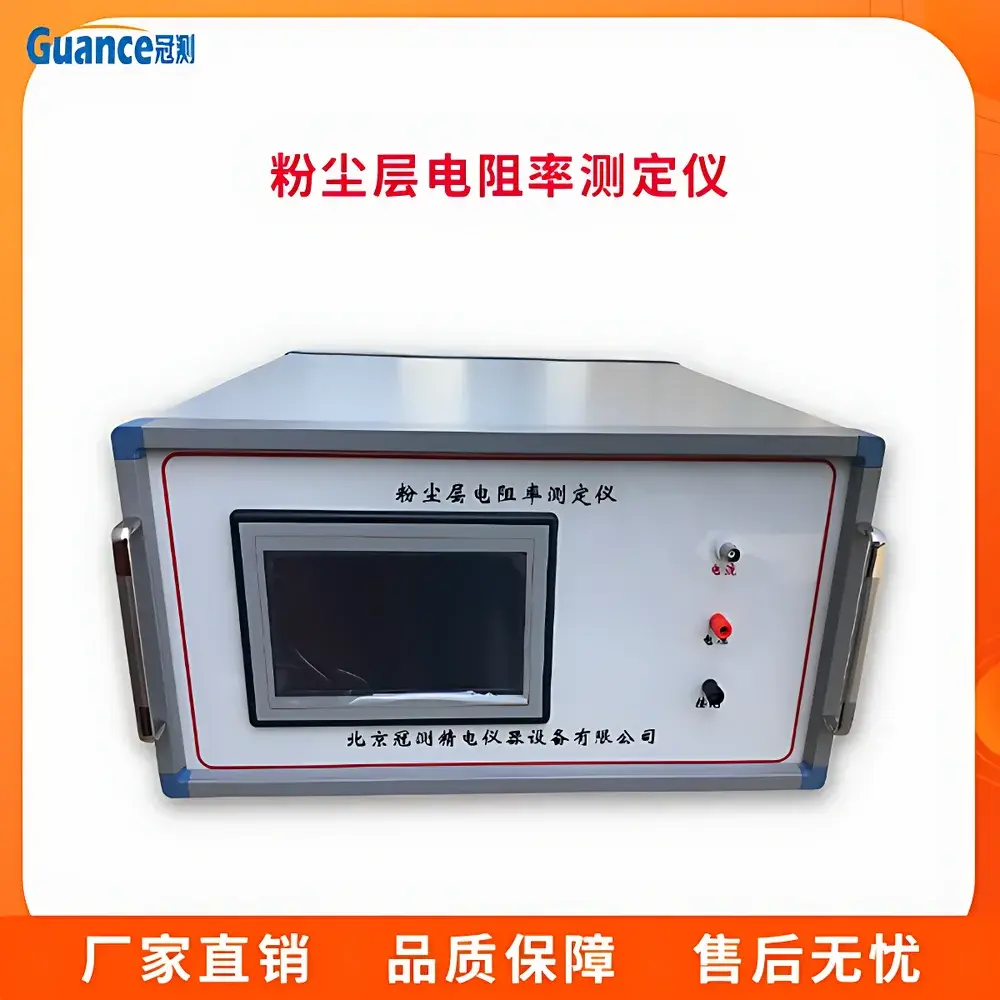
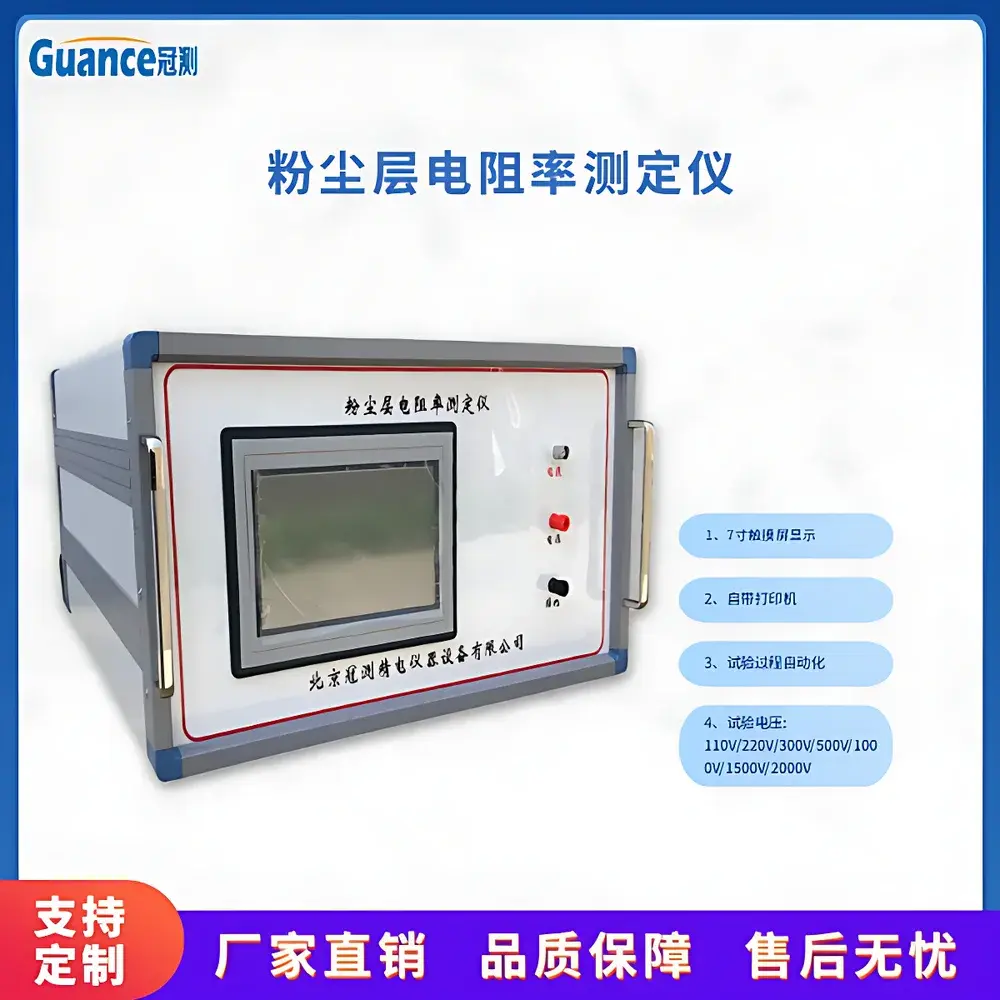
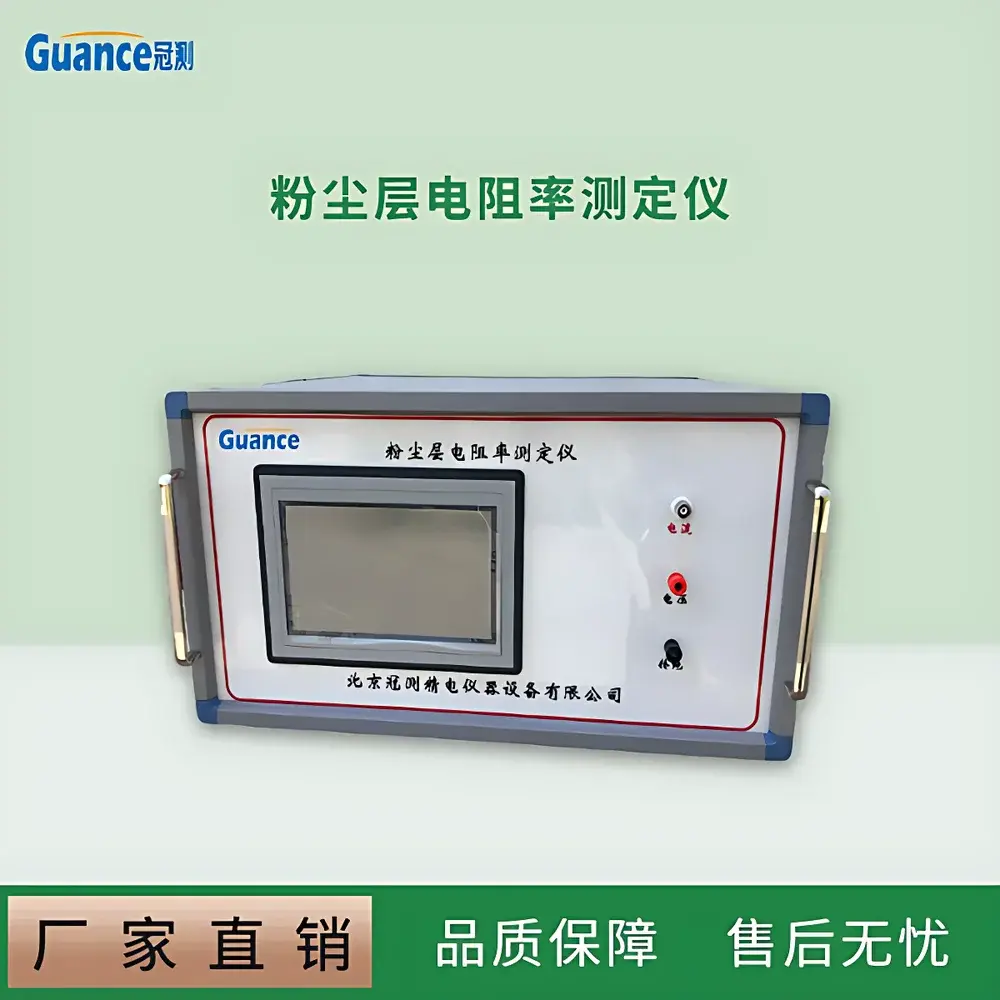
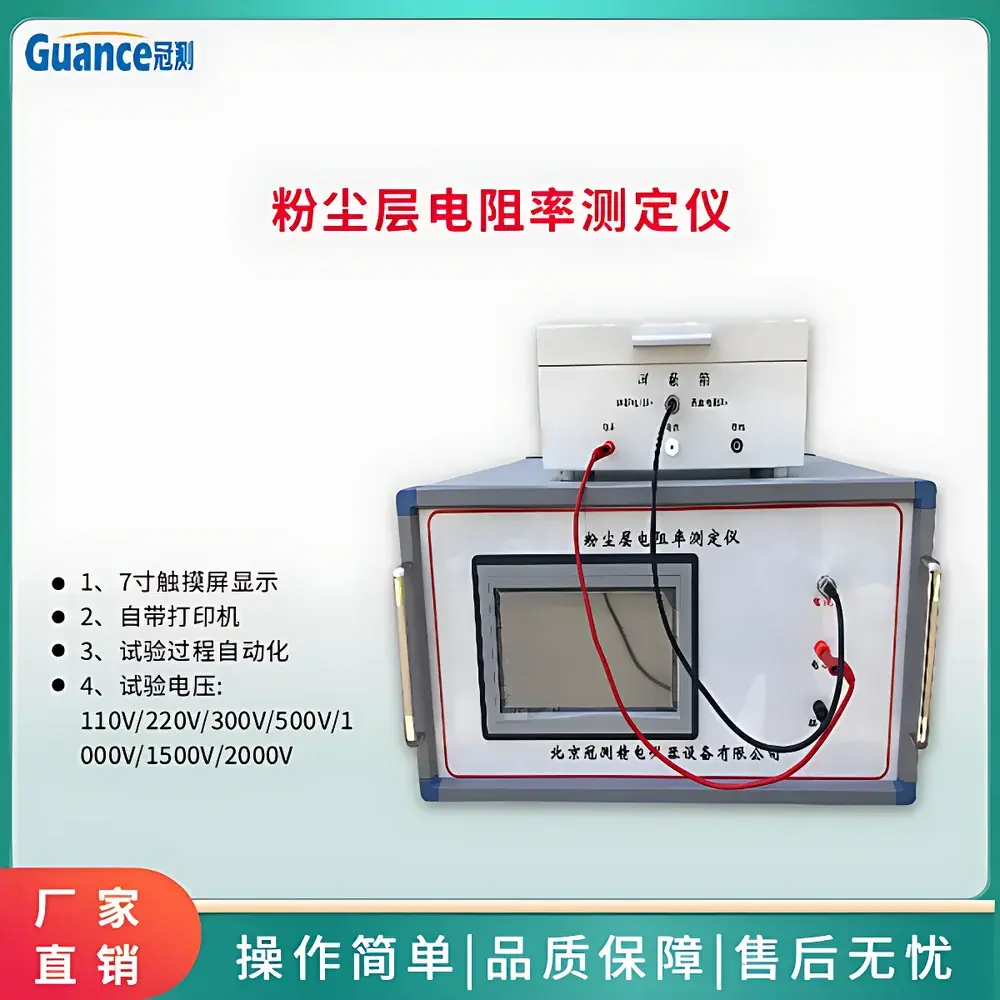
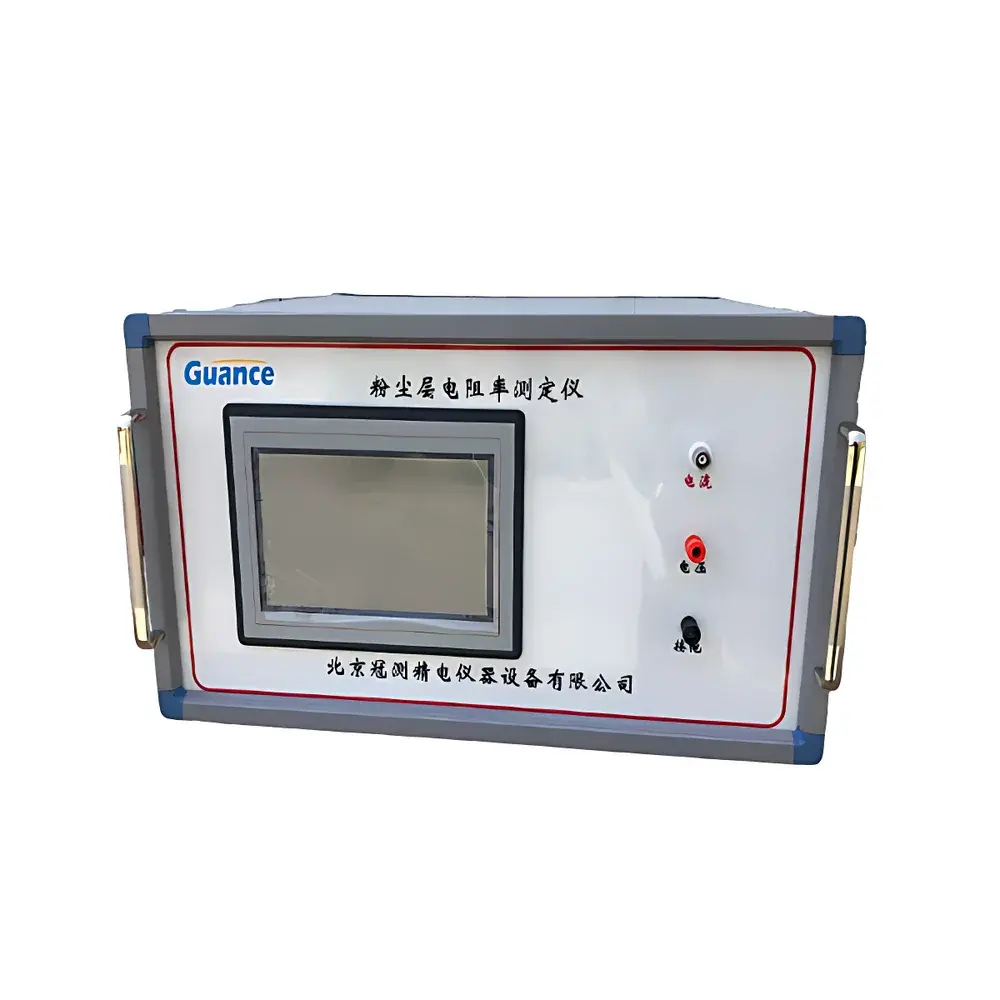
GuanCe GEST-126T Fully Automated Dust Layer Resistivity Tester
| Brand | GuanCe Instruments |
|---|---|
| Origin | Beijing, China |
| Manufacturer Type | Authorized Distributor |
| Country of Origin | China |
| Model | GEST-126T |
| Test Voltages | DC 110 V, 220 V, 300 V, 500 V, 1000 V, 1500 V, 2000 V |
| Series Resistor | 10 kΩ |
| Maximum Breakdown Current | 200 mA |
| Electrode Material | Stainless Steel |
| Measurement Accuracy | ±1% |
| Compliance | GB/T 12476.9–2010, GB/T 16427–2018 |
Overview
The GuanCe GEST-126T Fully Automated Dust Layer Resistivity Tester is a precision instrument engineered for the standardized determination of electrical resistivity in compacted layers of combustible dusts. It operates on the principle of direct-current (DC) two-electrode resistivity measurement under controlled compaction and environmental conditions. The device applies a selectable high-voltage DC bias across parallel stainless-steel electrodes embedded within a defined dust column, measuring the resulting current to compute resistivity (ρ) in ohm-meters (Ω·m) using the geometric factor derived from electrode area and inter-electrode spacing. This methodology conforms strictly to the physical definition specified in GB/T 16427–2018 and GB/T 12476.9–2010: ρ = R × (A / d), where R is measured resistance, A is electrode contact area, and d is electrode separation. The instrument is purpose-built for hazard classification in industrial hygiene, explosion safety engineering, and electrostatic risk assessment—particularly in coal handling, grain milling, metal powder processing, and pharmaceutical manufacturing environments where dust layer resistivity directly informs grounding requirements and zone classification per IEC 61241 and NFPA 77.
Key Features
- Seven-step programmable DC voltage output (110 V to 2000 V), enabling stepwise resistivity profiling across conductivity regimes—from highly insulating (>10⁹ Ω·m) to conductive (<10³ Ω·m) dust layers.
- Integrated 10 kΩ series current-limiting resistor ensures compliance with safety thresholds during high-voltage testing and prevents uncontrolled arc initiation during near-breakdown events.
- Stainless-steel parallel-plate electrodes (precision-machined, passivated surface finish) provide stable interfacial contact, minimal polarization drift, and long-term corrosion resistance against reactive dust chemistries.
- Automated measurement sequence: includes pre-compaction leveling, controlled dust loading, pneumatic or manual compression (per standard height/pressure protocols), voltage ramping, stabilized current acquisition, and auto-calculated resistivity output.
- Front-panel digital display with real-time voltage, current, and computed resistivity values; dual-unit support (Ω·m and log₁₀(Ω·m)) for rapid hazard tier identification per ISO/IEC 80079-20-2 Annex D.
Sample Compatibility & Compliance
The GEST-126T accommodates dry, free-flowing, non-cohesive, and moderately cohesive combustible dusts—including carbonaceous, metallic, organic, and polymer-based powders—with particle size distributions typically ranging from 10 µm to 500 µm. Sample conditioning (e.g., moisture equilibration at 23 °C / 50% RH per ASTM D520) is recommended prior to testing. The system meets mandatory test method requirements of GB/T 12476.9–2010 (equivalent to IEC 60079-20-2:2016 Ed. 2.0) and GB/T 16427–2018 (harmonized with ISO/IEC 80079-20-2 Annex D). It supports documentation traceability for GLP-compliant laboratories and provides raw data export compatible with audit-ready reporting frameworks required under China’s AQ/T 4274–2016 and international ATEX/IECEx certification workflows.
Software & Data Management
While the base GEST-126T operates via embedded firmware with local display and manual data logging, optional USB-to-PC interface enables CSV-formatted export of time-stamped voltage, current, temperature (via external probe input), and calculated resistivity values. All measurements include automatic timestamping and operator ID field (manually entered). Data files comply with 21 CFR Part 11–aligned metadata structure when used with validated third-party LIMS or ELN platforms—supporting electronic signature, audit trail, and version-controlled report generation. Firmware updates are delivered via secure manufacturer portal and include calibration certificate synchronization and expanded voltage sweep scripting.
Applications
- Hazardous area classification (Zone 20/21/22) for process equipment design and enclosure selection.
- Evaluation of antistatic additive efficacy in polymer granules or coated pharmaceutical excipients.
- Validation of grounding integrity for silos, hoppers, and pneumatic conveying lines.
- Research into triboelectric charging behavior and charge decay kinetics in dust clouds vs. layers.
- Supporting technical submissions for IECEx, CCC, or CNEX certification of explosion-proof instrumentation.
FAQ
What is the minimum dust sample mass required for a valid test?
A minimum of 15 g of representative, sieved (≤500 µm) dust is required to achieve a reproducible 10 mm thick layer in the standard electrode cell (diameter: 50 mm).
Does the instrument include calibration verification tools?
Yes—the system ships with certified reference resistors (100 kΩ, 1 MΩ, 10 MΩ) traceable to CNAS-accredited standards, enabling daily functional verification per GB/T 16427–2018 Section 7.2.
Can humidity and temperature be monitored during testing?
Ambient temperature and relative humidity sensors may be externally connected via analog input; integrated environmental monitoring is available in the GEST-126T-ENV variant.
Is operator training included with purchase?
Comprehensive English-language documentation, video SOPs, and remote application support are provided; on-site training is available as a billable service.



