
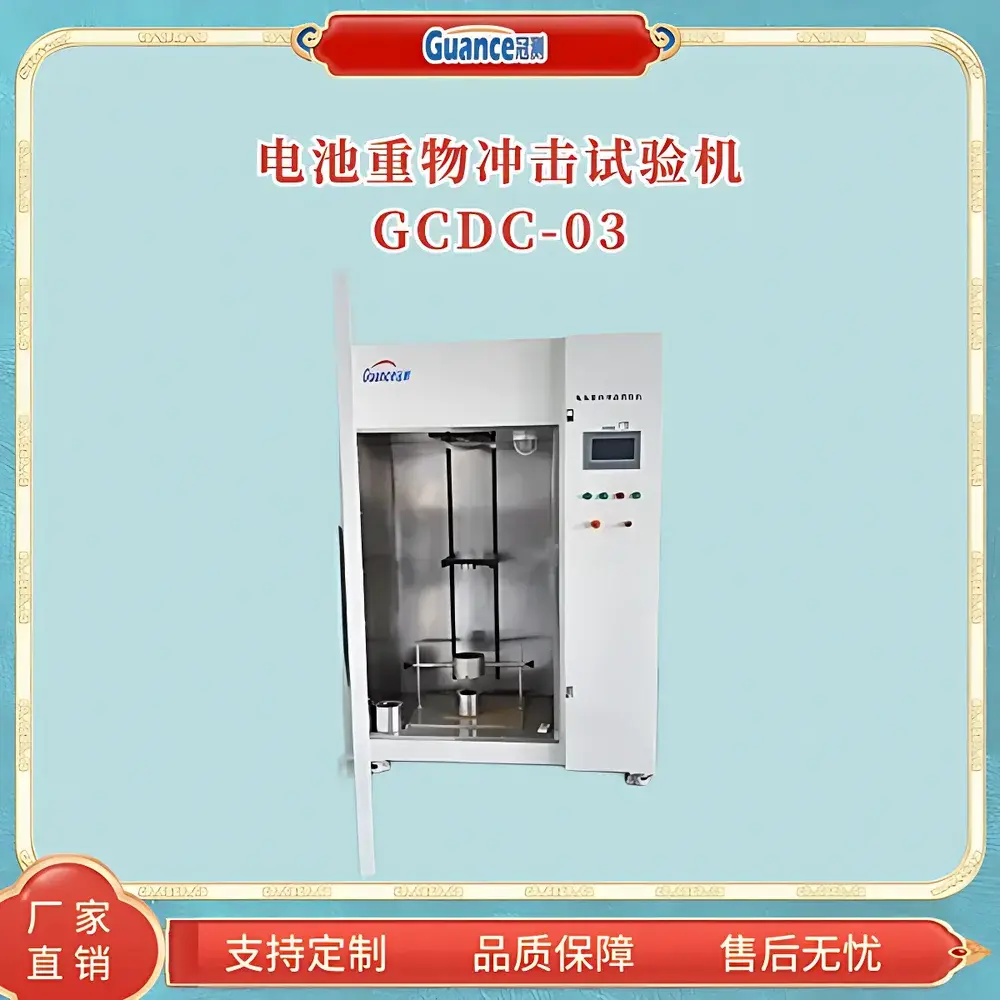
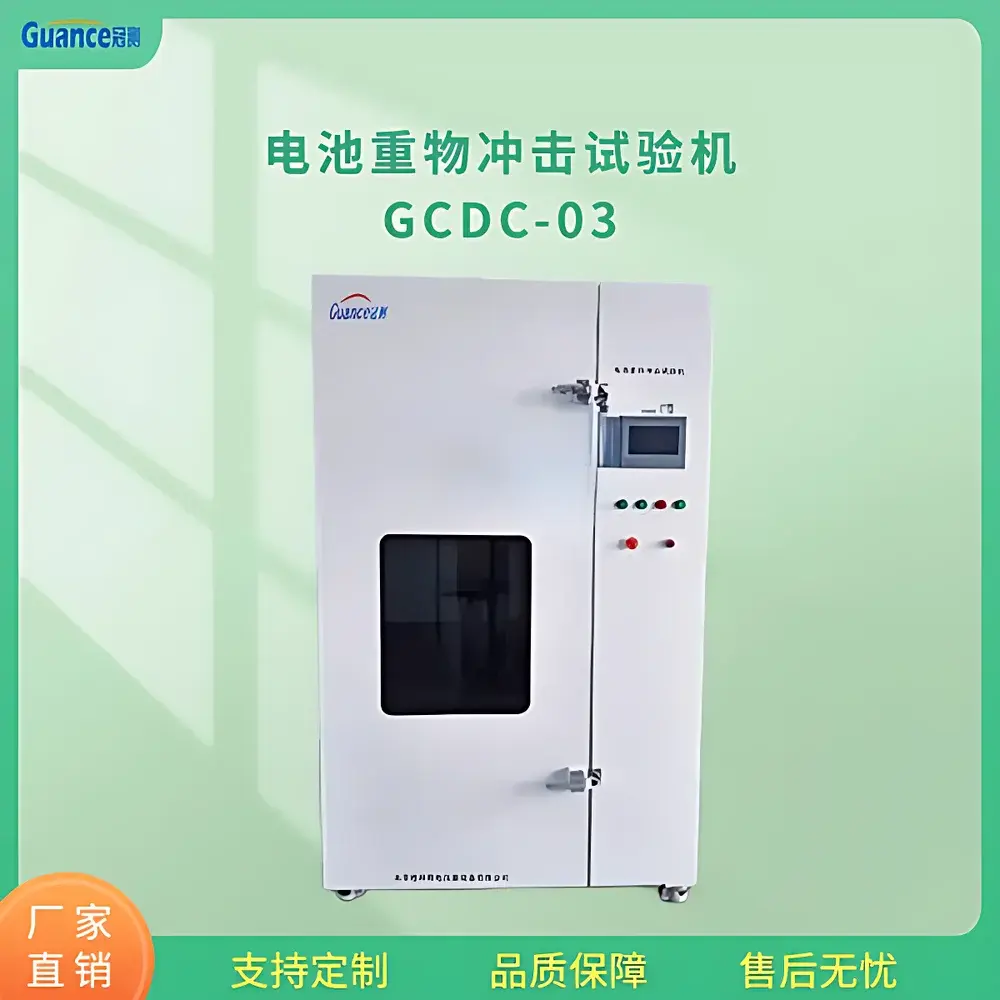
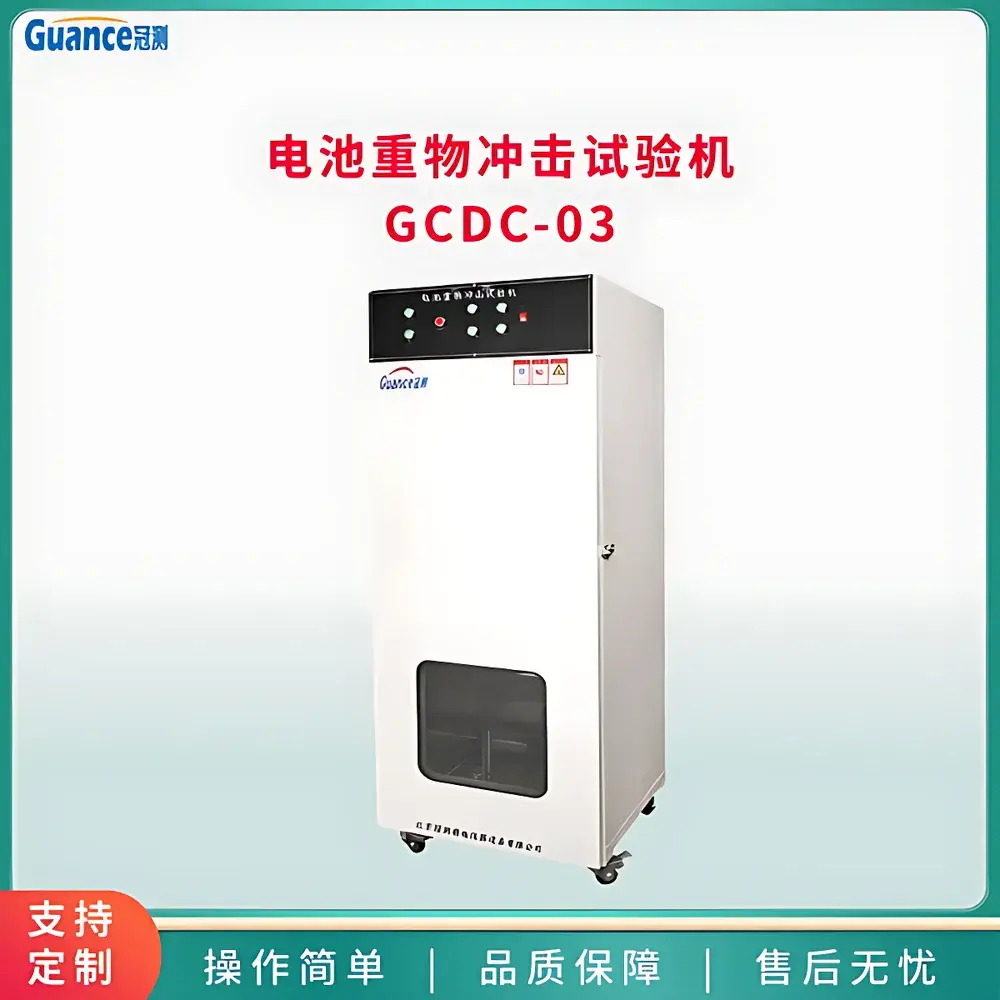
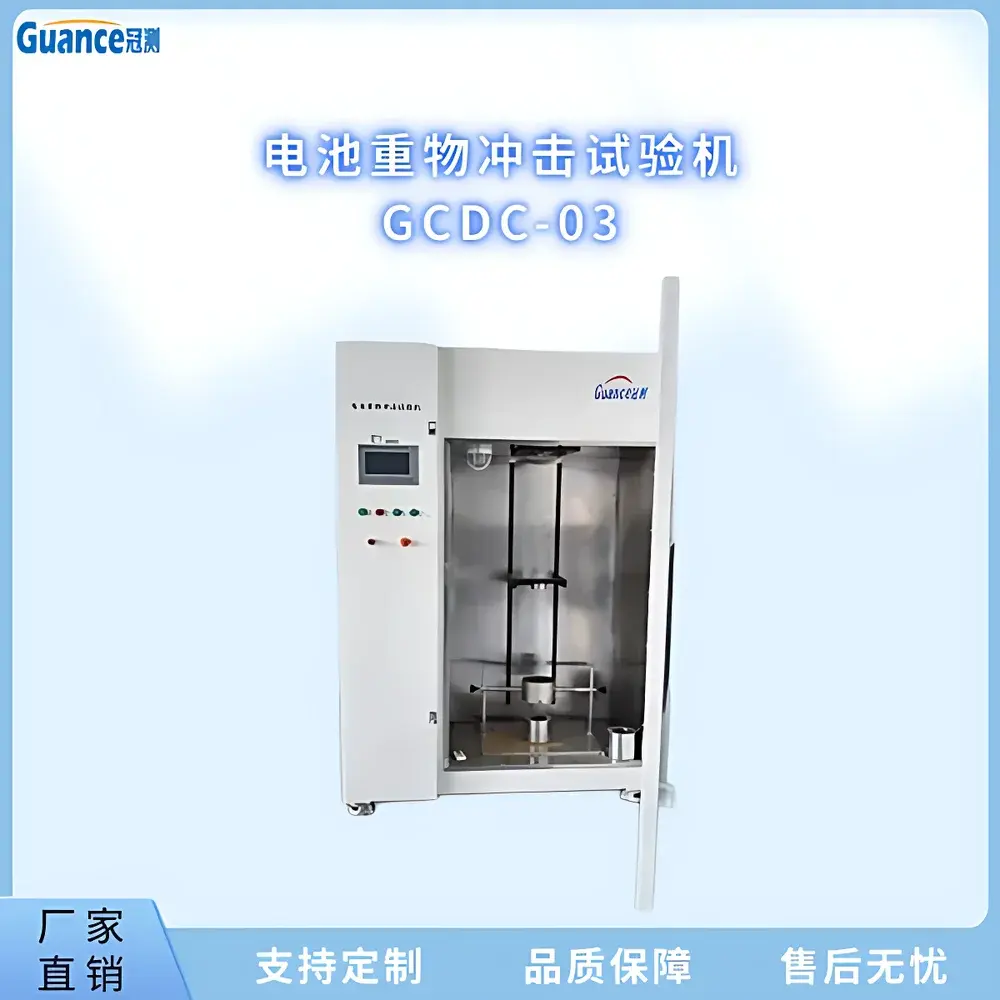
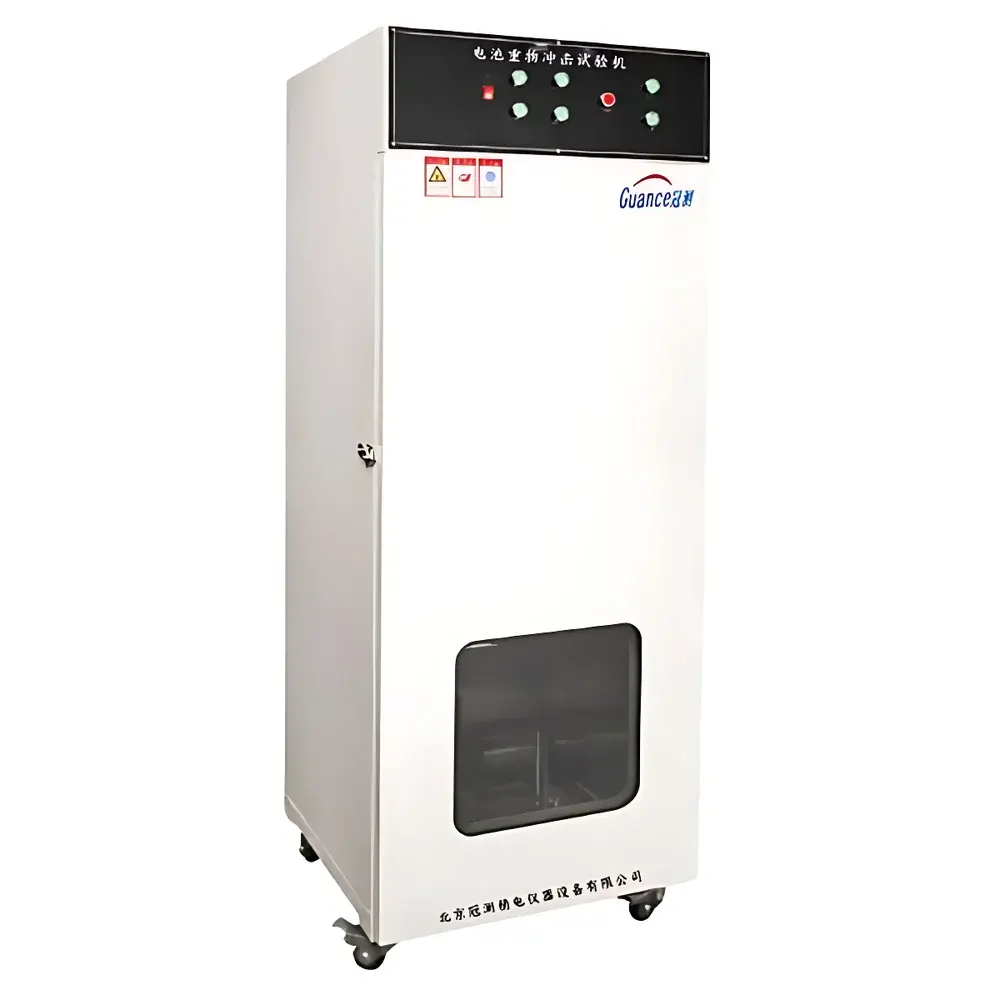
GuanCe Instruments GCDC-03.5 Battery Heavy Impact Tester
| Brand | GuanCe Instruments |
|---|---|
| Origin | Beijing, China |
| Model | GCDC-03.5 |
| Impact Mass | 9.1 kg or 10 kg stainless steel impact hammer |
| Impact Height Range | 300–1200 mm (adjustable, digital height display, ±2 mm accuracy) |
| Height Adjustment | Motorized |
| Crossbar Diameter | 15.8 mm (5/8 in) stainless steel rod |
| Load Cell Range | 0–200 N |
| Maximum Lifting Height | 180 mm |
| Compliance Standards | IEC 62133, UN 38.3, UL 1642:2008, UL 2054:2008, QC/T 743–2006, QC/T 742–2006, QC/T 744–2006, GB/T 18287–2000, GB 8897.4–2002 (IEC 60086-4:2000), SJ/T 11169–1998, SJ/T 11170–1998 |
Overview
The GuanCe Instruments GCDC-03.5 Battery Heavy Impact Tester is a precision-engineered mechanical safety evaluation system designed to assess the structural integrity and thermal stability of primary and secondary lithium-based batteries under controlled mechanical abuse conditions. It operates on the principle of gravitational free-fall impact, where a calibrated mass is elevated to a defined height and released to strike a battery sample positioned in strict accordance with international regulatory test protocols. The instrument replicates worst-case mechanical stress scenarios—such as accidental drops or crushing during transport or handling—that may trigger internal short circuits, electrolyte decomposition, or thermal runaway. Its rigid frame, motorized height adjustment, and digital height verification ensure repeatable impact energy delivery across multiple test cycles, supporting objective pass/fail determination per mandated safety thresholds (no fire, no explosion).
Key Features
- Motorized height adjustment mechanism enabling precise, reproducible positioning between 300 mm and 1200 mm, with real-time digital height readout and ±2 mm positional accuracy.
- Dual-mass configuration: interchangeable 9.1 kg (20 ± 1 lb) and 10.0 kg (±0.46 kg) stainless steel impact hammers, each certified for dimensional consistency and surface hardness (≥55 HRC) to minimize deformation during impact.
- Standardized 15.8 mm (5/8 inch) diameter stainless steel crossbar fixture—rigidly mounted and orthogonal to the test plane—to simulate localized stress concentration at the battery’s geometric center, as required by IEC 62133 Clause 7.1.2 and UN 38.3 Section 38.3.2.2.
- Integrated load cell (0–200 N range) for optional force-time profile acquisition when paired with external data acquisition systems; supports post-test analysis of peak impact force and impulse duration.
- Robust dual-layer safety enclosure: inner chamber constructed from 304 stainless steel (electropolished finish); outer shell fabricated from A3 carbon steel with epoxy powder coating; viewing window composed of laminated tempered safety glass with integrated LED illumination.
- Ventilation port (120 mm diameter) located at rear panel to facilitate rapid dissipation of off-gases in the event of venting—critical for maintaining operator safety and preserving optical clarity during observation.
Sample Compatibility & Compliance
The GCDC-03.5 accommodates cylindrical (e.g., 18650, 21700), prismatic, pouch, and coin-cell formats. For cylindrical and prismatic cells, orientation protocols are strictly enforced: longitudinal axis parallel to the test plane, with the 15.8 mm crossbar contacting the curved or flat surface at mid-length; prismatic units undergo two independent impacts—one on the wide face, one on the narrow face—after 90° rotation about the vertical axis. Coin-cell testing requires horizontal placement with the crossbar centered over the anode/cathode interface. All tests adhere to single-impact-per-sample protocol, using fresh specimens for each trial. The system fully satisfies mechanical test requirements specified in IEC 62133:2017, UN Manual of Tests and Criteria Part III, Subsection 38.3, UL 1642 (Clause 10), UL 2054 (Section 14), QC/T 743–2006, and GB/T 18287–2000. Test reports generated using this apparatus are admissible for CE marking, CB Scheme certification, and UN 38.3 transport approval submissions.
Software & Data Management
The GCDC-03.5 operates as a stand-alone electromechanical platform without embedded firmware or proprietary software. All operational parameters—including set height, actual drop height, impact mass selection, and test timestamp—are manually recorded by the operator into standardized laboratory notebooks or LIMS-integrated electronic test records. To support GLP/GMP compliance, users may integrate optional third-party data loggers (e.g., National Instruments CompactDAQ or Keysight DAQ970A) with the built-in load cell output (mV/V analog signal) and height encoder feedback. Audit trails, user authentication, and electronic signature capabilities must be implemented at the enterprise-level LIMS or ELN layer, consistent with FDA 21 CFR Part 11 requirements for regulated battery safety testing laboratories.
Applications
- Pre-certification safety validation for lithium-ion, lithium-polymer, and lithium-metal batteries prior to UN 38.3 submission.
- Quality control screening of production lots in battery manufacturing facilities to verify mechanical robustness against design-specified abuse limits.
- R&D evaluation of novel electrode architectures, separator materials, or cell packaging designs under standardized impact loading.
- Root cause analysis of field failure incidents involving mechanical trauma (e.g., dropped power tools, EV battery pack collisions).
- Supporting ISO 12405-2 (electric vehicle traction batteries) and IEEE 1625/1725 (portable computing/mobile devices) conformance testing programs.
FAQ
What standards does the GCDC-03.5 explicitly support?
IEC 62133, UN 38.3, UL 1642:2008, UL 2054:2008, QC/T 743–2006, QC/T 742–2006, QC/T 744–2006, GB/T 18287–2000, GB 8897.4–2002, SJ/T 11169–1998, and SJ/T 11170–1998.
Is the 15.8 mm crossbar included with the system?
Yes—the stainless steel crossbar (15.8 mm diameter, ≥300 mm length, center-aligned mounting brackets) is supplied as standard equipment.
Can the tester accommodate custom impact masses beyond 9.1 kg and 10 kg?
No—the mechanical design, lifting mechanism, and structural reinforcement are validated only for the specified 9.1 kg and 10 kg hammers; substitution with non-certified masses voids compliance traceability.
Does the system provide automatic pass/fail判定 based on thermal events?
No—thermal event detection (fire, explosion, smoke) requires visual observation through the safety window or integration with external thermal imaging or gas-sensing systems; the GCDC-03.5 delivers only mechanical impact execution.
What electrical supply is required for operation?
Single-phase 220 V AC, 50/60 Hz, 3 A dedicated circuit with proper grounding and overcurrent protection.
Related Products



