
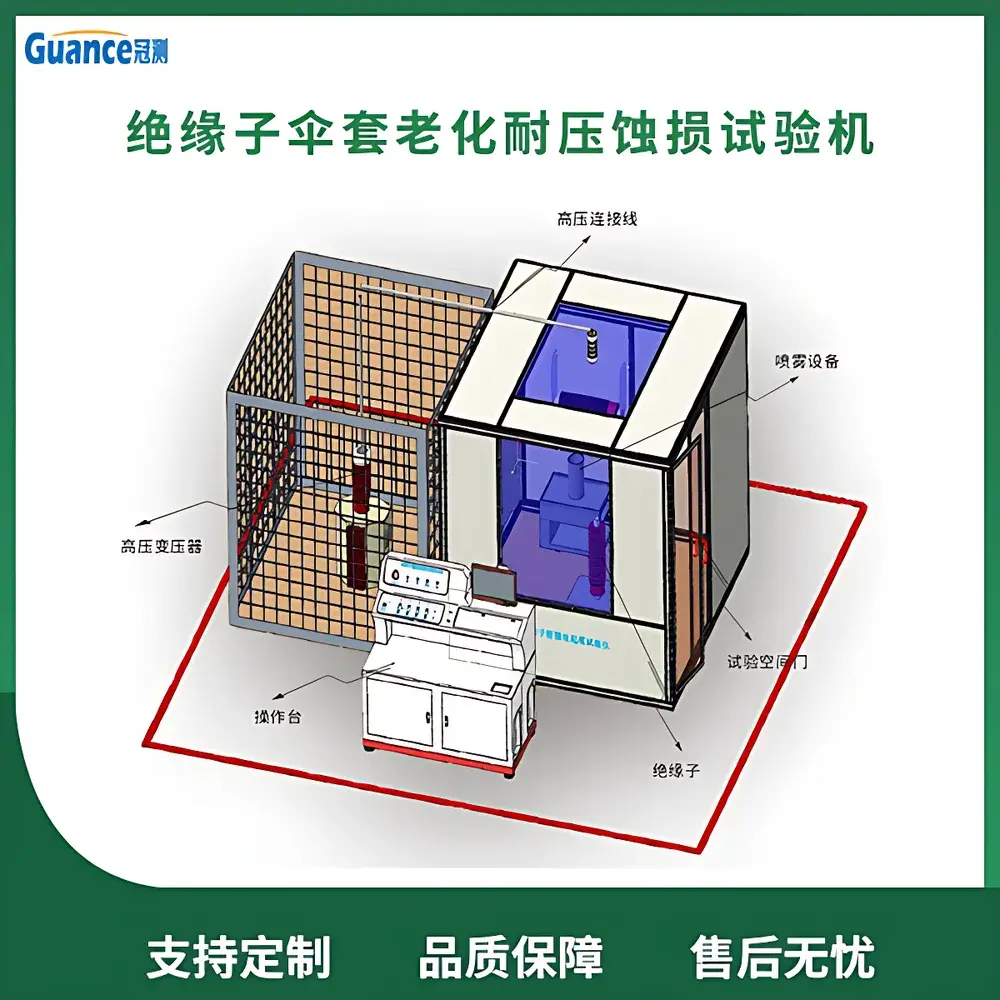
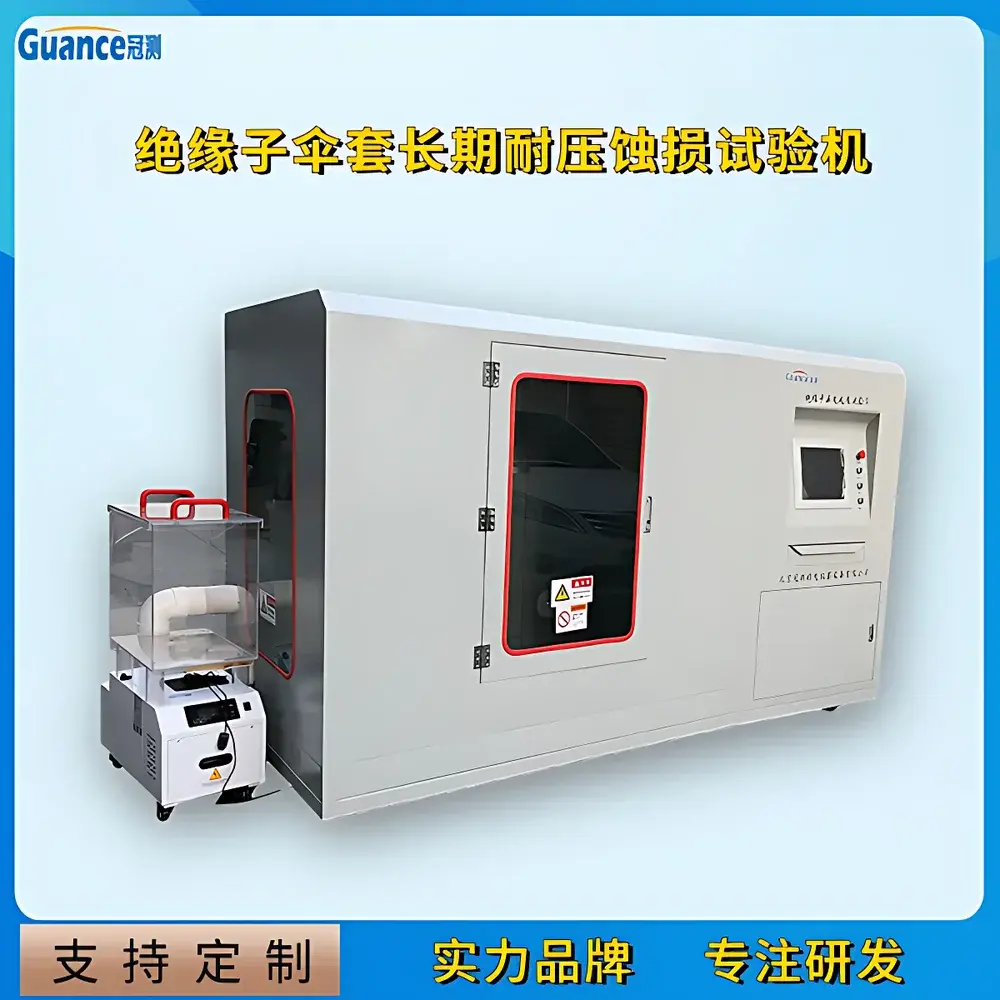
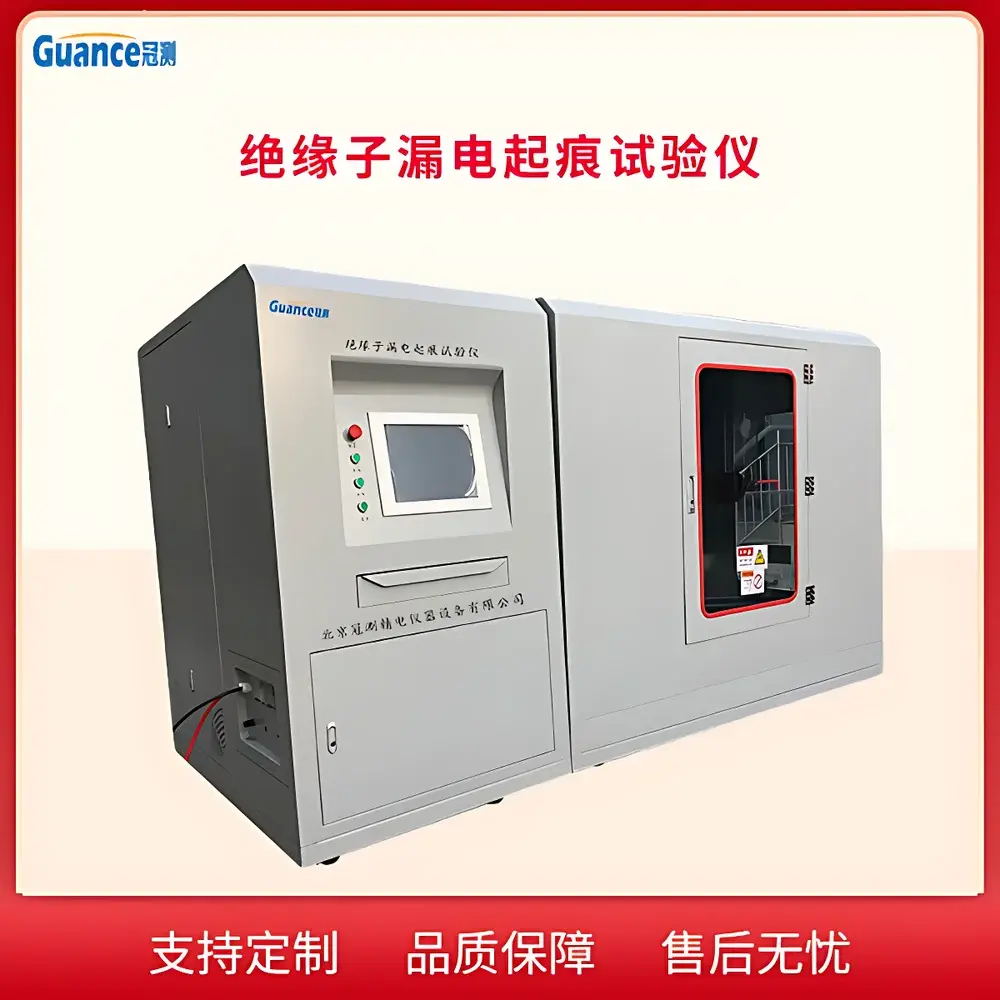
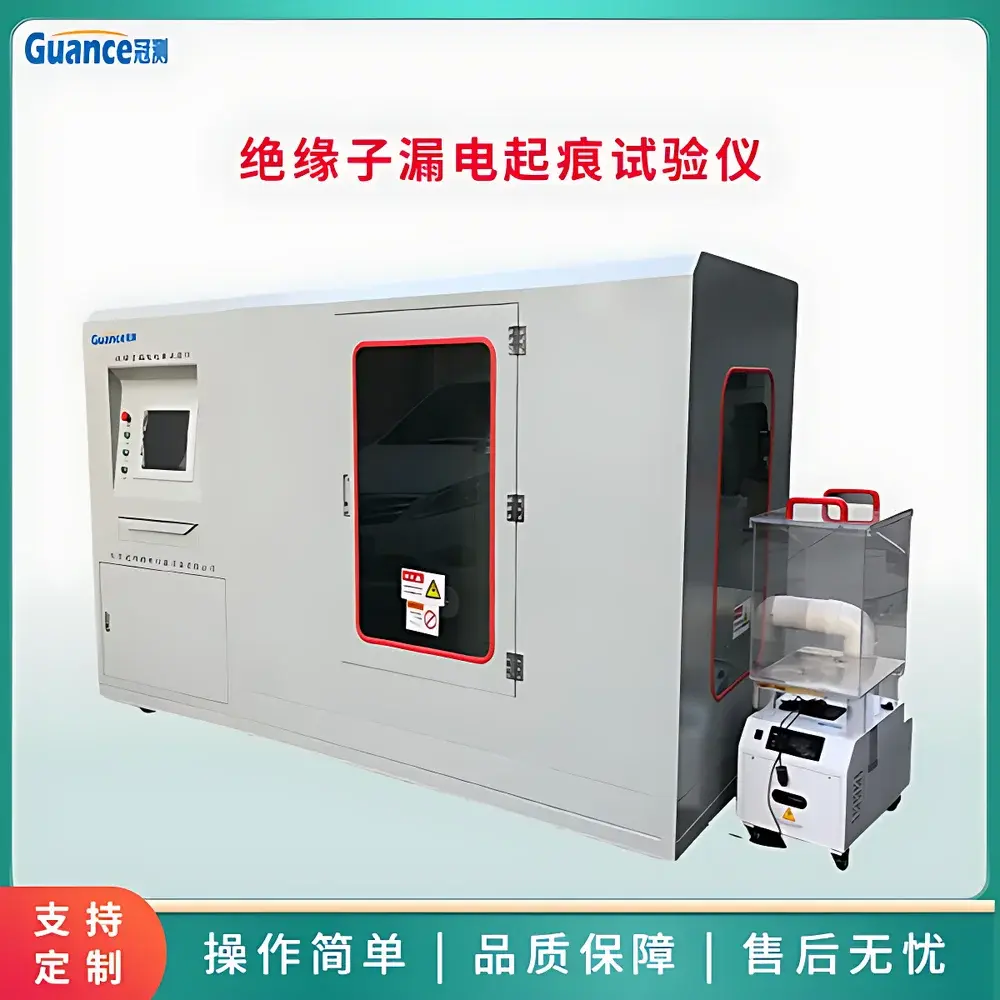
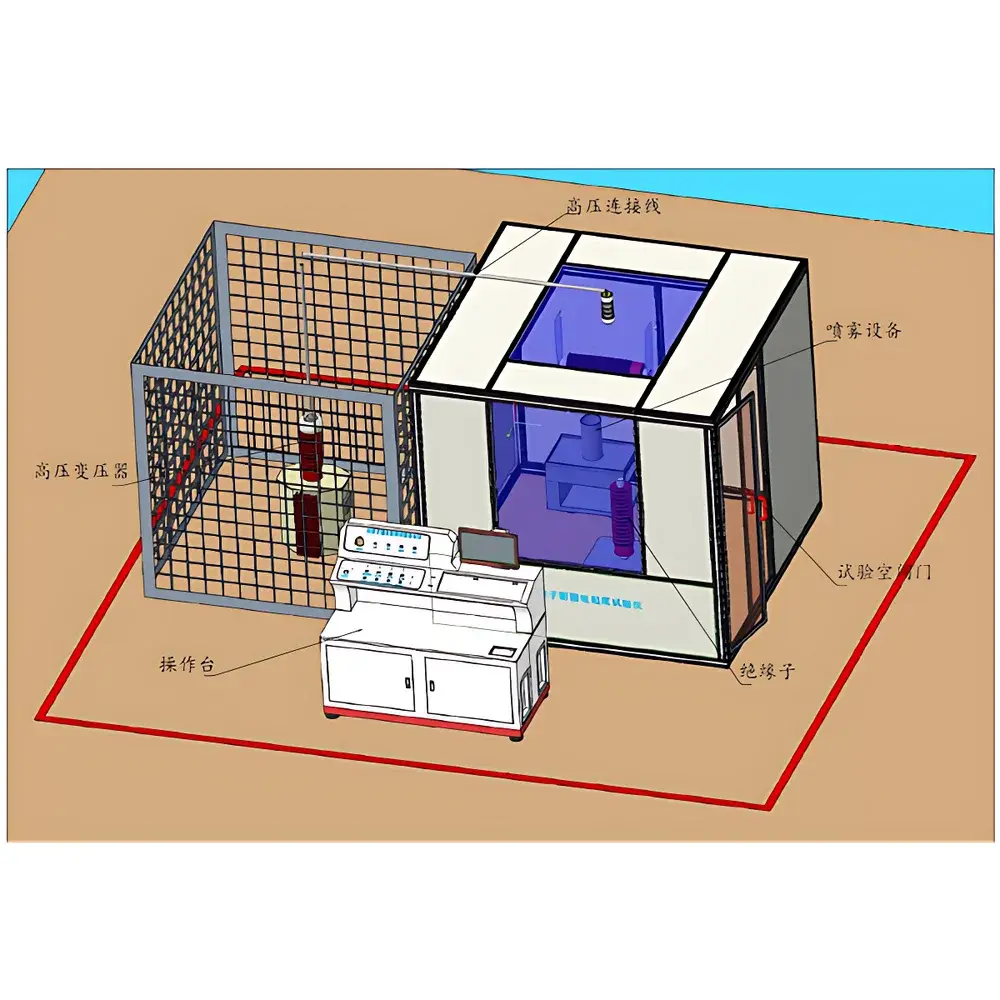
GuanCe Instruments NLD-AII2 Insulator Dielectric Strength & Salt-Fog Universal Testing System
| Brand | GuanCe Instruments |
|---|---|
| Origin | Beijing, China |
| Manufacturer Type | Authorized Distributor |
| Country of Origin | China |
| Model | NLD-AII2 |
| Instrument Type | Electromechanical Universal Testing System |
| Input Voltage | AC 220 V |
| Output Voltage Range | AC 0–50 kV / DC −50–0 kV (adjustable) |
| Power Rating | 50 kVA |
| Voltage Accuracy | < ±2% |
| Current Output Capacity | ≥1 A (HV side) |
| Current Measurement Accuracy | < ±1% |
| Test Duration | Up to 1000 h continuous |
| Fog Chamber Volume | 4 m³ (L×W×H = 2000 × 1200 × 1700 mm) |
| 雾化颗粒Size | 5–10 µm |
| Salt Spray Rate | (0.4 ± 0.1) L/m³·h |
| Airflow Velocity at Specimen | 3 m/s |
| Specimen Spacing | ≥400 mm from ceiling and walls |
| Specimen Capacity | 1 horizontal + 1 vertical mounting position |
| Safety Interlock | Door-activated HV cutoff and automatic zeroing |
| Control System | Embedded industrial computer with real-time data logging |
| Dimensions (L×W×H) | 3400 × 1300 × 1800 mm |
| Weight | 300 kg |
Overview
The GuanCe Instruments NLD-AII2 Insulator Dielectric Strength & Salt-Fog Universal Testing System is a purpose-built, integrated test platform engineered for evaluating the long-term dielectric integrity and surface erosion resistance of polymeric and composite insulators under combined electrical stress and accelerated environmental aging. Unlike conventional mechanical universal testers, the NLD-AII2 operates on a dual-stress principle: simultaneous application of high-voltage AC/DC stress (up to 50 kV) and controlled salt-fog exposure in a sealed, climate-regulated chamber. This replicates the critical service conditions experienced by overhead line and substation insulators in coastal, industrial, or desert-dust environments—where surface conductivity, dry-band arcing, and electrochemical tracking govern failure mechanisms. The system complies fully with GB/T 20142–2006 and GB/T 22079–2008, aligning its test protocols with internationally referenced methodologies for high-voltage insulator qualification.
Key Features
- Integrated high-voltage source with dual-mode output: continuously adjustable AC 0–50 kV and DC −50–0 kV, featuring active voltage regulation and real-time ripple monitoring.
- UL-certified salt-fog generation subsystem using ultrasonic nebulization, delivering stable, metrologically traceable fog density of (0.4 ± 0.1) L/m³·h with droplet size distribution tightly constrained to 5–10 µm (verified per ISO 9223 Annex B).
- Full-spectrum safety architecture: interlocked access door triggers immediate HV shutdown and automatic discharge to <100 V within 100 ms; redundant overcurrent protection with user-defined trip thresholds.
- Dual-axis specimen mounting configuration supporting concurrent horizontal and vertical orientation testing—enabling comparative evaluation of gravity-driven leakage current paths and wetting behavior.
- Embedded industrial control unit with deterministic real-time OS, supporting uninterrupted 1000-hour test cycles with automatic power-loss recovery and timestamped event logging.
- Comprehensive electrical parameter monitoring: synchronized acquisition of applied voltage, leakage current, and arc pulse count at 1 kHz sampling rate, with hardware-based anti-aliasing filtering.
Sample Compatibility & Compliance
The NLD-AII2 accommodates standard cylindrical and pin-type polymeric insulators up to 1200 mm in height and 300 mm in shed diameter. Mounting fixtures are modular and non-conductive (ceramic/composite), ensuring minimal field distortion. All test procedures conform to the acceptance criteria and pass/fail definitions specified in GB/T 20142–2006 (for overhead line column insulators) and GB/T 22079–2008 (for indoor/outdoor polymer-housed insulators). While primarily designed for Chinese national standards, the system’s fog generation parameters, voltage ramp profiles, and measurement traceability pathways are directly translatable to IEC 60587 (electrical resistance of tracking-resistant materials), ASTM D2303 (electrical endurance of insulating materials), and IEEE Std 1313.2–1999 (insulator contamination testing guidelines). Calibration certificates for voltage dividers and current shunts are issued per ISO/IEC 17025 requirements.
Software & Data Management
The embedded control software provides a secure, audit-ready interface compliant with GLP principles. It features role-based access control (operator, supervisor, administrator), electronic signature support, and full 21 CFR Part 11–compatible audit trails—including timestamps for all parameter changes, start/pause/resume actions, and manual interventions. Real-time voltage–current Lissajous curves are rendered with dynamic scaling and overlay capability for multi-run comparison. Historical datasets are stored in encrypted SQLite databases with SHA-256 hashing; export is supported via USB 2.0 port in CSV, PDF (formatted test reports), and XML (for LIMS integration). All calibration coefficients are digitally signed and version-locked; recalibration events automatically trigger report regeneration for affected historical tests.
Applications
- Qualification testing of silicone rubber and EPDM composite insulators prior to grid deployment.
- Comparative assessment of hydrophobicity recovery rates across different housing formulations under sustained electrical stress.
- Accelerated aging studies correlating salt-fog exposure duration, leakage current magnitude, and surface erosion depth (measured post-test via profilometry or SEM).
- Root-cause analysis of flashover incidents in contaminated environments—reproducing field failure modes under controlled lab conditions.
- Supporting R&D for novel nanocomposite coatings by quantifying reduction in leakage current and delay in dry-band formation.
- Third-party certification testing for manufacturers seeking CCC, CQC, or international type-test compliance.
FAQ
Does the NLD-AII2 meet international standards such as IEC or ASTM?
Yes—the core test methodology and performance specifications are aligned with IEC 60587, ASTM D2303, and IEEE 1313.2. While hardware compliance is certified to GB standards, all measurement subsystems (voltage, current, fog density) are calibrated traceably to national metrology institutes, enabling cross-standard validation.
Can the system operate unattended for the full 1000-hour test cycle?
Yes. The embedded controller supports autonomous execution with built-in watchdog timers, thermal monitoring, and automatic recovery from brief power interruptions. All operational states and anomalies are logged with UTC timestamps.
Is remote monitoring or network connectivity supported?
The base configuration includes isolated RS-485 and USB interfaces. Optional Ethernet module (IEEE 802.3, TCP/IP stack) enables secure remote status viewing and alarm notification via Modbus TCP or custom API—without compromising functional safety isolation.
What maintenance intervals are recommended for the ultrasonic fog generator?
Ultrasonic transducers require quarterly inspection and descaling using dilute citric acid solution. Nebulizer chambers must be cleaned after every 200 hours of cumulative operation to prevent NaCl crystallization-induced drift in spray uniformity.
How is test validity ensured when multiple specimens are evaluated sequentially?
Each test run initiates a new calibration verification sequence: pre-test HV null check, fog density validation using gravimetric collection, and baseline leakage current measurement under no-stress conditions—all recorded in the audit trail.



