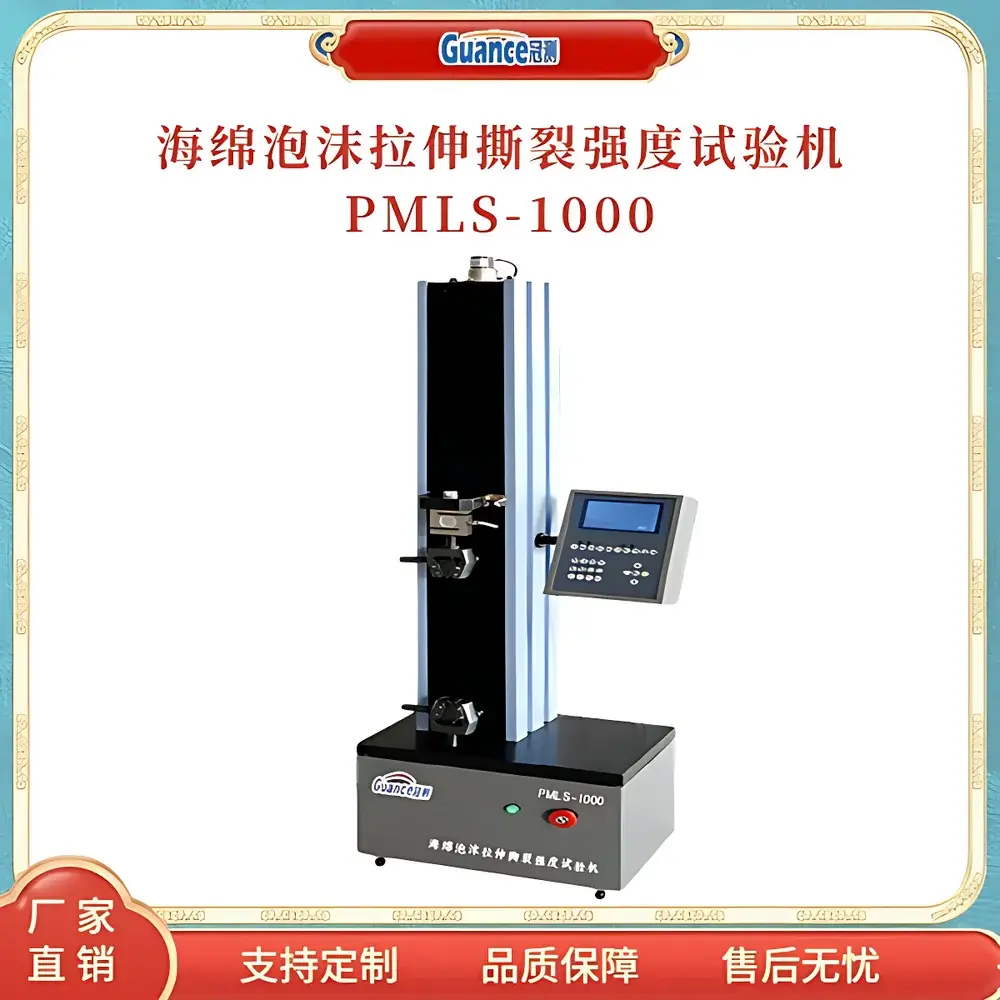
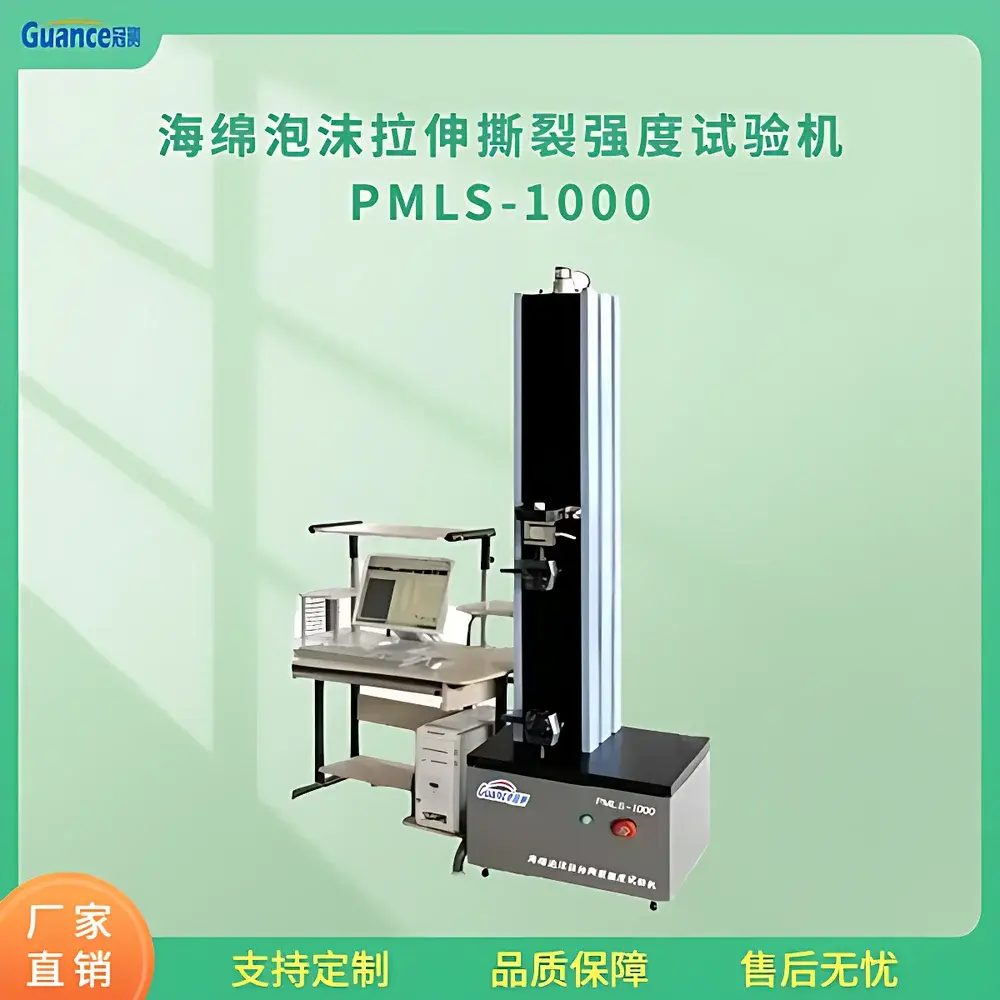
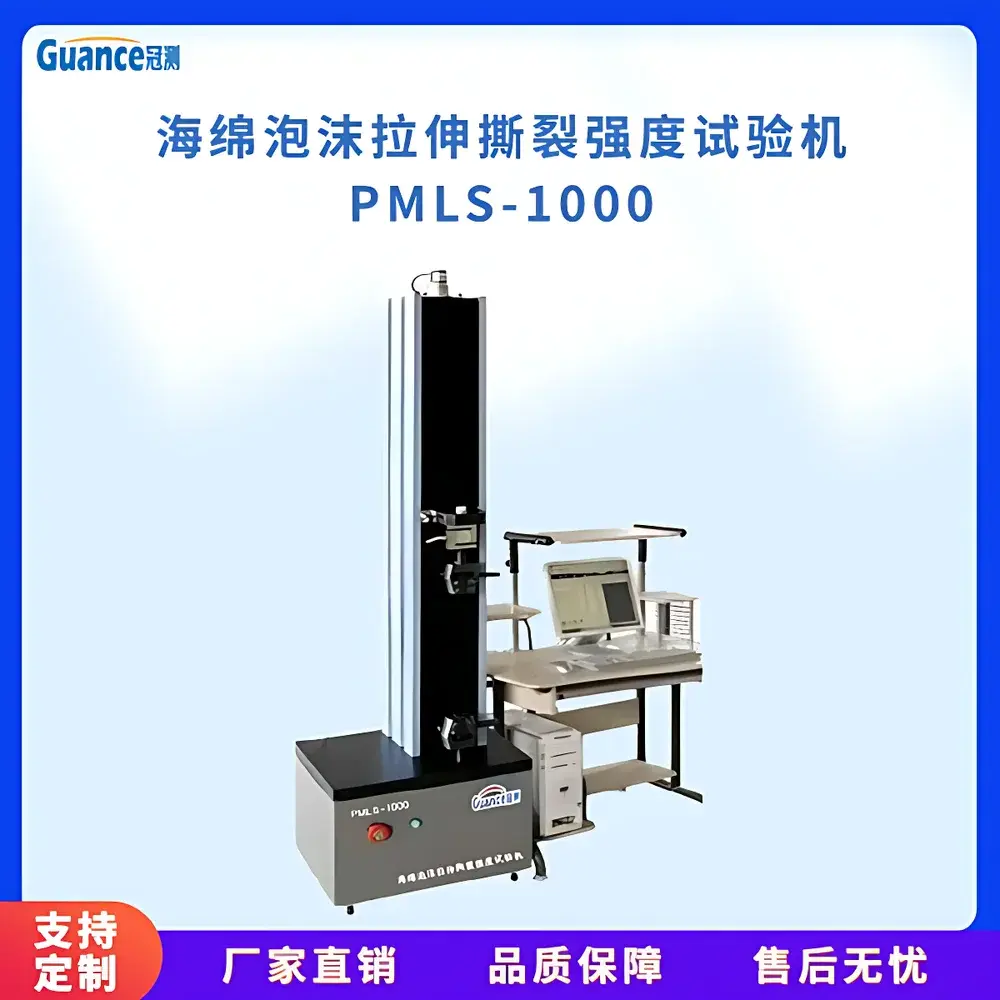
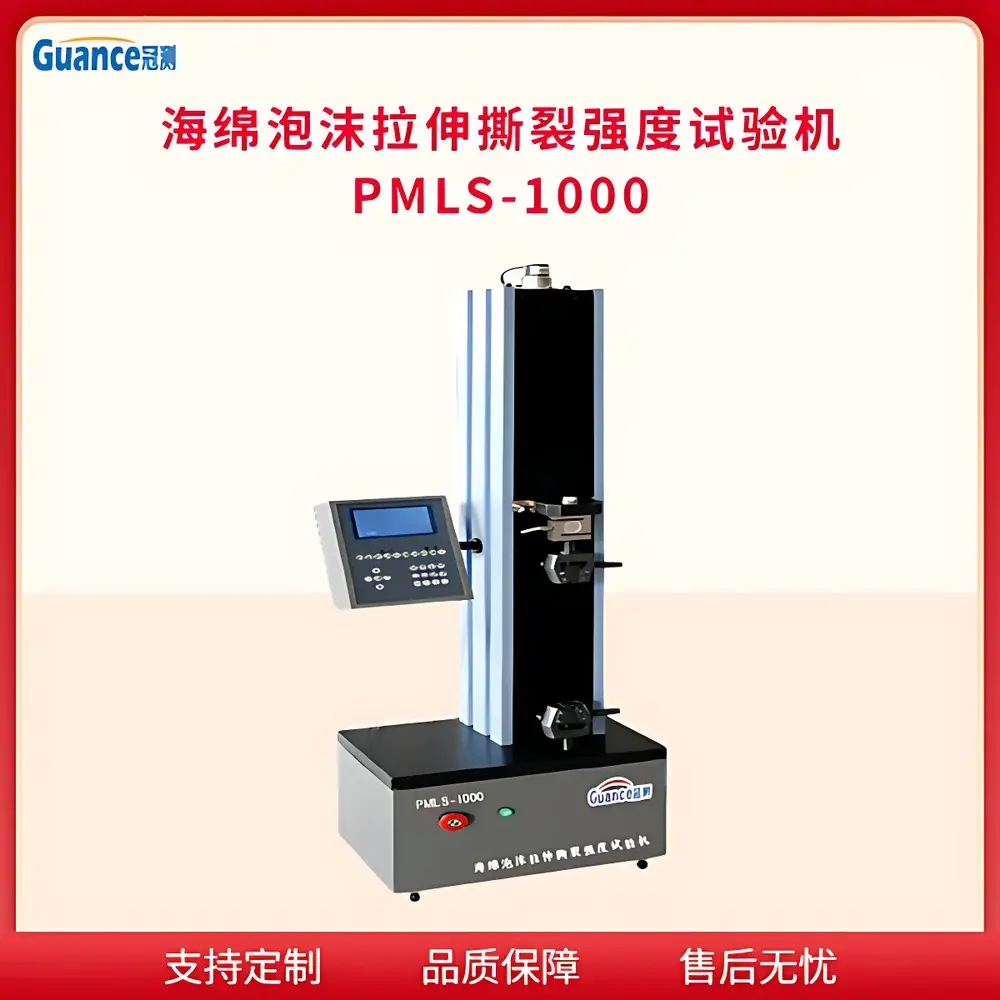
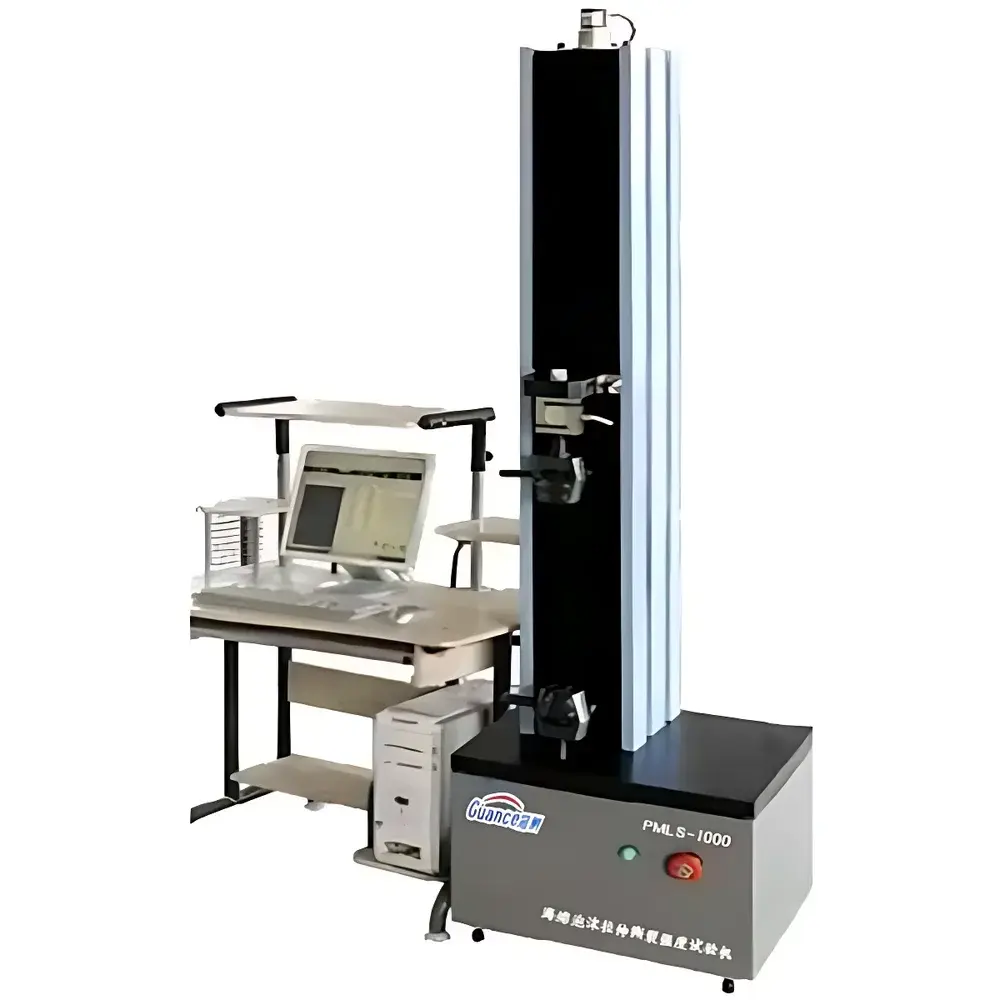
GuanCe Instruments PMLS-1000.5 Foam Tensile & Tear Strength Tester
| Brand | GuanCe Instruments |
|---|---|
| Origin | Beijing, China |
| Manufacturer Type | Authorized Distributor |
| Country of Origin | China |
| Model | PMLS-1000.5 |
| Max Test Load | 1000 N |
| Force Accuracy | ±1% of reading |
| Displacement Resolution | 0.01 mm |
| Crosshead Speed Range | 0.05–300 mm/min |
| Stroke | 800 mm (excluding fixtures) |
| Dimensions (L×W×H) | 435 × 275 × 1700 mm |
| Power Supply | 220 V, 50 Hz |
| Compliance | GB/T 6344–2008, GB/T 10808–2006, ISO 1798:1997 |
Overview
The GuanCe Instruments PMLS-1000.5 Foam Tensile & Tear Strength Tester is a single-column universal testing system engineered for precise mechanical characterization of flexible polymeric foams and sponge materials. Designed in accordance with internationally recognized standards—including ISO 1798:1997 (Flexible cellular polymeric materials — Determination of tensile strength and elongation at break), GB/T 6344–2008 (Soft cellular polymeric materials — Determination of tensile strength and elongation at break), and GB/T 10808–2006 (High-polymer porous elastic materials — Determination of tear strength)—this instrument delivers repeatable, traceable mechanical data under controlled quasi-static loading conditions. Its core architecture employs a digitally controlled AC servo motor coupled to a precision ball-screw actuation system via arc-synchronous timing belts, enabling high-fidelity force-displacement profiling across a wide speed range (0.05–300 mm/min). The system operates on fundamental principles of uniaxial tension and trouser-tear mechanics, supporting both ASTM D3574-style tear protocols and standardized tensile evaluation for quality assurance, R&D validation, and incoming material inspection in foam manufacturing and packaging engineering environments.
Key Features
- Single-column rigid frame with high-stiffness aluminum alloy construction, optimized for minimal deflection during high-load tear testing up to 1000 N
- Full-range, non-stepped load measurement using a high-accuracy load cell calibrated to ±1% of full-scale reading
- Optical encoder-based displacement sensing with 0.01 mm resolution and ±1% accuracy over full 800 mm stroke
- Three-speed programmable crosshead switching during active test—enabling rapid preloading, stable ramping, and controlled post-failure retraction without interrupting data acquisition
- Integrated 7-inch color LCD touchscreen interface with real-time graphical display of force, displacement, strain rate, peak load, and stress–strain curves
- Dual-limit protection architecture: hardware-based mechanical end-stop switches complement software-defined travel limits to prevent over-travel damage
- Automatic test termination upon specimen rupture, followed by programmed return-to-start positioning for next-cycle readiness
- Overload cutoff at 103–105% of nominal capacity, ensuring sensor integrity and operator safety
- Thermal-stable digital drive system with closed-loop speed control accuracy better than ±1% across entire velocity spectrum
Sample Compatibility & Compliance
The PMLS-1000.5 accommodates standard test specimens per ISO 1798 and GB/T 10808, including trouser-tear strips (25 mm wide × 100 mm long), dumbbell-shaped tensile bars (Type I or IV per ISO 37), and custom-cut foam slabs up to 150 mm in width. Fixture sets include pneumatic or manual clamping jaws with serrated faces to prevent slippage of low-modulus cellular materials. All test methods align with regulatory expectations for physical testing in ISO 9001-certified production facilities and GLP-compliant laboratories. While the system itself does not carry CE or UL certification, its measurement methodology supports audit-ready documentation for internal QA/QC, supplier qualification, and technical file preparation compliant with EU Regulation (EC) No 1935/2004 (food-contact materials) and FDA guidance for packaging component mechanical validation.
Software & Data Management
The embedded firmware provides local data logging with timestamped force–displacement records stored in CSV format on internal flash memory. Optional USB export enables transfer to external PCs for statistical analysis in Excel or specialized packages such as Minitab or JMP. The system supports user-defined test templates, pass/fail thresholds, and automatic calculation of key metrics—including tensile strength (kPa), elongation at break (%), and tear resistance (N/mm). Though not natively 21 CFR Part 11 compliant, the device can be integrated into validated laboratory networks where electronic records are governed by institutional SOPs requiring audit trails, electronic signatures, and data integrity controls. Raw output files retain metadata (operator ID, date/time, calibration status, environmental notes) to support traceability requirements in regulated packaging development workflows.
Applications
- Quality control of polyurethane, latex, and viscoelastic memory foams used in mattress cores, automotive seating, and medical cushioning
- Validation of tear propagation resistance in protective packaging foams subjected to handling stresses during logistics
- Comparative assessment of formulation changes—e.g., blowing agent ratios, crosslink density, or filler content—on mechanical robustness
- Supporting ASTM D3574 Annex A1 (tear resistance) and Annex B1 (tensile properties) for foam suppliers serving Tier-1 OEMs
- Incoming inspection of recycled foam feedstock to verify minimum mechanical performance prior to reprocessing
- Research into fatigue-induced degradation mechanisms through sequential cyclic tear testing with load-controlled hold periods
FAQ
What standards does the PMLS-1000.5 directly support?
It is configured for compliance with ISO 1798:1997, GB/T 6344–2008, and GB/T 10808–2006, covering tensile strength, elongation at break, and trouser-tear resistance measurements.
Is the system compatible with third-party data acquisition software?
Yes—via USB serial emulation mode, the controller outputs ASCII-formatted real-time data streams suitable for integration with LabVIEW, Python-based DAQ systems, or custom SCADA platforms.
Can the machine perform compression tests on foam blocks?
No—the PMLS-1000.5 is mechanically and software-optimized for uniaxial tension and tear modes only; compression testing requires dedicated equipment conforming to ISO 3386 or ASTM D3574 Section C.
What maintenance intervals are recommended for long-term accuracy?
Load cell recalibration every 12 months or after 5,000 test cycles; belt tension verification quarterly; optical encoder cleaning biannually using lint-free swabs and isopropyl alcohol.
Does the system include factory calibration documentation?
Yes—each unit ships with a traceable calibration certificate issued against national metrology standards, listing as-found and as-left values for force and displacement axes.