
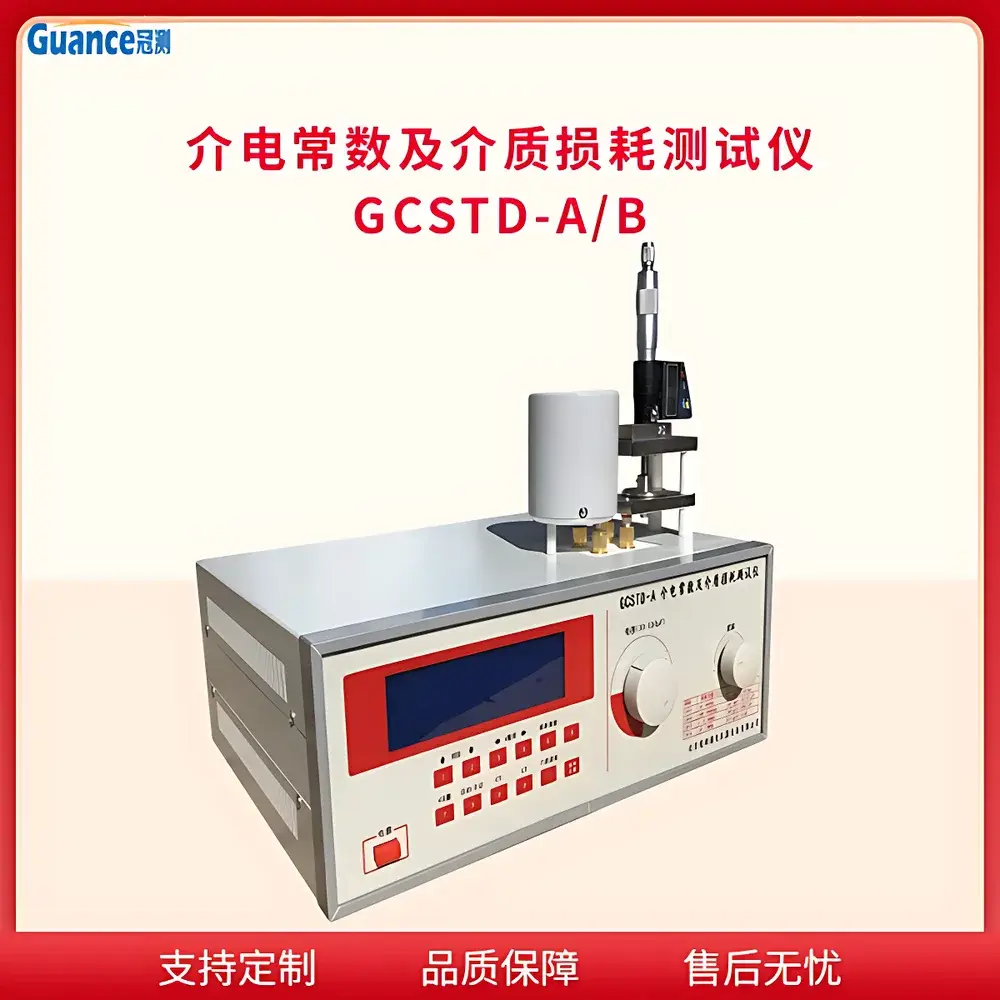
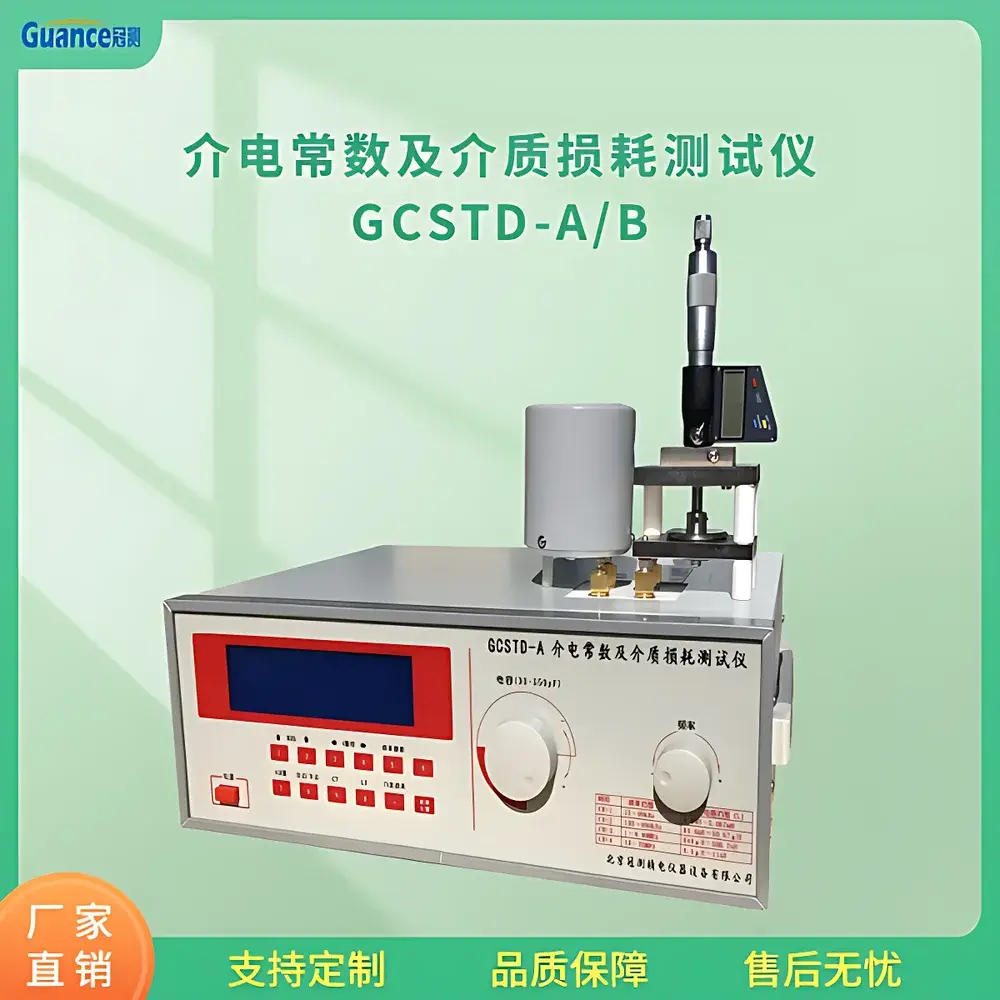
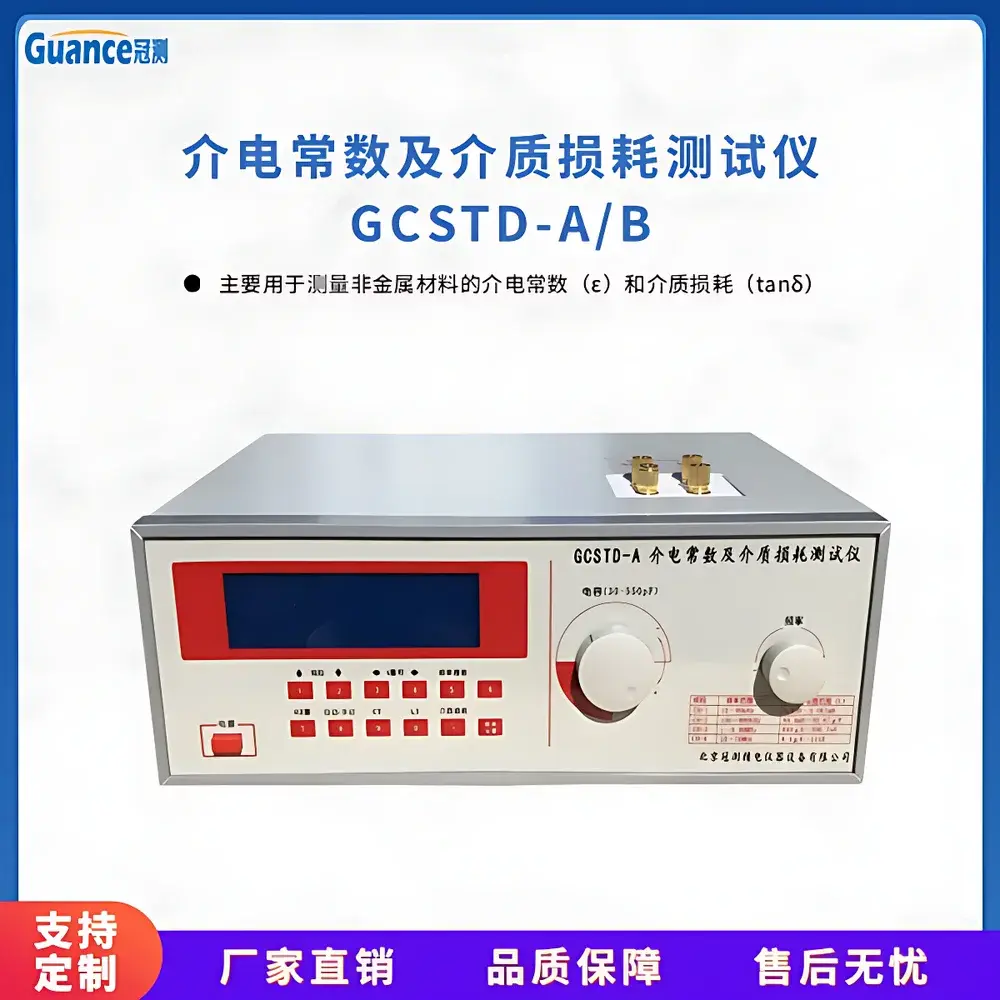
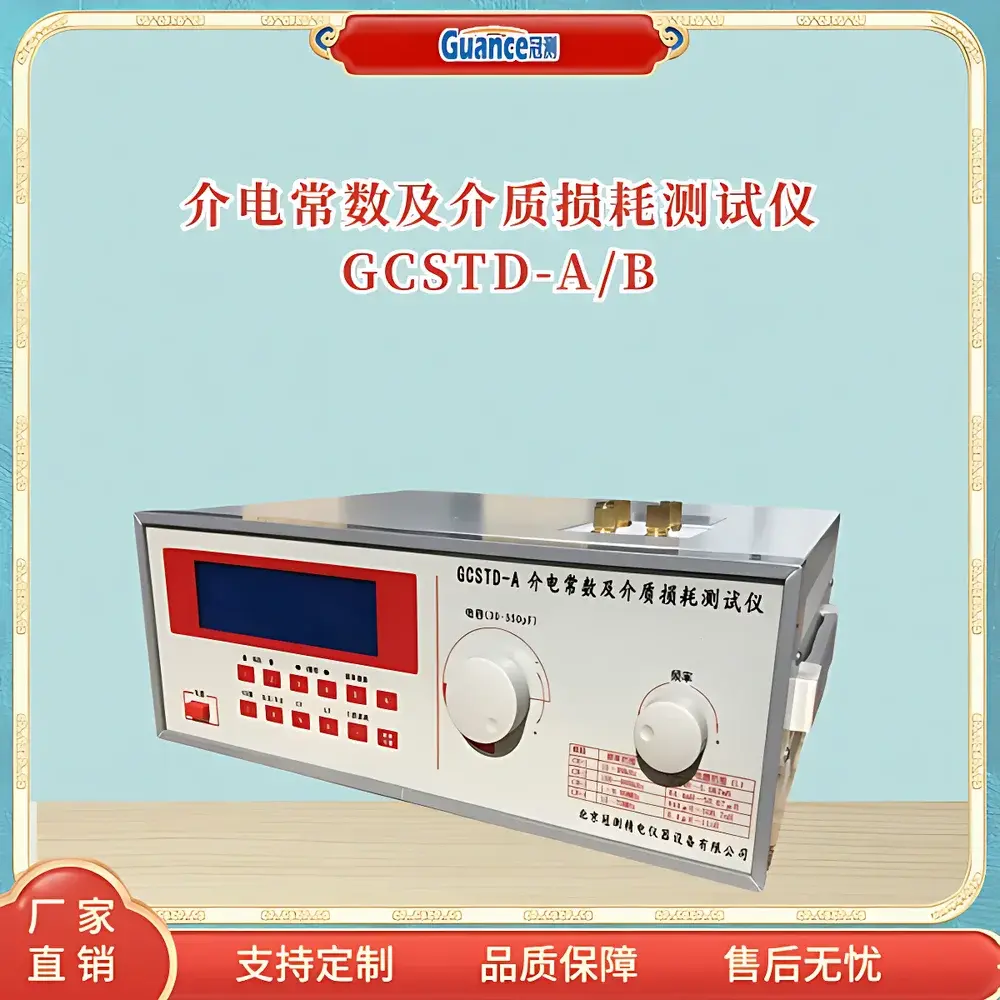
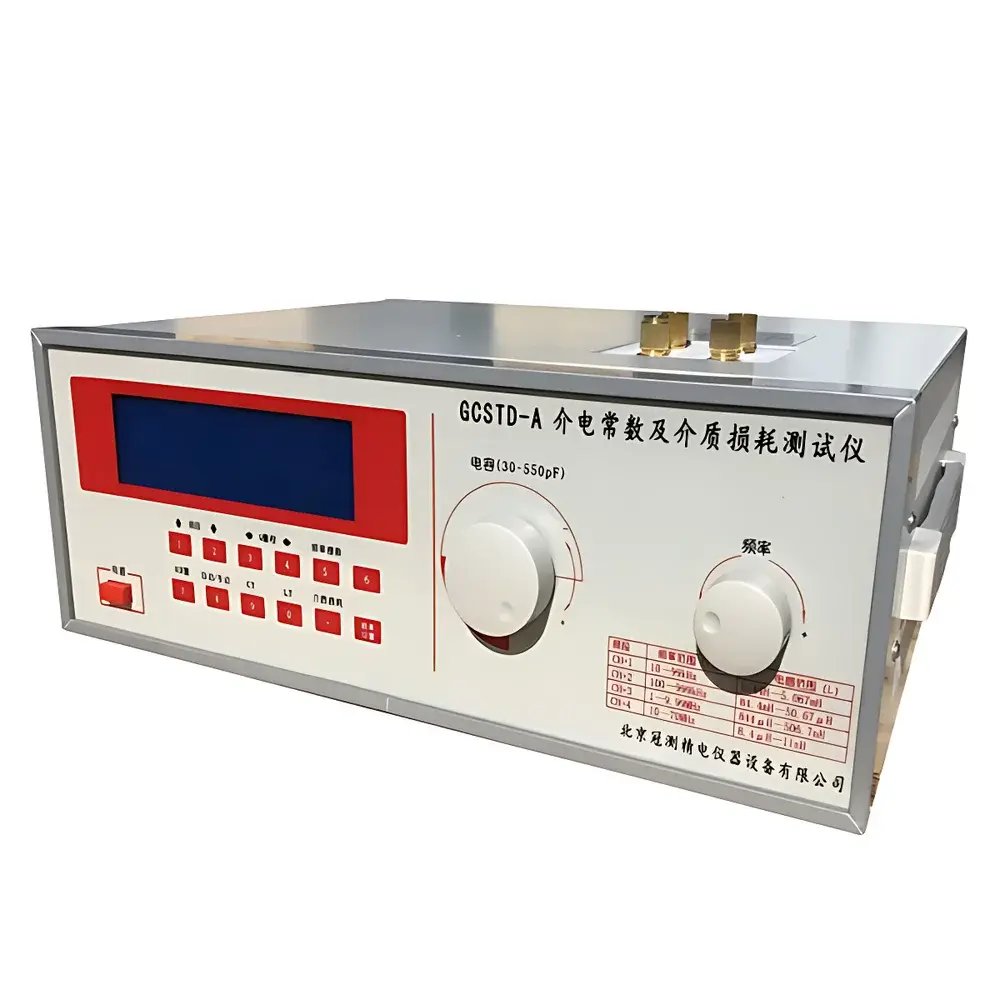
GuanCe GCSTD-AB3 Dielectric Constant and Dissipation Factor Analyzer
| Brand | GuanCe Instruments |
|---|---|
| Origin | Beijing, China |
| Manufacturer Type | Authorized Distributor |
| Country of Origin | China |
| Model | GCSTD-AB3 |
| Price | USD 270 (FOB) |
| Test Frequency Range | 10 kHz – 10 MHz (typical for AB3 variant) |
| Measurement Principle | High-Frequency Resonance Method (Q-meter based) |
| Display | Digital LCD with Auto-Resonance Search & Frequency Locking |
| Supported Sample Forms | Solid, Liquid, Powder |
| Standard Electrode Diameter | Φ38 mm |
| Solid Sample Thickness Range | 0.5–15 mm |
| Liquid Cell Dimensions | Φ48 mm ID × 7 mm depth (optional) |
| Operating Temperature | 0–40 °C |
| Relative Humidity | <80% RH |
| Power Supply | 220 V ±10%, 50 Hz ±2.5 Hz |
| Power Consumption | ~25 W |
| Net Weight | ~7 kg |
| Dimensions (L×W×H) | 380 × 280 × 132 mm |
Overview
The GuanCe GCSTD-AB3 Dielectric Constant and Dissipation Factor Analyzer is a precision impedance measurement system engineered for the quantitative characterization of dielectric properties in non-metallic materials. It operates on the high-frequency resonance principle—specifically, a digitally stabilized Q-meter architecture—enabling accurate determination of relative permittivity (εr) and dielectric loss tangent (tan δ) across a defined frequency band (10 kHz to 10 MHz, typical for the AB3 configuration). Unlike broadband impedance analyzers or time-domain reflectometry systems, the GCSTD-AB3 employs automatic resonance tracking with digital frequency locking, minimizing residual inductance in the tuning circuit and ensuring high reproducibility in Q-factor-based calculations. This methodology conforms to fundamental electromagnetic theory for lossy dielectrics under sinusoidal excitation, where tan δ = σ/(ωε′), and εr = Cx/C0, with Cx measured against a vacuum or air reference capacitor. The instrument is calibrated for use with standardized electrode geometries and is optimized for R&D environments requiring traceable, repeatable data under controlled laboratory conditions.
Key Features
- Digital frequency synthesis with automatic resonance point detection and real-time Q-value ranging
- Integrated microcontroller-based control system with auto-stabilized excitation amplitude and harmonic suppression
- Multi-range impedance measurement capability: capacitance (0.1 pF – 1 µF), inductance (0.1 µH – 100 mH), and series/parallel resistance (1 Ω – 10 MΩ)
- Standardized Φ38 mm parallel-plate electrode assembly for solids; optional liquid cell (Φ48 mm ID × 7 mm depth) and powder-compatible fixtures
- Low-residual-inductance resonant cavity design, reducing parasitic phase error and improving tan δ resolution at elevated frequencies
- Compliance-ready firmware architecture supporting manual audit trails and calibration log retention (user-maintained)
Sample Compatibility & Compliance
The GCSTD-AB3 accommodates solid dielectrics (ceramics, polymers, composites), insulating liquids (transformer oils, silicone fluids), and compacted powders—provided sample geometry meets dimensional specifications (e.g., solid thickness 0.5–15 mm, flatness ≤ 0.02 mm). Its measurement protocol aligns with multiple national and international standards: GB/T 1409–2006 (equivalent to IEC 60250), GB/T 5654–2007 (liquid dielectrics), GB/T 21216–2007 (conductive/lossy liquid characterization), GB/T 1693–2007 (vulcanized rubber), and GB/T 5594.4–1985 (electronic structural ceramics). While not pre-certified for FDA 21 CFR Part 11 or ISO/IEC 17025 accreditation, the instrument’s deterministic measurement workflow, stable analog front-end, and repeatable mechanical fixtures support GLP-compliant data generation when operated within documented SOPs—including environmental monitoring (23 ± 2 °C, <65% RH) and periodic verification using NIST-traceable reference capacitors.
Software & Data Management
The GCSTD-AB3 operates as a standalone benchtop instrument with embedded firmware—no PC dependency required for core measurements. All parameters (frequency, C, L, Q, Rs, Rp, tan δ, εr) are displayed in real time on a high-contrast LCD interface with unit-aware numeric formatting. Data export is manual via recorded operator logs; no proprietary software or USB/RS-232 interface is included in the base configuration. Users may integrate the instrument into automated test sequences using external GPIB or analog voltage output modules (available as third-party add-ons). For regulatory environments, laboratories are advised to implement supplementary documentation controls—including raw reading logs, electrode cleaning records, temperature/humidity logs, and annual verification reports—to satisfy internal QA requirements or external audit expectations (e.g., ISO 9001 clause 7.6).
Applications
- Quality assurance of ceramic capacitor dielectrics (e.g., BaTiO3-based formulations) during sintering process development
- Comparative evaluation of polymer matrix resins (epoxy, polyimide) for printed circuit board laminates
- Stability assessment of insulating oils under thermal aging per IEC 60156 protocols
- Research on ferroelectric thin films and multilayer ceramic structures where εr dispersion correlates with domain dynamics
- Educational labs demonstrating Maxwell-Wagner interfacial polarization in composite dielectrics
- Pre-screening of additive effects (e.g., nanofillers, plasticizers) on bulk dielectric loss mechanisms
FAQ
What frequency range does the GCSTD-AB3 cover?
The AB3 model is configured for operation from 10 kHz to 10 MHz, with discrete test points selectable via front-panel controls. Frequency accuracy is maintained within ±0.1% of set value using digital phase-locked loop (PLL) synthesis.
Can the instrument measure low-loss materials (tan δ < 10−4)?
Yes—within its specified frequency band and with proper electrode shielding and grounding, the system achieves tan δ resolution down to approximately 5 × 10⁻⁴ for samples with εr > 2.5 and thickness uniformity ≤ ±1% across the electrode area.
Is calibration certificate included with shipment?
A factory calibration report (non-accredited) is supplied, listing verification points against reference standards. NIST-traceable calibration is available upon request at additional cost and lead time.
How is electrode contact resistance compensated?
The instrument applies series-equivalent circuit modeling during calculation; users must select “series mode” for thin-film or high-resistivity samples to minimize contact-induced error in tan δ interpretation.
Does it support ASTM D150 testing protocols directly?
It satisfies all electrical and procedural requirements of ASTM D150–20 (Section 7–9), including electrode geometry, guard ring implementation (via optional accessory), and ambient conditioning. Full compliance requires user-defined test plans referencing relevant clauses.
Related Products



