
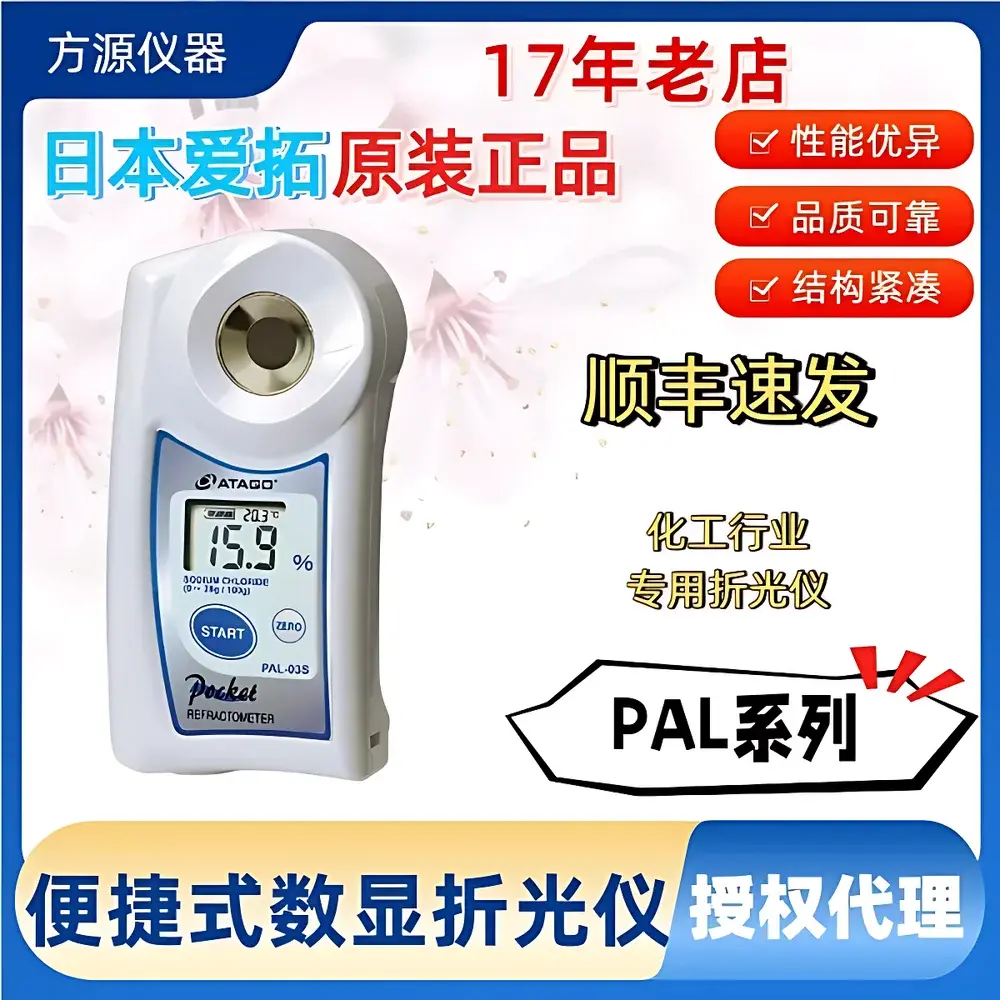
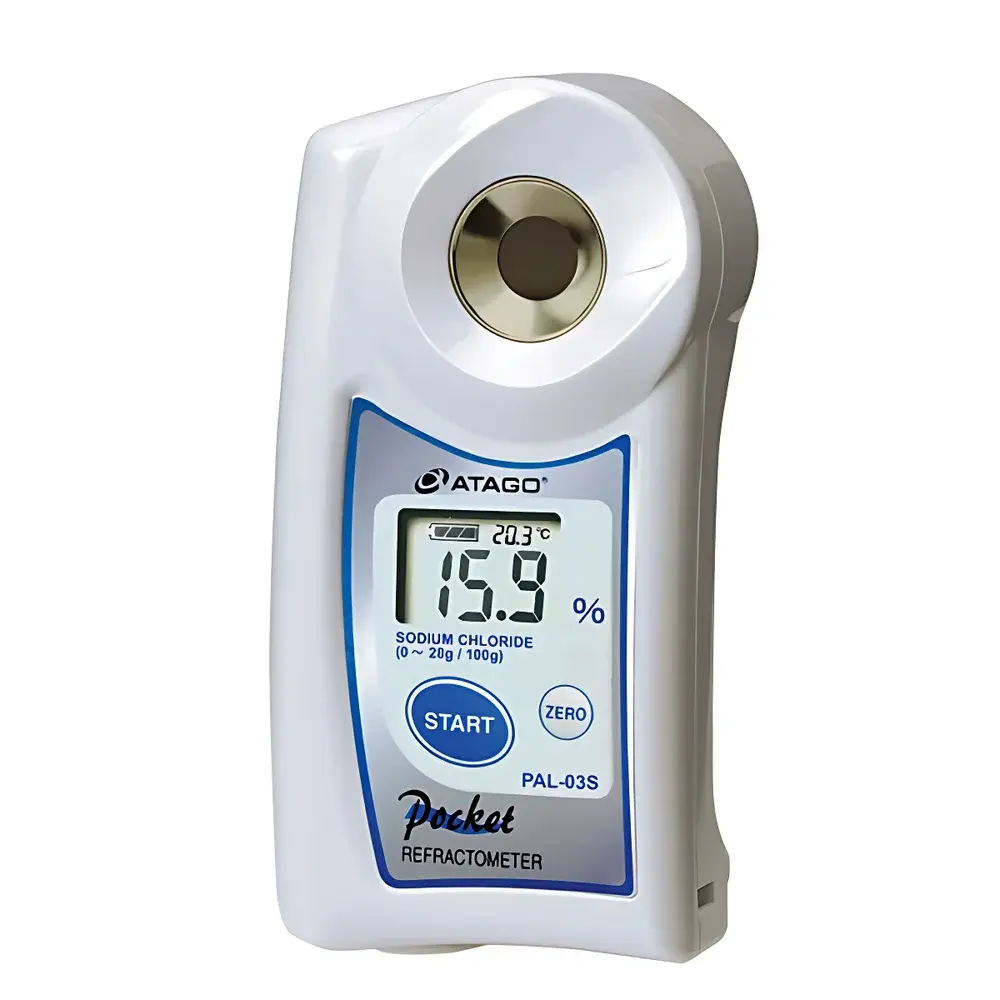

ATAGO PAL Series Industrial-Grade Portable Digital Refractometer
| Brand | ATAGO |
|---|---|
| Origin | Japan |
| Model | PAL Series (Industrial Chemical Application) |
| Type | Handheld Refractometer |
| Display | Digital LCD |
| Temperature Compensation | None |
| Measurement Range | 0.0–45.0% (w/w, Brix-equivalent scale) |
| Accuracy | ±0.4% |
| IP Rating | Dust- and Water-Resistant (IP65 compliant per ATAGO standard specifications) |
Overview
The ATAGO PAL Series Industrial-Grade Portable Digital Refractometer is a precision optical instrument engineered for rapid, on-site concentration measurement in chemical manufacturing, quality control laboratories, and field service environments. Based on the fundamental principle of critical angle refractometry—where the refractive index of a liquid sample is determined by measuring the angle at which light undergoes total internal reflection at the prism-sample interface—the PAL Series delivers repeatable, traceable measurements without requiring solvent calibration or complex alignment procedures. Unlike laboratory benchtop refractometers, this handheld device integrates a high-stability sapphire-coated measuring prism, temperature-insensitive optical path design, and real-time digital signal processing to maintain measurement integrity across ambient operating conditions (10–40 °C). While it does not feature active temperature control or Peltier-based thermal regulation, its optical architecture compensates for minor thermal drift through factory-calibrated algorithms aligned with ISO 21748 and ASTM D1218 standards for refractive index determination.
Key Features
- Compact, ergonomic housing constructed from impact-resistant polycarbonate with IP65-rated sealing—suitable for use in industrial production floors, storage warehouses, and outdoor sampling points.
- Digital LCD display with backlight illumination ensures legibility under low-light conditions and during extended shift operations.
- One-button operation: automatic zeroing (START ZERO function), single-point calibration verification, and immediate readout in % (w/w) units—optimized for routine QC checks rather than research-grade metrology.
- Sapphire-coated glass prism provides exceptional scratch resistance and long-term optical stability, minimizing maintenance frequency and recalibration intervals.
- Battery-powered operation (2 × AAA alkaline cells) supports up to 10,000 measurements per set; auto-power-off after 3 minutes of inactivity conserves energy without compromising workflow continuity.
Sample Compatibility & Compliance
The PAL Series is validated for aqueous solutions commonly encountered in industrial chemical applications—including glycol-water mixtures, acid/base dilutions, surfactant formulations, and polymer emulsions—provided samples are optically clear and free of suspended particulates. Viscosity limits are defined by capillary flow dynamics on the prism surface; samples exceeding 500 mPa·s require pre-dilution or alternative sampling protocols. Device compliance includes conformity with IEC 61000-4 electromagnetic immunity standards and RoHS Directive 2011/65/EU. While not certified for hazardous area use (ATEX/IECEx), its non-sparking enclosure and low-voltage circuitry meet general-purpose safety requirements for Zone 2 environments per EN 60079-0. Documentation packages support GLP-compliant recordkeeping when paired with external logging systems.
Software & Data Management
This refractometer operates as a standalone measurement tool with no embedded Bluetooth, USB, or wireless connectivity. All data remain local to the device display only; no onboard memory or export functionality is provided. For audit-trail compliance in regulated industries (e.g., ISO 9001-certified facilities), users must manually transcribe readings into LIMS or paper-based batch records. Calibration history and operator ID fields are not supported; therefore, adherence to internal SOPs governing instrument identification, calibration frequency (recommended daily pre-shift verification), and environmental monitoring logs is essential for regulatory readiness under FDA 21 CFR Part 11 or EU Annex 11 frameworks.
Applications
- Routine verification of incoming raw material concentration (e.g., ethylene glycol antifreeze blends, sodium hydroxide solutions).
- In-process monitoring of reaction mixture density during batch synthesis where refractive index correlates linearly with solute mass fraction.
- Final product release testing for consistency of water-miscible coolants, cleaning agents, and corrosion inhibitors.
- Field validation of formulation stability following transport or long-term storage—particularly where phase separation or hydration loss may occur.
- Supporting technical service teams during customer site audits, troubleshooting, and specification verification against contractual delivery parameters.
FAQ
Does the PAL Series support temperature-controlled measurements?
No. This model lacks integrated thermoelectric cooling or heating elements. Measurements are performed at ambient sample temperature, and no automatic temperature compensation algorithm is applied.
Can it measure non-aqueous solvents such as acetone or toluene?
Not recommended. The calibration curve is optimized for aqueous systems exhibiting Brix-like refractive behavior. Non-polar solvents produce erroneous readings due to divergent dispersion characteristics and potential prism coating degradation.
What is the required sample volume per measurement?
Approximately 0.3 mL is sufficient to fully cover the prism sensing area; excess fluid is contained by the integrated sample well geometry.
Is third-party calibration certification available?
Yes—ATAGO-accredited service centers provide NIST-traceable calibration reports upon request, including uncertainty budgets per ISO/IEC 17025:2017 requirements.
How often should the prism be cleaned between samples?
After every measurement when analyzing viscous, volatile, or residue-forming substances; use lint-free wipes and reagent-grade isopropanol followed by air drying—never abrasive cloths or ultrasonic baths.




