
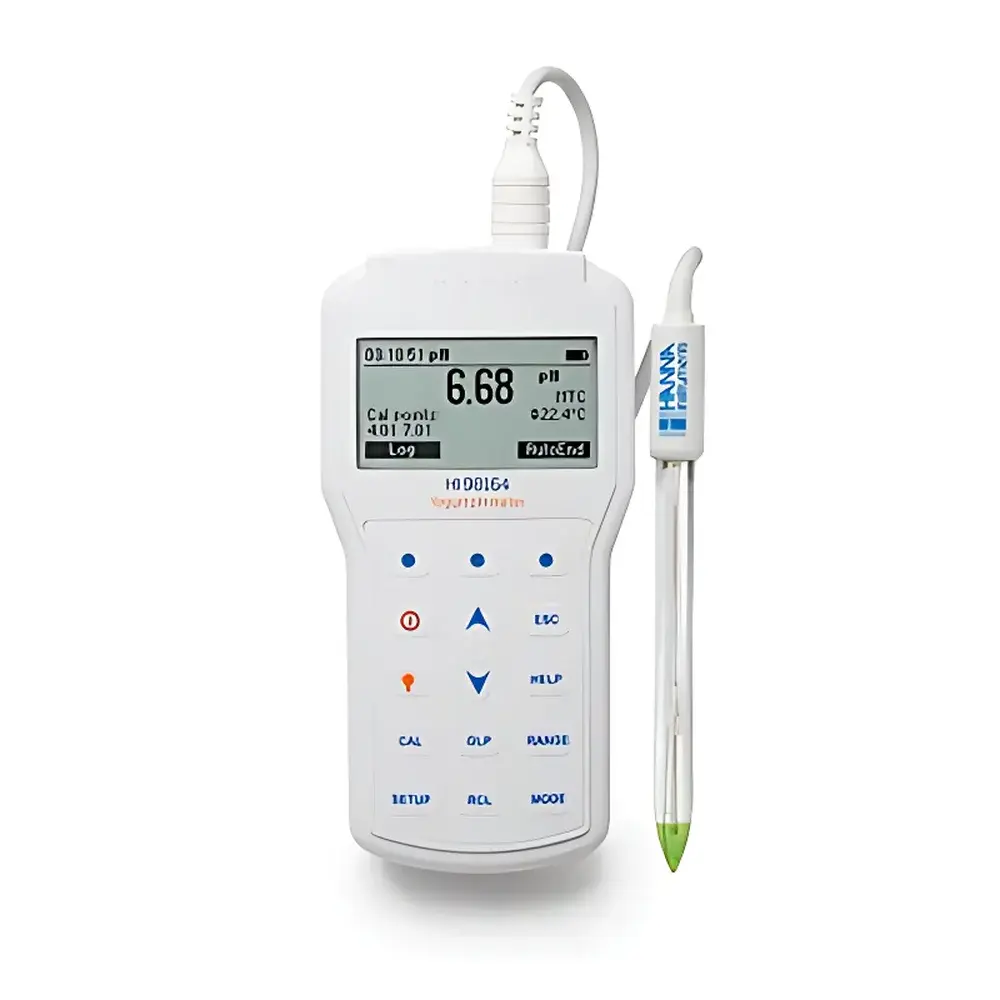
Hanna Instruments HI98164 Portable pH/mV/Temperature Meter for Yogurt Production
| Brand | Hanna Instruments |
|---|---|
| Origin | Italy |
| Model | HI98164 |
| pH Range | –2.000 to 20.000 |
| mV Range | ±2000.0 |
| Temperature Range | –20.0 to 120.0 °C |
| Resolution | 0.001 pH / 0.1 mV / 0.1 °C |
| Accuracy | ±0.002 pH / ±0.2 mV / ±0.4 °C |
| Calibration | Up to 5-point auto-recognizing and 5-point user-defined, with 7 built-in NIST-traceable buffer points |
| Electrode | FC2133 conical-tip pH electrode with integrated amplifier and PT1000 temperature sensor |
| Data Logging | 200 records (100 pH + 100 mV) |
| Interface | USB (HI92000-15 software compatible) |
| Protection Rating | IP67 |
| Power | 4×AAA batteries (BEPS low-battery warning) |
| Auto-off | Configurable (5/10/30/60 min or disabled) |
Overview
The Hanna Instruments HI98164 is a high-precision, portable benchtop-grade pH/mV/temperature meter engineered specifically for quality control in fermented dairy applications—particularly yogurt production. It operates on the principle of potentiometric measurement using a glass electrode system compliant with ISO 3696 (Grade 2 water), ASTM D1293, and USP for pH determination. The instrument integrates a proprietary conical-tip pH electrode (FC2133) with an embedded solid-state amplifier and a high-stability PT1000 temperature sensor, enabling true automatic temperature compensation (ATC) across the full operational range (–20.0 to 120.0 °C). Its extended pH range (–2.000 to 20.000) accommodates highly acidic whey fractions, alkaline cleaning-in-place (CIP) solutions, and post-fermentation neutralization stages—critical for HACCP-aligned process verification in ISO 22000-certified facilities.
Key Features
- Five-point auto-recognizing calibration with seven preloaded NIST-traceable buffer values (1.68, 4.01, 6.86, 7.01, 9.18, 10.01, 12.45 pH), supporting both standard and custom calibration sequences per ISO/IEC 17025 internal calibration protocols.
- Sensor Check™ diagnostic function provides real-time electrode health assessment—including slope (%), offset (mV), and response time—enabling proactive maintenance and reducing measurement uncertainty in GLP-compliant environments.
- Auto-endpoint locking algorithm stabilizes readings within ±0.001 pH/sec drift threshold, eliminating operator-dependent interpretation errors during batch release testing.
- GLP-compliant data management: timestamped calibration logs (date, time, buffer IDs, slope, offset) stored internally and exportable via USB to HI92000-15 software for 21 CFR Part 11–enabled audit trails.
- IP67-rated enclosure ensures resistance to splash, steam, and condensation common in dairy processing rooms; validated for continuous operation at 100% RH and ambient temperatures up to 50 °C.
- Battery Error Prevention System (BEPS) triggers visual alert at ≤5% remaining charge, preventing data corruption during critical pH titration steps in acidification monitoring.
Sample Compatibility & Compliance
The HI98164 is optimized for direct immersion measurement of liquid and semi-solid dairy matrices including raw milk, starter cultures, fermenting curd, finished yogurt, whey permeate, and caustic soda (NaOH) or nitric acid (HNO₃) CIP rinse solutions. Its FC2133 electrode features a low-resistance conical glass junction designed to minimize clogging from protein fouling and fat deposition—validated per AOAC 984.27 for dairy product pH analysis. The instrument meets IEC 61000-4 electromagnetic compatibility standards and conforms to EN 61326-1 for laboratory equipment used in industrial settings. All calibration buffers are certified to ISO/IEC 17025-accredited reference material specifications.
Software & Data Management
Data acquisition and traceability are supported through the HI92000-15 Windows-based software suite, which enables structured export of measurement records (pH/mV/°C), calibration history, and Sensor Check™ diagnostics into CSV or PDF formats. The software supports configurable user roles, electronic signatures, and audit trail generation aligned with FDA 21 CFR Part 11 requirements for electronic records and signatures. Internal memory stores up to 200 measurements (100 pH + 100 mV), each tagged with date/time stamp, temperature reading, and electrode status flag—facilitating rapid root-cause analysis during non-conformance investigations.
Applications
- Real-time monitoring of lactic acid fermentation kinetics during yogurt incubation (target pH 4.4–4.6).
- Verification of acidification endpoint prior to cooling and fruit addition.
- Validation of cleaning solution concentration (pH >12.0 for NaOH; pH <2.0 for HNO₃) in CIP cycle documentation.
- Quality assurance of whey separation pH stability (typically 5.8–6.2) in ultrafiltration feed streams.
- Batch release testing per ISO 22000 Clause 8.4.2 and Codex Alimentarius Standard CXS 221-2003 for fermented milks.
FAQ
Is the HI98164 compliant with FDA 21 CFR Part 11 for electronic records in regulated dairy manufacturing?
Yes—when used with HI92000-15 software configured with user authentication, audit trail logging, and electronic signature enforcement.
Can the FC2133 electrode be used for measuring viscous yogurt samples without recalibration?
Yes—the conical tip and open-junction design maintain stable response in high-viscosity matrices; however, rinsing with deionized water between samples is required per AOAC guidelines.
Does the instrument support manual temperature input if the probe is damaged?
No—temperature compensation is exclusively automatic via the integrated PT1000 sensor; manual entry is intentionally omitted to prevent human error in critical control points.
What is the recommended recalibration frequency for routine yogurt QC?
Per ISO/IEC 17025, recalibrate before each analytical session and after every 10 measurements—or immediately following exposure to extreme pH (12) solutions.
How does BEPS prevent data loss during battery depletion?
BEPS initiates a 60-second grace period upon detection of ≤5% charge, during which all active measurements complete and internal memory is safely flushed before shutdown.
Related Products



