
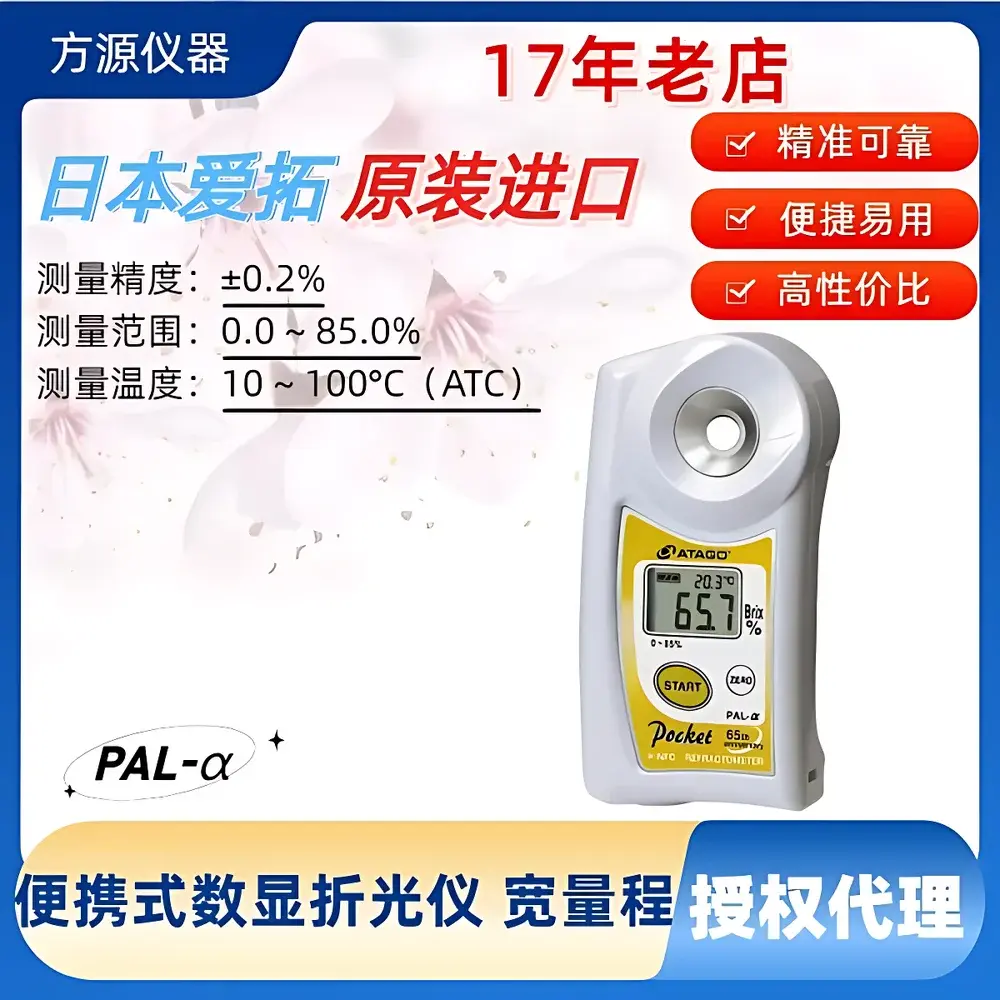
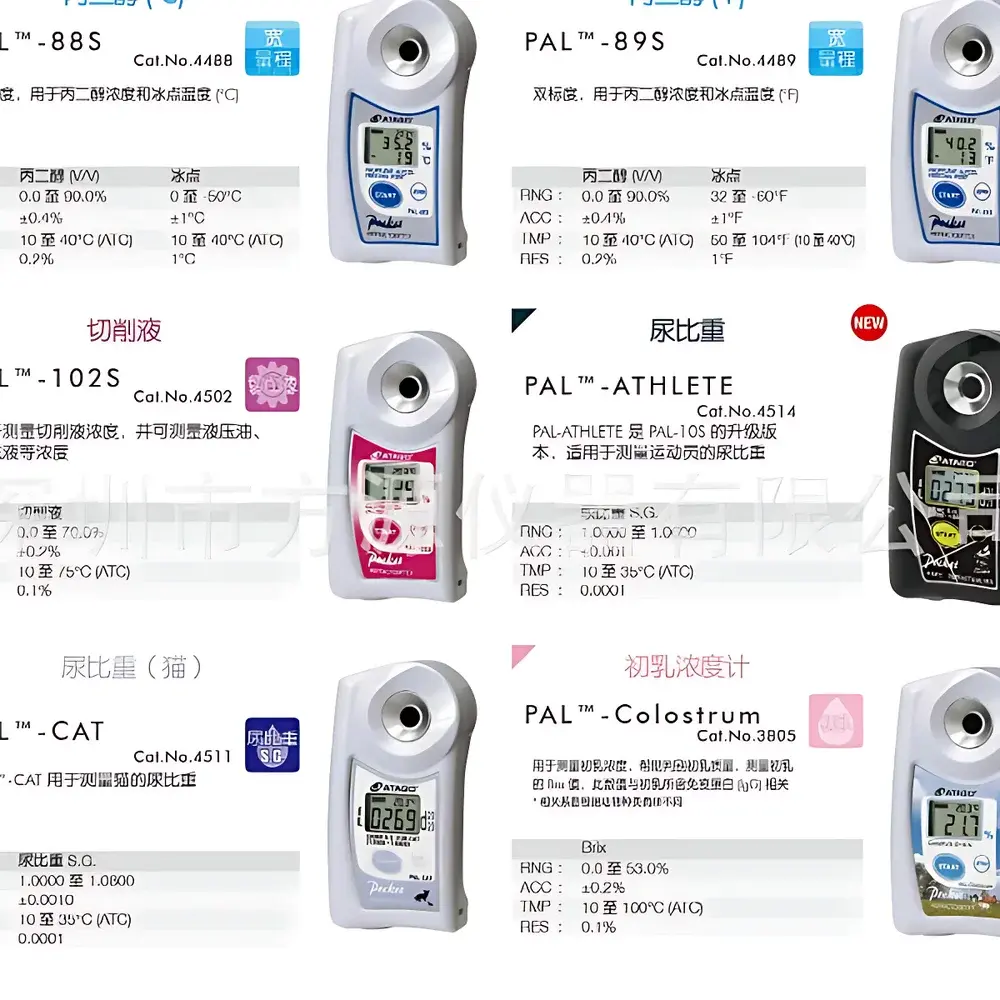
ATAGO PAL-α Wide-Range Digital Portable Refractometer
| Brand | ATAGO |
|---|---|
| Origin | Japan |
| Model | PAL-α Wide-Range |
| Type | Handheld Refractometer |
| Measurement Range | 0.0–85.0% (Brix or custom scale) |
| Accuracy | ±0.002 Brix units |
| Display | Digital LCD |
| Temperature Control | None |
| Compliance | CE, JIS K 0063, ISO 2173 |
Overview
The ATAGO PAL-α Wide-Range Digital Portable Refractometer is an optical measurement instrument engineered for rapid, field-deployable quantification of soluble solids concentration—primarily expressed as Brix (% w/w sucrose equivalent)—in liquid and semi-liquid samples. It operates on the fundamental principle of critical angle refractometry: incident light passes through a prism-sample interface, and the resulting refraction angle is measured via an internal photodiode array. This angle correlates directly with the sample’s refractive index (RI), which—under controlled temperature and standardized calibration—is converted to concentration using empirically validated polynomial algorithms embedded in firmware. Designed for routine quality control in food processing, beverage production, agricultural supply chains, and laboratory support environments, the PAL-α delivers high reproducibility across its extended 0.0–85.0% measurement range without requiring external power sources beyond its built-in battery.
Key Features
- Wide dynamic range of 0.0–85.0% Brix (or user-selectable alternate scales), enabling single-instrument deployment across diverse matrices—from low-sugar fruit juices to high-concentration jams, syrups, and brines.
- Digital LCD display with automatic zero-point compensation and real-time temperature compensation (ATC) based on integrated thermistor readings (calibrated per JIS K 0063 for 10–40°C ambient operation).
- Robust ergonomic housing rated IP65 for dust and water resistance, supporting use in humid production floors, cold storage rooms, orchards, and mobile inspection vehicles.
- Pre-programmed multi-scale functionality: over 50 application-specific scales—including TDS for coffee, Oechsle for grape must, Plato for wort, NaCl g/100g for brine, and ethanol % v/v for distilled spirits—accessible via intuitive button navigation.
- No external calibration hardware required; factory calibration traceable to NIST-traceable sucrose standards, with optional user recalibration using ATAGO-certified reference solutions (e.g., 0.0%, 10.0%, 50.0% Brix).
Sample Compatibility & Compliance
The PAL-α accommodates viscous, particulate-laden, and temperature-sensitive samples typical in food manufacturing—including fruit pulps, jam fillings, dairy concentrates, soy-based beverages, and fermented liquors—without clogging or optical interference. Its sapphire-coated prism resists scratching and chemical degradation from organic acids, alcohols, and saline solutions. The instrument complies with Japanese Industrial Standard JIS K 0063 (Refractometers for Sugar Solutions), aligns with ISO 2173:2003 (Fruit and vegetable products — Determination of soluble solids content — Refractometric method), and supports GLP-compliant documentation when paired with ATAGO’s optional data logging accessories. While not FDA 21 CFR Part 11 certified as a standalone unit, its measurement output is suitable for inclusion in auditable QC records under ISO/IEC 17025-accredited laboratories.
Software & Data Management
The PAL-α operates as a self-contained measurement node with no onboard memory or USB connectivity. However, it integrates seamlessly into enterprise QA workflows via optional accessories: the PAL-Link cable enables serial output to PCs running ATAGO’s free PAL-Data software (Windows-compatible), supporting CSV export, batch reporting, statistical process control (SPC) charting, and audit-ready timestamped logs. All scale selections, calibration events, and measurement history are retained within the software environment—not the device—ensuring full traceability for internal audits and regulatory inspections. Firmware updates are distributed through ATAGO’s global service network and require authorized service center intervention.
Applications
- Fruit processing: Real-time Brix verification during juice extraction, concentrate evaporation, and jam cooking to ensure consistent sweetness and shelf-stable water activity.
- Beverage formulation: Rapid verification of sugar-to-acid ratios in soft drinks, craft sodas, and ready-to-drink teas; ethanol screening in spirits post-distillation.
- Dairy & plant-based alternatives: Monitoring lactose, maltose, or sucrose content in whey permeate, yogurt bases, and oat milk formulations.
- Agricultural extension: On-site ripeness assessment of citrus, tomatoes, and grapes using crop-specific Brix thresholds correlated with flavor development and harvest timing.
- Seafood & preservation: Quantifying salt concentration (g/100g NaCl) in curing brines and verifying freeze-point depression in chilled transport media.
FAQ
What temperature range is supported for accurate measurements?
The PAL-α performs automatic temperature compensation between 10°C and 40°C. Measurements outside this range require manual correction using published RI–temperature coefficients or re-equilibration of the sample to within specification.
Can the PAL-α measure non-sugar solutes like sodium chloride or ethanol accurately?
Yes—via preloaded application-specific scales calibrated against primary reference materials. Each scale applies a unique RI-to-concentration conversion algorithm validated for its target analyte matrix (e.g., NaCl g/100g, ethanol % v/v).
Is the instrument suitable for GMP-regulated environments?
While the PAL-α itself lacks electronic audit trail capabilities, its measurement methodology, calibration traceability, and compatibility with PAL-Data software enable integration into GMP-aligned processes where raw data capture and reviewer approval protocols are externally managed.
How often should calibration be verified?
ATAGO recommends daily verification with at least one standard solution before first use and after any significant ambient temperature shift; full recalibration is advised every 3 months or per internal SOP requirements.
Does the PAL-α require periodic prism cleaning?
Yes—residue buildup affects optical path integrity. Clean the sapphire prism after each sample using lint-free tissue and distilled water or ATAGO-recommended prism cleaner (e.g., PAL™-Cleaner); avoid abrasive solvents or cotton swabs.





