
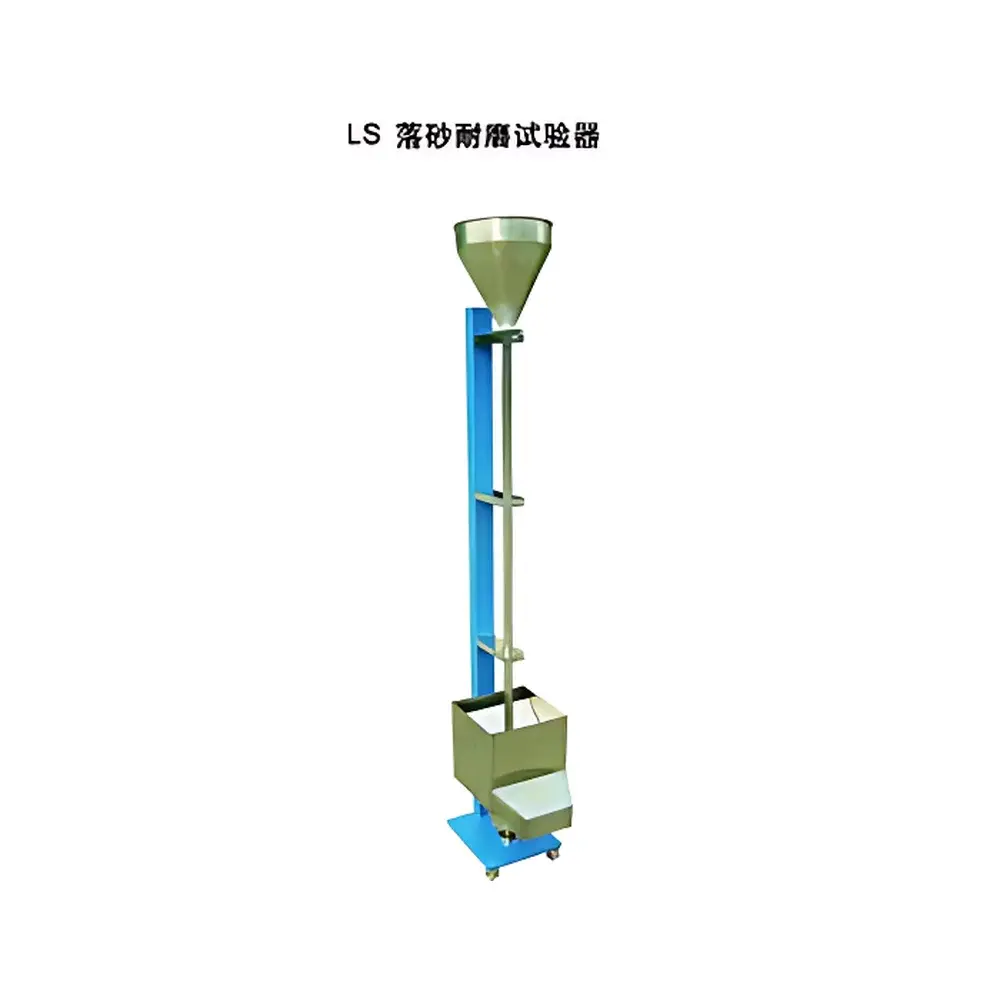
LS Tribological Tester – LS Sand Abrasion Resistance Tester
| Origin | Shanghai, China |
|---|---|
| Manufacturer Type | Authorized Distributor |
| Origin Category | Domestic (China) |
| Model | LS |
| Pricing | Available Upon Request |
| Overall Dimensions | 230 mm × 200 mm × 1500 mm (L × W × H) |
| Sand Delivery Tube Length | 914 mm (36 in) |
| Tube Internal Diameter | 19 mm (0.75 in) |
| Net Weight | 25 kg |
Overview
The LS Sand Abrasion Resistance Tester is a precision-engineered tribological testing instrument designed to quantitatively evaluate the abrasion resistance of organic coatings—such as paints, varnishes, and polymer films—under standardized gravity-fed sand flow conditions. Operating on the principle of controlled abrasive wear via calibrated free-fall sand impact, the device measures coating durability by determining the volume or mass of abrasive medium required to wear through a defined film thickness. This gravimetric abrasion methodology is grounded in established physical wear mechanics, where material loss is directly correlated with cumulative kinetic energy transfer from falling abrasive particles. The tester complies with ASTM D968–83 (Standard Test Method for Abrasion Resistance of Organic Coatings by Falling Abrasive), a widely accepted benchmark in industrial quality assurance, and JG/T 133–2000 (Technical Specification for Aluminum Alloy Building Curtain Walls), reflecting its applicability in architectural coating validation within regulated construction material frameworks.
Key Features
- Robust structural design with vertical aluminum alloy frame and stable base assembly, engineered for consistent sand trajectory alignment and minimal vibration-induced deviation.
- Precision-machined brass sand delivery tube (19 mm internal diameter, 914 mm length) ensures laminar, unobstructed abrasive flow and repeatable particle acceleration profile per ASTM D968 requirements.
- Integrated sample holder accommodates standard 100 mm × 150 mm coated test panels; clamping mechanism maintains perpendicular orientation relative to sand stream axis within ±0.5° tolerance.
- Modular sand reservoir with adjustable gate valve enables precise control over sand discharge rate, facilitating method reproducibility across operator shifts and laboratory sites.
- Non-corrosive stainless steel collection tray with graduated volume markings (0–1000 mL) supports direct volumetric measurement of abraded material or post-test gravimetric analysis using analytical balances (not included).
- Compliance-ready mechanical architecture—no embedded firmware or digital controls—ensures full traceability and audit compatibility under GLP and ISO/IEC 17025 environments.
Sample Compatibility & Compliance
The LS Tester accepts rigid, flat substrates with uniform coating thickness (typically 25–125 µm, as verified by magnetic induction or eddy current gauges). Compatible substrates include cold-rolled steel, aluminum alloy, and glass panels prepared per ASTM D2243 and ISO 1514. Coating systems tested include epoxy, polyurethane, acrylic, and fluoropolymer finishes used in automotive OEM, aerospace maintenance, and architectural cladding applications. Conformance to ASTM D968–83 is achieved through strict adherence to specified sand type (ASTM E11 Standard Sand, graded 16/20 mesh, SiO₂ ≥99.5%), drop height (152 mm above specimen surface), and flow rate calibration (target: 1.5–2.5 L/min, verified prior to each test series). While not an electronic data-generating system, the instrument’s mechanical repeatability supports full compliance with FDA 21 CFR Part 11 when paired with validated manual documentation workflows and controlled lab notebooks.
Software & Data Management
The LS Sand Abrasion Resistance Tester operates exclusively as a mechanical test platform with no integrated electronics, firmware, or software components. All operational parameters—including sand batch lot number, ambient temperature/humidity (recorded per ISO 2812-1), pre- and post-test coating thickness, and cumulative sand volume consumed—are documented manually in laboratory notebooks or LIMS-integrated electronic records. This analog architecture eliminates cybersecurity vulnerabilities and simplifies IQ/OQ/PQ validation for regulated environments. Users may employ third-party spreadsheet templates (e.g., Excel-based ASTM D968 calculation sheets) to compute abrasion resistance index (mL/µm or g/µm), generate trend charts, and archive raw data in accordance with internal QA protocols and ISO/IEC 17025 clause 7.5.2 (Control of Records).
Applications
- Quality control of coil-coated metal sheets in continuous manufacturing lines.
- Comparative evaluation of anti-graffiti and UV-stabilized facade coatings for high-traffic urban infrastructure.
- R&D screening of novel crosslinker chemistries in waterborne acrylic systems.
- Third-party certification testing for EN 13523-8 (Coil Coated Metals — Test Methods — Part 8: Resistance to Abrasion).
- Supplier qualification audits requiring physical evidence of coating robustness under simulated sandstorm exposure.
FAQ
What standard sand is recommended for use with the LS Tester?
ASTM E11 Standard Sand (16/20 mesh, nominal particle size 0.85–1.18 mm) is required for ASTM D968–83 compliance. Certified reference sand must be sourced from accredited suppliers and accompanied by CoA verifying SiO₂ content and particle size distribution.
Can the LS Tester be used for non-organic materials such as ceramic coatings or anodized layers?
While not explicitly covered by ASTM D968, empirical adaptation is possible with protocol modification and inter-laboratory correlation studies; however, results are considered comparative only and must be clearly qualified in test reports.
Is calibration certification provided with the instrument?
The LS Tester requires no periodic calibration per ASTM D968, but users must verify tube dimensions (ID/length), vertical alignment, and sand flow rate before initial use and at least daily during extended test campaigns.
Does the unit include sand or require separate procurement?
Sand is not supplied with the instrument and must be ordered separately as a consumable; recommended storage: desiccated environment at 23 ± 2°C and 50 ± 5% RH.
How is abrasion resistance quantified from test output?
Resistance is expressed as the volume (mL) or mass (g) of sand required to expose the substrate through the coating layer, normalized to measured dry film thickness (µm), yielding units of mL/µm or g/µm—lower values indicate superior abrasion resistance.



