
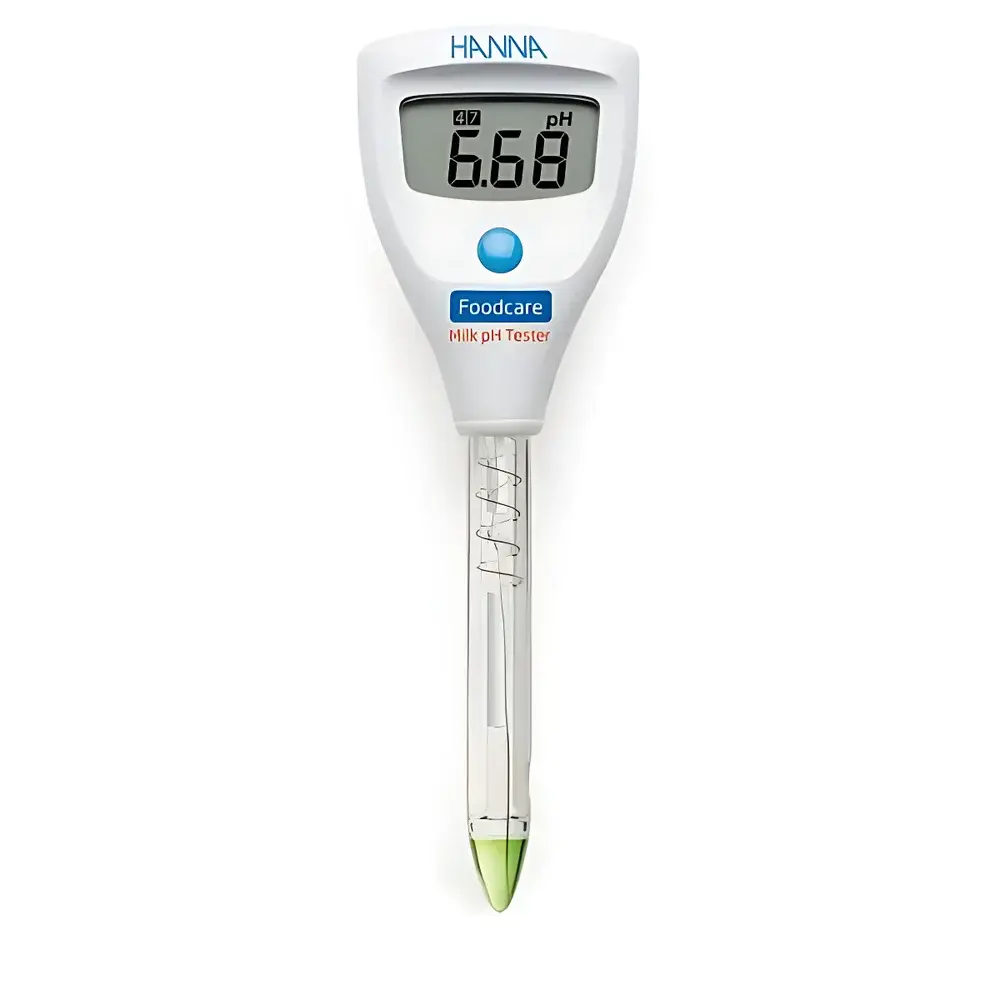
Hanna HI981034 Foodcare Milk pH Tester
| Brand | Hanna Instruments |
|---|---|
| Origin | Italy |
| Model | HI981034 |
| Application | Dedicated pH measurement for raw, pasteurized, and UHT milk and dairy products |
| Calibration | Automatic 1- or 2-point calibration with buffer recognition |
| Electrode Type | Integrated, food-grade, conical-tip pH electrode with built-in temperature sensor (ATC) |
| IP Rating | IP67 dust- and water-resistant housing |
| Power | 4 × AAA batteries (approx. 200 hours continuous use) |
| Display | Large LCD with backlight, dual-level pH and temperature readout |
| Compliance | Designed to meet ISO 5725 (accuracy/repeatability), AOAC Official Method 987.04 (milk pH), and FDA Grade A Pasteurized Milk Ordinance (PMO) Annex G requirements |
Overview
The Hanna HI981034 Foodcare Milk pH Tester is a purpose-built, handheld pH meter engineered exclusively for the rapid, accurate, and repeatable measurement of pH in liquid dairy matrices—including raw milk, pasteurized milk, ultra-high-temperature (UHT) treated milk, whey, and reconstituted powdered milk. Unlike general-purpose pH meters, the HI981034 implements a specialized electrochemical architecture optimized for high-fat, protein-rich, and low-conductivity samples that commonly cause electrode fouling, slow response, or drift in conventional sensors. Its integrated conical-tip pH electrode features a food-grade, open-junction reference system with a ceramic frit designed to resist clogging by casein micelles and fat globules, while the built-in thermistor enables automatic temperature compensation (ATC) across the full dairy-relevant range (0 to 50 °C). The device operates on the fundamental principle of potentiometric pH measurement—detecting the potential difference between a pH-sensitive glass membrane and a stable reference electrode—calibrated against standardized dairy buffers (e.g., pH 4.01 and 6.86 at 25 °C) traceable to NIST.
Key Features
- Dedicated dairy calibration protocol with automatic buffer recognition for pH 4.01 and 6.86—eliminating manual buffer selection errors and ensuring compliance with AOAC 987.04 and PMO Annex G procedures.
- Conical-tip, open-junction pH electrode with food-grade stainless steel body and ceramic junction—engineered for mechanical durability during frequent immersion in viscous milk and resistance to protein adsorption.
- IP67-rated enclosure with sealed keypad and gasketed battery compartment—certified for operation in cold-room environments, wet processing areas, and mobile field testing without risk of ingress-related failure.
- Large backlit LCD displaying simultaneous pH and temperature values with real-time stability indicator—enabling immediate visual assessment of measurement equilibrium per ISO 5725-2 precision criteria.
- Battery life monitoring and auto-power-off after 8 minutes of inactivity—supporting extended shift usage while preserving calibration integrity between measurements.
Sample Compatibility & Compliance
The HI981034 is validated for direct immersion measurement in unfiltered, non-homogenized milk samples at temperatures ranging from 4 °C (refrigerated raw milk) to 45 °C (post-pasteurization holding tanks). It maintains measurement stability in samples with total solids >12%, fat content up to 4.5%, and titratable acidity ≤0.22% lactic acid. The instrument conforms to critical regulatory frameworks governing dairy quality control: it satisfies the pH verification requirements of the U.S. FDA Grade A PMO Annex G for raw and pasteurized milk acceptance; supports validation documentation per ISO/IEC 17025 accredited laboratories; and aligns with the procedural controls mandated by EU Regulation (EC) No 853/2004 for dairy hygiene management systems.
Software & Data Management
While the HI981034 operates as a standalone field instrument without onboard data logging, its analog output interface (via optional HI92000 USB adapter) enables direct connection to Hanna’s HI92000 PC software for GLP-compliant data export. This workflow supports audit-ready records including date/time stamps, operator ID fields, calibration history (including slope/mV offset), and measurement metadata—fully traceable for FDA 21 CFR Part 11–aligned environments when paired with electronic signature configuration. All calibration events are stored in non-volatile memory and retrievable via the device interface, fulfilling internal QA record retention policies for dairy processors operating under HACCP or FSSC 22000 certification.
Applications
- Raw milk receiving inspection: Rapid verification of pH ≤6.70 to detect early-stage microbial spoilage or mastitis-affected milk prior to processing.
- Pasteurization process control: Monitoring post-heat-treatment pH shifts indicative of thermal denaturation or contamination.
- Whey separation and cheese-making: Tracking pH evolution during acidification to optimize curd formation and enzymatic activity.
- Quality assurance in UHT and ESL milk production: Ensuring final product pH remains within specification (typically 6.5–6.8) to prevent Maillard browning and shelf-life degradation.
- Regulatory audits and third-party certification: Providing documented, reproducible pH evidence compliant with USDA, FDA, and EU dairy inspection protocols.
FAQ
Is the HI981034 suitable for measuring pH in cream or condensed milk?
No—its calibration and electrode design are optimized for fluid milk and whey. High-viscosity or high-sugar matrices require alternative instrumentation (e.g., HI98190 with flow-cell interface).
Does the instrument require routine electrode cleaning between samples?
Yes—rinse with deionized water after each measurement; for persistent residue, soak the electrode tip in 10% citric acid solution for 2 minutes, followed by thorough rinsing.
Can calibration be performed at non-standard temperatures?
Calibration buffers must be equilibrated to ambient temperature prior to use; the ATC system compensates only for sample temperature—not buffer temperature deviation.
What is the recommended recalibration frequency in continuous dairy line use?
Per AOAC 987.04, recalibrate before each batch, after every 10 samples, or whenever ambient temperature changes exceed ±2 °C.
Is the HI981034 compatible with ISO/IEC 17025 method validation?
Yes—the device’s documented accuracy (±0.02 pH), repeatability (±0.01 pH), and traceable calibration procedure support inclusion in laboratory validation protocols.






