
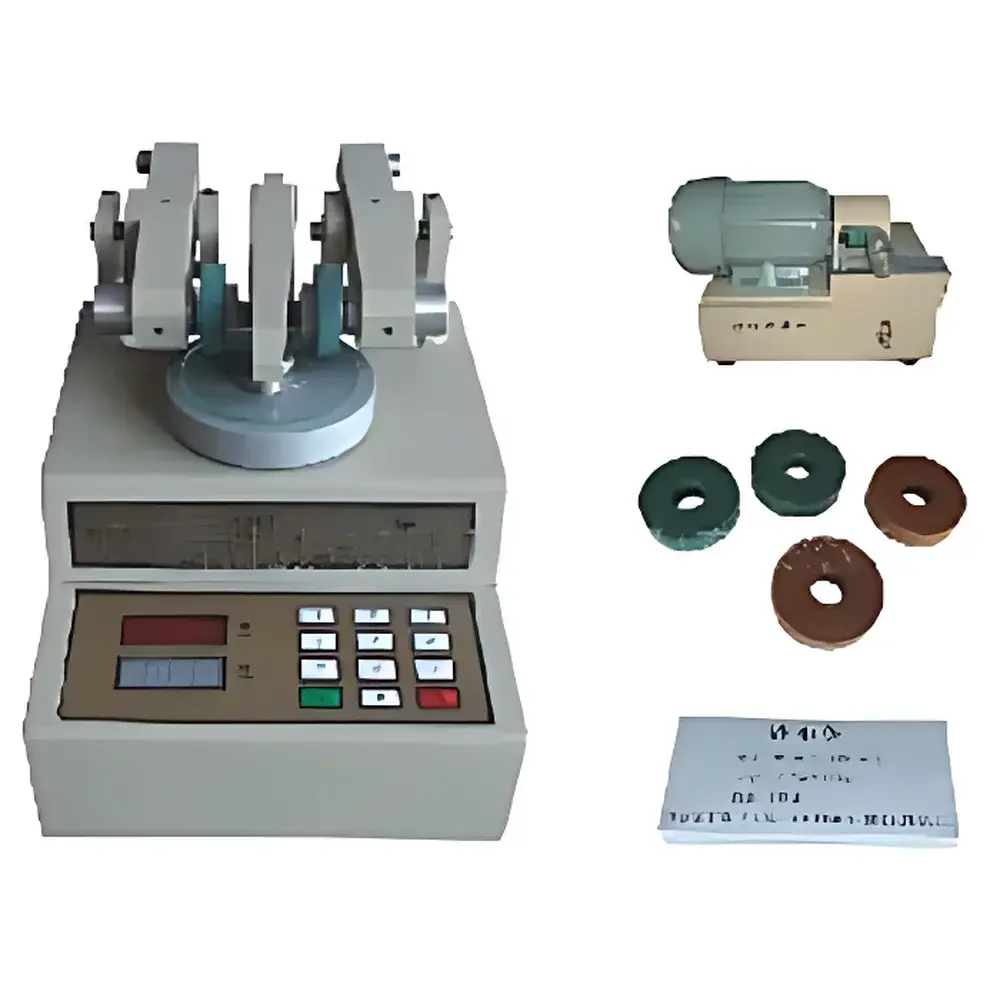
Taber-style Coating Abrasion Tester JM-IV
| Origin | Guangdong, China |
|---|---|
| Manufacturer Type | Authorized Distributor |
| Origin Category | Domestic (PRC) |
| Model | JM-IV |
| Pricing | Available Upon Request |
| Rotational Speed | 60 ± 2 rpm |
| Sample Holder Diameter | 100 mm × Thickness 8 mm × Height 3 mm |
| Standard Load Weights | 500 g, 750 g |
| Sandwheel Balancing Weights | 20 g (shaft-mounted), 20 g, 10 g, 5 g, 2 g, 1 g |
| Reference Glass Disc | 100 × 8 × 3 mm |
| Drive Motor | 25 W, 220 V, 4-pole |
| Abrasive Wheels | 50 × 12 mm, Grade 100 & 120 |
| Counter Display | 4-digit LED (0–9999) |
| Wheel Truing Motor | 40 W, 220 V, 2850 rpm |
| Vacuum System | VW-80G, Adjustable Airflow |
| Main Unit Dimensions (L×W×H) | 360 × 240 × 220 mm |
| Truing Unit Dimensions | 300 × 180 × 180 mm |
Overview
The Taber-style Coating Abrasion Tester JM-IV is a precision-engineered tribological instrument designed to quantify the abrasion resistance of organic coatings and thin-film materials under controlled rotary wear conditions. Based on the fundamental principles of the ASTM D4060 and ISO 7784-2 standards—and aligned with the Chinese national standard GB/T 1768–1979—the JM-IV employs dual abrasive wheels mounted in counter-rotating radial paths on a horizontally rotating test platen. As the platen rotates at a nominal speed of 60 ± 2 rpm, the right-hand wheel traverses outward from the sample center while the left-hand wheel moves inward, generating an X-shaped, bi-directional wear pattern per revolution. This orthogonal, non-directional abrasion geometry eliminates directional bias inherent in linear reciprocating testers, delivering higher reproducibility and better correlation with real-world service conditions—particularly for floor coatings, marine deck paints, traffic marking materials, and architectural finishes.
Key Features
- Dual-wheel abrasion geometry ensuring isotropic surface wear distribution and eliminating directional artifacts
- Adjustable load application via calibrated weights (500 g and 750 g) to simulate varying service stresses
- Modular sandwheel balancing system with fine-tuned mass increments (1–20 g) for precise torque compensation
- Integrated vacuum extraction (VW-80G) with adjustable airflow to remove abraded debris in real time, preventing secondary abrasion and ensuring consistent wear kinetics
- Self-truing capability via dedicated high-speed motor (2850 rpm) for maintaining abrasive wheel geometry and contact profile over extended test cycles
- Four-digit LED counter (0–9999) with manual reset, enabling accurate tracking of total revolutions and facilitating standardized test protocols
- Rugged aluminum alloy chassis and precision-machined sample holder (100 mm Ø × 8 mm thick) for dimensional stability and thermal consistency during prolonged operation
Sample Compatibility & Compliance
The JM-IV accommodates rigid, flat specimens up to 100 mm in diameter and 8 mm in thickness—including coated metal panels, glass substrates (100 × 8 × 3 mm reference discs), plastic laminates, decorative boards, paper sheets, and woven textiles. Its mechanical design conforms to the geometric and kinematic requirements of ISO 7784-2:2018 (Paints and varnishes — Determination of resistance to abrasion — Part 2: Rotary abrasion method) and supports full compliance with ASTM D4060 (Standard Test Method for Abrasion Resistance of Organic Coatings by the Taber Abraser). When operated within documented SOPs—including pre-conditioning at 23 ± 2 °C and 50 ± 5 % RH—the instrument supports GLP-compliant data generation suitable for regulatory submissions, QC release testing, and supplier qualification audits. Optional calibration certificates traceable to NIM (National Institute of Metrology, China) are available upon request.
Software & Data Management
While the JM-IV operates as a stand-alone electromechanical tester without embedded firmware or touchscreen interface, its modular architecture enables seamless integration into laboratory data management workflows. All operational parameters—including applied load, wheel grade, rotational count, and ambient conditions—are recorded manually or via external digital loggers compliant with 21 CFR Part 11 requirements. The repeatable mechanical design ensures high inter-instrument reproducibility, allowing multi-site laboratories to establish cross-platform reference datasets. For automated reporting, users may interface the counter output signal (TTL-compatible pulse train) with third-party DAQ systems or LIMS platforms using standard RS-232 or USB-to-serial adapters. Audit trails, operator IDs, and instrument calibration history must be maintained externally per ISO/IEC 17025:2017 clause 7.7.
Applications
- Quantitative evaluation of coating durability for industrial maintenance paints, epoxy flooring systems, and anti-scratch topcoats
- Comparative wear ranking of UV-cured, waterborne, and solvent-based formulations under identical mechanical stress
- Quality control screening of batch-to-batch consistency in OEM automotive clearcoats and aerospace primer systems
- Accelerated wear simulation for printed circuit board solder masks and flexible display substrate coatings
- Performance benchmarking of abrasion-resistant films used in medical device housings and consumer electronics enclosures
- Research-grade tribological studies on polymer nanocomposites, graphene-enhanced coatings, and self-healing film architectures
FAQ
What standards does the JM-IV comply with?
The JM-IV is mechanically configured to meet the physical and procedural specifications of ISO 7784-2:2018 and ASTM D4060, and is validated for use with GB/T 1768–1979.
Can the JM-IV test non-coated substrates such as bare plastics or metals?
Yes—provided the specimen is rigid, flat, and dimensionally stable under abrasive loading; however, interpretation of mass loss data requires reference to substrate-specific wear mechanisms and baseline controls.
Is calibration documentation included with shipment?
A factory verification report confirming rotational speed, counter accuracy, and load weight tolerances is supplied; NIM-traceable calibration certificates are optional and require advance ordering.
How often should the abrasive wheels be trued?
Truing is recommended after every 500 revolutions or whenever visible edge rounding, uneven wear tracks, or inconsistent mass-loss trends are observed.
Does the instrument support GLP/GMP audit requirements?
Yes—when operated within a documented quality system that includes instrument logbooks, preventive maintenance records, operator training verification, and raw data retention per ISO/IEC 17025.



