
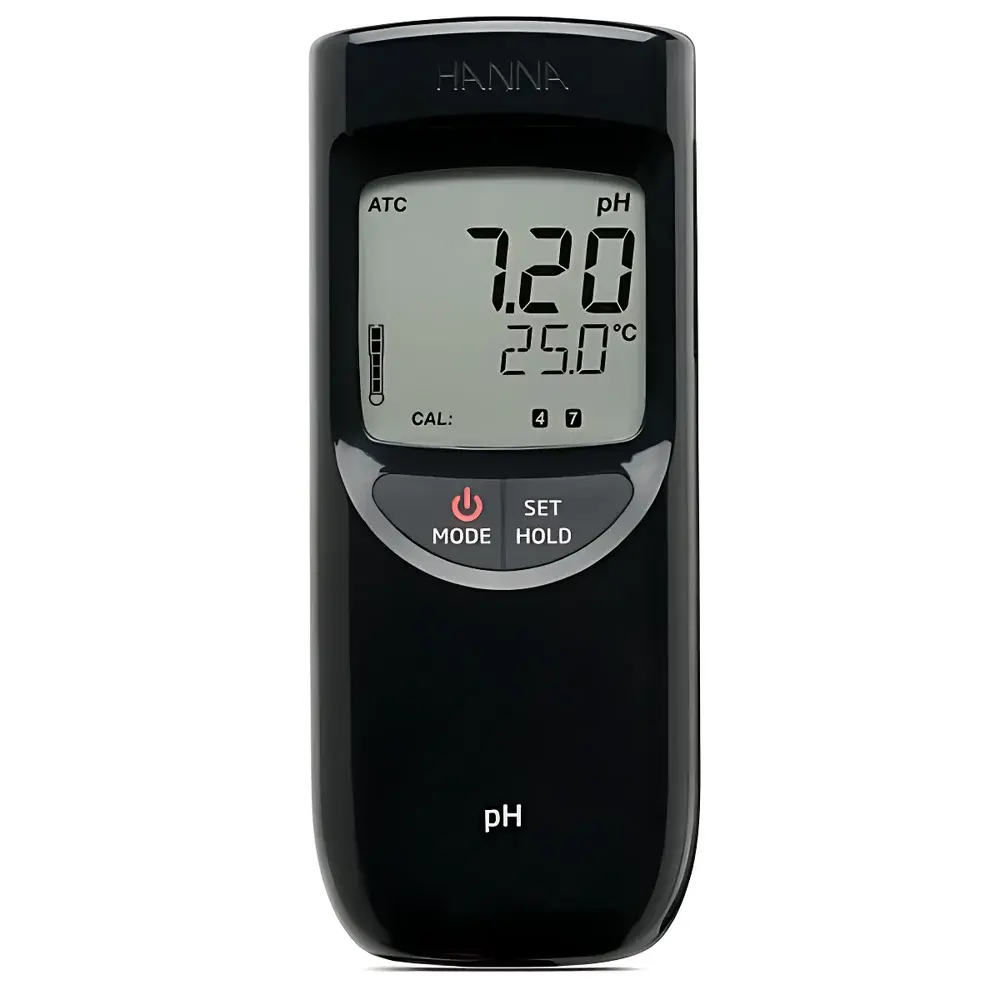
Hanna HI991001 Portable pH and Temperature Meter with Integrated HI1296D Electrode
| Brand | Hanna Instruments |
|---|---|
| Origin | Italy |
| Model | HI991001 |
| Instrument Type | Portable pH Meter |
| Parameter Type | Single-Parameter (pH & °C) |
| pH Range | -2.00 to 16.00 pH |
| Temperature Range | -5.0 to 105.0°C |
| pH Resolution | 0.01 pH |
| pH Accuracy | ±0.02 pH |
| Temperature Accuracy | ±0.5°C (≤60°C), ±1.0°C (>60°C) |
| Calibration | Auto-recognition 1–2-point calibration with two built-in buffer sets (pH 4.01/7.01/10.01 and pH 4.01/6.86/9.18) |
| Temperature Compensation | Automatic (ATC), -5.0 to 105.0°C |
| Electrode | HI1296D stainless-steel body pH/temperature combination electrode with integrated Pt1000 sensor |
| Power | 3 × 1.5 V AAA batteries |
| Auto-off | After 20 minutes of inactivity |
| IP Rating | IP67 (dust-tight and immersion-resistant up to 1 m for 30 min) |
| Dimensions | 152 × 58 × 30 mm |
| Weight | 205 g |
Overview
The Hanna HI991001 is a rugged, field-ready portable pH and temperature meter engineered for high-reliability measurements in demanding industrial and environmental applications—including electroplating bath monitoring, wastewater treatment process control, and swimming pool water quality management. It operates on the fundamental principle of potentiometric pH measurement: the voltage difference between a glass pH sensing electrode and a stable reference electrode is converted into a pH value using the Nernst equation (−59.16 mV/pH unit at 25°C). The integrated HI1296D electrode combines a low-resistance pH glass membrane with a built-in Pt1000 temperature sensor, enabling real-time automatic temperature compensation (ATC) across the full operational range (−5.0 to 105.0°C). Designed for compliance with ISO 7888 and ASTM D1293 standards for pH measurement in aqueous samples, the HI991001 delivers traceable accuracy (±0.02 pH) and robust repeatability—critical for regulatory reporting and process validation in GLP- and GMP-aligned facilities.
Key Features
- IP67-rated housing ensures dust-tight operation and submersion resistance up to 1 meter for 30 minutes—ideal for wet, corrosive, or outdoor environments.
- Large backlit LCD displays simultaneous pH and temperature readings with intuitive on-screen guidance, including calibration status, stability indicator, and ATC activation status.
- Two-button interface minimizes operational complexity: dedicated keys for measurement initiation and calibration mode entry—reducing operator error in fast-paced settings.
- BEPS™ (Battery Error Prevention System) actively monitors battery voltage and prevents measurement under insufficient power, eliminating drift artifacts caused by low-voltage instability.
- Auto-recognition calibration supports both standard IUPAC (pH 4.01, 7.01, 10.01) and technical (pH 4.01, 6.86, 9.18) buffer sets; the instrument automatically detects and applies the correct slope and offset during 1- or 2-point calibration.
- HI1296D electrode features a titanium-reinforced stainless-steel body with a conical pH tip optimized for immersion in viscous or particulate-laden samples (e.g., plating baths, sludge supernatants), minimizing clogging and mechanical damage.
Sample Compatibility & Compliance
The HI991001 is validated for direct immersion measurement in aqueous matrices with conductivity ≥200 µS/cm, including acidic and alkaline electroplating electrolytes (e.g., nickel sulfate, copper cyanide, and chromium trioxide baths), municipal and industrial wastewater effluents, and chlorinated or brominated recreational water. Its extended pH range (−2.00 to 16.00) accommodates highly aggressive media beyond conventional meter limits. The instrument meets CE marking requirements per Directive 2014/30/EU (EMC) and 2014/35/EU (LVD), and its electrode design complies with ISO 8466-1 for reference electrode stability in non-standard solutions. While not FDA 21 CFR Part 11 compliant out-of-the-box (as it lacks audit-trail-capable software), raw pH/temperature data can be documented manually in accordance with ISO/IEC 17025:2017 Clause 7.7 (result reporting) and EPA Method 150.1 (pH determination in water).
Software & Data Management
The HI991001 operates as a standalone field instrument without onboard data logging or Bluetooth connectivity. All measurements are displayed in real time only; no internal memory or export functionality is included. For traceable recordkeeping, users must transcribe values manually into laboratory notebooks or LIMS-compatible spreadsheets. Calibration history—including date, buffer IDs used, measured mV, slope (%), and offset (mV)—is not stored but is visible during calibration and may be recorded externally. This architecture aligns with facilities prioritizing simplicity, minimal validation burden, and avoidance of electronic record integrity requirements under 21 CFR Part 11.
Applications
- Electroplating Process Control: Monitoring pH stability in acid copper, nickel, and zinc plating baths to maintain deposit uniformity and adhesion—deviations >±0.2 pH directly impact metal ion hydrolysis and anode corrosion rates.
- Wastewater Neutralization: Verifying pH adjustment efficacy during lime or caustic dosing prior to discharge, ensuring compliance with local NPDES permit limits (typically pH 6.0–9.0).
- Swimming Pool & Spa Management: Routine verification of disinfectant efficacy via pH-dependent hypochlorous acid (HOCl) equilibrium—optimal range: 7.2–7.8.
- Environmental Field Screening: Rapid assessment of acid mine drainage (AMD) or alkaline leachate from construction sites, where extreme pH values (11.0) indicate geochemical disturbance.
- Educational & Training Labs: Teaching core electrochemical concepts—including junction potential, liquid junction error, and temperature-induced Nernst slope variation—using a physically durable, low-maintenance platform.
FAQ
What electrode is supplied with the HI991001?
The HI991001 includes the HI1296D stainless-steel-shielded combination pH/temperature electrode with integrated Pt1000 sensor and conical glass tip.
Can the HI991001 measure pH in non-aqueous solvents?
No—it is designed exclusively for aqueous or high-conductivity aqueous-miscible solutions (e.g., diluted ethanol-water mixtures). Pure organic solvents will cause unstable readings and electrode damage.
Is manual temperature compensation possible?
No—temperature compensation is fully automatic (ATC) and tied to the HI1296D’s built-in sensor; no manual input or offset adjustment is supported.
How often should the HI1296D electrode be cleaned and stored?
Rinse with deionized water after each use; store immersed in HI70300 pH storage solution. Clean weekly with HI7061L general-purpose cleaning solution if used in oily or protein-rich matrices.
Does the HI991001 meet ISO/IEC 17025 requirements for accredited testing?
Yes—as a measurement device, it satisfies metrological traceability when calibrated with NIST-traceable buffers and operated per Hanna’s stated specifications; however, full accreditation requires documented uncertainty budgets and procedural SOPs maintained by the user laboratory.





