
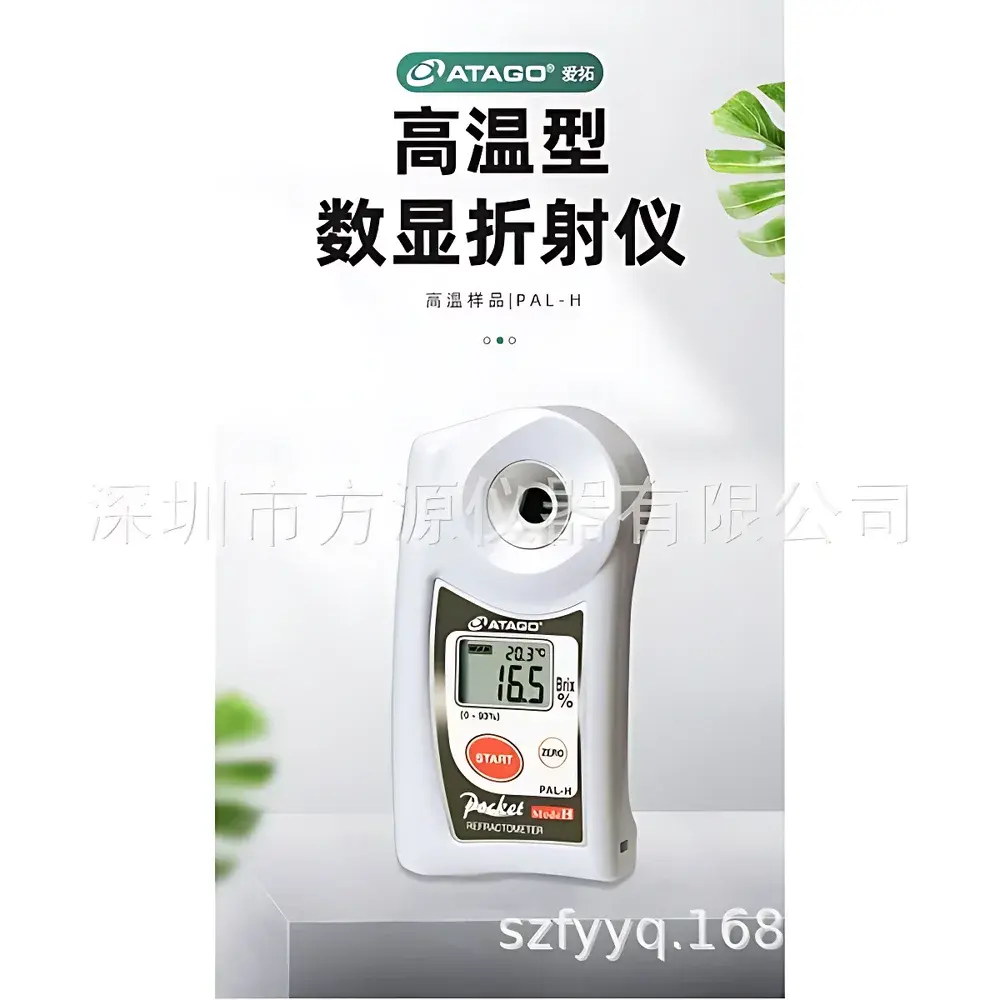
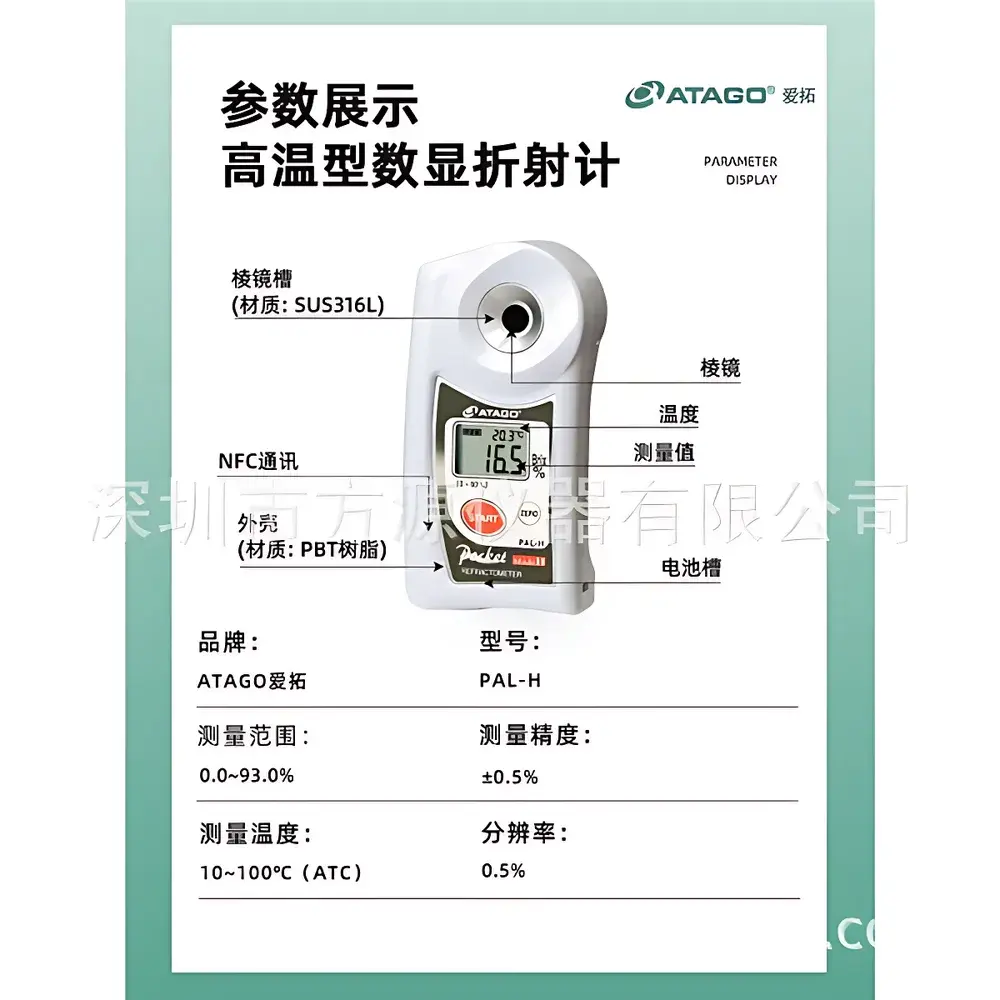
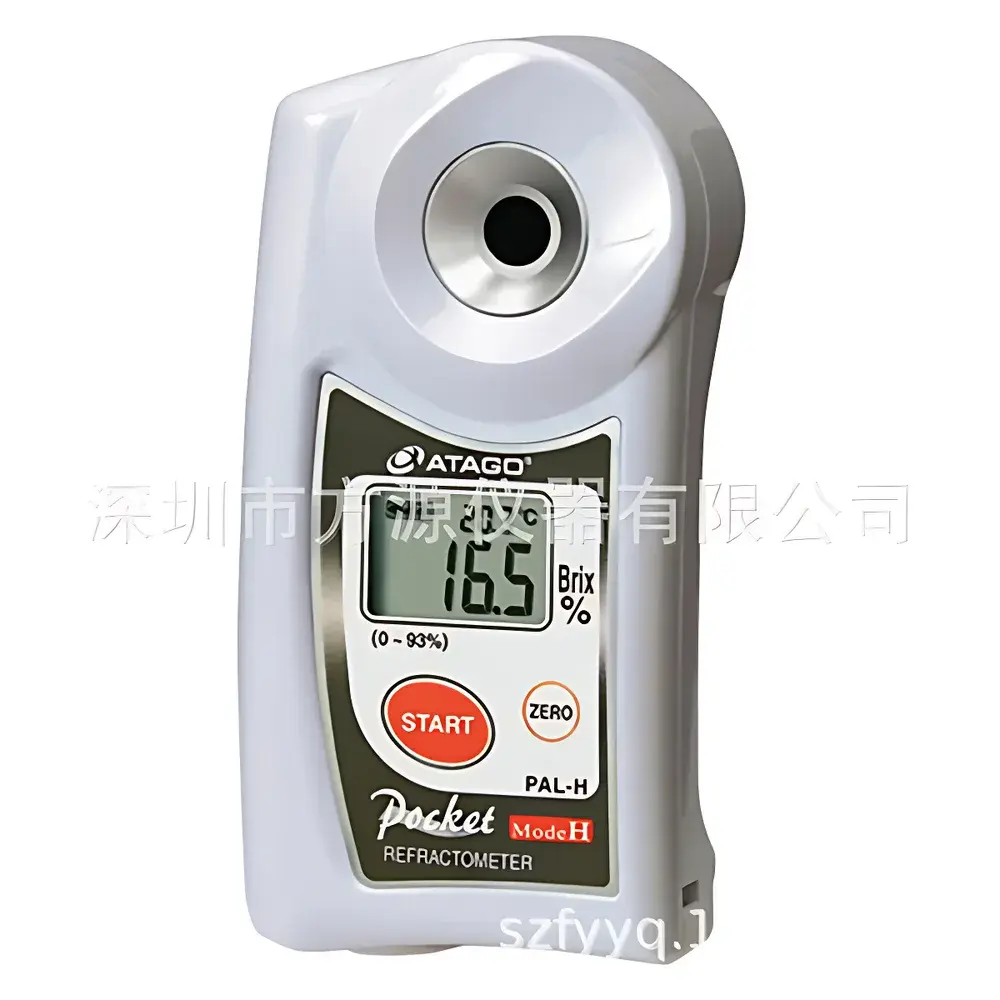
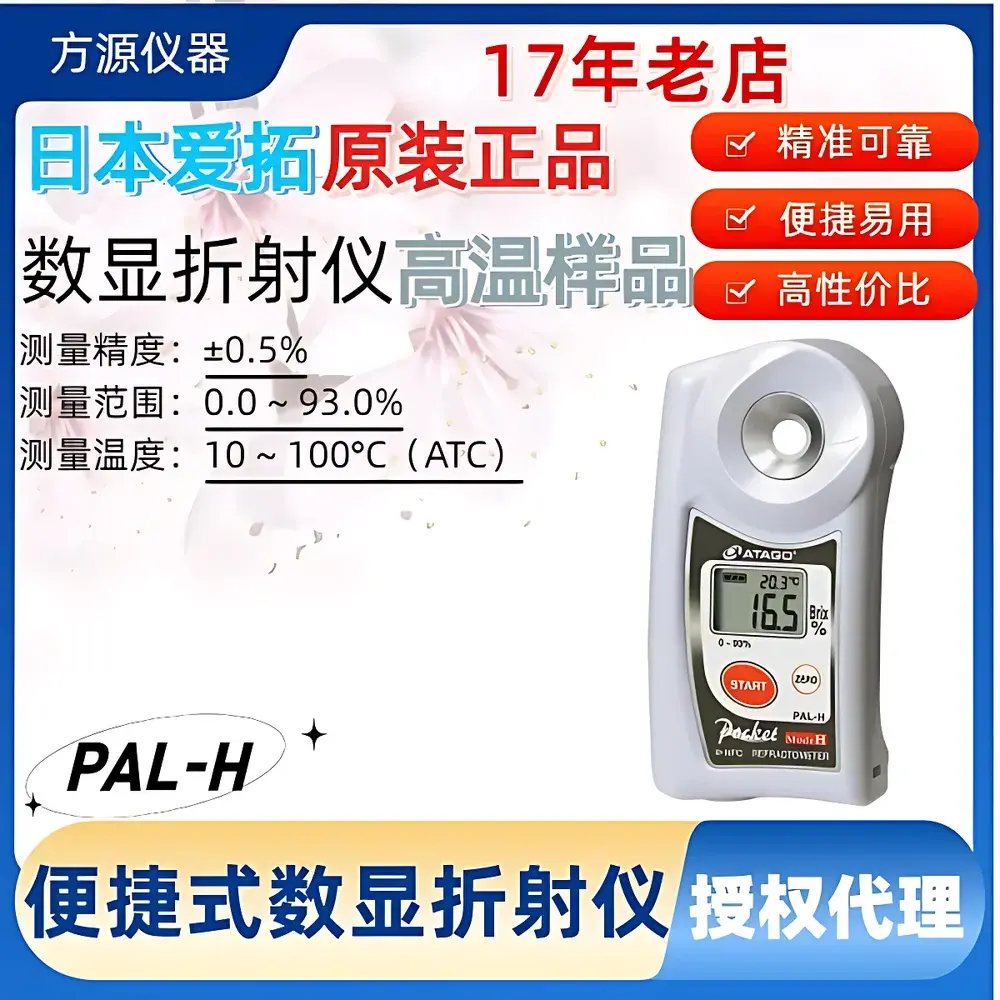
ATAGO PAL-H Portable Digital High-Temperature Refractometer
| Brand | ATAGO |
|---|---|
| Origin | Japan |
| Model | PAL-H |
| Type | Handheld Refractometer |
| Measurement Range | 0.0–93.0% (w/w or v/v, application-dependent) |
| Accuracy | ±0.5% |
| Temperature Compensation | Automatic (ATC), 10–100°C |
| Display | Digital LCD |
| Power Source | 2× AAA batteries |
| Compliance | CE-marked, ISO/IEC 17025 traceable calibration support available |
Overview
The ATAGO PAL-H is a rugged, handheld digital refractometer engineered for precise concentration measurement of high-temperature liquid samples—specifically designed to operate reliably at sample temperatures up to 100°C without requiring external cooling or dilution. Unlike conventional benchtop or standard portable refractometers limited to ambient-temperature use, the PAL-H integrates a thermally stabilized prism assembly and proprietary temperature-compensated optical path, enabling direct, real-time measurement of hot process streams, sterilized solutions, and thermally sensitive formulations. Its core operating principle relies on the critical angle measurement of total internal reflection at the prism-sample interface, converted via ATAGO’s proprietary algorithm into concentration values expressed in % (w/w or v/v), ppm, or g/100g depending on the calibrated scale. The instrument is widely deployed in pharmaceutical manufacturing (e.g., steam-sterilized excipient solutions), food thermal processing (e.g., hot syrup concentration control), chemical synthesis (e.g., elevated-temperature reaction mixture monitoring), and industrial cleaning validation where real-time hot-sample verification is required under GMP or ISO 9001 environments.
Key Features
- High-temperature operation: Direct measurement of samples from 10°C to 100°C with built-in Automatic Temperature Compensation (ATC)
- Digital LCD display with backlight for low-light lab or production floor readability
- Compact, ergonomic design with IP65-rated housing for resistance to dust and water splashes
- Fast measurement cycle: <2 seconds per reading with auto-hold function
- Multi-scale capability: Pre-programmed scales for ethanol (PAL-33S/34S), isopropanol (PAL-37S), hydrogen peroxide (PAL-39S), hypochlorous acid (PAL-4555), peracetic acid (PAL-4557), urea, and hydrocarbon cleaners—each validated per ATAGO’s traceable calibration protocols
- No moving parts or consumables; maintenance-free optical system with sapphire-coated prism
- Battery-powered (2× AAA) with >10,000 measurements per set; low-battery indicator and auto-power-off
Sample Compatibility & Compliance
The PAL-H is compatible with aqueous and polar organic solutions commonly encountered in QC labs and production lines—including alcohols, oxidizers, disinfectants, cleaning agents, and pharmaceutical excipients. It is not suitable for strongly acidic, caustic, or highly viscous (>500 mPa·s) samples without prior validation. All factory-installed scales are developed in alignment with relevant industry reference methods: ethanol and IPA scales conform to ASTM D4052 and ISO 3696 grade 3 water equivalency; hypochlorous acid and peracetic acid modes support EPA Method 300.0 and EN 13624:2013 verification workflows. While the PAL-H itself is not FDA 21 CFR Part 11 compliant as a standalone device, its measurement data can be integrated into compliant LIMS or ELN systems via manual entry or optional RS-232 output (with adapter). Calibration verification is supported using NIST-traceable sucrose and sodium chloride standards; ATAGO provides documented calibration certificates upon request for GLP/GMP audits.
Software & Data Management
The PAL-H operates as a self-contained instrument with no embedded software or onboard memory. All measurement data must be recorded manually or transferred externally. Optional accessories include the ATAGO RS-232 communication cable and dedicated PC software (RefractoLink™ v4.2), enabling ASCII-formatted data export to CSV or Excel-compatible formats for trend analysis, SPC charting, and audit-ready documentation. When used in regulated environments, users may implement procedural controls—including defined calibration intervals (recommended daily pre-shift verification), operator training records, and logbook entries—to satisfy ISO/IEC 17025 clause 7.7 (uncertainty evaluation) and Annex A.2 (equipment management). Firmware updates are performed exclusively by authorized ATAGO service centers and documented per change control SOPs.
Applications
- Pharmaceutical: Real-time monitoring of hot buffer solutions post-autoclaving, ethanol-based sanitizers in cleanroom gowning areas, and peracetic acid concentrations in CIP rinse validation
- Food & Beverage: Concentration control of hot sugar syrups, caramel melts, and pasteurized fruit concentrates directly from kettles or fill lines
- Chemical Manufacturing: In-process verification of hydrocarbon cleaner bath strength during precision component cleaning, and H₂O₂ stability testing in thermal storage tanks
- Healthcare & Disinfection: Field verification of hypochlorous acid (HOCl) and peracetic acid (PAA) disinfectant concentrations per CDC/EPA guidance for environmental surface decontamination
- Academic Research: Teaching labs requiring student-safe, repeatable refractive index correlation studies across temperature gradients
FAQ
What is the maximum sample temperature the PAL-H can measure directly?
The PAL-H is rated for direct contact with samples up to 100°C. No cooling or dilution is required—measurements are compensated automatically within the 10–100°C range.
Does the PAL-H require recalibration when switching between different scales (e.g., ethanol to HOCl)?
No. Each preloaded scale is independently calibrated at the factory. However, users must perform a zero-point verification with distilled water (or appropriate blank) before each measurement session per ATAGO’s recommended practice.
Can the PAL-H measure non-aqueous solvents like acetone or hexane?
No. The instrument is optimized for aqueous and water-miscible polar solvents. Non-polar or volatile solvents may damage the prism coating or yield unreliable readings due to evaporation artifacts.
Is the PAL-H compliant with ISO 17025 for accredited testing laboratories?
The instrument itself is not accredited, but it supports ISO/IEC 17025 compliance when used within a validated method, with documented calibration, uncertainty estimation, and trained personnel—per ATAGO Application Note AN-PALH-01.
How often should the prism be cleaned, and what cleaning agents are recommended?
Clean the prism immediately after each measurement using lint-free tissue and reagent-grade water or isopropyl alcohol. Avoid abrasive pads, acetone, or strong acids/bases to preserve the sapphire coating.




