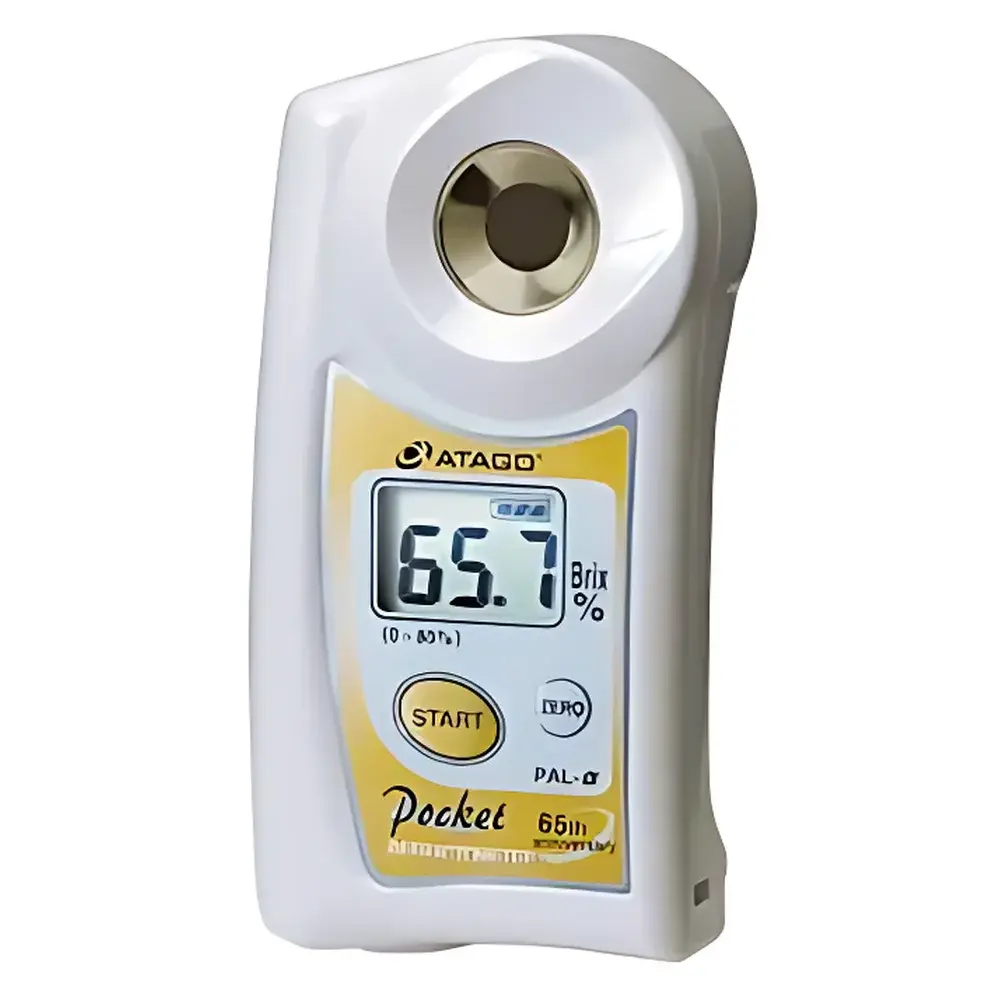
ATAGO PAL-α Digital Pocket Refractometer
| Brand | ATAGO |
|---|---|
| Origin | Japan |
| Model | PAL-α |
| Brix Range | 0.0–85.0% |
| Temperature Range | 9.0–99.9°C |
| Brix Resolution | 0.1% |
| Temperature Resolution | 0.1°C |
| Accuracy (Brix) | ±0.2% |
| Accuracy (Temperature) | ±1.0°C |
| Sample Volume | 0.3 mL |
| Measurement Time | 3 seconds |
| Power Supply | 2 × AAA batteries |
| IP Rating | IP65 |
| Dimensions | 55(W) × 31(D) × 109(H) mm |
| Weight | 100 g (body only) |
| Automatic Temperature Compensation (ATC) | Yes |
| Operating Ambient Temperature | 10–40°C |
| Measured Sample Temperature Range | 10–100°C |
Overview
The ATAGO PAL-α Digital Pocket Refractometer is a precision optical instrument engineered for rapid, field-deployable measurement of refractive index—converted to Brix concentration—across a broad range of aqueous liquid samples. Based on the fundamental principle of total internal reflection at the prism–sample interface, the PAL-α employs a high-stability LED light source and a linear CCD photodetector array to determine the critical angle of refraction with high repeatability. Its wide Brix range (0.0–85.0%) accommodates applications from low-concentration fruit juices and soft drinks to highly concentrated syrups, honey, and industrial sugar solutions. Designed for robustness in dynamic industrial environments, the PAL-α integrates automatic temperature compensation (ATC) across 10–100°C, ensuring consistent Brix readings independent of sample thermal drift. As a handheld, battery-powered device certified to IP65, it withstands dust ingress and low-pressure water jets—making it suitable for wet-process lines, QC benches, warehouse inspections, and outdoor agricultural testing without risk of operational interruption.
Key Features
- Extended Brix measurement range (0.0–85.0%) optimized for high-solids formulations including molasses, condensed milk, and pharmaceutical excipient solutions.
- High-resolution display showing simultaneous Brix (%) and sample temperature (°C), both resolved to 0.1 units.
- True automatic temperature compensation (ATC) using an integrated thermistor sensor; eliminates manual correction tables or external calibration adjustments.
- Minimal sample requirement of only 0.3 mL—enabling non-destructive verification of small-batch or high-value products.
- Three-second measurement cycle time, enabling throughput of >200 tests per shift in routine quality control workflows.
- IP65-rated enclosure ensures operational integrity in humid, washdown, or dusty environments typical of food processing, beverage bottling, and chemical manufacturing facilities.
- Compact ergonomic design (55 × 31 × 109 mm; 100 g) with intuitive single-button operation—no training required for line operators or field technicians.
Sample Compatibility & Compliance
The PAL-α is validated for use with transparent to slightly turbid aqueous solutions where dissolved solids dominate refractive behavior—including sucrose, glucose, fructose, sodium chloride, glycerol, propylene glycol, and common food-grade acids and preservatives. It is not intended for strongly absorbing, highly viscous (>500 cP), or emulsified systems without prior validation. The instrument complies with ISO 2173:2003 (fruit juice analysis) and supports adherence to Codex Alimentarius standards for sugar content labeling. While not intrinsically certified for hazardous locations, its battery-powered architecture and sealed optics meet general safety requirements for Zone 2/Class I Division 2 environments when used with appropriate handling protocols. Calibration traceability is maintained via NIST-traceable sucrose reference standards (RE-110010 through RE-110060), each certified to ±0.03–0.05% Brix uncertainty.
Software & Data Management
The PAL-α operates as a standalone field instrument with no embedded software, firmware updates, or digital connectivity—ensuring long-term reliability, zero cybersecurity exposure, and immunity to OS obsolescence. All measurements are displayed locally and retained only in volatile memory during active use. For regulated environments requiring audit trails (e.g., FDA 21 CFR Part 11, GLP, or GMP), users must implement external documentation procedures: handwritten logbooks, barcode-linked LIMS entries, or camera-captured screen images paired with timestamped metadata. Optional accessories—including calibrated sucrose standards and protective carrying cases (RE-39409, RE-39410)—support consistent calibration verification and transport integrity across shifts and sites.
Applications
- Real-time Brix verification during juice concentration, syrup blending, and jam cooking in food manufacturing.
- In-line QC checks for consistency of cleaning-in-place (CIP) rinse water conductivity proxies and detergent concentration.
- Agricultural field testing of fruit ripeness, grape maturity (must weight), and maple sap concentration prior to evaporation.
- Pharmaceutical excipient lot release (e.g., dextrose or sorbitol solutions) where USP refractometric methods apply.
- Chemical process monitoring of glycol-based heat transfer fluids, antifreeze blends, and salt brine concentrations.
- Educational laboratories for teaching optical principles, solution thermodynamics, and analytical method validation fundamentals.
FAQ
Does the PAL-α require periodic factory recalibration?
No—routine user verification using supplied sucrose standards is sufficient. Factory recalibration is recommended only after physical impact, prolonged exposure to extreme temperatures (>40°C ambient), or observed drift exceeding ±0.2% Brix against certified references.
Can the PAL-α measure non-sugar solutes such as sodium chloride or ethanol?
Yes—but Brix scale readings will not represent % w/w NaCl or % v/v ethanol directly. Users must apply empirically derived conversion factors or generate custom calibration curves per ISO 5725 guidelines.
Is the prism surface chemically resistant to acidic or alkaline samples?
The sapphire-coated prism is resistant to pH 2–12 solutions; however, prolonged contact with strong oxidizers (e.g., hypochlorite) or hydrofluoric acid is prohibited.
How does ATC affect measurement accuracy at elevated temperatures?
ATC corrects for thermal expansion-induced refractive index shift using a built-in thermistor and proprietary algorithm compliant with the ICUMSA standard temperature correction model for sucrose solutions.
What is the expected battery life under typical usage?
Approximately 10,000 measurements (3 seconds each) per set of two AAA alkaline batteries—equivalent to 6–12 months of daily QC use depending on frequency.
Related Products