
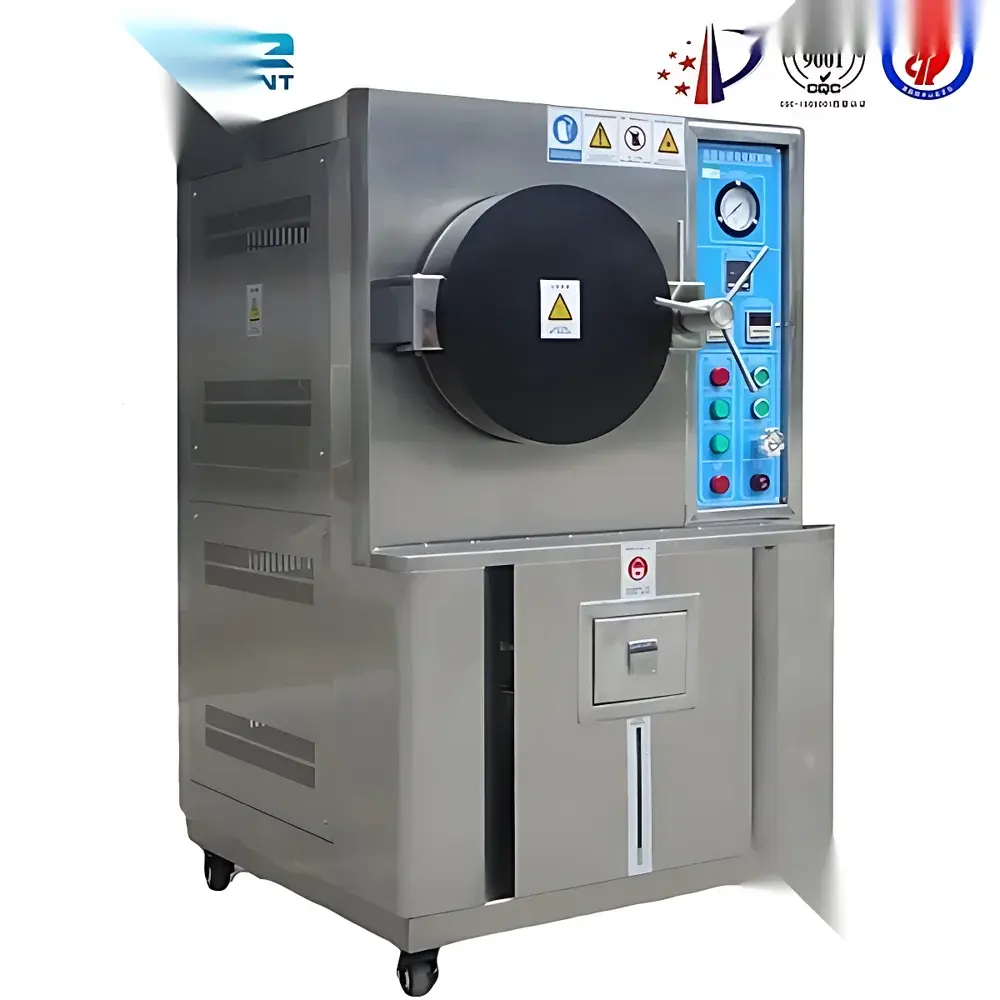
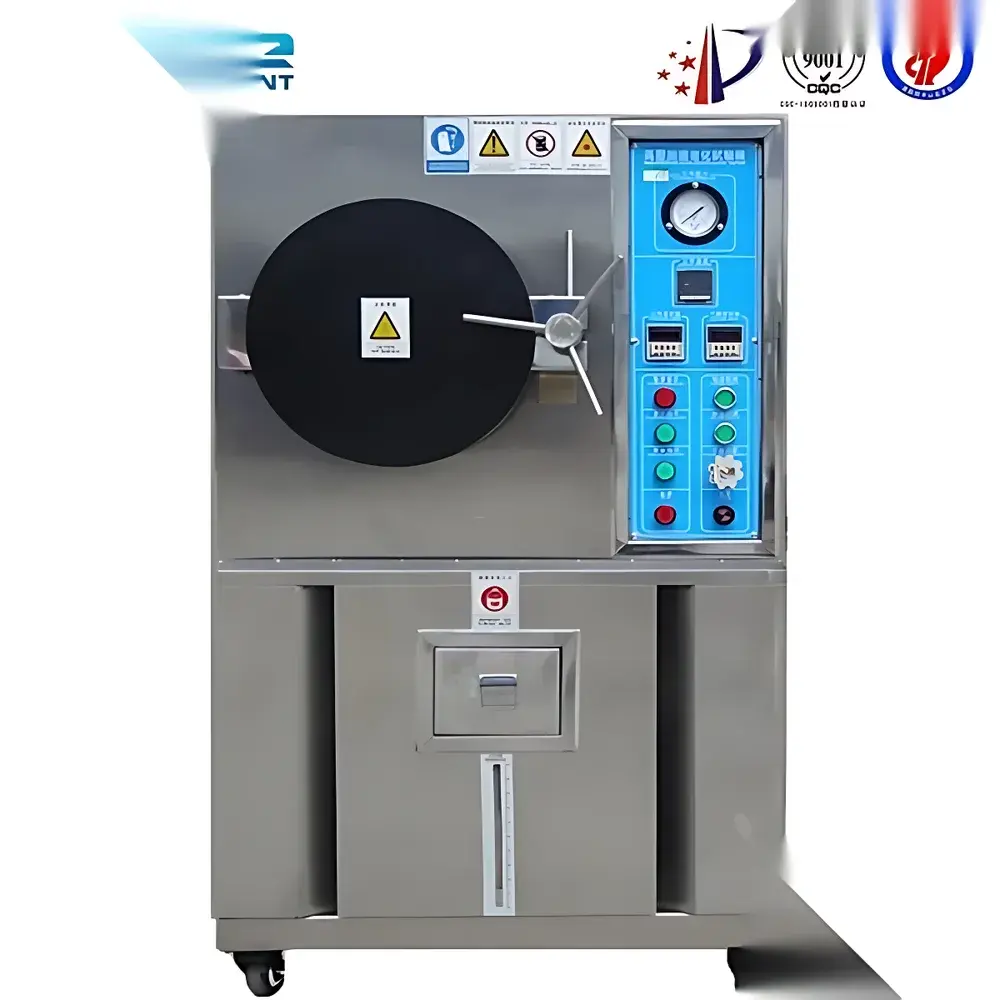
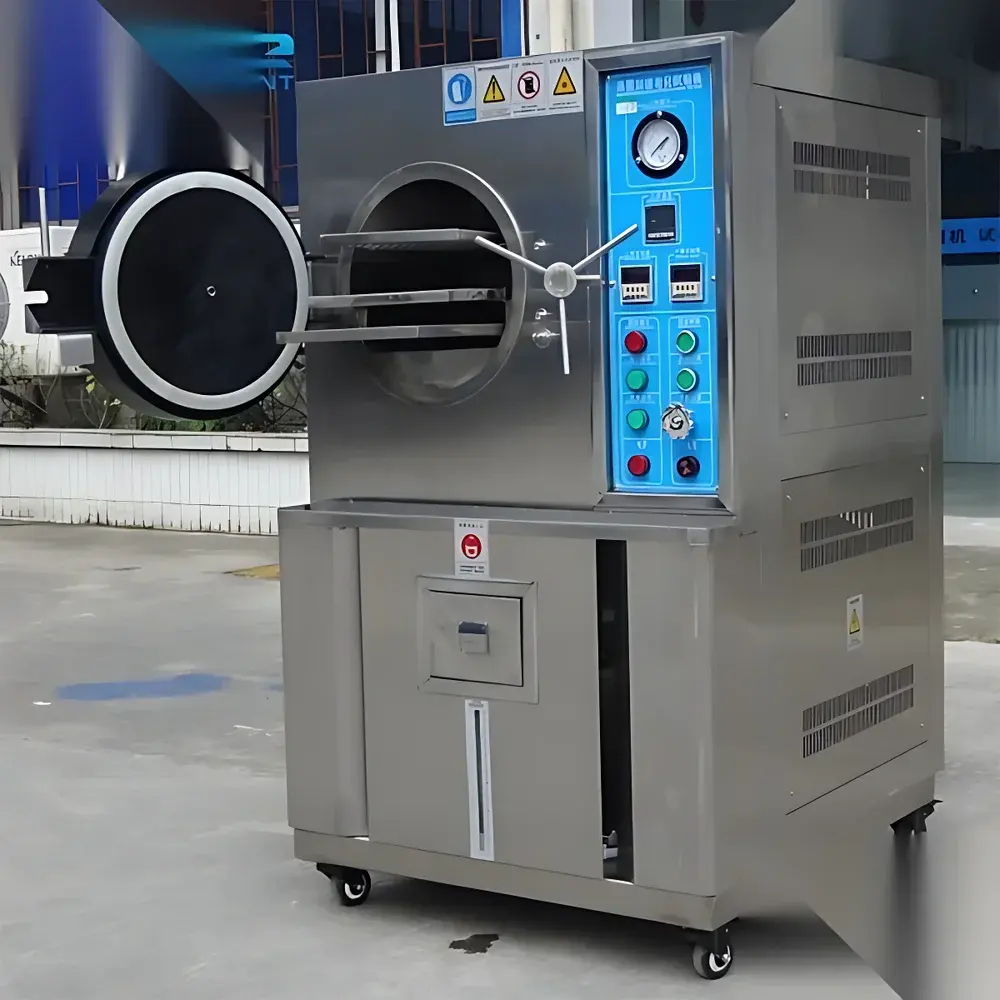
Other Brands OK-PTC-25 / OK-PTC-35 High-Pressure Steam Aging Chamber (PCT)
| Key | Chamber Internal Diameter × Depth = ∅250×450 mm (OK-PTC-25) |
|---|---|
| Temperature Range | RT+100°C to 132°C |
| Humidity | 100% RH |
| Pressure Range | 0.0–2.8 kg/cm² (gauge), max working pressure 3.0 kg/cm² (absolute), safety limit 4.0 kg/cm² |
| Temp. Uniformity | ±1.5°C |
| Temp. Control Accuracy | ±0.5°C |
| Temp. Resolution | 0.1°C |
| Pressurization Time (0 → 2.0 kg/cm²) | ~30 min |
| Inner Chamber Material | SUS304 stainless steel |
| Outer Casing | SECC steel with electrostatic powder coating |
| Compliance | ASTM D2247, IEC 60068-2-66, ISO 11357-4, JIS C 0068, MIL-STD-810H, UL 1012, NACE TM0177, DIN 50017, BS EN 60068-2-66 |
Overview
The OK-PTC-25 and OK-PTC-35 High-Pressure Steam Aging Chambers (commonly referred to as Pressure Cooker Tests or PCT systems) are engineered for accelerated reliability evaluation of electronic components, encapsulated semiconductors, PCB assemblies, and moisture-sensitive packaging under controlled high-humidity, elevated-temperature, and pressurized saturated steam conditions. Operating on the principle of forced saturation—where ambient air is evacuated and replaced with pure steam at defined thermodynamic states—the system subjects test specimens to accelerated hydrolytic stress, simulating years of field-level moisture ingress in hours or days. Unlike conventional humidity chambers, PCT units maintain 100% relative humidity at temperatures up to 132°C while simultaneously applying gauge pressures up to 2.8 kg/cm² (≈275 kPa), thereby elevating the dew point and driving moisture diffusion into microvoids, die attach interfaces, and polymer matrices at rates significantly exceeding standard THB (Temperature-Humidity-Bias) testing. This methodology aligns with industry-recognized failure acceleration models based on Arrhenius kinetics and Fickian diffusion theory.
Key Features
- Two standardized chamber configurations: OK-PTC-25 (∅250 × 450 mm internal volume) and OK-PTC-35 (∅350 × 500 mm), optimized for batch throughput and spatial uniformity.
- Precision temperature control via PID algorithm with SSR output, achieving ±0.5°C stability and 0.1°C resolution using Pt100 platinum resistance sensors.
- Dual-stage pressure regulation with analog gauge display and fail-safe mechanical relief valves rated to 4.0 kg/cm² absolute pressure.
- Horizontal cylindrical chamber geometry minimizes condensate pooling and enables ergonomic sample loading/unloading without vertical lift constraints.
- Integrated vacuum-assisted air purge cycle prior to steam introduction ensures removal of oxygen and non-condensable gases—critical for eliminating oxidation artifacts and maintaining steam purity per IEC 60068-2-66 requirements.
- Automatic safety interlocks: door remains mechanically locked until internal pressure drops below 0.1 kg/cm²; simultaneous auto-depressurization, vacuum break, and water replenishment initiated upon cycle completion.
- Robust thermal architecture featuring insulated SUS304 inner chamber, SECC outer casing with corrosion-resistant electrostatic coating, and high-efficiency steam generation via insulated heating elements.
Sample Compatibility & Compliance
The OK-PTC series accommodates a broad range of sample types including bare dies, molded IC packages (QFP, BGA, CSP), multilayer ceramic capacitors, conformally coated PCBs, medical device housings, and automotive-grade connectors. All operational parameters adhere to internationally harmonized test standards governing moisture sensitivity level (MSL) qualification and long-term reliability validation. Key referenced specifications include: ASTM D2247 (standard practice for conditioning plastics in high-humidity environments), IEC 60068-2-66 (test method for damp heat, steady state, accelerated with steam), ISO 11357-4 (plastics—differential scanning calorimetry—part 4: determination of specific heat capacity), JIS C 0068 (environmental testing methods for electrical and electronic equipment), and MIL-STD-810H Method 507.6 (high temperature/humidity/pressure). The system supports GLP-compliant data integrity through time-stamped event logging and configurable audit trails.
Software & Data Management
While the base configuration employs a dedicated LED-based microcontroller interface with real-time display of chamber temperature, pressure, and elapsed time, optional RS-485/Modbus RTU communication enables integration into centralized laboratory management systems (LIMS) or SCADA platforms. All recorded parameters—including ramp profiles, dwell durations, pressure transients, and safety event flags—are stored internally with non-volatile memory retention for ≥100 cycles. For regulated environments requiring electronic records compliance, the system can be configured with optional FDA 21 CFR Part 11–ready software modules supporting user authentication, electronic signatures, and immutable audit logs. Calibration certificates traceable to NIST or national metrology institutes are available upon request.
Applications
- Qualification of moisture sensitivity levels (MSL) per JEDEC J-STD-020 for surface-mount devices prior to reflow soldering.
- Accelerated life testing of encapsulation integrity in power modules and optoelectronic assemblies.
- Evaluation of delamination resistance in wafer-level chip-scale packages (WLCSP) and fan-out wafer-level packaging (FOWLP).
- Validation of conformal coating performance against steam penetration under extreme thermal-hygric stress.
- Corrosion susceptibility screening of metallic contacts and solder joints per NACE TM0177 (sulfide stress cracking) and ASTM B117 (salt spray) complementary protocols.
- Material compatibility assessment of adhesives, underfills, and molding compounds used in aerospace and automotive electronics.
FAQ
What is the maximum allowable test duration per cycle without manual intervention?
Standard operation supports continuous runtime up to 100 hours per fill cycle; optional automatic water replenishment kits extend unattended operation indefinitely.
Does the system meet requirements for ISO/IEC 17025-accredited laboratories?
Yes—when paired with documented calibration procedures, traceable sensor verification, and validated operational protocols, the OK-PTC platform satisfies key technical requirements for accredited environmental testing laboratories.
Can the chamber be operated at sub-atmospheric pressure for pre-conditioning vacuum steps?
Yes—the integrated vacuum pump enables evacuation to ≤10 mbar prior to steam injection, supporting multi-step test sequences defined in IEC 60068-2-66 Annex A.
Is third-party certification (e.g., UL, CE) available for this model?
CE marking documentation and UL 1012 compliance reports are provided upon order confirmation; site-specific certification may require additional factory inspection.
How is temperature uniformity verified across the working volume?
Uniformity is validated using a 9-point thermocouple mapping procedure per IEC 60068-3-5, with results certified in the出厂 calibration report supplied with each unit.



