
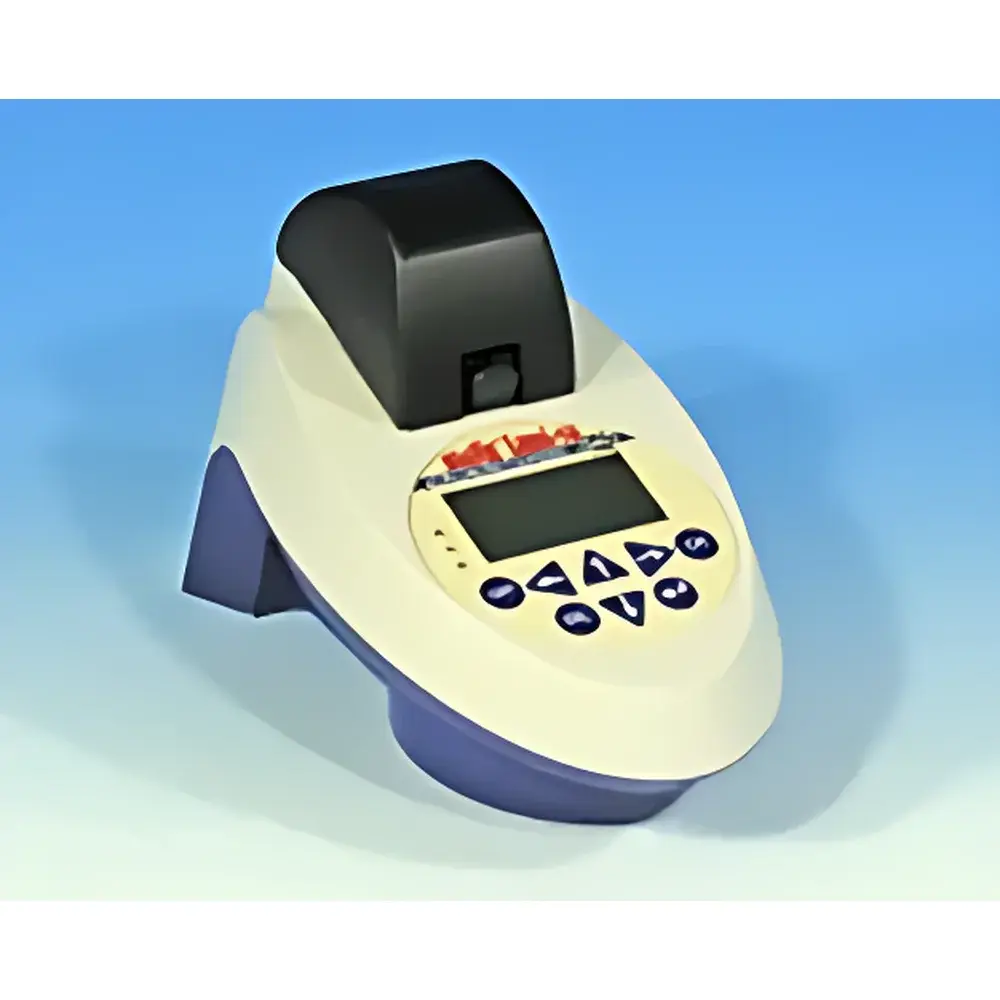
MN BioFix Lumi-10 Portable Water Toxicity Analyzer
| Brand | MN |
|---|---|
| Origin | Germany |
| Manufacturer Type | Authorized Distributor |
| Origin Category | Imported |
| Model | BioFix Lumi-10 |
| Instrument Type | Portable |
| Biological Agent | Bioluminescent Bacteria (Aliivibrio fischeri) |
| Operating Temperature Range | 0°C to 40°C |
| Reagent Storage & Usage Temperature | 0°C to 40°C |
| Coefficient of Variation (CV) | <10% |
| Photon Detection Rate | 5,000 photons per 0.1 second |
| Default Measurement Duration | 10 seconds (adjustable from 0.5 to 20 seconds) |
| Detector | Fast Single-Photon-Counting Photomultiplier Tube (PMT) |
| Spectral Sensitivity Range | 380–630 nm |
| Display | LED monochrome, 128 × 64 pixels |
| Data Storage Capacity | 2,000 measurement records |
| Relative Humidity Tolerance | 10–90% RH (non-condensing) |
| Recommended Operational Ambient Temperature | 15–30°C |
| Power Supply | 3× rechargeable Ni-Cd batteries or AC adapter (230 V/50 Hz or 115 V/60 Hz) |
| Dimensions (H×W×D) | 170 × 150 × 280 mm |
| Weight | 2.0 kg (including batteries) |
| Compliance | EU Low-Voltage Directive 73/23/EEC, EMC Directive 89/336/EEC (as amended by 92/31/EEC) |
Overview
The MN BioFix Lumi-10 Portable Water Toxicity Analyzer is a field-deployable, bioluminescence-based instrument engineered for rapid, quantitative assessment of acute aquatic toxicity in environmental water samples. It operates on the principle of inhibition bioassay using freeze-dried Aliivibrio fischeri — a marine luminous bacterium whose light-emitting metabolic activity is directly suppressed upon exposure to toxicants. The instrument measures the reduction in photon emission intensity over a defined incubation period (default 10 s), expressed as percentage inhibition relative to a non-toxic control. This method conforms to internationally recognized standards including ISO 11348-3 (Water quality — Determination of the inhibitory effect of water samples on the light emission of Vibrio fischeri — Part 3: Method using freeze-dried bacteria) and DIN 38412-L34. Designed for robustness in variable field conditions, the Lumi-10 integrates a high-sensitivity single-photon-counting photomultiplier tube (PMT) with spectral response optimized for bacterial bioluminescence (380–630 nm), enabling detection of sub-lethal toxic effects at low concentrations without sample preconcentration.
Key Features
- True portability: Weighing only 2.0 kg with integrated battery pack (3× Ni-Cd), enabling operation in remote sampling locations without grid power.
- Dual power mode: Supports uninterrupted operation via rechargeable batteries or universal AC input (115 V/60 Hz or 230 V/50 Hz).
- Pre-programmed assay templates: Six built-in test protocols facilitate standardized execution of common regulatory and research workflows — including blank calibration, sample inhibition testing, and reference standard verification.
- On-device data governance: Each record stores geotag-ready metadata — sampling location ID, sample code, date, time, operator ID, and measurement duration — supporting traceability and audit readiness.
- High-speed photon counting: Capable of resolving up to 5,000 photons within 0.1 s, ensuring statistical reliability even under low-light conditions typical of highly inhibited samples.
- Reproducible performance: Demonstrates coefficient of variation (CV) <10% across repeated measurements under controlled laboratory and field conditions, meeting ISO 5725-2 precision criteria for biological assays.
Sample Compatibility & Compliance
The BioFix Lumi-10 accepts liquid water samples including surface water, groundwater, wastewater effluents, industrial discharges, and treated drinking water. Sample volumes are standardized at 1.0 mL per test; no filtration or pH adjustment is required unless sample turbidity exceeds 50 NTU (in which case optional 0.45 µm membrane filtration is recommended). All reagents are supplied as lyophilized A. fischeri vials with guaranteed shelf life ≥18 months at 2–8°C. The instrument complies with EU regulatory frameworks governing electrical safety and electromagnetic compatibility: Low-Voltage Directive 73/23/EEC and Electromagnetic Compatibility Directive 89/336/EEC (as amended by 92/31/EEC). Its design supports alignment with GLP-compliant data integrity requirements through timestamped, immutable storage of raw photon counts and user-defined metadata.
Software & Data Management
The embedded microcontroller runs firmware with real-time signal processing algorithms optimized for PMT dark-current compensation and pulse-height discrimination. Data export occurs via RS-232 serial interface (9-pin D-sub) to external PCs running Windows-compatible data acquisition software — enabling direct integration into LIMS environments. Stored records (up to 2,000) retain full measurement context: raw photon count, normalized inhibition %, assay template ID, ambient temperature, and operator input fields. No proprietary drivers are required; standard terminal emulation (e.g., PuTTY) suffices for manual data dump. Firmware updates are performed via serial bootload protocol, preserving configuration settings across revisions.
Applications
- Rapid screening of industrial discharge compliance prior to release into municipal sewer systems or receiving waters.
- Emergency response monitoring during chemical spills or accidental releases where immediate toxicity hazard assessment is critical.
- Validation of wastewater treatment plant performance by quantifying effluent toxicity before and after tertiary treatment stages.
- Ecotoxicological field studies assessing spatial gradients of contamination in rivers, lakes, and estuaries.
- Quality assurance of reclaimed water used in irrigation or industrial cooling circuits.
- Academic and regulatory research supporting development of site-specific water quality criteria under frameworks such as the EU Water Framework Directive (WFD) and US EPA Whole Effluent Toxicity (WET) testing guidelines.
FAQ
What biological indicator organism does the BioFix Lumi-10 use?
It employs freeze-dried Aliivibrio fischeri, a non-pathogenic, marine-derived luminous bacterium standardized under ISO 11348-3.
Can the instrument operate in sub-zero ambient temperatures?
While the specified operating range extends to 0°C, optimal reproducibility is achieved between 15–30°C; reagents must be equilibrated to assay temperature prior to use.
Is the device suitable for continuous unattended monitoring?
No — it is designed for discrete batch analysis. For continuous applications, consider fixed-station luminometers with automated sampling modules.
How is data integrity ensured during field deployment?
Each measurement is timestamped, assigned a unique sample ID, and stored with full contextual metadata; exported datasets include checksums for validation.
Does the system support FDA 21 CFR Part 11 compliance?
The standalone instrument does not provide electronic signatures or audit trails; however, exported data files may be imported into validated LIMS platforms that meet Part 11 requirements.
Related Products







