
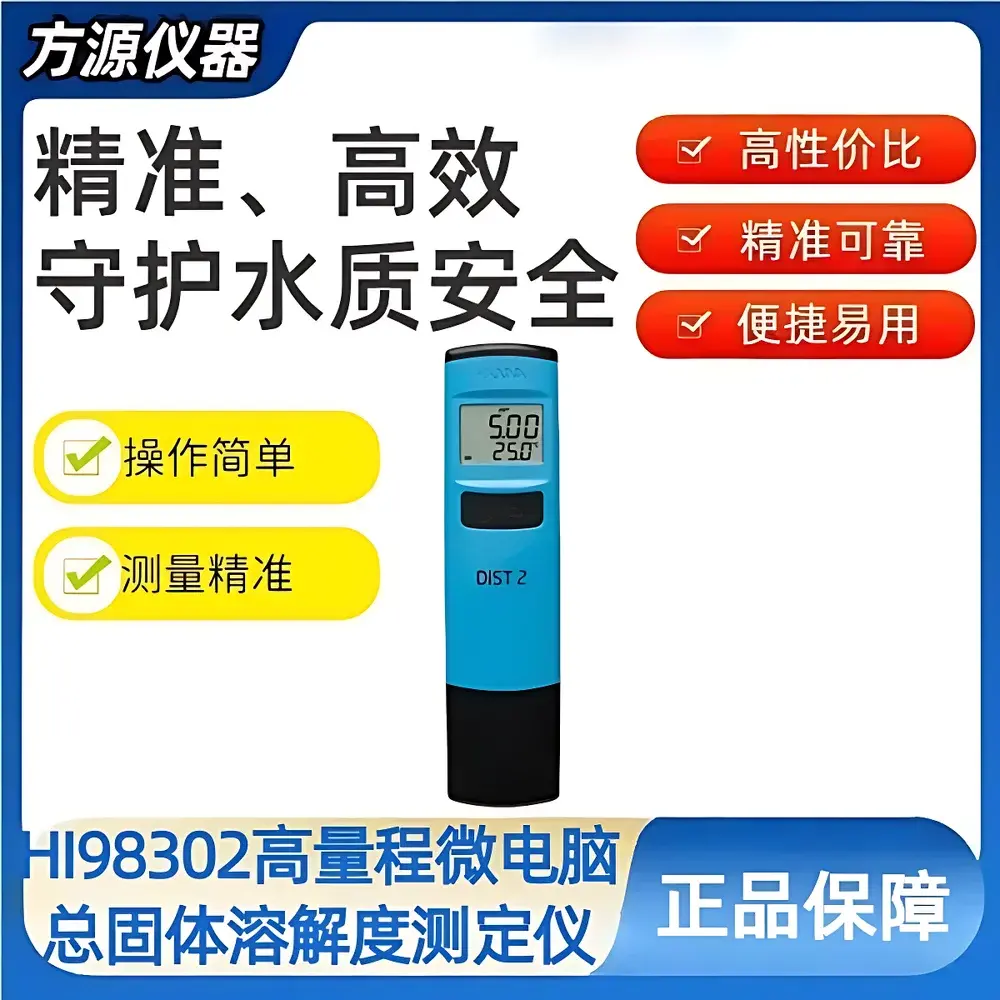
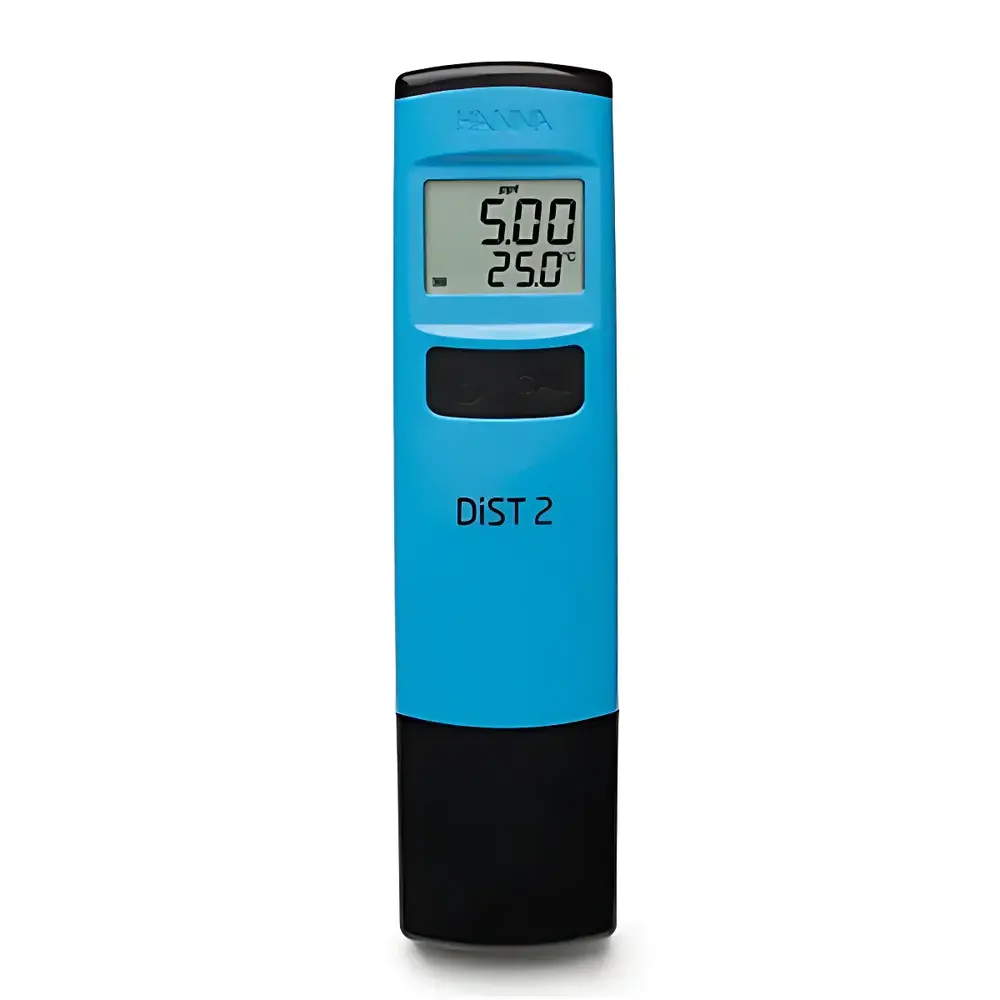
Hanna HI98302 High-Range Portable TDS Meter
| Brand | Hanna Instruments |
|---|---|
| Origin | Italy |
| Model | HI98302 High-Range Microprocessor-Based Total Dissolved Solids (TDS) Meter |
| Instrument Type | Portable |
| Parameter Type | Single-Parameter |
| Measurement Range | 0.00 to 10.00 ppt (g/L) |
| Resolution | 0.01 ppt (g/L) |
| Accuracy | ±2% F.S. at 20°C/68°F |
| Temperature Compensation | Automatic, 0.0 to 50.0°C |
| TDS Conversion Factor | 0.5 |
| Default Calibration Point | 6.44 ppt (g/L) at 25°C (HI70038 recommended) |
| Power Source | 3V CR2032 coin cell battery |
| Dimensions | 160 × 40 × 17 mm |
| Weight | 75 g |
| IP Rating | Not specified |
| Operating Environment | 0 to 50°C, RH ≤ 100% |
Overview
The Hanna HI98302 is a high-range portable total dissolved solids (TDS) meter engineered for field and laboratory applications where rapid, reliable estimation of ionic solute concentration in aqueous solutions is required. It operates on the principle of electrical conductivity measurement, converting conductance readings into TDS values using a fixed conversion factor of 0.5 — consistent with the industry-standard NaCl-based calibration protocol. This approach provides traceable, repeatable results for non-specific ionic load assessment across diverse sample matrices, including potable water, process water, beverage formulations, hydroponic nutrient solutions, and environmental surface water. Unlike laboratory-grade benchtop TDS analyzers that support multi-point calibration or variable conversion factors, the HI98302 is optimized for operational simplicity and rugged portability, featuring an integrated two-electrode graphite sensor with built-in temperature compensation (ATC) to ensure stable readings across ambient conditions from 0.0 to 50.0°C.
Key Features
- High-resolution dual-line LCD display with simultaneous TDS and temperature readouts for immediate contextual interpretation
- Automatic single-point recognition calibration at 6.44 ppt (g/L) using Hanna’s certified standard solution HI70038, eliminating manual calibration input errors
- Integrated graphite two-pole electrode with embedded thermistor for real-time ATC (0.0–50.0°C), minimizing thermal drift and improving inter-laboratory reproducibility
- Three programmable auto-off modes (8 min, 60 min, or disabled) to extend battery life without compromising measurement readiness
- Compact, ergonomic housing (160 × 40 × 17 mm) and lightweight design (75 g) suitable for extended handheld use in field surveys or production line QC checks
- Powered by a single 3V CR2032 lithium coin cell with typical service life exceeding 2,000 measurements under normal usage conditions
Sample Compatibility & Compliance
The HI98302 is intended for use with low-to-moderate ionic strength aqueous samples, including municipal drinking water, bottled water, soft drinks, brewing wort, aquarium water, and wastewater effluent. It is not designed for high-conductivity brines, organic solvents, or viscous suspensions. While it does not carry formal ISO/IEC 17025 accreditation, its calibration methodology aligns with ASTM D1125–22 (Standard Test Methods for Electrical Conductivity and Resistivity of Water) and supports routine compliance with EPA Method 120.1 for TDS estimation in environmental monitoring programs. The device meets CE marking requirements for electromagnetic compatibility (EMC Directive 2014/30/EU) and low-voltage safety (LVD Directive 2014/35/EU). For GLP/GMP environments, users must maintain calibration logs, electrode maintenance records, and temperature verification data as part of documented quality procedures.
Software & Data Management
The HI98302 is a standalone instrument with no onboard data logging, USB interface, or Bluetooth connectivity. All measurements are displayed in real time only; no internal memory or export functionality is provided. This architecture ensures deterministic response time and eliminates firmware-related failure modes common in connected devices. Users requiring traceable data capture must employ external recording methods — such as manual entry into LIMS-compatible spreadsheets or integration with third-party digital logbooks. Calibration verification and electrode cleaning intervals should be scheduled per SOPs aligned with ISO/IEC 17025 Clause 6.4.2 (Equipment Management) and FDA 21 CFR Part 11 Annex A (if used in regulated pharmaceutical or food manufacturing settings).
Applications
- Water treatment facilities: Monitoring influent/effluent TDS for membrane integrity checks and reverse osmosis performance validation
- Food & beverage QA/QC: Verifying consistency of sugar syrups, carbonated beverages, and dairy processing rinse water
- Agricultural & hydroponics: Tracking nutrient solution stability and detecting salt accumulation in recirculating systems
- Environmental field studies: Rapid screening of freshwater bodies for anthropogenic salinity intrusion or runoff contamination
- Educational laboratories: Teaching fundamental principles of solution conductivity, ion mobility, and empirical TDS correlation models
FAQ
What is the recommended calibration standard for the HI98302?
Hanna recommends HI70038 (6.44 ppt TDS at 25°C), a traceable NaCl-based standard certified to NIST-traceable reference materials.
Why does the HI98302 use a fixed TDS conversion factor of 0.5?
This factor reflects the standard NaCl equivalence ratio used in conductivity-to-TDS conversion per ASTM D1125, ensuring comparability across labs using conventional TDS meters.
How often should the graphite electrode be cleaned?
After each use involving turbid, oily, or high-solids samples, rinse with deionized water and soak in Hanna’s HI7061L electrode cleaning solution for 30 minutes before storage.
Can the HI98302 measure seawater or brackish water?
No — its 0.00–10.00 ppt range is insufficient for seawater (~35 ppt); use HI98304 (0.0–100.0 ppt) or HI98308 (0.0–1000.0 ppt) for higher salinity applications.
Is temperature compensation applied during calibration?
Yes — the built-in thermistor automatically adjusts conductivity-to-TDS conversion based on measured sample temperature within 0.0–50.0°C.
Related Products





