
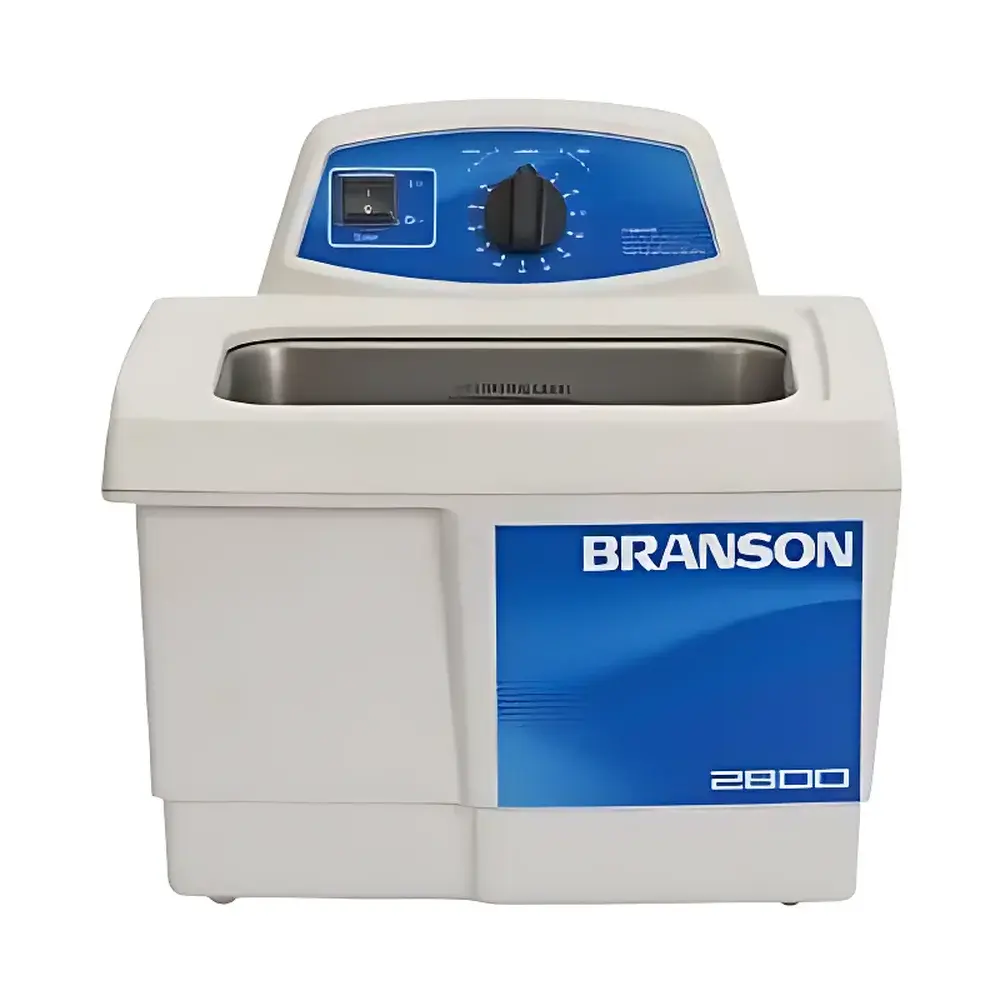
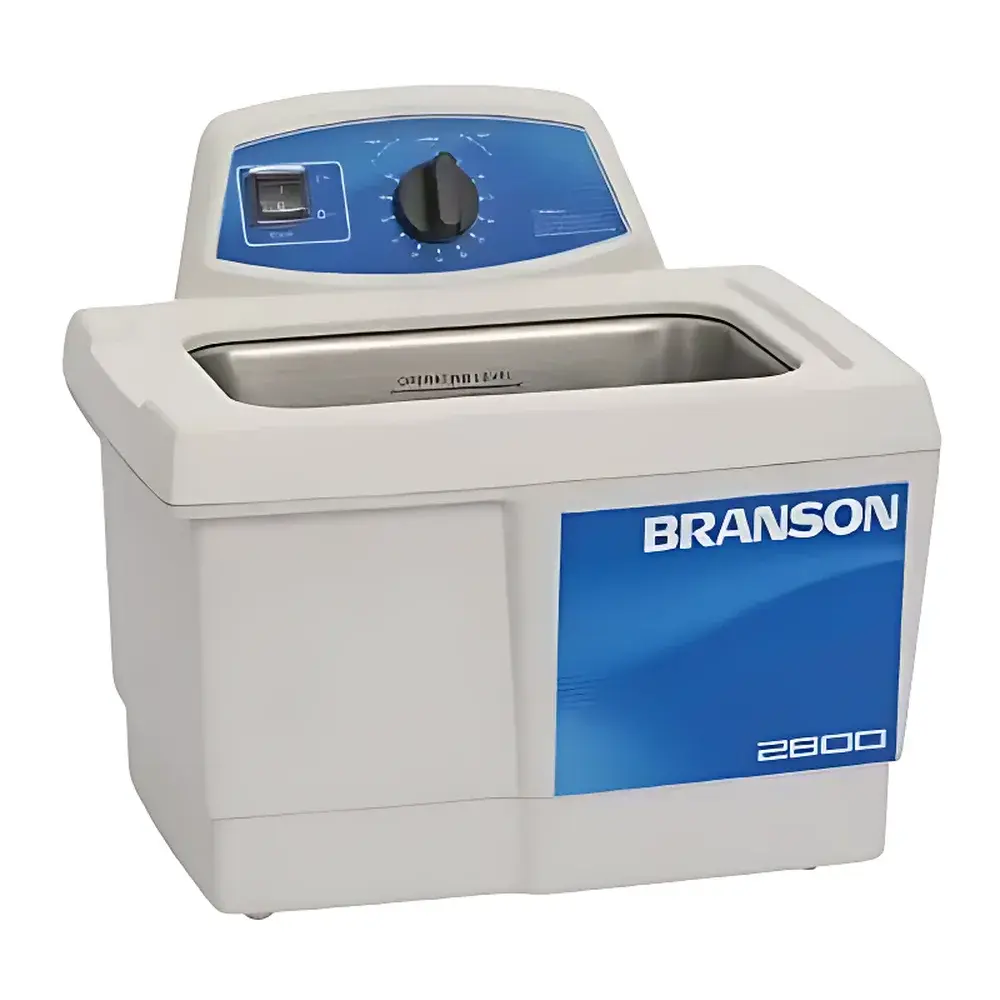
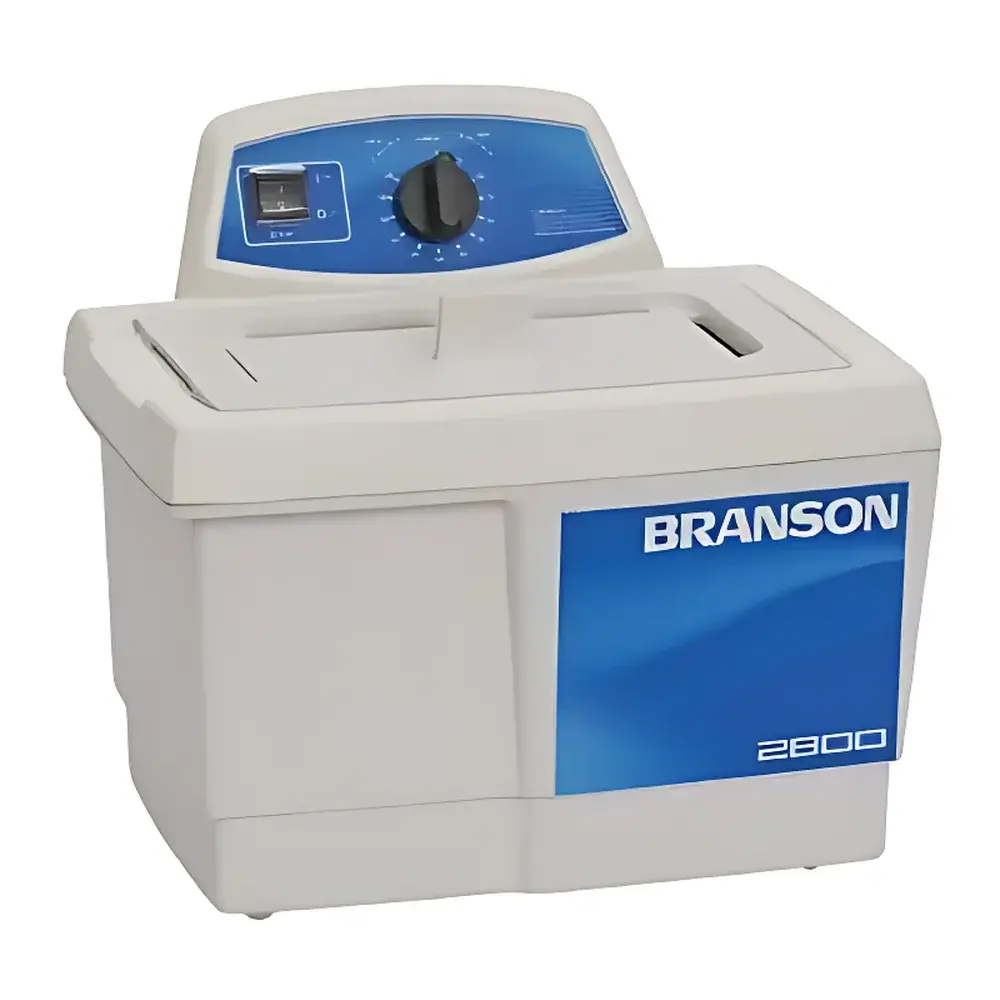
Branson M2800H-C Benchtop Ultrasonic Cleaner
| Brand | Branson |
|---|---|
| Origin | USA |
| Model | M2800H-C |
| Tank Capacity | 2.8 L |
| Frequency | 40 kHz |
| Timer Range | 0–60 min or continuous |
| Max Heating Temperature | 69 °C |
| Heating Power | 105 W |
| Ultrasonic Power | 130 W |
| Internal Dimensions (L×W×D) | 230 × 140 × 100 mm |
| External Dimensions (L×W×D) | 337 × 304 × 302 mm |
| Weight | 4.1 kg |
| Compliance | CE, FCC, CSA, UL, TÜV-certified |
| Construction | Polypropylene (PP) tank and chassis |
| Transducer Type | Langevin-type metal/ceramic |
| Sweep Frequency Function | Yes |
| Power Tracking | Automatic output stabilization |
| Drain Port | Not equipped |
| Control Interface | Mechanical timer + one-touch heater switch |
Overview
The Branson M2800H-C is a precision-engineered benchtop ultrasonic cleaner designed for consistent, repeatable cleaning performance in analytical laboratories, quality control environments, and R&D facilities. It operates on the principle of acoustic cavitation—where high-frequency sound waves (40 kHz) generate microscopic vacuum bubbles in the cleaning solution that rapidly collapse, releasing localized energy to dislodge particulate contaminants, organic residues, and biofilms from delicate surfaces. Unlike fixed-frequency units, the M2800H-C incorporates real-time power tracking and professional sweep frequency modulation, ensuring stable acoustic energy delivery regardless of load variation, solution composition, or temperature drift. This architecture minimizes standing wave formation and promotes uniform cavitation distribution across the entire tank volume—critical for reproducible cleaning outcomes in regulated workflows.
Key Features
- Automatic power tracking circuitry maintains constant ultrasonic output under dynamic load conditions—including varying sample geometries, immersion depths, and solution conductivity—enabling cross-user and cross-batch consistency.
- Sweep frequency technology continuously modulates the drive signal across a narrow band around 40 kHz, disrupting nodal patterns and eliminating “dead zones” within the tank for homogeneous energy distribution.
- Langevin-type transducers integrate robust metal housing with high-curie-point ceramic elements, delivering extended operational life and thermal stability during prolonged heating cycles.
- Polypropylene (PP) construction provides inherent resistance to common laboratory solvents, acids (e.g., dilute HCl, HNO₃), and alkaline solutions—supporting compatibility with aqueous, enzymatic, and mild solvent-based cleaning chemistries.
- Vertical PCB orientation and elevated control panel placement minimize exposure to condensation and spill ingress, significantly enhancing long-term reliability in humid or splash-prone lab settings.
- Mechanical timer offers precise 1–60 minute intervals or continuous operation mode; integrated one-touch heater enables rapid thermal equilibration up to 69 °C without requiring digital interface interaction.
- Optimized tank geometry and standardized fill line ensure optimal acoustic coupling and cavitation efficiency—validated via ASTM E1712-22 recommended performance verification protocols.
Sample Compatibility & Compliance
The M2800H-C accommodates a broad range of laboratory components including glassware (vials, cuvettes, pipette tips), metal tools (tweezers, forceps, surgical instruments), printed circuit boards, optical lenses, and semiconductor wafers. Its 2.8 L capacity supports batch processing of small-to-medium parts while maintaining sufficient solution depth for full submersion. All electrical systems comply with international safety standards: CE (2014/30/EU EMC Directive and 2014/35/EU LVD), FCC Part 15 Class B, CSA C22.2 No. 61010-1, UL 61010-1, and TÜV Rheinland certification per IEC 61010-1:2010. These certifications confirm protection against electric shock, fire hazard, mechanical instability, and electromagnetic interference—essential for integration into GLP/GMP-compliant laboratories subject to FDA 21 CFR Part 11 audit requirements.
Software & Data Management
As a fully analog-controlled instrument, the M2800H-C does not incorporate embedded firmware, network connectivity, or data logging capabilities. This design philosophy prioritizes operational simplicity, electromagnetic noise immunity, and long-term serviceability—particularly advantageous in environments where software validation (e.g., IQ/OQ/PQ documentation per GAMP 5) would otherwise impose regulatory overhead. All user interactions occur via tactile mechanical controls, eliminating dependency on display calibration, battery backup, or cybersecurity updates. For labs requiring traceable process records, external time-stamped video monitoring or standalone temperature/data loggers (e.g., compliant with ISO/IEC 17025) may be deployed alongside the unit without compromising its certified safety architecture.
Applications
The M2800H-C serves critical roles in sample preparation workflows across multiple disciplines: removal of polishing compounds from metallurgical specimens prior to SEM imaging; decontamination of HPLC autosampler vials and LC-MS injection needles; cleaning of quartz crystal microbalance (QCM) sensors between measurement cycles; degassing of low-viscosity solvents used in thin-film deposition; and pre-sterilization treatment of reusable labware in microbiology and cell culture suites. Its stable 40 kHz output and thermal regulation capability make it especially suitable for applications requiring simultaneous sonication and controlled heating—such as accelerated solvent extraction of plant metabolites or dissolution testing of pharmaceutical dosage forms per USP .
FAQ
Does the M2800H-C support remote control or computer interfacing?
No. It features exclusively manual, analog controls to ensure deterministic behavior and eliminate software-related failure modes.
Is the unit compatible with flammable solvents?
Not recommended. The heater and transducer design are intended for aqueous or water-miscible solutions only; use in volatile organic solvents requires explosion-proof rated equipment.
What maintenance is required for long-term reliability?
Routine inspection of the drain plug seal (if retrofitted), periodic descaling of the tank using diluted acetic acid, and visual verification of transducer adhesion integrity every 12 months.
Can the unit be validated for use in regulated pharmaceutical manufacturing?
Yes—its documented compliance with TÜV, UL, and IEC 61010-1 enables inclusion in equipment qualification protocols (IQ/OQ) when paired with external calibration and environmental monitoring.
Is the polypropylene tank resistant to sodium hydroxide solutions?
Yes—PP exhibits excellent resistance to ≤10% NaOH at temperatures up to 60 °C; prolonged exposure above this concentration or temperature may cause gradual stress cracking.



