
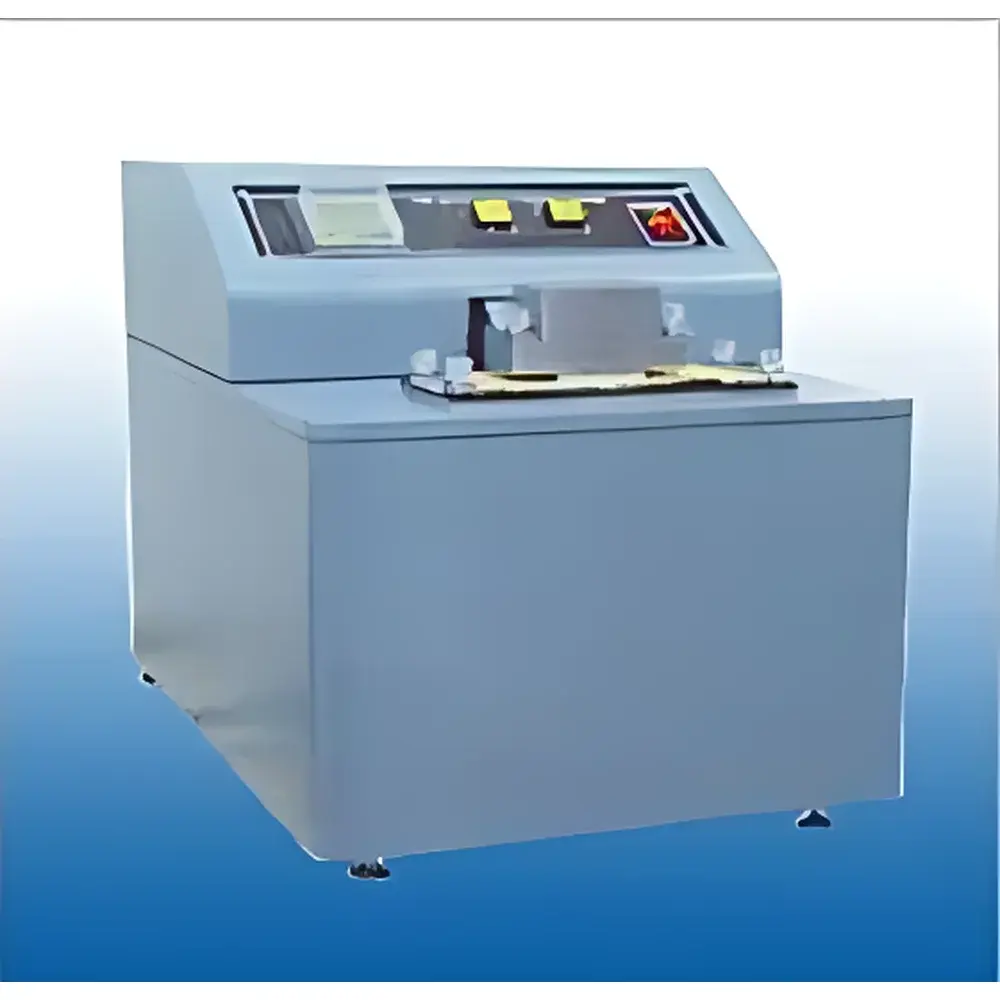
Fangyuan Instruments GB7706 Ink Rub Resistance Tester
| Brand | Fangyuan Instruments |
|---|---|
| Origin | Guangdong, China |
| Manufacturer Type | Authorized Distributor |
| Country of Origin | China |
| Model | GB7706 |
| Quotation | Upon Request |
| Specimen Area | 60 × 210 mm |
| Rubbing Speed | 4 adjustable speeds (21 / 42 / 85 / 106 cycles per minute) |
| Applied Load | 4.5 lb (2.04 kg, 20 N) |
| Stroke Length | 60 mm |
| Cycle Count Range | 0–999,999 (auto-stop) |
| Rubbing Contact Area | 50 × 100 mm |
| Power Consumption | 40 W |
| Dimensions (W×D×H) | 300 × 325 × 300 mm |
| Net Weight | 20 kg |
| Input Voltage | AC 220 V, 1 A |
Overview
The Fangyuan Instruments GB7706 Ink Rub Resistance Tester is a precision-engineered tribological testing system designed to quantify the mechanical durability of printed ink layers, photosensitive coatings on PS plates, and functional surface coatings on packaging, labels, and industrial substrates. It operates on the principle of controlled linear reciprocating abrasion—applying standardized normal force and cyclic motion between a test specimen and a defined abradant (typically white offset printing paper or book paper), thereby simulating real-world handling, stacking, and transport conditions that induce ink transfer, smearing, or coating delamination. The instrument adheres strictly to the geometric, kinematic, and loading specifications outlined in GB/T 7706–2008 (Chinese National Standard for Flexographic and Gravure Printing Inks), while maintaining technical compatibility with JIS K 5701 (Japanese Industrial Standard for Printing Ink Rub Resistance) and general requirements of ISO 9001 quality management systems for test method validation and equipment control.
Key Features
- Four precisely calibrated rubbing frequencies (21, 42, 85, and 106 cycles per minute) enable method-specific protocol alignment—e.g., low-speed evaluation for delicate substrates versus high-cycle stress testing for industrial-grade packaging.
- Fixed-load application mechanism delivers consistent 20 N (4.5 lbf) normal force via calibrated deadweight system, eliminating pneumatic or spring-based variability and ensuring inter-laboratory reproducibility.
- Digital counter with six-digit resolution (0–999,999 cycles) supports both endpoint-driven testing (e.g., “stop at 1000 cycles”) and time-series monitoring for degradation kinetics analysis.
- Modular specimen holder accommodates standard 60 × 210 mm samples; the 50 × 100 mm active contact zone ensures uniform pressure distribution and avoids edge-effect artifacts during evaluation.
- Compact benchtop architecture (300 × 325 × 300 mm) integrates low-power 40 W operation and EMI-suppressed motor drive—optimized for QC labs with limited floor space and strict energy-use policies.
- Compliance-ready mechanical design facilitates integration into GLP- and GMP-regulated environments, with traceable load calibration paths and documented maintenance intervals aligned with ISO/IEC 17025 laboratory accreditation requirements.
Sample Compatibility & Compliance
The GB7706 tester accepts rigid and semi-rigid planar specimens—including coated paperboard, aluminum foil laminates, PET film, corrugated board facing layers, and photopolymer PS plates—provided they meet dimensional stability criteria under 20 N static load. Surface curvature, warpage >0.2 mm/m, or substrate thickness <0.1 mm may compromise contact uniformity and require custom fixturing. The instrument satisfies essential verification criteria for GB/T 7706–2008 Clause 5.2 (mechanical configuration), JIS K 5701 Annex B (rubbing parameters), and supports audit-ready documentation for ISO 9001:2015 Clause 7.1.5 (monitoring and measuring resources). While not intrinsically FDA 21 CFR Part 11 compliant (as it lacks electronic records functionality), its analog-digital hybrid architecture permits external data capture via RS-232 or USB-serial interfaces for integration with validated LIMS platforms.
Software & Data Management
The GB7706 operates as a stand-alone electromechanical tester with embedded microcontroller logic—no proprietary software is required for basic operation. Cycle count, speed selection, and power status are displayed via LED interface. For laboratories requiring digital traceability, optional serial output enables connection to third-party data acquisition systems (e.g., LabVIEW, MATLAB, or custom Python scripts) to log timestamps, cycle counts, and operator IDs. All calibration records—including load verification certificates and stroke-length metrology reports—must be retained per ISO/IEC 17025 Section 6.4.10; instrument logs do not auto-generate electronic audit trails but support manual entry into secure, version-controlled QA databases.
Applications
- Quantitative assessment of flexographic and gravure ink rub resistance for food packaging compliance (e.g., EU Framework Regulation (EC) No 1935/2004 migration risk mitigation).
- PS plate endurance screening prior to press installation—correlating rub cycles to predicted print run length under controlled environmental conditions.
- Comparative evaluation of UV-curable, water-based, and solvent-based coating systems for label stock manufacturers.
- Root-cause analysis of batch-to-batch variation in ink adhesion during supplier qualification audits.
- Validation of post-printing varnish or lamination processes intended to enhance surface hardness and scuff resistance.
FAQ
Does the GB7706 comply with ASTM D5264 or ISO 11644?
No—the GB7706 implements the Chinese national standard GB/T 7706 methodology, which differs in stroke length, load definition, and abradant specification from ASTM D5264 (rotary abrasion) and ISO 11644 (dry rub fastness for textiles). Cross-standard correlation requires empirical mapping studies.
Can I use alternative abradants such as cotton cloth or sandpaper?
Not without method revalidation. GB/T 7706 mandates white offset printing paper (or equivalent book paper) as the reference abradant. Substitution alters coefficient of friction and wear mechanics, invalidating conformance claims.
Is periodic recalibration required?
Yes—load verification using NIST-traceable force standards is recommended every 6 months or after 5,000 operational cycles; stroke length should be confirmed annually with calibrated calipers per manufacturer’s maintenance schedule.
What is the expected service life under routine QC usage?
With scheduled lubrication of linear guides and periodic inspection of cam follower wear, the mechanical system maintains metrological integrity for ≥8 years at ≤10 test cycles/day average duty cycle.
Does the unit include calibration certification?
A factory-issued calibration report (covering load and stroke verification) is provided with each shipment; full ISO/IEC 17025-accredited calibration must be arranged separately through an accredited third-party laboratory.



