


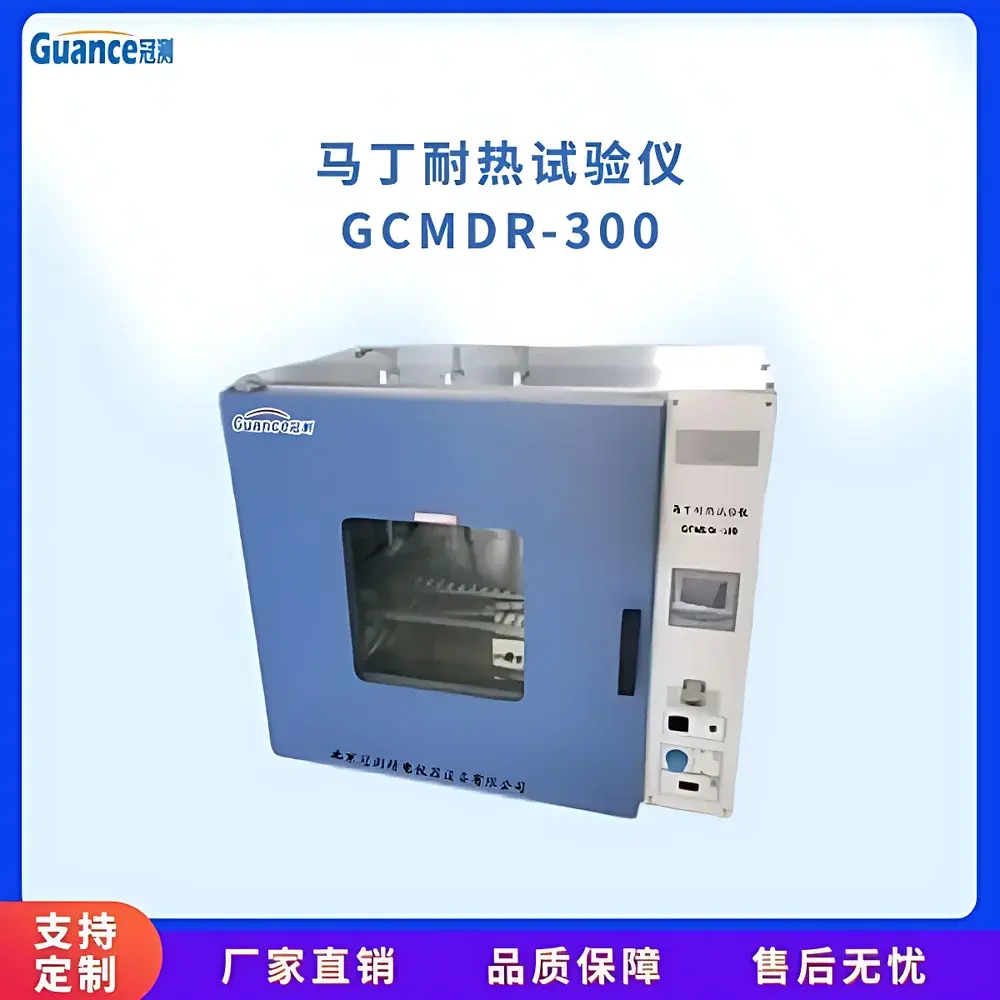
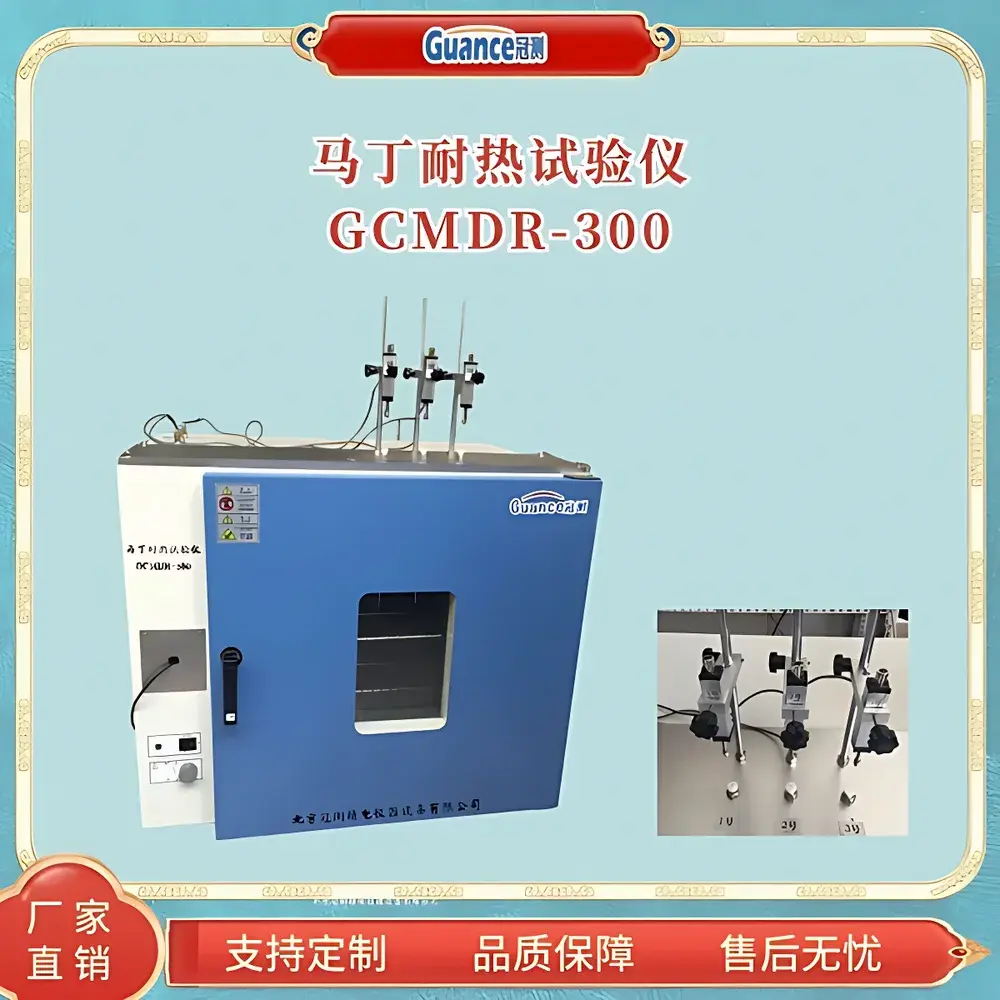
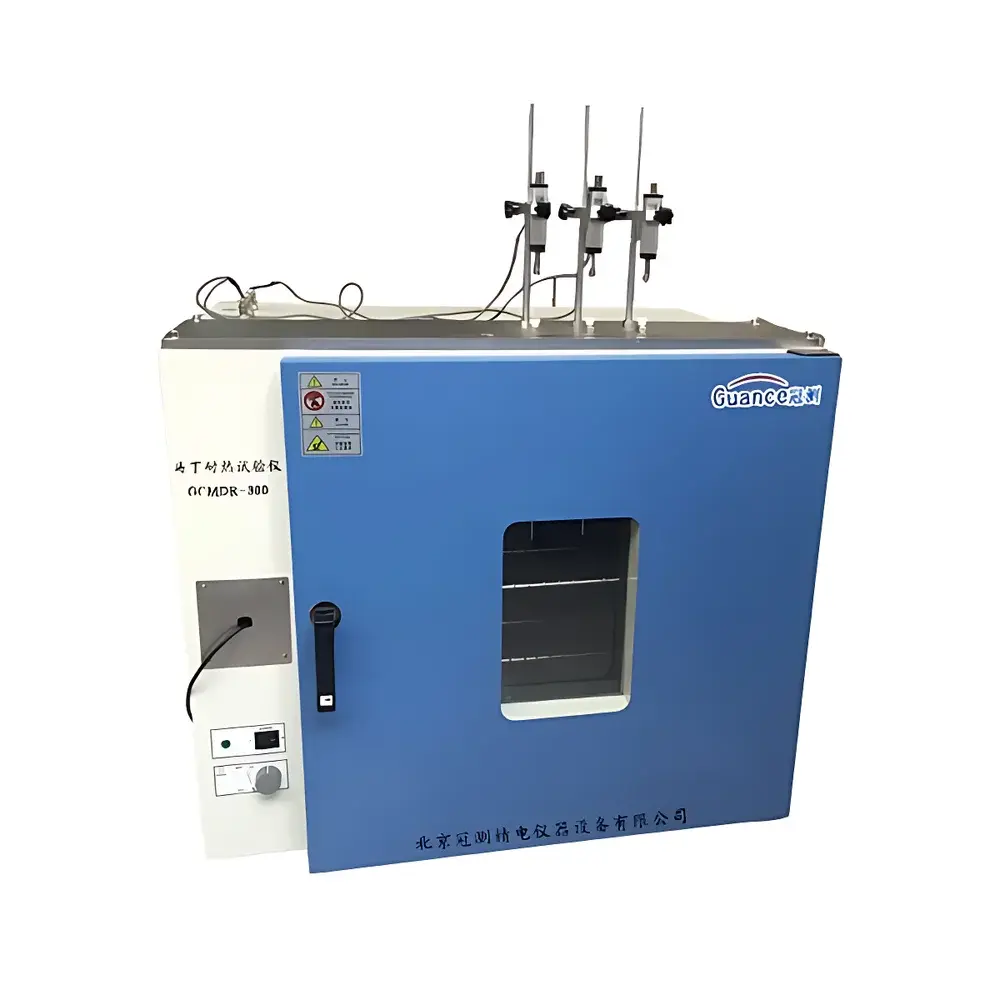
GuanCe Instruments GCMDR-300 Microcomputer-Controlled Martin Heat Resistance Tester
| Brand | GuanCe Instruments |
|---|---|
| Origin | Beijing, China |
| Manufacturer Type | Authorized Distributor |
| Country of Origin | China |
| Model | GCMDR-300 |
| Price | USD 1,750 (FOB Beijing) |
Overview
The GuanCe Instruments GCMDR-300 Microcomputer-Controlled Martin Heat Resistance Tester is a precision thermal deformation evaluation system engineered for standardized determination of the Martin heat resistance temperature (MHRT) of rigid plastics, thermosetting resins, vulcanized rubber, and polymer-based cable compounds. Based on the fundamental principle of controlled bending deflection under constant mechanical stress during linear thermal ramping, the instrument applies a defined flexural load (50 ± 0.2 kgf/cm²) to standardized bar specimens while heating at a strictly regulated rate—either 50 ± 3 °C/h or 10 ± 2 °C per 12 minutes—per ASTM D1525 (equivalent to GB/T 1035, GB/T 1699, and HG/T 3847). The MHRT is defined as the temperature at which the specimen’s mid-span deflection reaches 6 mm under specified loading conditions. This method provides a comparative, reproducible metric for ranking relative thermal stability among polymeric materials in quality control, formulation development, and incoming raw material verification.
Key Features
- Triple-channel high-resolution displacement measurement using calibrated digital micrometer sensors (resolution: 0.001 mm), enabling simultaneous real-time tracking of three specimens with independent data logging
- LabVIEW-based proprietary control and acquisition software with PID-integrated intelligent temperature regulation—ensuring thermal ramp stability within ±3 °C/h deviation over the full 40–300 °C operational range
- Automated load calculation engine that computes required mass distribution based on specimen dimensions and target stress (50 ± 0.2 kgf/cm²), minimizing operator-dependent error
- Full test automation: parameter input → auto-load positioning → thermal ramp initiation → deflection monitoring → endpoint detection at 6 mm → data archiving
- Configurable graphical interface displaying overlayable displacement vs. temperature curves for all three channels; individual trace toggling supported for comparative analysis
- Comprehensive reporting module supporting editable templates and direct export to Microsoft Word (.docx) and Excel (.xlsx) formats for audit-ready documentation
Sample Compatibility & Compliance
The GCMDR-300 accommodates standard rectangular bar specimens measuring 120 ± 2 mm (length) × 15 ± 0.2 mm (width) × 10 ± 0.2 mm (thickness); thicker samples may be surface-machined to nominal 10 mm thickness. Effective span length is fixed at 56 ± 1 mm. The system complies with national and international standards including GB/T 1035–2008, GB/T 1699–2003, and HG/T 3847–2008. While not certified to ISO/IEC 17025 calibration requirements out-of-box, its architecture supports traceable calibration via NIST-traceable reference thermocouples and certified displacement standards. All software-generated reports include timestamped metadata, user ID fields, and version-stamped test parameters—facilitating alignment with GLP documentation practices and internal QA workflows.
Software & Data Management
The embedded LabVIEW application runs on a dedicated industrial PC (included) and implements role-based access control, electronic signature support, and configurable audit trails. Raw displacement and temperature time-series data are stored in binary-encoded .lvm files with embedded header metadata (test ID, operator, date/time, calibration status). Export functions preserve numerical precision and curve fidelity in both tabular and graphical outputs. The system supports CSV batch import for multi-test sequence programming and includes built-in statistical tools for inter-specimen variance analysis (e.g., mean MHRT, standard deviation, confidence intervals at 95%). Data integrity safeguards include automatic write-protection after test completion and optional network backup to SMB shares.
Applications
- Quality assurance of thermoset molding compounds (e.g., phenolics, epoxies) prior to release
- Comparative thermal stability screening during polymer blend development
- Incoming inspection of rubber compounds used in automotive sealing systems
- Regulatory documentation for cable jacketing materials per IEC 60811 compliance pathways
- Failure analysis of heat-distorted components in post-mortem investigations
- Educational use in polymer engineering laboratories for ASTM/GB method training
FAQ
What is the maximum allowable specimen thickness before machining is required?
Specimens exceeding 10.2 mm in thickness must be machined to 10.0 ± 0.2 mm on both faces to ensure uniform stress distribution and compliant span-to-thickness ratio.
Can the instrument operate continuously across multiple shifts without recalibration?
Yes—the thermal sensor and displacement transducers maintain stability for ≥8 hours of uninterrupted operation; however, daily verification using a certified reference block (recommended at 100 °C and 200 °C) is advised per internal QA protocols.
Is FDA 21 CFR Part 11 compliance supported?
The base software does not include electronic signature validation or audit trail encryption features required for Part 11 enforcement; however, it exports fully attributable data sets compatible with validated third-party LIMS platforms that provide such functionality.
What maintenance intervals are recommended for long-term accuracy?
Biannual verification of thermal ramp linearity and displacement sensor linearity is recommended using NIST-traceable references; annual replacement of silicone oil bath fluid is required to maintain thermal homogeneity.
Does the system support external PLC integration for factory-floor automation?
No native Modbus TCP or EtherNet/IP drivers are included; however, the LabVIEW runtime exposes shared variables via TCP/IP, enabling custom integration with supervisory control systems through documented APIs.






