
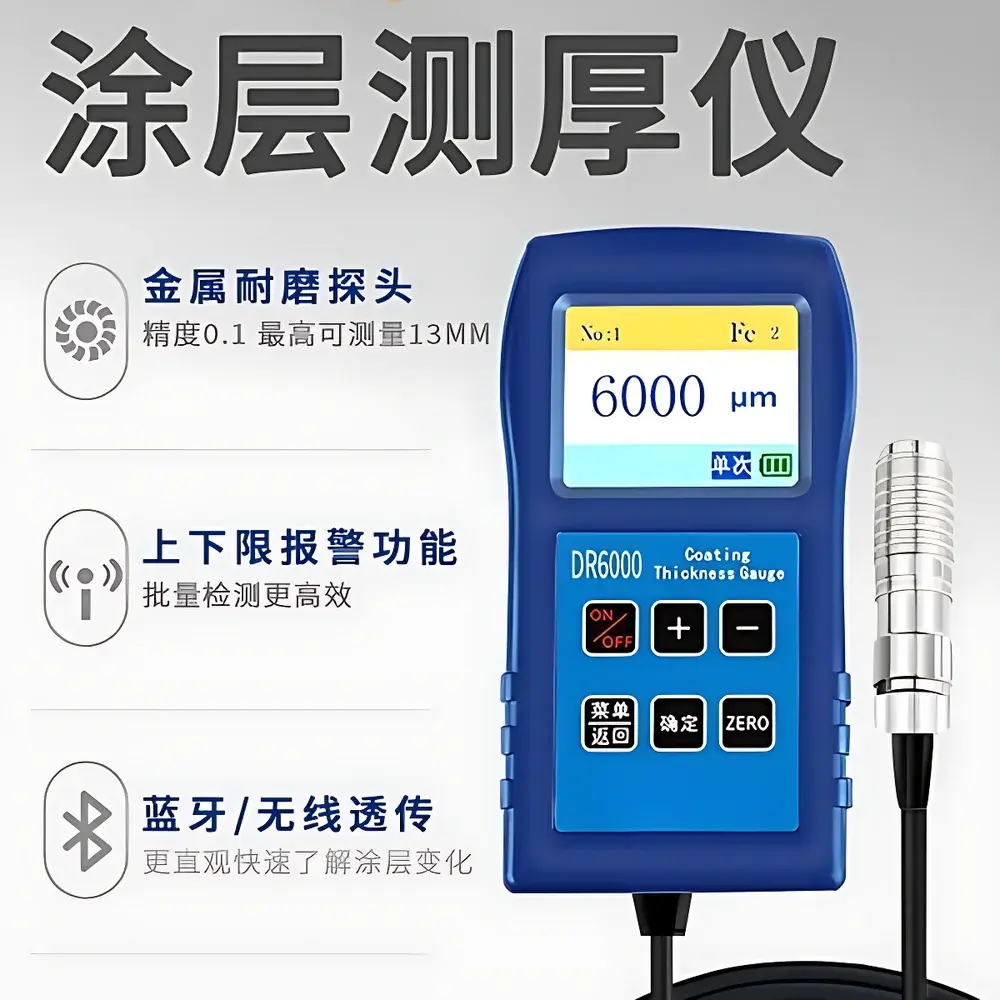
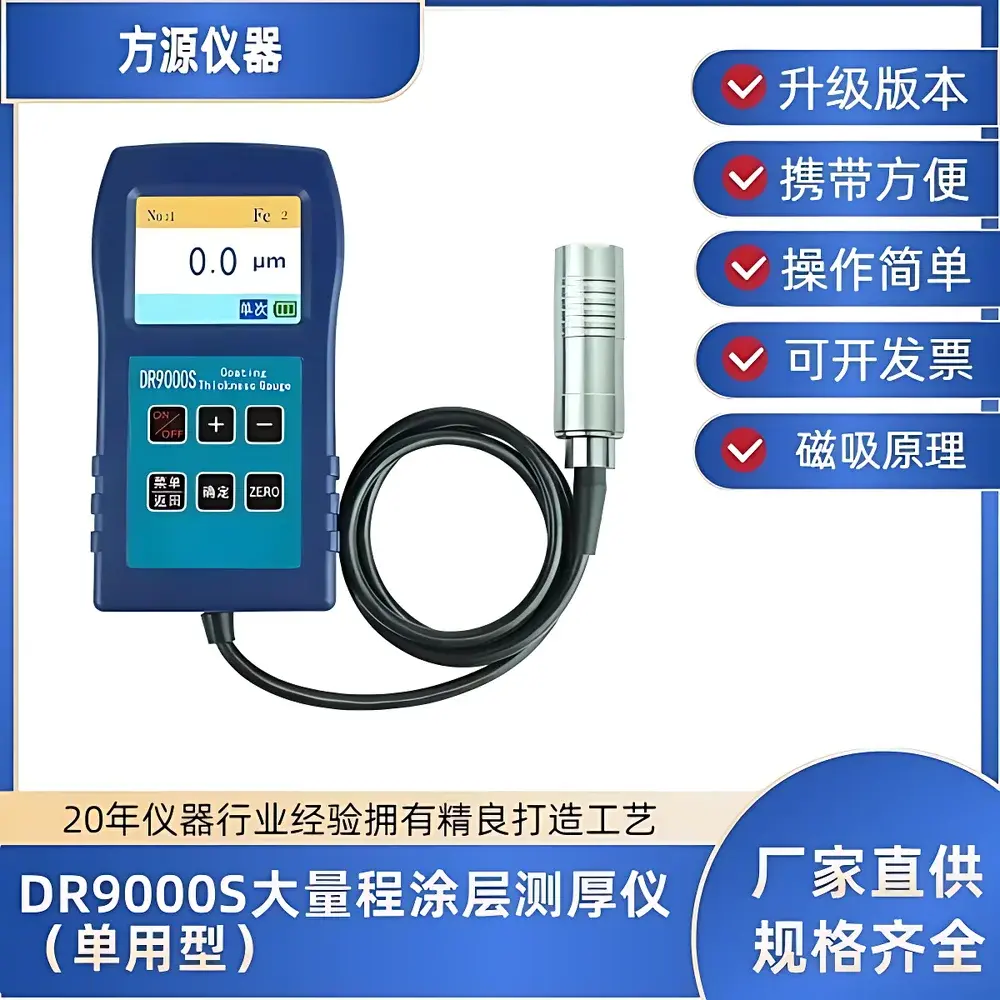
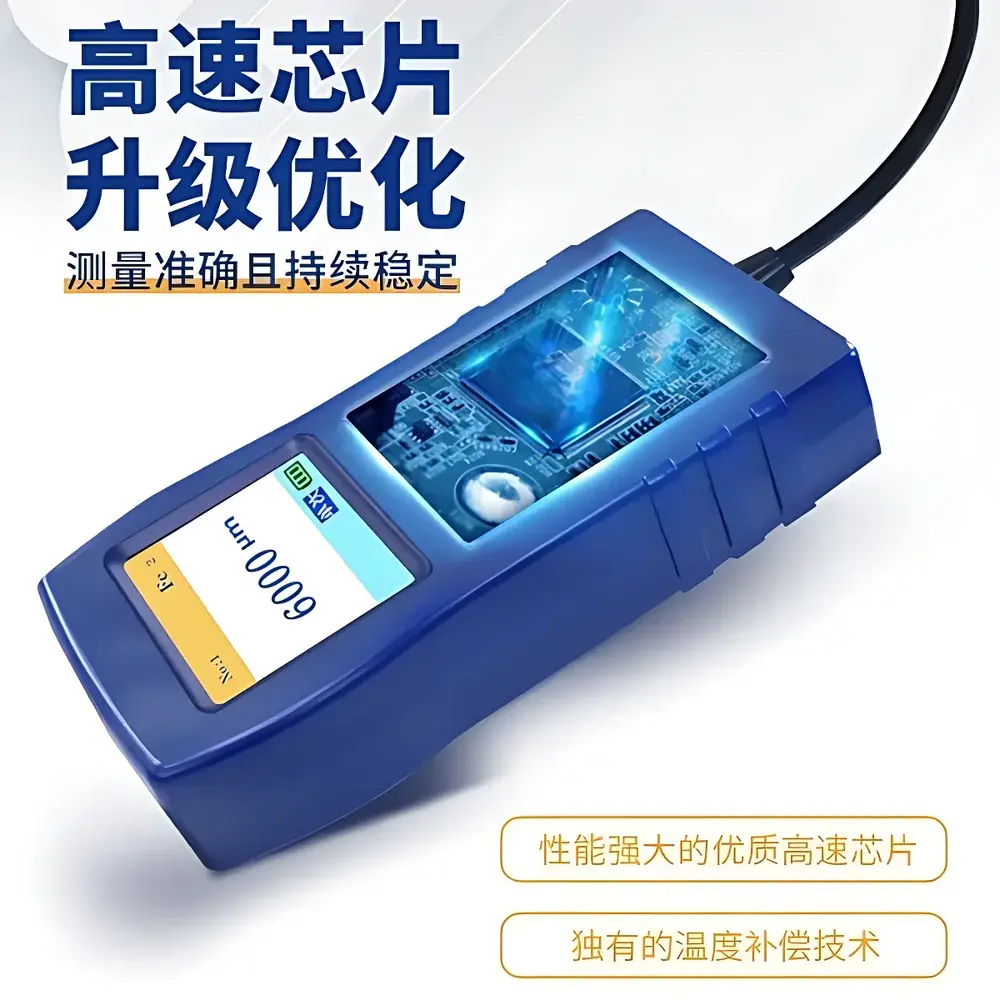
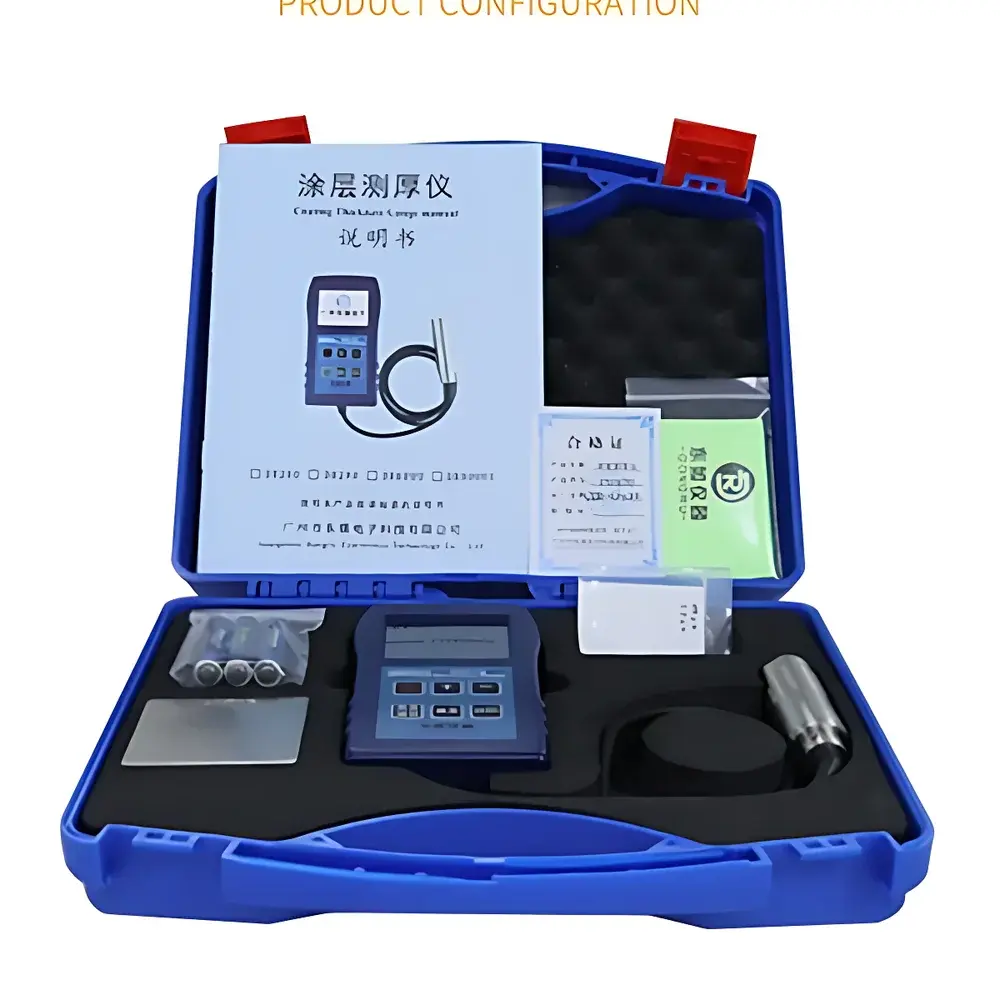
Fangyuan Instruments DR9000 Dual-Mode Coating Thickness Gauge (Magnetic Induction & Eddy Current)
| Brand | Fangyuan Instruments |
|---|---|
| Origin | Guangdong, China |
| Model | DR9000 |
| Measurement Principles | Magnetic Induction (for Fe substrates) & Eddy Current (for non-Fe substrates) |
| Measurement Range | 0–1250 µm (Fe), 0–1250 µm (non-Fe) |
| Resolution | 0.1 µm (≤100 µm), 1 µm (>100 µm) |
| Accuracy | ±(1–3)% of reading or ±2 µm (whichever is greater) |
| Substrate Compatibility | Ferrous (steel, iron) and non-ferrous (aluminum, stainless steel, copper, zinc, brass) |
| Display | 2.4" TFT LCD with backlight |
| Data Storage | Up to 10,000 readings (grouped by batch ID) |
| Interface | USB-C for data export |
| Compliance | ISO 2178, ISO 2360, ASTM B499, ASTM D7091, DIN EN ISO 1461 |
Overview
The Fangyuan Instruments DR9000 is a dual-mode handheld coating thickness gauge engineered for precision, repeatability, and field-deployable reliability in industrial quality control and laboratory verification environments. It operates on two well-established, standards-compliant physical principles: magnetic induction for non-destructive measurement on ferromagnetic substrates (e.g., carbon steel, cast iron), and eddy current for non-conductive coatings on non-ferrous conductive substrates (e.g., aluminum, copper, stainless steel, zinc-coated galvanized steel). This dual-sensor architecture eliminates the need for manual mode switching or substrate pre-identification in mixed-material workflows—sensor auto-detection ensures correct principle selection upon contact. The instrument delivers traceable thickness data across a broad dynamic range (0–1250 µm), supporting critical applications such as galvanizing process validation, paint and powder coating QC, corrosion protection system auditing, and fireproofing intumescent layer verification.
Key Features
- Auto-substrate recognition: Integrated dual-sensor probe dynamically selects magnetic induction or eddy current mode based on real-time substrate conductivity and permeability assessment.
- High-resolution TFT display: 2.4-inch backlit screen with adjustable contrast ensures legibility under variable lighting—including workshop floors, outdoor inspection sites, and low-illumination confined spaces.
- Statistical batch analysis: On-device calculation of mean, standard deviation, min/max, and Cp/Cpk indices per measurement group (up to 10,000 stored readings, organized by user-defined batch ID).
- Calibration traceability: Supports multi-point calibration using certified foil and shunt standards; calibration history (date, operator ID, reference values) is logged and exportable.
- Ruggedized industrial housing: IP63-rated enclosure with rubberized impact zones and scratch-resistant sapphire window protects against dust, splashes, and mechanical shock during daily use.
- USB-C connectivity: Enables direct data transfer to Windows/Linux workstations without proprietary drivers; exports CSV files compatible with LIMS, Minitab, and Excel-based SPC platforms.
Sample Compatibility & Compliance
The DR9000 is validated for quantitative thickness measurement of non-magnetic, electrically insulating layers—including epoxy, polyurethane, acrylic, PVC, enamel, zinc (hot-dip and electrogalvanized), and thermoset powder coatings—applied over both ferrous and non-ferrous metallic substrates. It conforms to international metrological standards governing non-destructive testing of coatings: ISO 2178 (magnetic method), ISO 2360 (eddy current method), ASTM B499 (standard test method for measurement of coating thicknesses by magnetic and eddy-current test methods), ASTM D7091 (practice for nondestructive measurement of dry film thickness of nonmagnetic coatings applied to ferrous metals and nonconductive coatings on non-ferrous metals), and DIN EN ISO 1461 (zinc coatings on fabricated iron and steel articles). Its measurement uncertainty profile satisfies GLP-aligned documentation requirements for third-party audit readiness.
Software & Data Management
Data acquisition and reporting are fully integrated into routine QA/QC workflows. Each stored record includes timestamp, substrate type (auto-detected), measurement mode, raw thickness value, temperature (via internal sensor), and operator ID (configurable via device menu). Batch-level summary reports can be generated onsite and exported as CSV or PDF. The USB-C interface supports mass storage mode—no additional software installation required. For enterprise integration, the DR9000’s structured data format is compatible with FDA 21 CFR Part 11–compliant systems when deployed with appropriate audit-trail middleware. Calibration certificates, firmware revision logs, and measurement history are retained onboard for full traceability across instrument lifecycle.
Applications
- Galvanizing line monitoring: Real-time verification of zinc coating mass and uniformity per ISO 1461 and ASTM A123.
- Powder coating QC: In-process thickness checks prior to curing to prevent under-film corrosion or over-application waste.
- Aerospace component finishing: Verification of primer and topcoat thickness on aluminum airframes per AMS 2400 and Boeing D6-17487.
- Automotive OEM paint shops: Layer-by-layer thickness validation of e-coat, primer surfacer, basecoat, and clearcoat stacks.
- Infrastructure corrosion protection: Field audits of epoxy and FBE coatings on pipelines, bridges, and offshore platforms per NACE SP0169 and ISO 21809.
- Fireproofing compliance: Quantitative assessment of intumescent coating thickness on structural steel to meet UL 1709 and EN 13381-8 requirements.
FAQ
Does the DR9000 require separate probes for ferrous and non-ferrous measurements?
No—the integrated dual-mode probe automatically detects substrate type and applies the appropriate physical principle (magnetic induction or eddy current) without user intervention.
Can measurement data be exported directly to statistical process control (SPC) software?
Yes—CSV exports include all metadata (batch ID, timestamp, operator, substrate type) and are natively readable by common SPC tools including Minitab, JMP, and custom Python/Pandas pipelines.
Is the DR9000 suitable for measuring coatings on curved or irregular surfaces?
It supports curvature compensation down to 10 mm radius via optional curved-foot probe accessories (sold separately); flat-surface accuracy specifications apply only to planar substrates.
How often does the instrument require recalibration?
Annual recalibration is recommended per ISO/IEC 17025 guidelines; however, daily verification using certified zero and span standards is required before critical measurement campaigns.
Does the device support multi-language UI for international teams?
The firmware includes English, Spanish, French, German, and simplified Chinese language options, configurable via system settings menu.



