
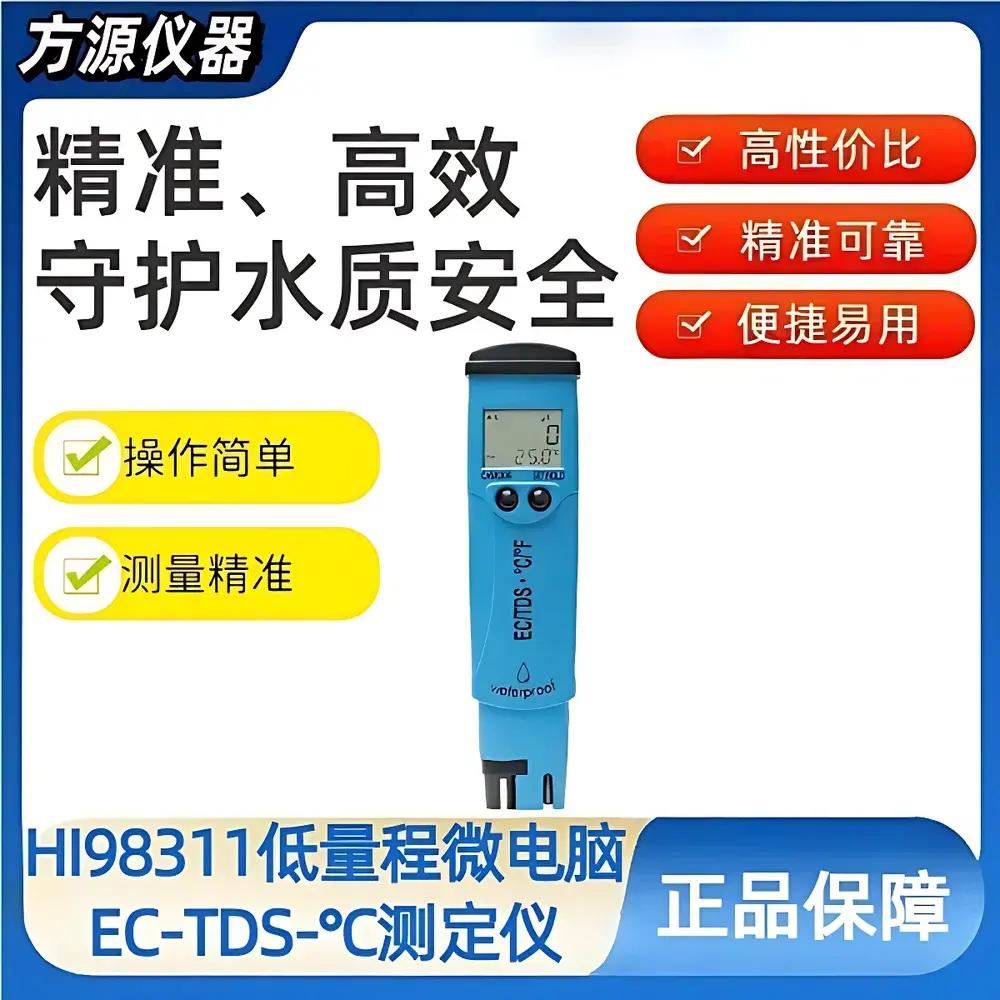
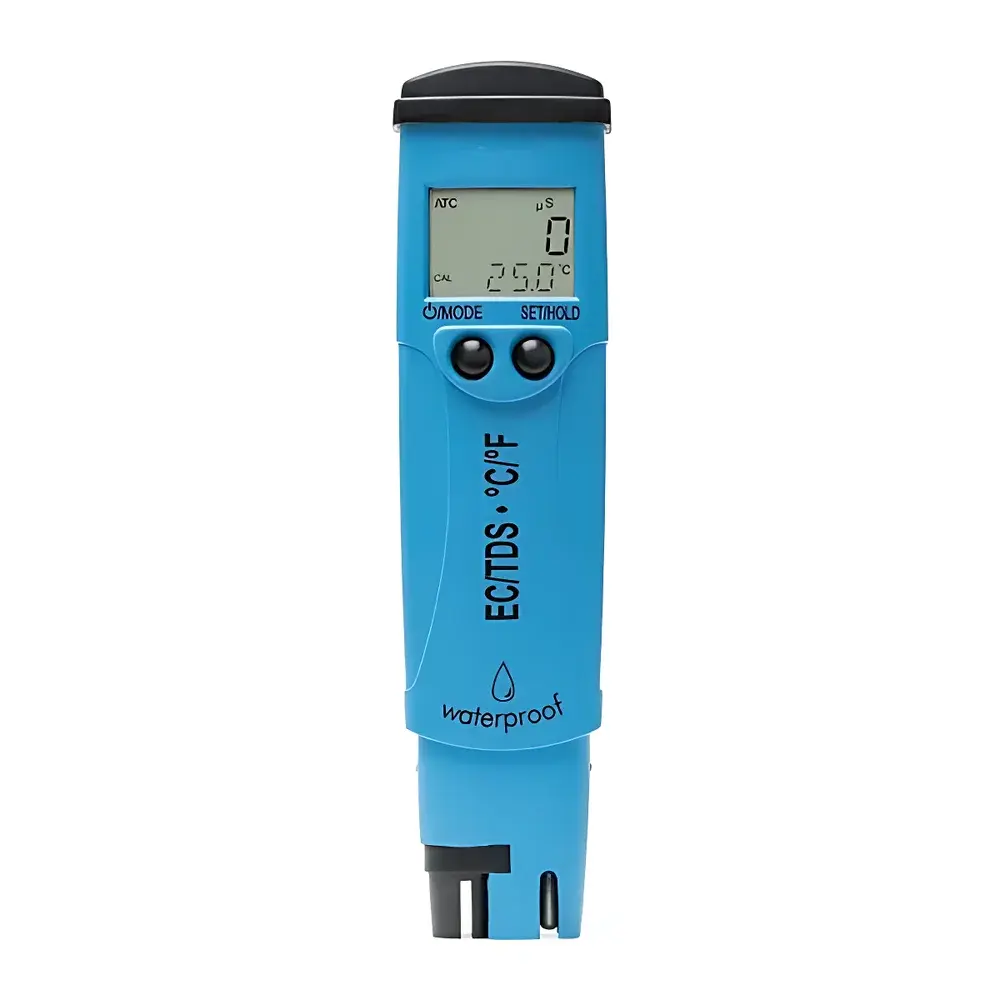
Hanna HI98311 Portable Microprocessor-Based Low-Range EC/TDS/°C Meter
| Brand | Hanna Instruments |
|---|---|
| Origin | Italy |
| Model | HI98311 |
| Instrument Type | Portable |
| Parameter Type | Single-Parameter |
| EC Measurement Range | 0 to 3999 µS/cm |
| EC Resolution | 1 µS/cm |
| EC Accuracy | ±2% of reading (@20°C) |
| Temperature Compensation | Automatic (0 to 50°C) |
| Temperature Range | 0.0 to 50.0°C |
| Temperature Resolution | 0.1°C |
| Temperature Accuracy | ±0.5°C |
| Calibration | One-point EC/TDS calibration |
| Power Supply | 4×1.5V AAA batteries (approx. 200 hours continuous use) |
| IP Rating | IP67 dust/water resistant |
| Dimensions | 145 × 80 × 35 mm |
| Weight | 230 g |
Overview
The Hanna HI98311 is a compact, field-deployable microprocessor-based meter engineered for precise, on-site measurement of low-range electrical conductivity (EC), total dissolved solids (TDS), and temperature in aqueous solutions. Designed around a robust two-electrode conductivity cell with fixed-cell constant (k = 1.0 cm⁻¹), the instrument operates on the principle of conductometric measurement—applying an alternating current across the electrodes to minimize polarization effects and electrode fouling. Its optimized low-range detection capability (0–3999 µS/cm) makes it especially suitable for monitoring ultrapure water systems, hydroponic nutrient solutions, freshwater aquaculture, environmental surface water sampling, and low-ionic-strength process streams where high-resolution EC data below 1 mS/cm is critical. The integrated NTC thermistor provides real-time automatic temperature compensation (ATC) referenced to 20°C, ensuring traceable and reproducible results across variable ambient conditions.
Key Features
- True portable architecture with IP67-rated enclosure—fully sealed against dust ingress and submersible up to 1 m for 30 minutes, enabling reliable operation in humid, outdoor, or wet-lab environments.
- Single-button operation with intuitive LCD display showing simultaneous EC, TDS (ppm), and °C readings—no menu navigation required for routine measurements.
- Fixed-cell-constant (k = 1.0 cm⁻¹) graphite conductivity probe with molded-in temperature sensor—eliminates manual cell constant entry and reduces calibration drift.
- Automatic temperature compensation (0–50°C) using built-in NTC thermistor; user-selectable TDS conversion factor (0.50–0.71) compliant with ISO 7888 and ASTM D1125 guidelines.
- Battery life optimized for extended field deployment—up to 200 hours on four standard AAA cells, with low-battery indicator and auto-power-off after 8 minutes of inactivity.
- One-point calibration protocol using certified 1413 µS/cm KCl standard—aligned with ISO/IEC 17025 traceability requirements when performed with accredited reference materials.
Sample Compatibility & Compliance
The HI98311 is validated for use with non-aggressive, low-viscosity aqueous samples including deionized water, rainwater, irrigation runoff, aquarium water, nutrient reservoirs, and municipal drinking water sources. It is not intended for high-salinity seawater, viscous industrial effluents, or strongly oxidizing/reducing media. While not certified for GMP or FDA-regulated production environments, its design supports GLP-compliant documentation workflows when paired with external lab notebooks or LIMS-integrated data logging accessories. The instrument conforms to CE marking directives (2014/30/EU EMC and 2011/65/EU RoHS), and its measurement methodology aligns with foundational principles outlined in ISO 7888 (electrical conductivity of water) and ASTM D1125 (standard test methods for electrical conductivity of water).
Software & Data Management
The HI98311 operates as a standalone, calibration-locked instrument without onboard memory or digital connectivity. All measurements are displayed in real time and must be manually recorded. For regulated environments requiring audit trails, users may integrate the meter into broader quality systems via external data capture—e.g., pairing with calibrated handheld loggers or mobile apps that support manual entry with timestamped metadata. Though lacking native USB/Bluetooth output, its consistent repeatability (±1 µS/cm typical intra-unit reproducibility) and stable zero baseline support periodic verification per ISO/IEC 17025 Section 6.4.6 (monitoring equipment performance). Calibration records, probe maintenance logs, and environmental condition notes should be retained per organizational SOPs for traceability.
Applications
- Hydroponics and controlled-environment agriculture: Monitoring EC stability of nutrient solutions to prevent osmotic stress in leafy greens and fruiting crops.
- Environmental field surveys: Rapid screening of stream, pond, and groundwater EC to assess salinity intrusion or anthropogenic contamination.
- Water treatment validation: Verifying low-conductivity output from reverse osmosis or deionization units prior to point-of-use distribution.
- Academic teaching labs: Introducing core electrochemical concepts—including Ohm’s law application in solution, ion mobility, and temperature dependence of conductivity—using a rugged, student-safe platform.
- Aquaculture health management: Tracking EC trends in recirculating aquaculture systems (RAS) as a proxy for ionic balance and metabolic waste accumulation.
FAQ
Does the HI98311 support multi-point EC calibration?
No. It is designed exclusively for single-point calibration using a 1413 µS/cm KCl standard, consistent with its target use case in low-range, field-oriented applications where simplicity and speed are prioritized over ultra-high metrological rigor.
Can the TDS conversion factor be adjusted?
Yes. Users may select between 0.50, 0.65, or 0.71 via the setup mode—enabling alignment with specific water matrices (e.g., 0.50 for sodium chloride-dominated waters, 0.71 for mixed electrolyte systems) per ISO 7888 Annex A recommendations.
Is the probe replaceable as a separate component?
Yes. The integrated EC/TDS/°C probe (HI76311) is a consumable item with a typical service life of 12–18 months under normal field use; replacement probes are available with factory calibration certificates.
What does IP67 rating mean for daily operation?
It certifies full protection against dust ingress and temporary immersion in water up to 1 m depth for 30 minutes—making the unit suitable for rinsing after field use, accidental drops in puddles, or storage in damp transport cases without functional compromise.
How often should calibration be performed?
Daily calibration is recommended before first use in critical applications; for routine monitoring, calibration every 2–3 days or whenever a change in sample matrix is introduced ensures measurement integrity within stated accuracy specifications.






