
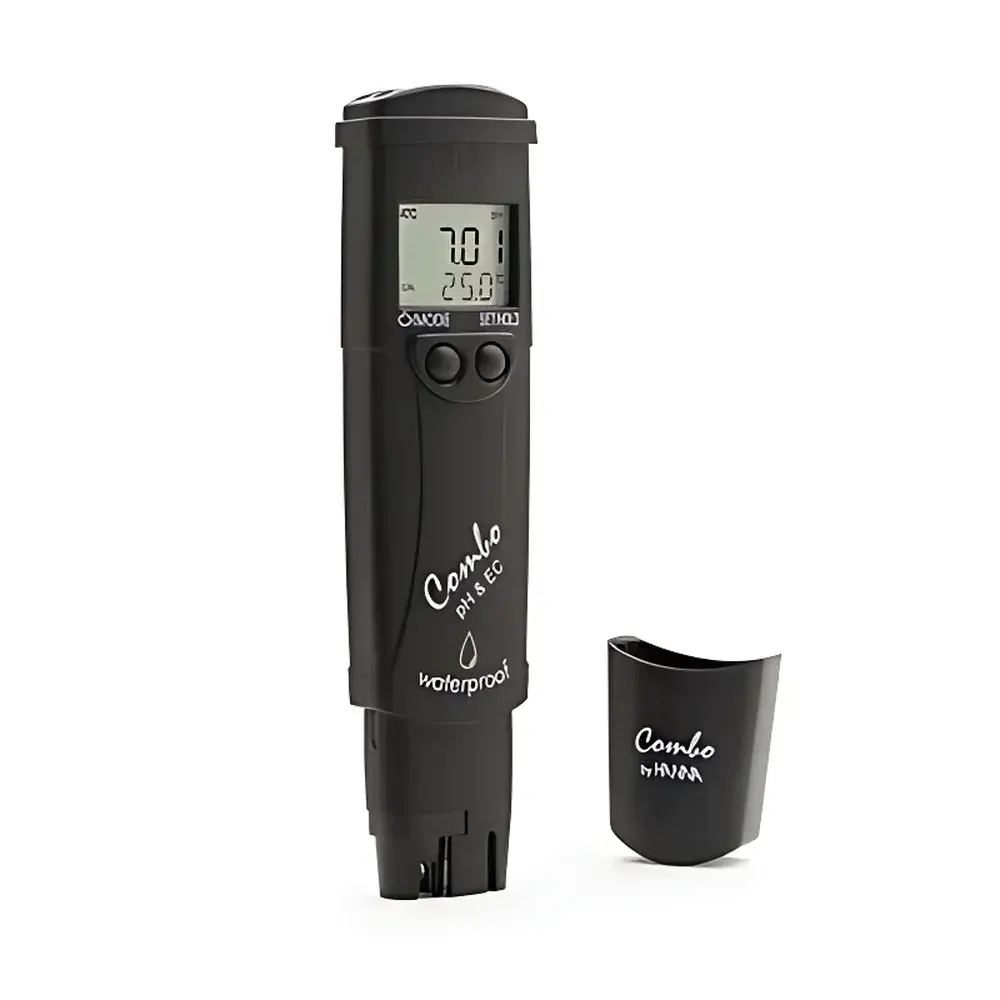
Hanna HI98130 High-Range Portable pH/EC/TDS/°C Meter
| Brand | Hanna Instruments |
|---|---|
| Origin | Italy |
| Model | HI98130 |
| Instrument Type | Portable Multiparameter Meter |
| pH Range | 0.00 to 14.00 |
| pH Resolution | 0.01 |
| pH Accuracy | ±0.05 at 25°C |
| EC Range | 0.00 to 20.00 mS/cm |
| EC Resolution | 0.01 mS/cm |
| EC Accuracy | ±2% F.S. |
| TDS Range | 0.00 to 10.00 ppt (g/L) |
| TDS Resolution | 0.01 ppt |
| TDS Accuracy | ±2% F.S. |
| Temperature Range | 0.0 to 60.0 °C |
| Temp Resolution | 0.1 °C |
| Temp Accuracy | ±0.5 °C |
| Calibration | Auto-recognition 1–2 point pH |
| ATC | Yes, β coefficient adjustable (0.0–2.4 %/°C) |
| TDS Factor | 0.45–1.00 |
| Power | 4 × 1.5 V button cells |
| Dimensions | 163 × 40 × 26 mm |
| Weight | 100 g |
Overview
The Hanna HI98130 is a high-range portable multiparameter meter engineered for field-deployable yet laboratory-grade measurement of pH, electrical conductivity (EC), total dissolved solids (TDS), and temperature in aqueous solutions. It operates on electrochemical principles: pH is determined via potentiometric response across a glass electrode membrane relative to a stable reference junction; EC is measured using two-electrode AC conductivity detection; TDS is derived from EC using user-selectable linear conversion factors (0.45–1.00); and temperature is acquired via an integrated NTC thermistor with automatic compensation algorithms. Designed for robustness in variable ambient conditions—from agricultural runoff monitoring to aquaculture management and industrial process water verification—the HI98130 delivers traceable accuracy without requiring benchtop infrastructure. Its dual-line LCD display, intuitive two-button interface, and on-screen calibration prompts eliminate reliance on external documentation, enabling rapid deployment by technicians with minimal training.
Key Features
- True multiparameter capability: Simultaneous real-time display of pH (or EC or TDS) alongside temperature in °C or °F
- Auto-recognition calibration: Intelligent electrode recognition supports 1–2 point pH calibration using factory-stored buffers (pH 4.01, 7.01, 10.01 or 4.01, 6.86, 9.18) and single-point EC/TDS calibration against built-in reference values (12.88 mS/cm and 6.44 ppt)
- Programmable temperature compensation: Adjustable β coefficient (0.0–2.4 %/°C) for precise EC correction across diverse sample chemistries and thermal profiles
- Integrated sensor architecture: HI73127 probe combines a replaceable polypropylene-body pH glass electrode with a fixed stainless-steel EC/TDS sensor and embedded NTC temperature sensor—eliminating inter-probe alignment errors and cable-induced noise
- BEPS (Battery Error Prevention System): Continuously monitors cell voltage and disables measurement if power drops below operational threshold, preventing drift-induced inaccuracies
- Low-power design: Automatic shutdown after 8 minutes of inactivity extends battery life up to 200 hours per set of four LR44 cells
- Ruggedized housing: IP67-rated enclosure withstands immersion, dust ingress, and mechanical shock typical of outdoor and industrial environments
Sample Compatibility & Compliance
The HI98130 is validated for use with freshwater, wastewater, nutrient solutions, hydroponic reservoirs, cooling tower fluids, and low-ionic-strength process streams. It complies with ISO 7888 (water quality — determination of electrical conductivity), ASTM D1125 (standard test methods for electrical conductivity and resistivity of water), and USP (electrical conductivity of purified water). While not certified for GMP/GLP environments, its ATC algorithm, calibration traceability, and audit-ready manual log functionality support data integrity requirements under FDA 21 CFR Part 11 when paired with documented SOPs. The instrument’s ±0.05 pH accuracy at 25°C meets the performance criteria outlined in ISO 10523 for routine pH monitoring in environmental and industrial applications.
Software & Data Management
The HI98130 operates as a standalone field instrument with no onboard memory or USB connectivity. All measurements are displayed in real time and intended for immediate recording or transcription. Calibration history—including date, buffer used, slope (%), and offset (mV)—is retained until next calibration cycle. For regulated workflows, users are advised to maintain external logs compliant with ALCOA+ principles (Attributable, Legible, Contemporaneous, Original, Accurate, Complete, Consistent, Enduring, Available). Hanna provides printable calibration certificates and traceable standard solutions (HI7030 for EC, HI70038 for TDS) that conform to ISO/IEC 17025-accredited manufacturing practices.
Applications
- Agricultural water testing: Monitoring irrigation source pH and salinity to prevent soil alkalization or nutrient lockout
- Aquaculture and hatchery management: Ensuring optimal water chemistry for larval development and biofilter efficiency
- Hydroponics and vertical farming: Maintaining nutrient solution stability across growth stages
- Environmental field surveys: Rapid assessment of surface water quality indicators during EPA-led watershed studies
- Facility maintenance: Verifying cooling tower cycles, boiler feedwater pretreatment, and RO reject stream composition
- Educational laboratories: Teaching core electrochemical concepts including Nernst equation application, conductivity theory, and temperature compensation models
FAQ
Does the HI98130 support GLP-compliant data logging?
No—it lacks internal memory, timestamping, or electronic signature capability. For GLP compliance, manual calibration logs and printed records must be maintained per organizational SOP.
Can the EC/TDS sensor be replaced independently of the pH electrode?
No—the EC/TDS element and temperature sensor are permanently integrated into the HI73127 probe assembly. Only the pH sensing portion is user-replaceable.
What is the recommended calibration frequency for field use?
Daily calibration is advised when measuring critical samples; otherwise, verify before each sampling session using at least one standard buffer and one EC/TDS standard.
Is the instrument suitable for seawater analysis?
Not recommended—its 20.00 mS/cm upper EC limit is below typical seawater conductivity (~53 mS/cm), risking saturation and nonlinearity.
How does the BEPS system improve measurement reliability?
BEPS halts readings when battery voltage falls below 4.8 V, preventing erroneous outputs caused by insufficient drive current to the analog front-end circuitry.




