
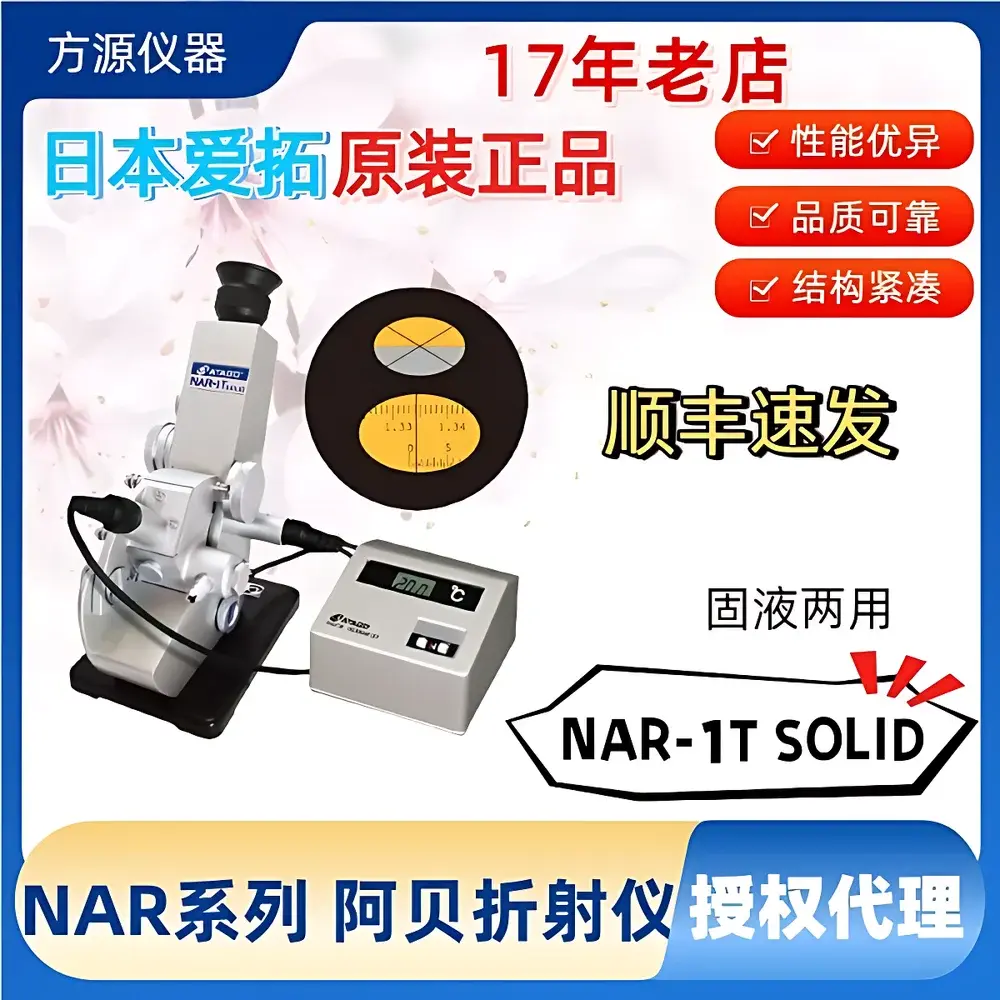
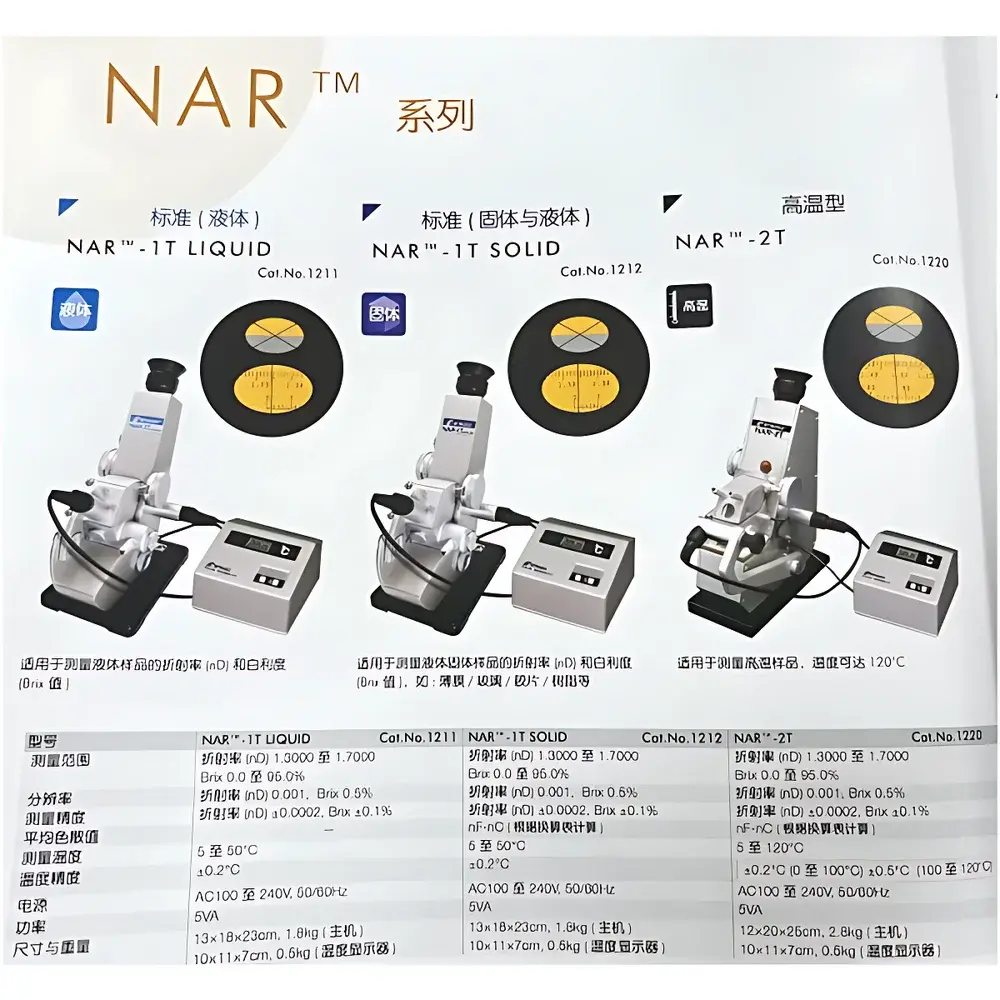
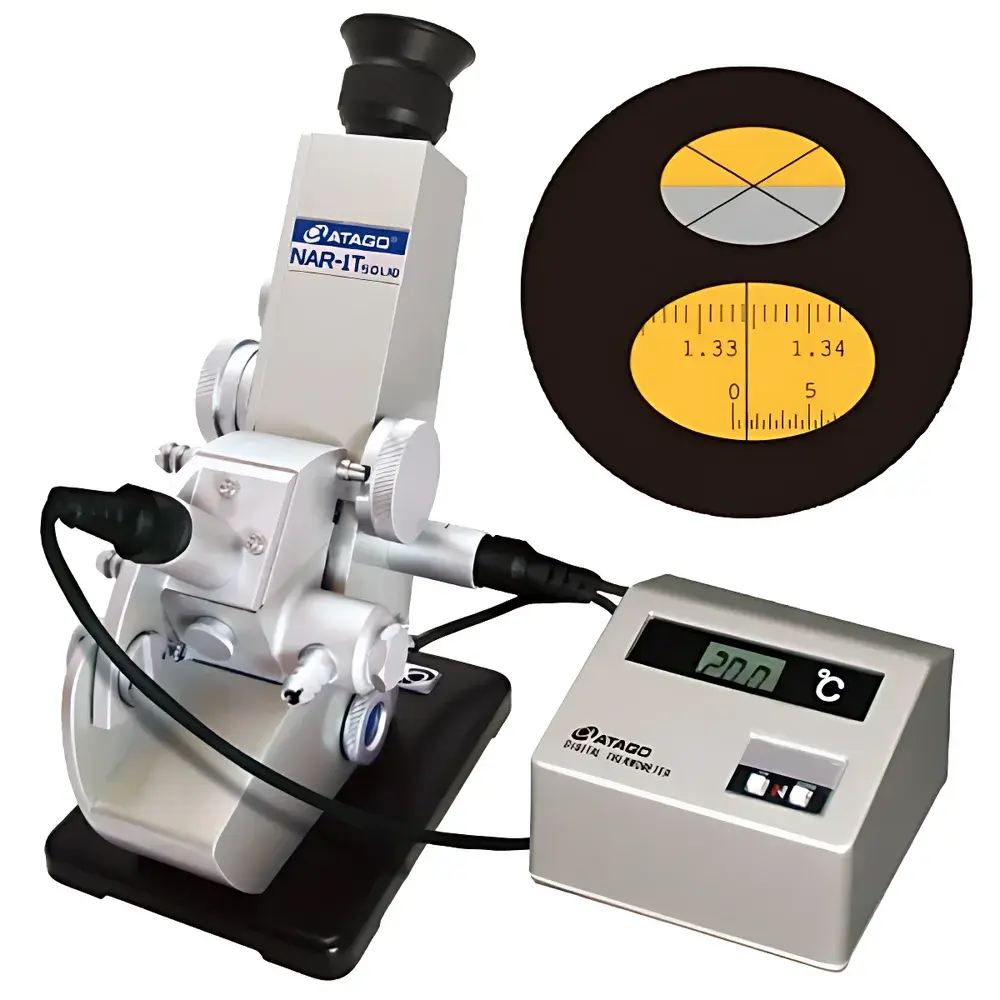
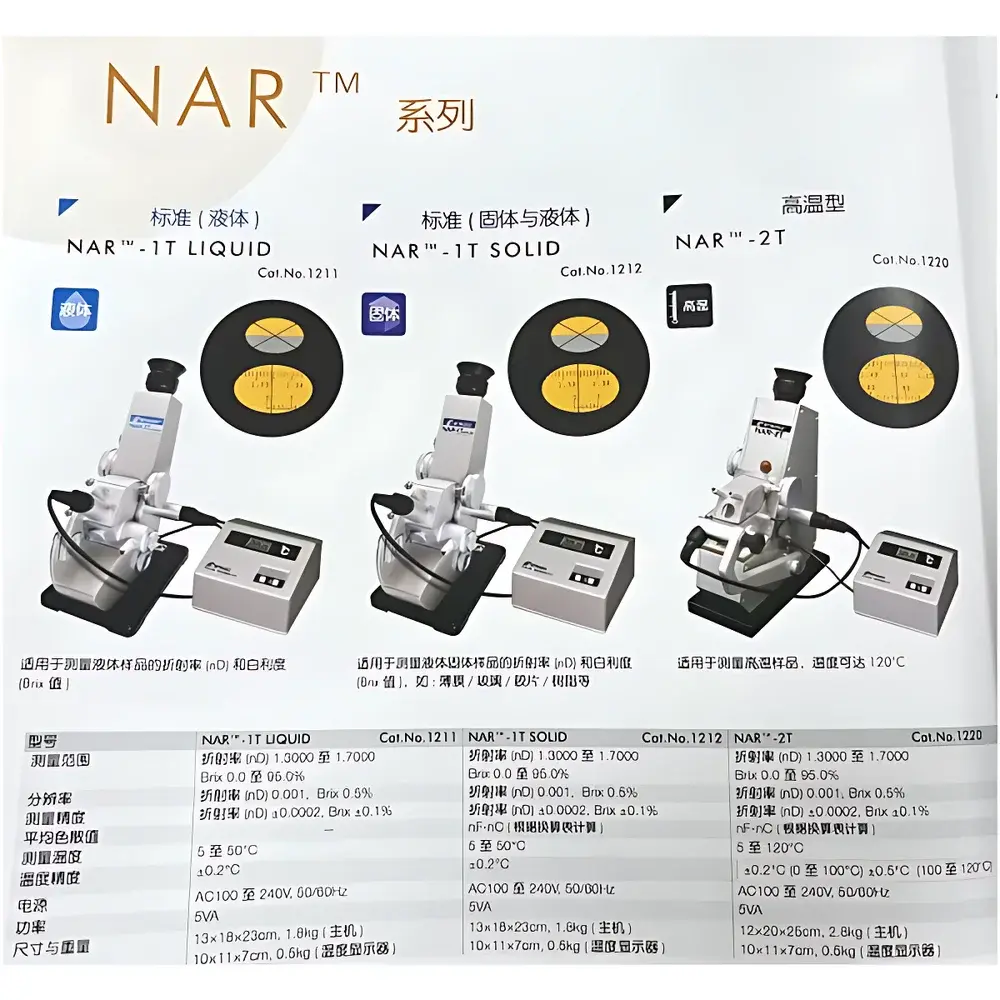
ATAGO NAR-1T SOLID Desktop Refractometer
| Brand | ATAGO |
|---|---|
| Origin | Japan |
| Model | NAR-1T SOLID |
| Type | Benchtop Refractometer |
| Temperature Control | Yes |
| Digital Display | Yes |
| Refractive Index (nD) Range | 1.3000–1.7000 |
| Brix Range | 0.0–95.0% |
| Operating Temperature Range | 5–50 °C |
Overview
The ATAGO NAR-1T SOLID is a precision benchtop refractometer engineered for high-accuracy measurement of refractive index (nD) and soluble solids content (Brix) across both solid and liquid samples. Based on the classical Abbe principle—utilizing collimated light incidence and critical angle detection—the instrument delivers traceable, repeatable optical measurements without requiring sample dilution or destructive preparation. Its dual-sample capability stems from an integrated prism assembly with interchangeable contact surfaces: a standard liquid prism for solutions and a specialized solid-contact stage equipped with adjustable pressure clamping and temperature-stabilized measurement geometry. Designed for routine quality control and R&D laboratories, the NAR-1T SOLID complies with fundamental optical metrology requirements outlined in ISO 21748 (guidance on repeatability and reproducibility in refractometry) and supports alignment with ASTM D1218 and JIS K 0061 standards for refractive index determination.
Key Features
- Abbe-type optical design with high-precision glass prisms and calibrated scale illumination system
- Dual-mode operation: seamless transition between liquid droplet analysis and solid surface measurement via mechanical prism configuration switch
- Integrated Peltier-based temperature control unit maintaining ±0.1 °C stability across the 5–50 °C operating range—critical for thermally sensitive materials such as polymers, gels, and pharmaceutical ointments
- High-resolution digital display showing nD to four decimal places (0.0001) and Brix to 0.1% resolution, with automatic temperature compensation (ATC) referenced to 20 °C
- Robust aluminum alloy chassis with anti-vibration damping base, optimized for stable placement on laboratory benches without external leveling
- Calibration verification using certified reference standards (e.g., distilled water at 20 °C: nD = 1.3330; sucrose solution at 20 °C: 10.00% Brix)
Sample Compatibility & Compliance
The NAR-1T SOLID accommodates a broad spectrum of industrial and scientific specimens: aqueous solutions (electrolytes, acids, bases), organic solvents (ethanol, acetone, glycerol), semi-solids (hydrogels, adhesives, cosmetic creams), and transparent-to-translucent solids (plastic films, optical lenses, silicone elastomers, crystalline wafers). Sample contact area requirements are minimal—solid samples ≥10 mm × 10 mm with surface flatness ≤2 µm Ra. For regulated environments, the instrument supports GLP-compliant documentation when paired with external data logging systems. While the device itself does not include FDA 21 CFR Part 11 electronic signature functionality, its analog output (0–5 V) and RS-232 interface enable integration into validated LIMS or ELN platforms where audit trails and user access controls are managed externally.
Software & Data Management
The NAR-1T SOLID operates as a standalone optical instrument with no embedded firmware or proprietary software dependency. Measurement values are displayed locally and can be transmitted in real time via RS-232 serial protocol to host PCs running third-party acquisition software (e.g., LabVIEW, MATLAB, or custom Python scripts using pySerial). Analog voltage output permits direct connection to chart recorders or PLC-based monitoring systems. Data export formats include ASCII-delimited text for CSV import into Excel or statistical analysis tools. No internal memory or timestamping is provided—data integrity relies on synchronized external logging with defined calibration intervals and operator identification protocols per ISO/IEC 17025 requirements.
Applications
- Pharmaceutical manufacturing: concentration verification of syrups, gel bases, and excipient solutions prior to filling
- Food & beverage QA: Brix validation in fruit juices, jams, dairy concentrates, and sugar-free sweetener formulations
- Chemical R&D: solvent purity assessment, polymer solution concentration profiling, and resin curing kinetics monitoring
- Materials science: refractive index mapping of thin-film coatings, optical-grade plastics, and composite laminates
- Academic teaching labs: demonstration of dispersion relationships, Snell’s law verification, and temperature-dependent optical property studies
FAQ
Does the NAR-1T SOLID require annual recalibration by an accredited lab?
No mandatory annual recalibration is specified by ATAGO; however, users must perform daily verification with traceable reference standards and document results per internal SOPs. External recalibration is recommended every 12–24 months depending on usage frequency and criticality of measurement.
Can it measure opaque or highly scattering solids?
No—it requires optically homogeneous contact between the prism and sample surface. Opaque, fibrous, or granular solids yield unreliable readings due to internal light scattering and incomplete total internal reflection.
Is the temperature control system compatible with external chillers or circulators?
No—the Peltier module is self-contained and non-expandable. It operates independently within its rated ambient temperature range (15–30 °C) and does not support auxiliary fluid loops.
What cleaning agents are approved for the prism surface?
Only reagent-grade ethanol, acetone, or lens-cleaning tissue dampened with deionized water. Abrasive cleaners, halogenated solvents, or ultrasonic immersion are strictly prohibited.
How is measurement uncertainty estimated for this instrument?
Per ATAGO technical documentation, combined standard uncertainty is ±0.0002 for nD and ±0.2% for Brix under controlled environmental conditions (20 ±0.5 °C, <50% RH), based on repeatability testing across five independent operators.




