
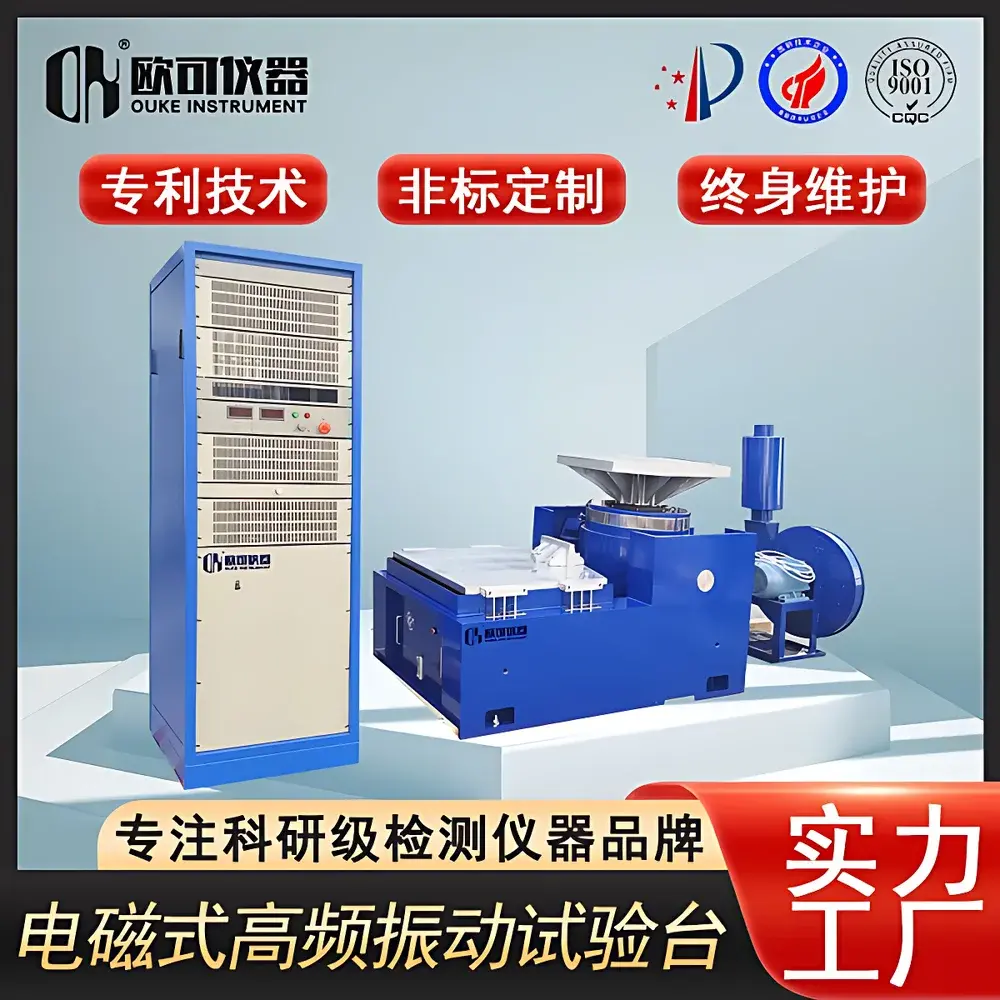
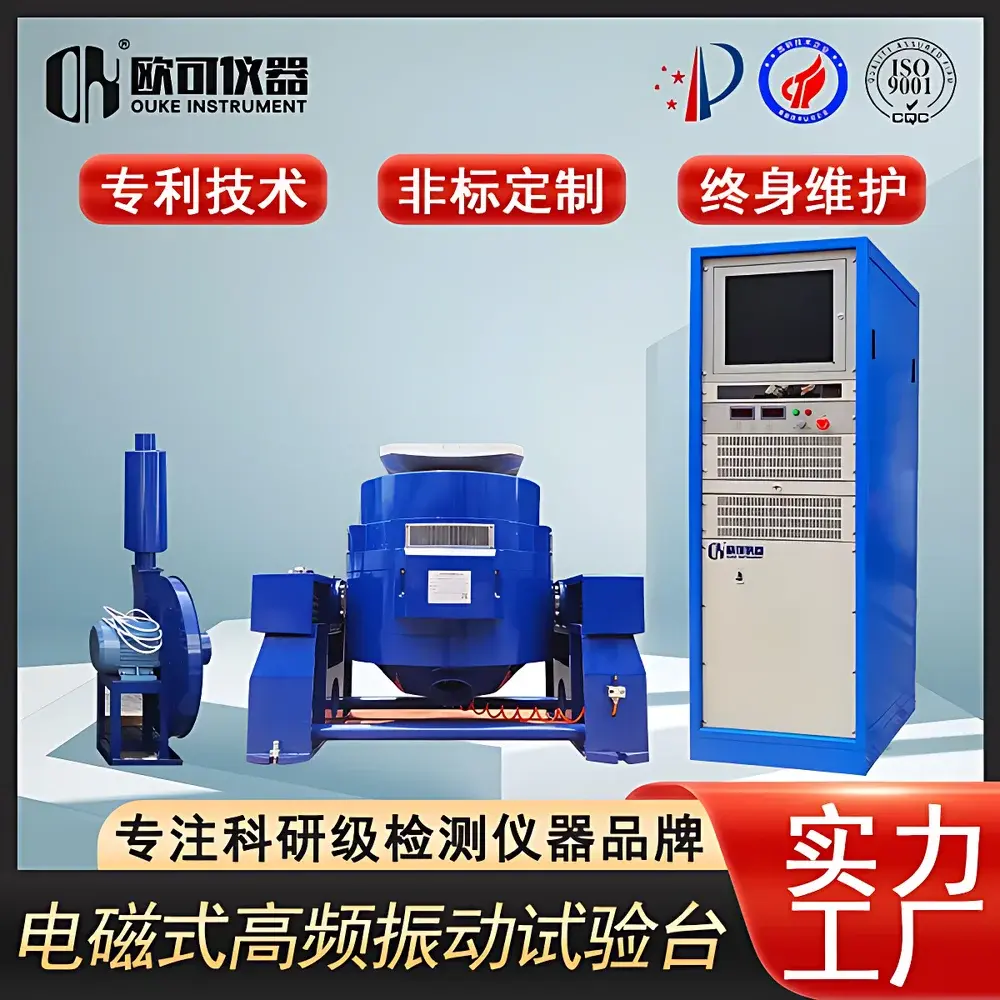
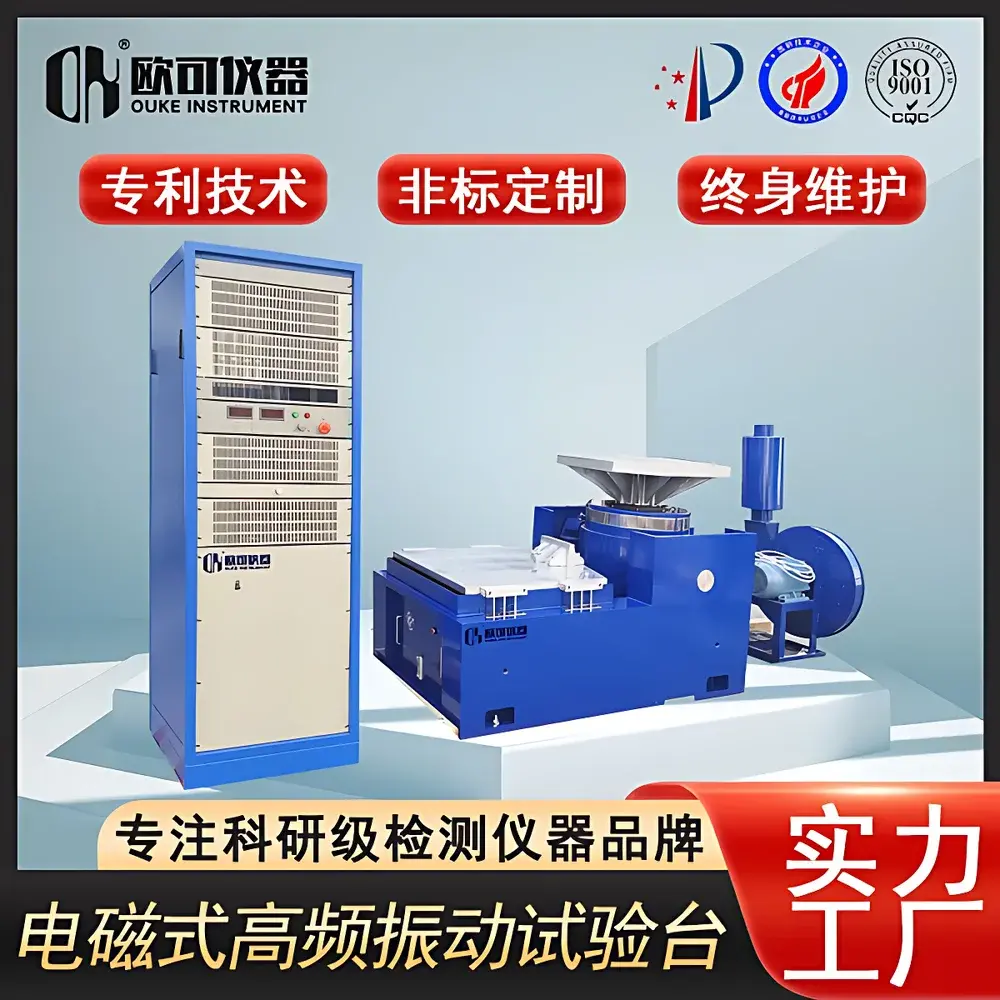
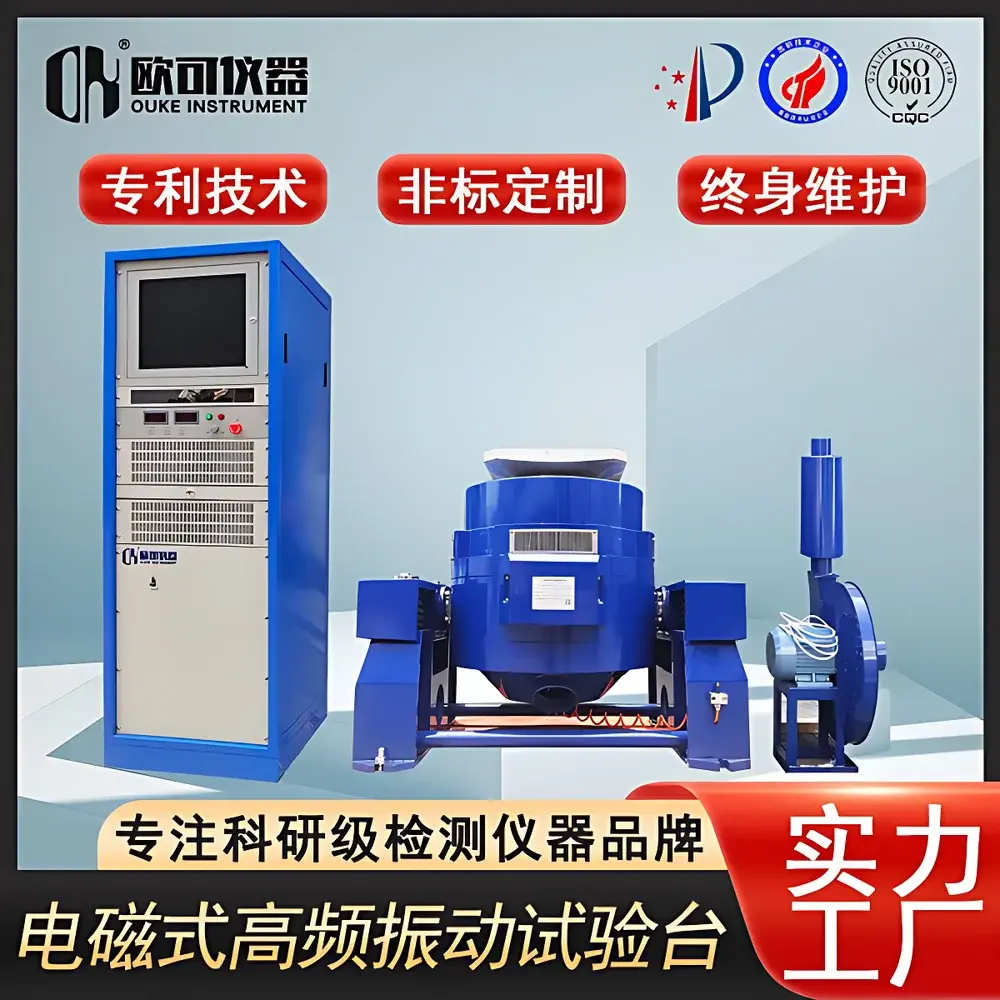
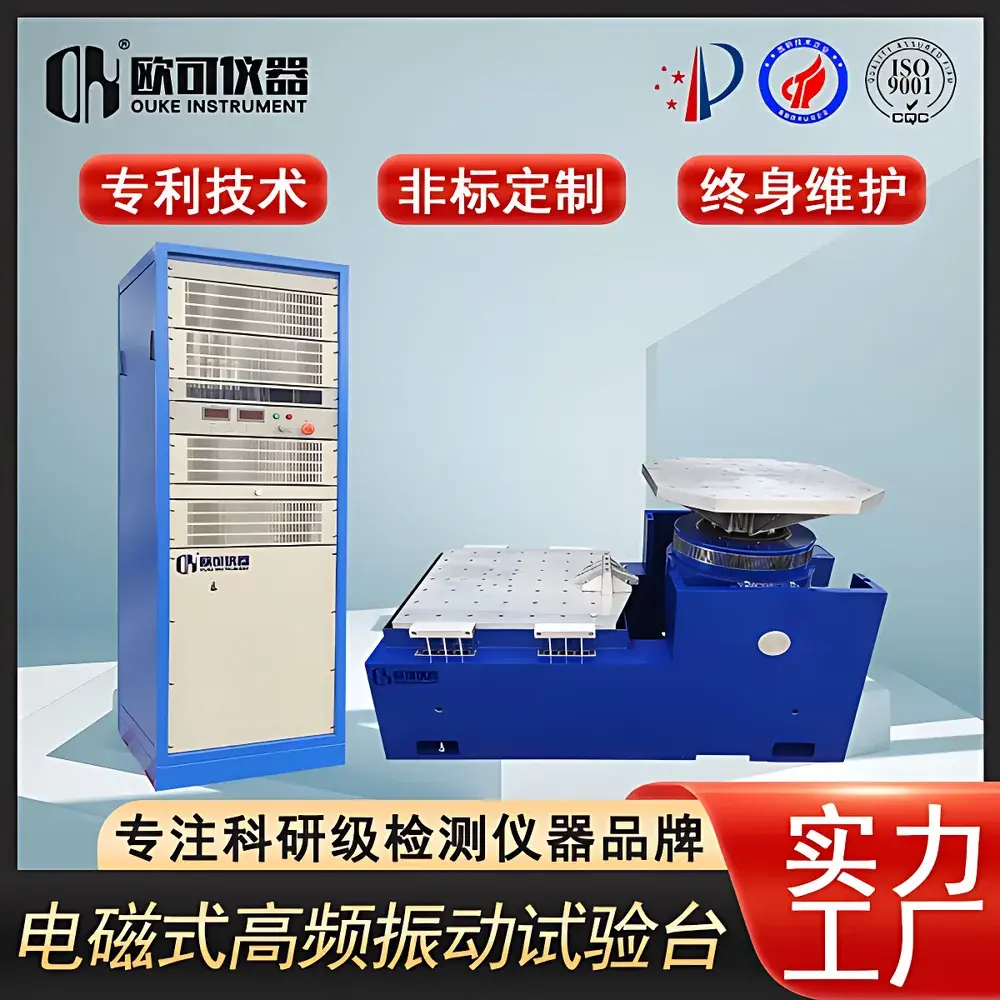
OK-ES-3.001 Electric Sinusoidal Vibration Test System
| Brand | OK Instruments |
|---|---|
| Origin | Guangdong, China |
| Manufacturer Type | OEM Manufacturer |
| Country of Origin | China |
| Model | OK-ES-3.001 |
| Instrument Type | Electrodynamical Shaker |
| Rated Force | 1.98 kN |
| Frequency Range | 5–5000 Hz |
| Maximum Payload | 70 kg |
| Tabletop Dimensions | 300 × 300 × 30 mm |
| Peak Acceleration | 10 g |
Overview
The OK-ES-3.001 Electric Sinusoidal Vibration Test System is a precision-engineered electrodynamical shaker designed for laboratory-based simulation of deterministic, single-frequency harmonic excitation. It operates on the Lorentz force principle—where a current-carrying voice coil interacts with a static magnetic field to generate controlled linear motion—enabling high-fidelity sinusoidal displacement, velocity, or acceleration waveforms across a broad frequency spectrum. This system is purpose-built for resonance search, fatigue life evaluation, structural integrity verification, and qualification testing under periodic mechanical stress conditions representative of transportation (e.g., road vehicle vibration, aircraft engine harmonics), operational environments (e.g., rotating machinery, marine propulsion), and design validation protocols per ISO 10816, ASTM D999, and MIL-STD-810H Method 514.7.
Key Features
- Electrodynamical actuation architecture delivering high waveform fidelity and low harmonic distortion (<5% THD typical at rated output)
- Wide operational bandwidth: 5 Hz to 5000 Hz, supporting both low-frequency modal survey and high-frequency component-level screening
- Rated force output of 1.98 kN enables dynamic testing of mid-size assemblies up to 70 kg total mass (including fixture and test article)
- Rigid 300 × 300 × 30 mm aluminum tabletop with threaded mounting pattern (M6, 25 mm pitch) optimized for modal decoupling and repeatable fixture integration
- Integrated closed-loop digital control architecture with real-time feedback from triaxial reference accelerometers
- Thermal management system featuring forced-air cooling for amplifier and shaker coil, ensuring stable performance during extended dwell tests
- Compliant with CE electromagnetic compatibility (EMC) directives and IEC 61000-6-3/6-4 emission standards
Sample Compatibility & Compliance
The OK-ES-3.001 accommodates rigid and semi-rigid specimens—including PCBs, automotive ECUs, avionics enclosures, optical modules, and small mechanical subassemblies—when mounted via custom or standardized fixtures. Fixture design must maintain modal isolation above 1.5× the highest test frequency to prevent spurious resonance coupling. The system supports compliance testing per ISO 20282 (hand-held electronic devices), IEC 60068-2-6 (sinusoidal vibration), and GB/T 2423.10 (Chinese national standard equivalent to IEC 60068-2-6). All hardware interfaces conform to IEEE 1588 Precision Time Protocol (PTP) for synchronized multi-channel acquisition in GLP/GMP environments requiring audit-ready timestamping.
Software & Data Management
Control and analysis are executed via OK-VCS v4.2 software—a Windows-based platform compliant with FDA 21 CFR Part 11 for electronic records and signatures. The software provides full configurability for sine sweep (linear/logarithmic), fixed-frequency dwell, dual-axis phase-synchronized excitation, and multi-segment test profiles. Real-time FFT and transfer function estimation (H1 estimator) support rapid resonance identification. Raw time-series data (acceleration, drive voltage, current) are logged in HDF5 format with embedded metadata (test ID, operator, calibration date, sensor serial numbers). Export options include CSV, MATLAB .mat, and UFF58 formats. Audit trails record all parameter changes, user logins, and calibration events with immutable timestamps.
Applications
- Aerospace: Qualification of satellite subsystems, UAV components, and flight-critical sensors under harmonic engine-induced vibration
- Automotive: Durability validation of ADAS cameras, infotainment head units, and battery management systems per LV-124 and GMW14872
- Electronics manufacturing: JESD22-B103 (sine vibration) compliance testing for semiconductor packages and flex-rigid PCBs
- Defense & security: Environmental screening of handheld radios, night vision devices, and targeting systems against MIL-STD-810H Clause 514.7
- Packaging R&D: Simulation of truck-trailer transport spectra to optimize cushioning design per ISTA 3A
- Academic research: Experimental modal analysis (EMA) of composite laminates, MEMS structures, and additively manufactured lattice materials
FAQ
What is the maximum payload capacity when operating at 5000 Hz?
At 5000 Hz, the system’s peak acceleration capability remains 10 g, but payload must be reduced to ≤15 kg to maintain force-limited operation within the 1.98 kN envelope.
Does the system support multi-axis simultaneous control?
The OK-ES-3.001 is a single-axis vertical shaker; horizontal excitation requires optional OK-HS-300 horizontal slip table (sold separately), enabling orthogonal axis testing with phase coherence.
Is third-party calibration traceable to NIST or CNAS standards supported?
Yes—OK Instruments provides factory calibration certificates traceable to CNAS-accredited laboratories; NIST-traceable calibration kits (including reference accelerometers and charge amplifiers) are available upon request.
Can the controller perform real-time resonance tracking during sine sweep?
Yes—the VCS software implements adaptive sweep rate reduction near detected resonances (±5 Hz window) with automatic dwell initiation and amplitude hold, per ISO 10816-3 Annex B guidelines.
What safety interlocks are integrated into the system?
Hardware-enforced limits include over-acceleration cutoff (12 g threshold), coil temperature shutdown (>120°C), amplifier over-current protection, and emergency stop circuitry meeting IEC 60204-1 Category 3 requirements.



