
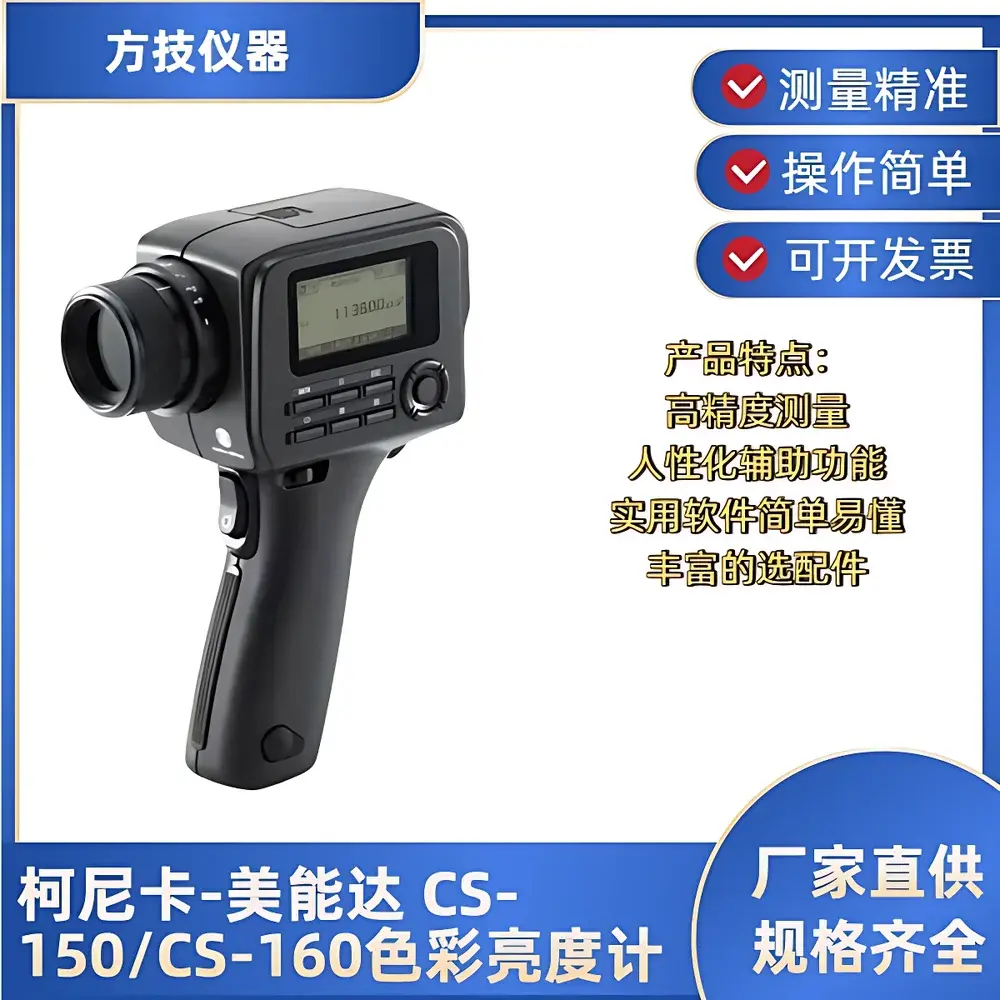
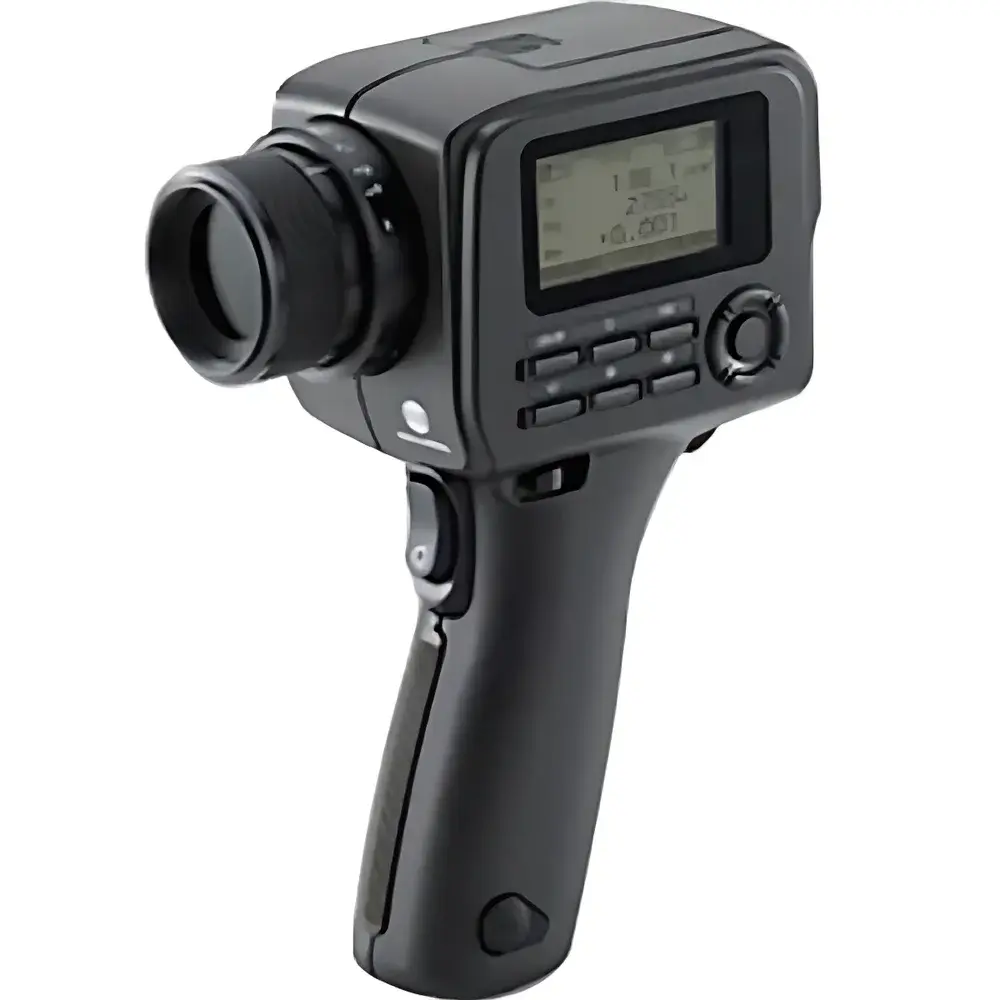
Konica Minolta CS-150/CS-160 Portable Color Luminance Meter
| Brand | Konica Minolta |
|---|---|
| Origin | Japan |
| Model Series | CS-150 / CS-160 |
| Measurement Angles | CS-150 — 1° |
| Luminance Range | CS-150 — 0.01 to 999,900 cd/m² |
| Output | CIE 1931 xy Chromaticity Coordinates, Luminance (Lv), Correlated Color Temperature (CCT), Dominant Wavelength, Excitation Purity |
| Compliance | JIS Z 8722, CIE No. 15, ISO/CIE 11664-3, ASTM E308 |
Overview
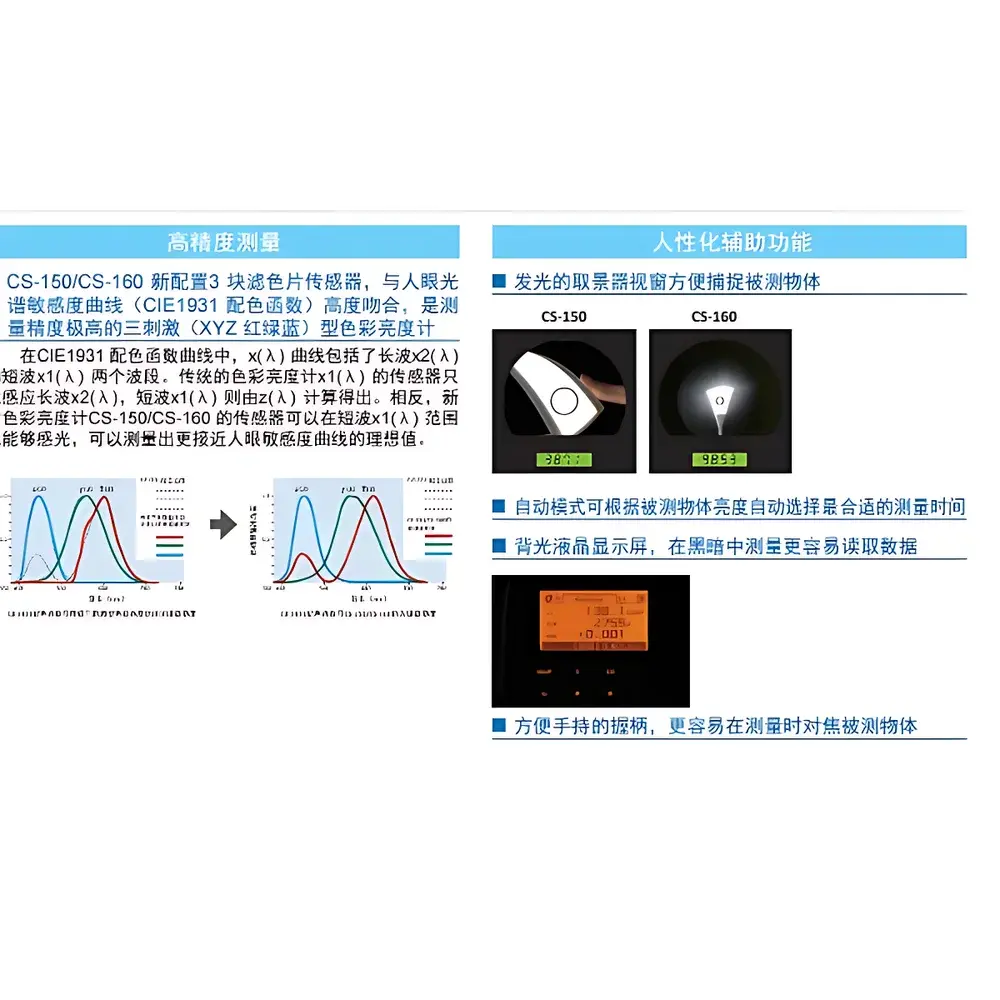
The Konica Minolta CS-150 and CS-160 are handheld, portable color luminance meters engineered for high-accuracy photometric and colorimetric evaluation of light-emitting and reflective surfaces. Based on tristimulus colorimetry principles aligned with the CIE 1931 standard observer and XYZ color matching functions, these instruments integrate a silicon photodiode array with precision optical filters to deliver spectrally corrected measurements of luminance (Lv) and chromaticity (x, y). Unlike broadband illuminance meters, the CS-150/CS-160 series performs true colorimetric analysis—quantifying not only brightness but also chromatic coordinates, correlated color temperature (CCT), dominant wavelength, and excitation purity. Their compact ergonomic design, battery-powered operation, and real-time display make them suitable for field deployment in lighting validation, display manufacturing QA, transportation signaling verification, and R&D laboratories requiring traceable, repeatable surface radiance assessment.
Key Features
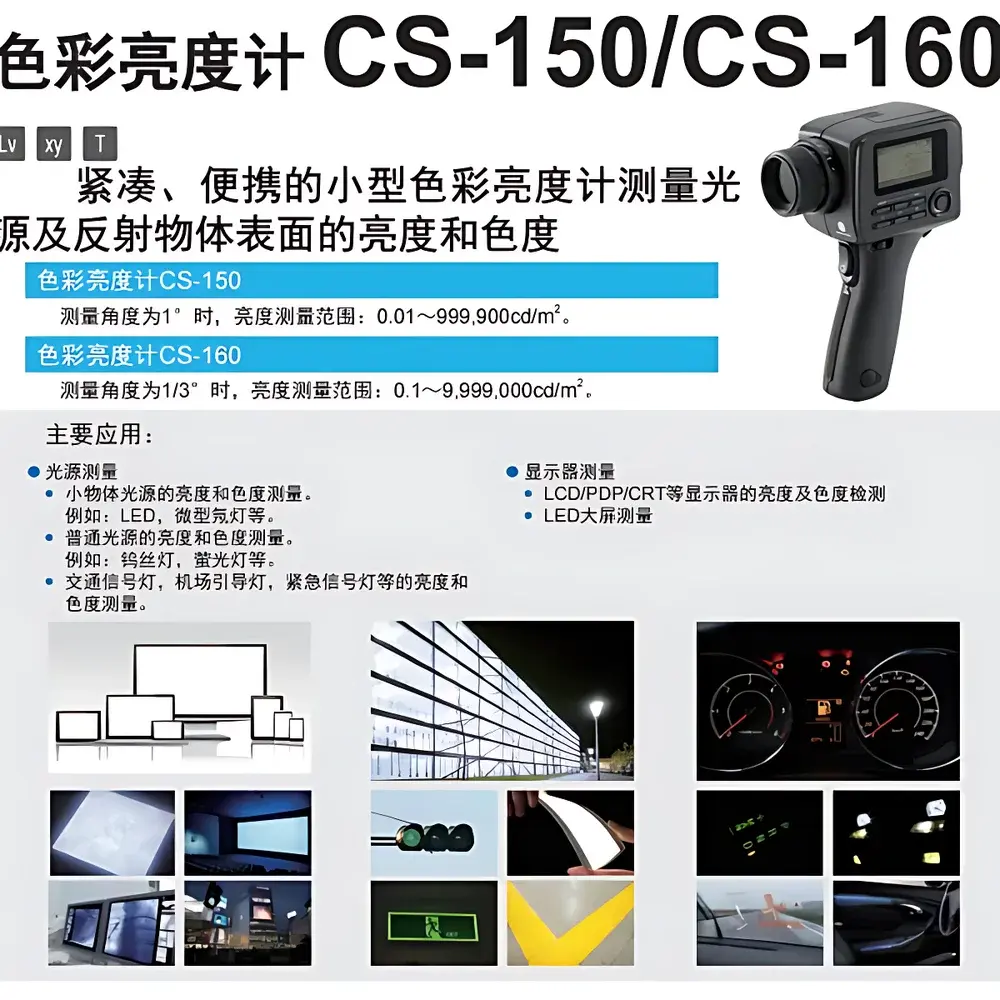
- Two interchangeable measurement configurations: CS-150 with 1° field-of-view (FOV) optimized for moderate-brightness sources (0.01–999,900 cd/m²); CS-160 with 1/3° FOV enabling high-resolution targeting of small or intense emitters (0.1–9,999,000 cd/m²).
- Integrated CIE-compliant spectral correction ensures adherence to JIS Z 8722, ISO/CIE 11664-3, and ASTM E308 standards for colorimetric accuracy across LED, OLED, fluorescent, incandescent, and neon-based sources.
- Real-time dual-parameter display showing luminance (cd/m²) and CIE 1931 chromaticity coordinates (x, y) simultaneously—no external software required for basic evaluation.
- Onboard memory stores up to 100 measurement sets with timestamp and user-defined ID; data export via USB to CSV-compatible spreadsheets for further statistical analysis or SPC reporting.
- Rugged aluminum housing, IP50-rated enclosure, and low-power consumption (approx. 10 hours continuous use on AA batteries) support extended field operation without AC dependency.
Sample Compatibility & Compliance
The CS-150/CS-160 series is validated for measuring both self-luminous and reflective targets under controlled ambient conditions. It accommodates discrete light sources such as individual LEDs, micro-neon indicators, OLED pixels, and traffic signal modules, as well as larger-area emitters including LCD, PDP, and CRT displays. For reflective applications, it supports Lambertian and near-Lambertian surfaces when used with calibrated reference tiles (e.g., NIST-traceable white standards). Instrument calibration follows Konica Minolta’s factory-certified procedure, traceable to national metrology institutes (NMI-Japan). All measurements comply with regulatory frameworks governing visual signaling systems—including ICAO Annex 14 (airfield lighting), EN 12367 (road traffic signals), and FDA guidance for medical display luminance uniformity (21 CFR Part 1020.33). Data integrity meets GLP/GMP documentation requirements through optional audit trail logging via Konica Minolta’s proprietary software suite.
Software & Data Management
The CS-150/CS-160 operates standalone but integrates seamlessly with Konica Minolta’s SpectraMagic NX software (Windows-based). This platform enables advanced data visualization, multi-point mapping, pass/fail thresholding against user-defined specification limits (e.g., Δu’v’, luminance uniformity %), and automated report generation compliant with ISO/IEC 17025 documentation standards. Raw measurement files include metadata such as instrument serial number, calibration date, operator ID, environmental temperature/humidity (when logged externally), and measurement geometry—supporting full traceability for ISO 9001 and FDA 21 CFR Part 11 electronic record compliance when deployed with appropriate system validation protocols.
Applications
- Display manufacturing: Verification of luminance uniformity, white point stability, and gamut consistency across LCD, OLED, and microLED panels during production line testing.
- Automotive and aerospace lighting: Validation of headlamp beam patterns, instrument cluster backlighting, and cockpit display readability under varying ambient illuminance conditions.
- Traffic infrastructure: Routine inspection of red/green/yellow signal luminance and chromaticity per ITE RP-12 and FHWA guidelines to ensure visibility at specified viewing distances.
- Medical device displays: Conformance testing of surgical monitor brightness and color fidelity per DICOM GSDF and IEC 62303 standards.
- Lighting R&D: Characterization of novel phosphor-converted LEDs, quantum dot emitters, and laser-based illumination systems where narrow-angle, high-dynamic-range photometry is critical.
FAQ
What is the difference between the CS-150 and CS-160 models?
The CS-150 uses a 1° measurement angle and is suited for general-purpose luminance and color evaluation of medium-brightness sources. The CS-160 employs a 1/3° angle, providing higher spatial resolution and extended upper-range capability for very bright or physically small emitters.
Does the instrument require periodic recalibration?
Yes—Konica Minolta recommends annual factory recalibration to maintain traceability to primary standards. Field verification using certified reference standards is advised before critical measurement campaigns.
Can the CS-150/CS-160 measure pulsed or modulated light sources?
These meters operate in DC mode only and are not designed for time-resolved or flicker analysis. For PWM-driven LEDs or strobed displays, use with an external shutter or synchronization trigger is not supported.
Is spectral power distribution (SPD) data available?
No—the CS-150/CS-160 does not provide full SPD output. It delivers CIE tristimulus-derived values only. For spectral analysis, consider Konica Minolta’s CS-2000A spectroradiometer.
How is measurement uncertainty determined for this instrument?
Typical combined standard uncertainty (k=2) is ±3% for luminance and ±0.003 in x,y chromaticity under standard calibration conditions, as documented in the instrument’s Certificate of Calibration (available upon request).



