
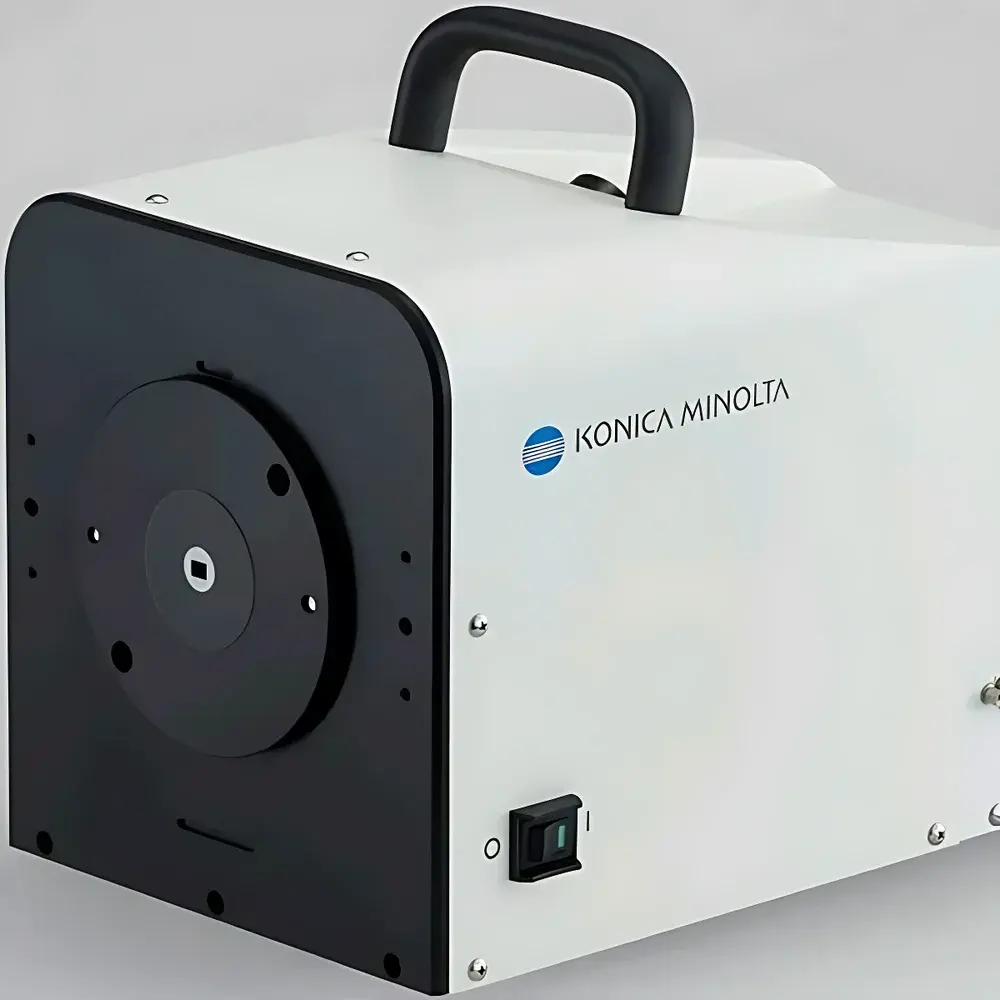
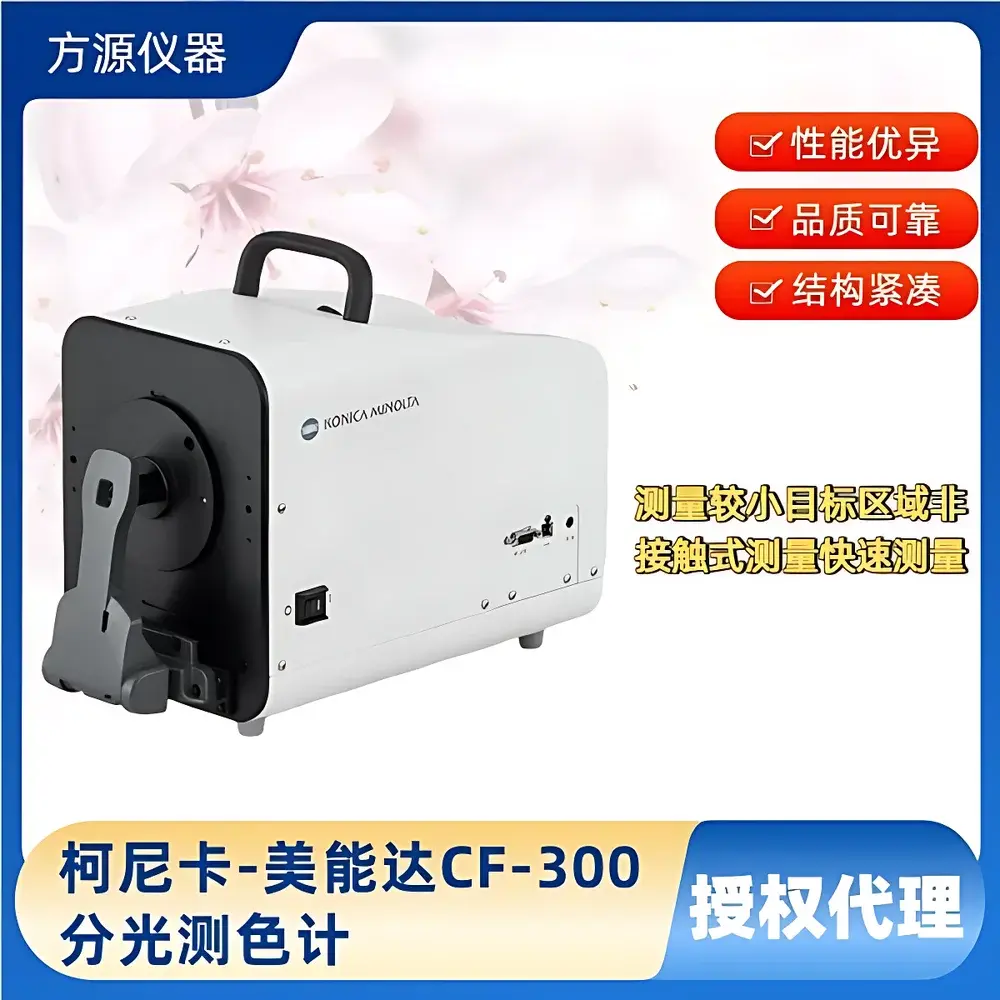
Konica Minolta CF-300 Non-Contact Spectrophotometer (Online Color Measurement System)
| Brand | Konica Minolta |
|---|---|
| Origin | Japan |
| Model | CF-300 |
| Instrument Type | Benchtop Spectrophotometer |
| Illumination/Observation Geometry | di:8°, de:8° (Diffuse Illumination / 8° Viewing) |
| SCI/SCE Modes | Switchable |
| Compliance | JIS Z 8722 Condition C, ISO 7724-1 |
| Integrating Sphere Diameter | Ø152 mm |
| Detector | Dual-row 40-element silicon photodiode array |
| Dispersion Element | Diffraction grating |
| Spectral Range | 400–700 nm |
| Wavelength Interval | 10 nm |
| Reflectance Range | 0–175% |
| Reflectance Resolution | 0.01% |
| Light Source | High-CRI white LED |
| Measuring Apertures | MAV Ø11 mm |
| Measured Area | Ø8 mm (0.75×1 mm for line-scan mode) |
| Measurement Distance | 0.0 mm (contact), 1.0 mm (NC), 0.7 mm (NC with glass) |
| Measurement Time | Approx. 0.1 s |
| Minimum Measurement Interval | Approx. 0.2 s |
| Repeatability | ΔE*ab ≤ 0.02 SD (MAV/SCI, 30 measurements on white calibration tile at 1 s intervals) |
| Inter-instrument Agreement | ΔE*ab ≤ 0.15 (BCRA Series II 12-color tile set, MAV/SCI, Konica Minolta reference standard conditions) |
| Interface | USB 2.0, RS-232C |
| Power Supply | Dedicated AC adapter (100–240 V AC, 50/60 Hz) |
| Operating Environment | 15–30°C, ≤80% RH (non-condensing) |
| Storage Environment | 0–40°C, ≤80% RH (non-condensing) |
| Dimensions (W×H×D) | 186×202×317 mm (246 mm with handle) |
| Weight | Approx. 7.3 kg |
Overview
The Konica Minolta CF-300 is a high-precision benchtop spectrophotometer engineered for non-contact and online color measurement in industrial quality control environments. It operates on the principle of diffuse illumination/8° viewing geometry (di:8°, de:8°), conforming to JIS Z 8722 Condition C and ISO 7724-1 standards—ensuring metrological traceability and inter-laboratory comparability. Its optical architecture features a Ø152 mm integrating sphere with dual-row 40-element silicon photodiode array detection and a precision diffraction grating dispersion system, delivering spectral data across the visible range (400–700 nm) at 10 nm intervals. The instrument supports both SCI (Specular Component Included) and SCE (Specular Component Excluded) measurement modes, enabling consistent evaluation of both textured and glossy surfaces without physical contact—a critical capability for fragile, hot, moving, or contamination-sensitive substrates in paint, plastics, textiles, automotive trim, and packaging production lines.
Key Features
- Non-contact measurement capability at fixed standoff distances (1.0 mm standard; 0.7 mm with protective glass), eliminating surface damage and wear on delicate or thermally sensitive samples.
- High-speed acquisition: full spectral measurement in ≈0.1 seconds, with minimum interval of ≈0.2 seconds—optimized for inline process monitoring and high-throughput QC stations.
- Multi-aperture configuration: MAV (Ø11 mm), XUSAV (5×7 mm), and NC (Ø34 mm) target masks accommodate diverse sample geometries, including curved, irregular, or small-area targets.
- Stable high-CRI white LED illumination ensures long-term photometric consistency and eliminates lamp aging-related drift common in xenon-based systems.
- Benchtop form factor (186×202×317 mm, 7.3 kg) with ergonomic handle enables flexible deployment in lab, pilot line, or near-machine-tool integration scenarios.
- Robust environmental tolerance: operational within 15–30°C and ≤80% RH (non-condensing), supporting use in controlled manufacturing environments compliant with ISO 17025 and IATF 16949 ambient requirements.
Sample Compatibility & Compliance
The CF-300 is validated for measuring reflective materials—including coated metals, molded polymers, printed films, ceramic glazes, and anodized aluminum—without requiring sample preparation or contact pressure. Its non-contact operation satisfies ISO 2813 (gloss measurement interference mitigation) and ASTM D2244 (color difference calculation) prerequisites. Instrument inter-comparability (ΔE*ab ≤ 0.15 against BCRA Series II tiles) meets the repeatability and reproducibility thresholds required for supplier qualification under AS9100 Rev D and automotive OEM color gate specifications (e.g., GM W3171, Ford EM-110). All spectral data output adheres to CIE 15:2018 and ISO/CIE 11664 colorimetric conventions, ensuring compatibility with enterprise-wide color management workflows.
Software & Data Management
The CF-300 interfaces natively with Konica Minolta’s SpectraMagic NX2 software (sold separately), a GLP/GMP-ready application supporting audit trail logging, user access levels, electronic signatures, and 21 CFR Part 11 compliance when configured with appropriate IT infrastructure. SpectraMagic NX2 computes CIE XYZ, L*a*b*, L*C*h*, ΔE*ab, ΔE00, Yxy, and Munsell coordinates, and supports custom tolerancing, pass/fail reporting, and statistical process control (SPC) charting. Raw spectral reflectance data (31-point or interpolated 10-nm intervals) is exportable in CSV, XML, and CxF/XRGA formats for integration into LIMS, MES, or PLM platforms. Firmware updates and calibration verification reports are managed via USB 2.0 or RS-232C—enabling secure, offline-capable validation in regulated environments.
Applications
- Real-time color verification during extrusion, coating, and printing processes where conveyor speed precludes manual contact measurement.
- Final inspection of automotive interior components (dashboards, door panels) under production lighting conditions, using SCE mode to suppress specular artifacts.
- Batch-to-batch consistency validation in pigment masterbatch manufacturing, leveraging SCI mode for total reflectance assessment independent of surface finish.
- Quality gate enforcement for incoming raw materials (e.g., colored resins, laminates) where physical contact risks scratching or static discharge.
- Color stability testing of UV-cured inks and functional coatings exposed to accelerated weathering cycles—enabled by rapid, repeatable non-contact acquisition before and after exposure.
FAQ
Is the CF-300 suitable for measuring transparent or translucent materials?
No—the CF-300 is designed exclusively for reflective (opaque or semi-opaque) substrates. Transmittance measurement requires a dedicated transmission spectrophotometer with dual-beam optics and integrating sphere transmission port.
Can the instrument be integrated into a PLC-controlled production line?
Yes—via RS-232C or USB virtual COM port, the CF-300 supports Modbus RTU and ASCII command protocols for triggering measurements, retrieving results, and status polling in real time.
Does the CF-300 require annual recalibration by an accredited lab?
While not mandatory, Konica Minolta recommends biannual verification using certified white and black calibration standards traceable to NIST or JCSS, particularly when used in FDA-regulated or ISO 9001-certified processes.
What is the warranty coverage and service support structure outside Japan?
The CF-300 carries a 24-month limited warranty; global technical support and certified calibration services are available through Konica Minolta’s authorized distribution network in EMEA, North America, and APAC regions.
How does the NC with glass configuration affect measurement accuracy?
The optional glass window introduces minimal spectral attenuation (<0.3% deviation in 400–700 nm band) and is factory-compensated in firmware; it maintains ΔE*ab repeatability within specification while protecting the optics from dust, splatter, or mechanical impact.



