
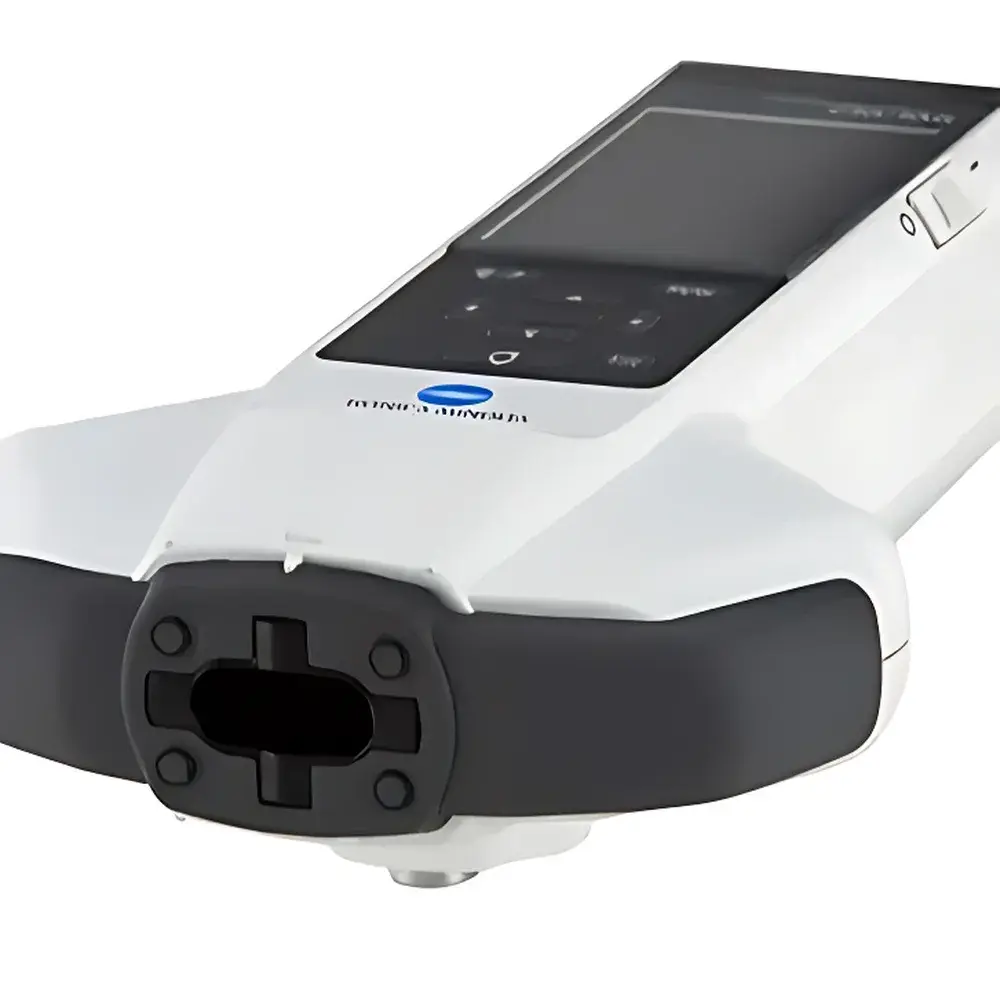
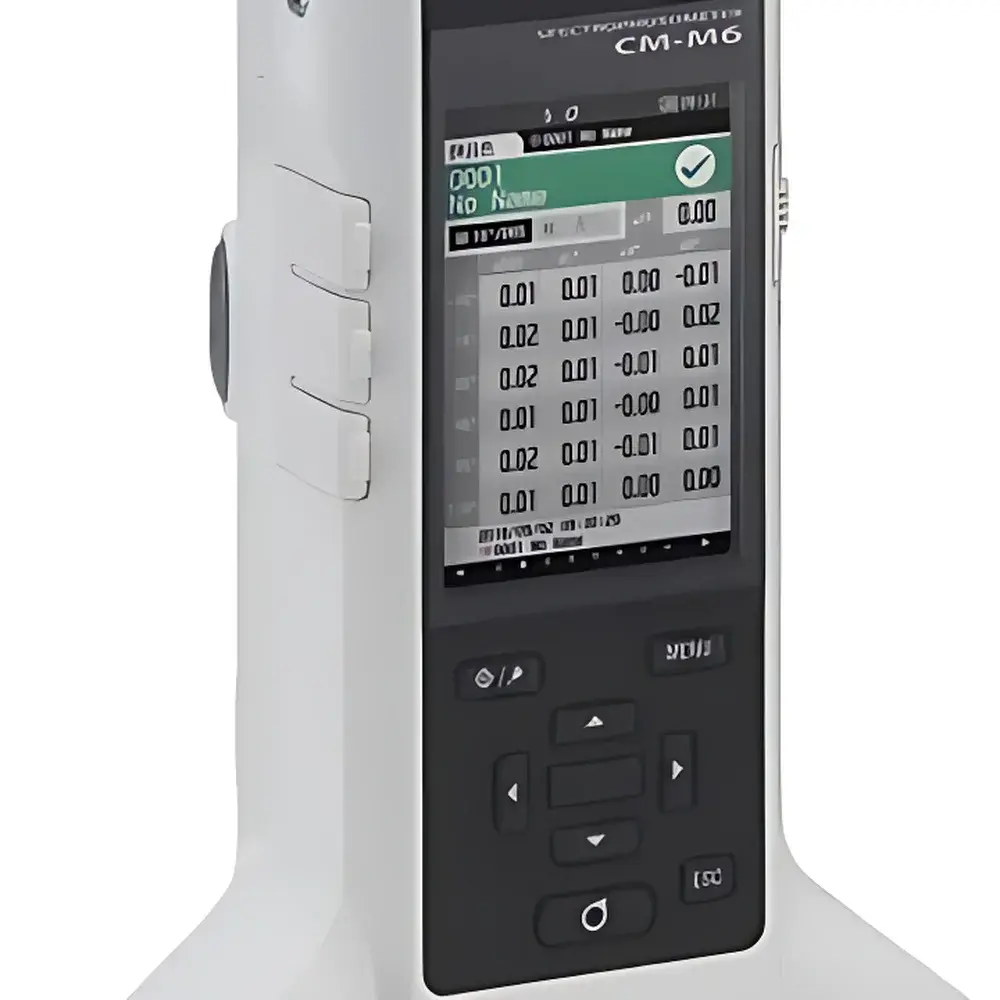
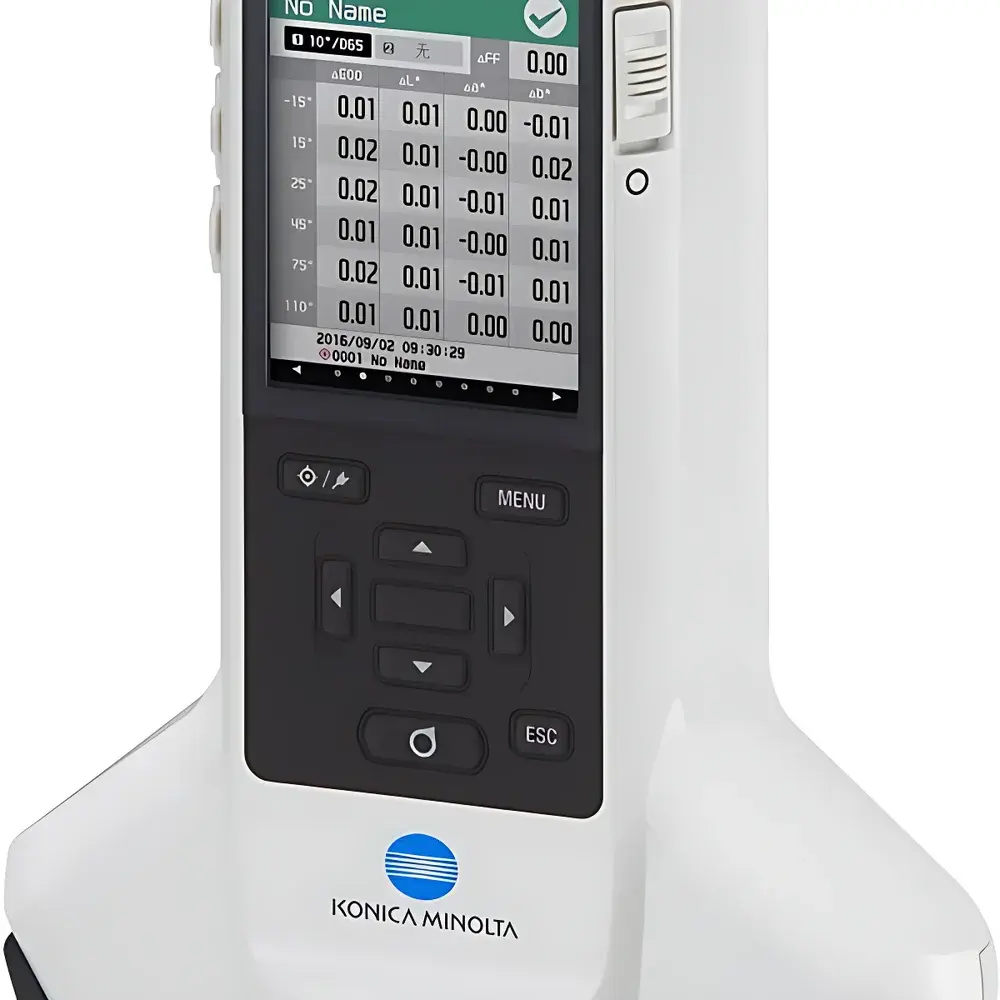
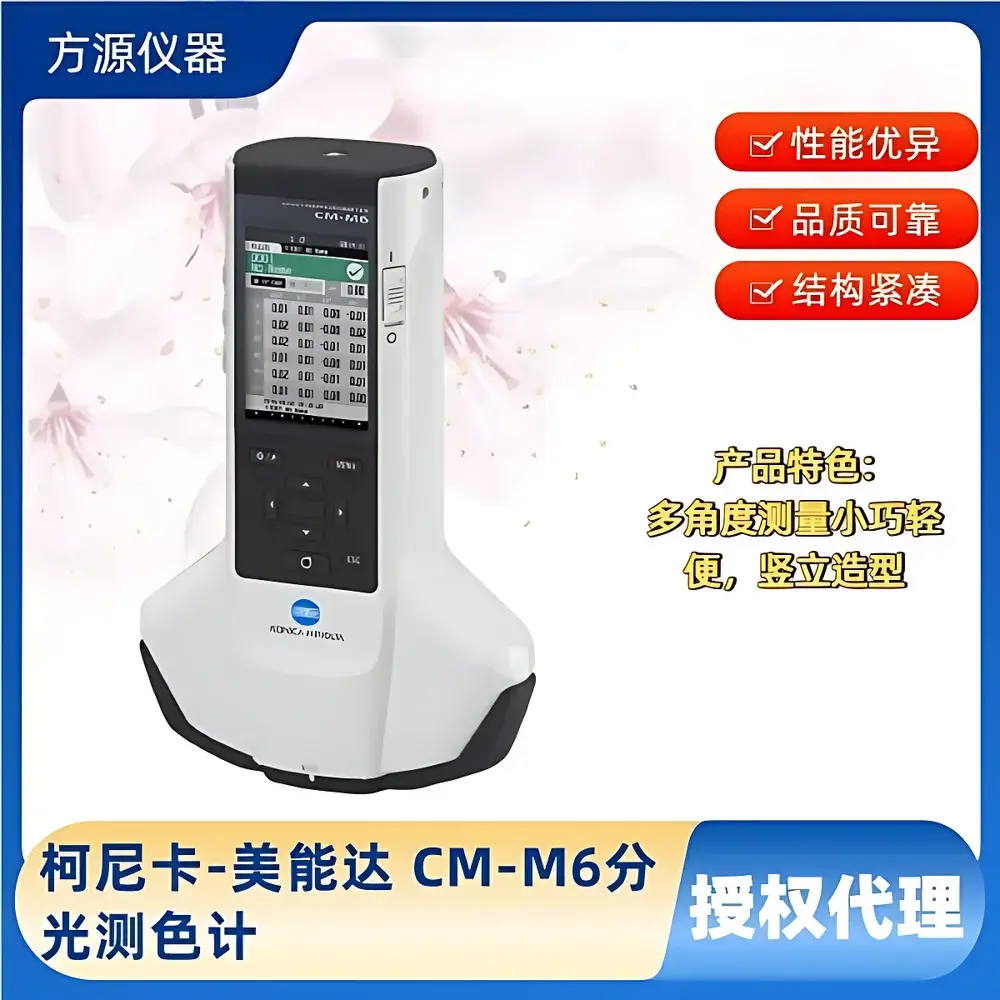
Konica Minolta CM-M6 Portable Multi-Angle Spectrophotometer
| Brand | Konica Minolta |
|---|---|
| Origin | Japan |
| Model | CM-M6 |
| Product Type | Multi-Angle Spectrophotometer |
| Instrument Form Factor | Portable (Handheld) |
| Measurement Geometry | 45° illumination / -15°, 15°, 25°, 45°, 75°, 110° multi-angle specular-reception |
| Illumination Area | 17 × 12 mm |
| Measurement Aperture Dimensions (varies by angle) | 45°: 6 × 6 mm (circular φ6 mm) |
| 25° | 6.4 × 6 mm |
| 15° & 75° | 7 × 6 mm |
| -15° & 110° | 14 × 6 mm (elliptical, reduced effective area in deep/small-bore applications) |
| Optical System | Mirror-Symmetric Dual-Optical-Path Architecture |
| Compliance | ISO 7724, ISO/CIE 11664, ASTM E308, JIS Z 8722 |
Overview
The Konica Minolta CM-M6 is a high-precision portable multi-angle spectrophotometer engineered for objective, repeatable measurement of gonioapparent materials—such as metallic, pearlescent, and effect coatings—where color appearance varies significantly with viewing and illumination geometry. Unlike conventional 45°/0° or d/8° spectrophotometers, the CM-M6 implements a true multi-angle goniospectrophotometric principle based on fixed-angle illumination at 45° and simultaneous detection across six distinct reception angles: −15°, 15°, 25°, 45°, 75°, and 110° relative to the surface normal. This configuration enables full characterization of spatial reflectance distribution (BRDF-like behavior) without mechanical repositioning. Its mirror-symmetric dual-optical-path architecture ensures robustness against minor operator-induced tilt during handheld operation—a critical design feature validated under ISO 13655 for measurement stability in field and production-floor environments.
Key Features
- Mirror-symmetric dual-optical-path system: Two identical illumination/reception arms arranged symmetrically about the instrument’s central axis compensate for angular misalignment, maintaining spectral fidelity and reducing measurement drift caused by hand movement.
- Fixed 45° illumination with six discrete specular-reception angles: Enables standardized evaluation of sparkle, graininess, and flop index per automotive OEM specifications (e.g., GMW14872, Ford FLTM BN 108-01).
- Variable aperture geometry: Measurement spot size adapts to angle—ranging from φ6 mm (45°) to 14 × 6 mm elliptical (−15°/110°)—with an oversized 17 × 12 mm illumination area designed to minimize edge effects and improve signal-to-noise ratio on textured or curved surfaces.
- Deep-cavity measurement capability: Optional deep-contact foot (28 mm long-side spacing) supports measurements in recessed or narrow-bore geometries; reported values in such configurations are referenced to instrument-specific calibration standards and documented as relative measurements per ISO 13655 Annex B.
- Integrated UV-filtered xenon flash lamp: Provides stable, pulsed D65-equivalent illumination with <±0.3 ΔE*ab repeatability over 10,000 measurements (per internal Konica Minolta validation protocol).
- Real-time spectral data acquisition: Captures full 360–740 nm spectrum (10 nm resolution) in <1.5 seconds per angle, with onboard storage for up to 2,000 multi-angle datasets.
Sample Compatibility & Compliance
The CM-M6 accommodates flat, curved, textured, and low-diffuse samples—including automotive clearcoats, plastic trim, powder-coated panels, and decorative laminates—without requiring sample masking or external fixtures in most cases. Its compact form factor and ergonomic grip facilitate consistent positioning on vertical or overhead surfaces. The instrument complies with ISO 7724-1 (colorimetric principles), ISO/CIE 11664 (CIE colorimetry), ASTM E308 (computation of CIE tristimulus values), and JIS Z 8722 (Japanese standard for color measurement). All factory calibrations are traceable to NMIJ (National Metrology Institute of Japan) reference standards. Data output formats support GLP/GMP audit trails when used with Konica Minolta’s SpectraMagic NX software (v3.9+), including user authentication, timestamped measurement logs, and electronic signature compliance with FDA 21 CFR Part 11 requirements.
Software & Data Management
SpectraMagic NX v4.x provides comprehensive analysis tools for multi-angle color data: flop index calculation (F.I. = L*15°/L*75°), sparkle and graininess quantification (per ISO 2813 and ASTM D523), and custom pass/fail tolerancing across all six angles simultaneously. Raw spectral files (.qtx) are exportable in CSV, XML, and CxF/X3 formats for integration into LIMS, MES, or statistical process control platforms. The software supports automated report generation compliant with IATF 16949 clause 8.5.1.2 (control of production and service provision), including measurement uncertainty estimation per GUM (Guide to the Expression of Uncertainty in Measurement) methodology.
Applications
- Automotive OEM and Tier-1 suppliers: In-line verification of effect paint batches, R&D evaluation of new pigment systems, and supplier quality audits.
- Coatings & ink manufacturers: Development and QC of metallic, interference, and retroreflective formulations.
- Plastics & consumer electronics: Color consistency validation for anodized aluminum, vacuum-metallized housings, and textured polycarbonate components.
- Architectural finishes: Specification compliance testing for façade panels and cladding materials under standardized viewing conditions.
- Academic research: Gonio-optical modeling of BRDF/BTDF properties in material science and computer graphics laboratories.
FAQ
What does “relative measurement” mean when using the deep-contact foot?
When measuring in recessed or small-bore geometries where the sample surface lies deeper than the optical path allows full illumination coverage, the instrument reports values normalized to its internal reference tile—these are designated as relative measurements and must be correlated to absolute standards via application-specific calibration curves.
Is the CM-M6 compliant with automotive industry multi-angle standards?
Yes—the CM-M6 meets the geometric and spectral requirements of GMW14872, Ford FLTM BN 108-01, and VW TL 226 for flop and sparkle assessment, and supports export of data in the standardized .qtx format required by OEMs.
Can the CM-M6 measure translucent or backlit materials?
No—the CM-M6 is optimized for opaque, reflective surfaces only; transmission or diaphanous materials require a dedicated integrating sphere spectrophotometer (e.g., Konica Minolta CM-700d).
How is measurement repeatability verified across angles?
Repeatability is validated per ISO 13655:2012 Annex A using a certified ceramic tile set measured 20 times per angle; typical 1σ standard deviation is ≤0.08 ΔE*00 for L*a*b* under controlled lab conditions (23 °C ±1 °C, 50% RH ±5%).
Does the instrument support wireless data transfer?
Yes—via optional Bluetooth 5.0 module (CM-M6-BT), enabling direct synchronization with SpectraMagic NX on Windows tablets or laptops without physical cabling.





