
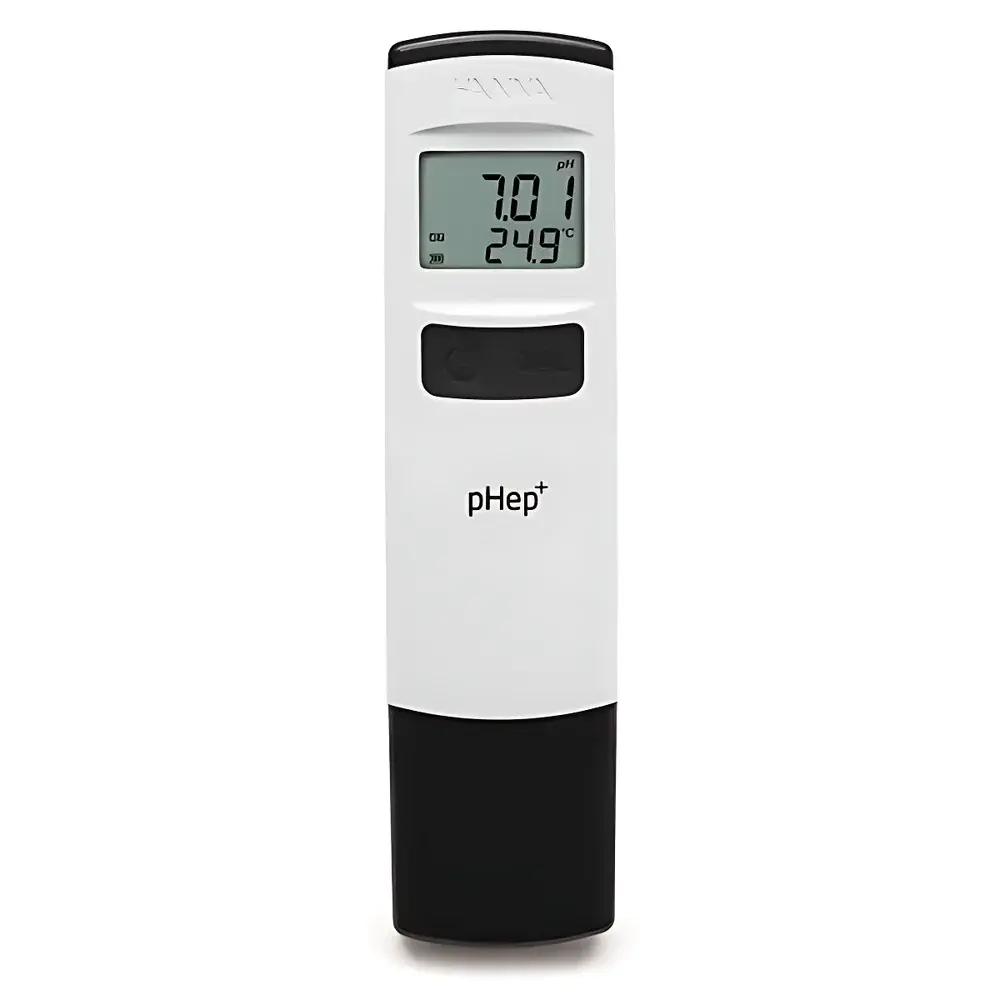
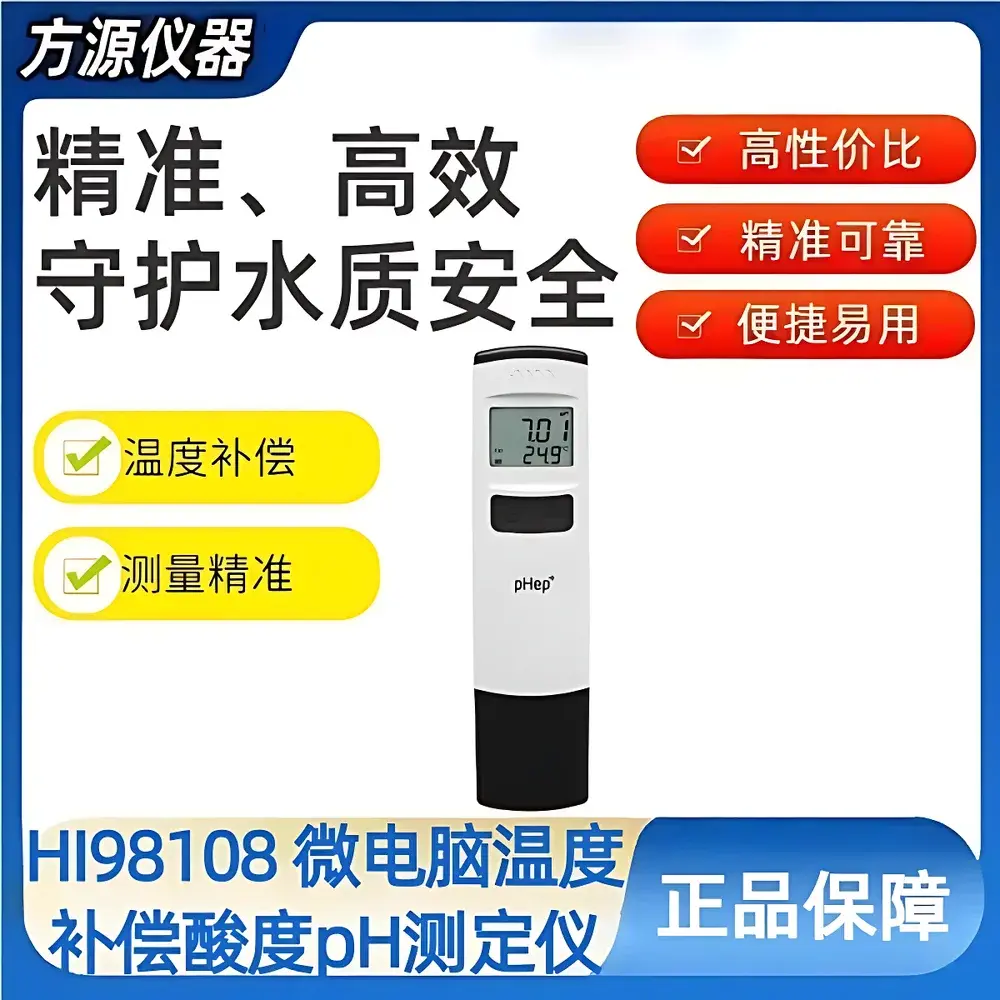
Hanna HI98108 Portable Microprocessor-Based pH Meter with Automatic Temperature Compensation
| Brand | Hanna Instruments |
|---|---|
| Origin | Italy |
| Model | HI98108 |
| Instrument Type | Portable pH Meter |
| Parameter Type | Single-Parameter (pH) |
| Measurement Range | 0.00 to 14.00 pH |
| Resolution | 0.1 pH |
| Accuracy | ±0.1 pH (@ 20°C) |
| Calibration | Manual 1–2 point (pH 4.01, 7.01, 10.01) |
| Temperature Compensation | Automatic (0 to 50°C) |
| Power Supply | 4 × 1.5 V button cells (LR44) |
| Operating Environment | 0 to 50°C (32 to 122°F), max 95% RH |
| Dimensions | 175 × 41 × 23 mm |
| Weight | 95 g |
Overview
The Hanna HI98108 is a compact, field-deployable pH meter engineered for rapid, reliable acid-base measurements in diverse operational environments—from quality control labs and wastewater treatment plants to food processing lines and agricultural field testing. It operates on the fundamental principle of potentiometric measurement: a glass pH electrode generates a millivolt signal proportional to hydrogen ion activity in solution, referenced against a stable internal Ag/AgCl reference system. The microprocessor-based circuitry converts this analog potential into a digital pH reading while applying real-time temperature compensation (ATC) using an integrated NTC thermistor. Unlike benchtop systems requiring external probes or complex calibration workflows, the HI98108 integrates sensor and electronics into a single handheld unit—optimized for ruggedness, low power consumption, and immediate deployment without warm-up delays or PC connectivity.
Key Features
- Integrated pH electrode with replaceable gel-filled reference junction and durable dialysis membrane—designed to resist clogging from particulates, oils, or high-salinity matrices.
- Automatic temperature compensation (0 to 50°C) ensures consistent accuracy across ambient and sample temperature fluctuations—critical for field applications where thermal equilibration is impractical.
- Two-point manual calibration routine using standardized NIST-traceable buffers (pH 4.01, 7.01, 10.01) enables traceable adjustment of both slope and offset; calibration status is displayed post-procedure for audit readiness.
- Large, backlit LCD screen provides clear readability under variable lighting conditions—including outdoor daylight and low-illumination industrial settings.
- Low-power architecture supports >200 hours of continuous operation on four LR44 button cells; battery life indicator alerts users prior to voltage drop-induced measurement drift.
- Ergonomic, IP67-rated housing resists dust ingress and withstands incidental water immersion—validated per IEC 60529 standards for portable instrumentation used in humid or splash-prone zones.
Sample Compatibility & Compliance
The HI98108 is validated for aqueous samples within standard pH ranges encountered in environmental monitoring (e.g., surface water, effluent), food safety (juices, dairy, brines), and educational laboratories. It complies with ISO 7888 (water quality—pH determination), ASTM D1293 (standard test method for pH of water), and supports GLP documentation requirements through its calibration memory and stable endpoint detection algorithm. While not FDA 21 CFR Part 11 compliant out-of-the-box (as it lacks electronic signature or audit trail functionality), its calibration log and fixed measurement protocol align with basic GMP hygiene and record-keeping expectations for non-regulated QC checkpoints.
Software & Data Management
As a standalone instrument, the HI98108 does not feature onboard data logging or USB/Bluetooth transmission. All measurements are displayed in real time only; no internal storage or export capability is included. This design prioritizes mechanical reliability, minimal firmware attack surface, and regulatory simplicity—making it suitable for environments where data sovereignty, cybersecurity constraints, or validation scope limitations preclude networked devices. Users requiring traceable records must manually transcribe values or pair the meter with external loggers via analog output (not supported on this model).
Applications
- On-site verification of pH in municipal drinking water distribution systems and stormwater runoff compliance sampling.
- Routine acidity checks during beverage production—soft drinks, wine fermentation tanks, and vinegar dilution batches.
- Soil extract analysis (1:1 or 1:5 CaCl₂ suspension) in agronomy field surveys.
- Quick-check validation of cleaning-in-place (CIP) rinse endpoints in pharmaceutical equipment sanitation protocols.
- Student laboratory exercises emphasizing electrode theory, calibration fundamentals, and error sources in electrochemical measurement.
FAQ
Does the HI98108 support automatic calibration?
No. Calibration requires manual selection of one or two standard buffer solutions (pH 4.01, 7.01, or 10.01) and user-initiated confirmation steps.
Can the electrode be replaced independently of the main unit?
No—the pH sensing element is permanently integrated; however, the dialysis membrane can be advanced ~1–2 mm to expose fresh electrolyte surface, extending functional service life between full replacements.
Is the device compatible with non-aqueous solvents?
Not recommended. The electrode is optimized for aqueous electrolyte systems; measurements in ethanol, acetone, or low-dielectric media may yield unstable readings and accelerated junction depletion.
What is the minimum sample volume required for accurate measurement?
A minimum depth of 12 mm immersion is required to cover both the pH glass bulb and reference junction; total volume should exceed 15 mL to ensure thermal and ionic equilibrium.
How often should calibration be performed?
Daily calibration is advised for critical measurements; for general screening, calibration before first use and after extended idle periods (>8 hours) meets typical ISO/ASTM field practice guidelines.






