
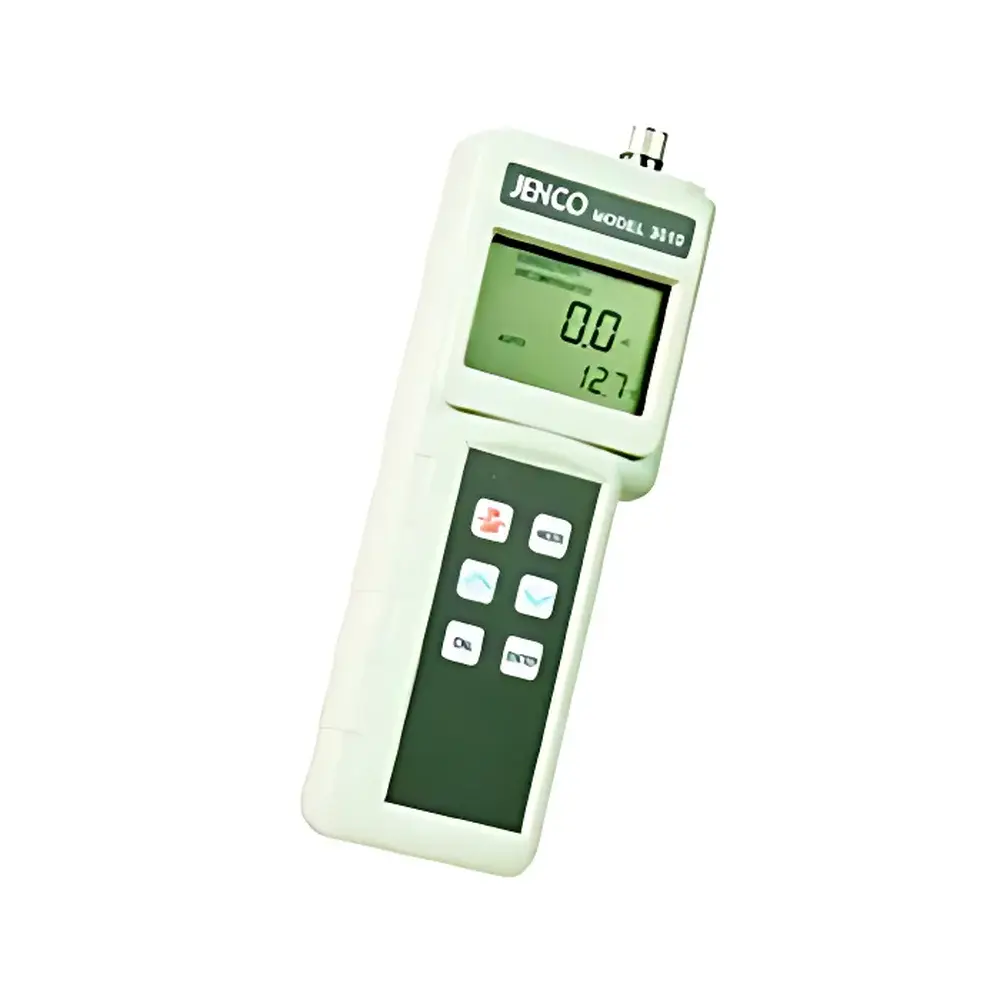
American-made Portable Conductivity Meter Model 3010
| Origin | USA |
|---|---|
| Distribution Model | Authorized Distributor |
| Import Status | Imported |
| Model | 3010 |
| Conductivity Range | 0.01 µS/cm to 200.0 mS/cm |
| TDS Range | 0.0–80.0 ppt |
| Resistivity Range | 0.01 µS/cm to 200.0 mS/cm (inverted scale) |
| Salinity Range | 0.0–80.0 ppt |
| Temperature Range | −10.0 to 120.0 °C |
| Accuracy | ±0.5% of full scale (FS) for conductivity |
| Minimum Resolution | 0.01 µS/cm (at low range) |
| Electrode Constants Supported | 0.1, 1.0, and 10.0 cm⁻¹ |
| Temperature Compensation | Automatic (NTC 10 kΩ thermistor), user-adjustable α (0.00–4.00 %/°C) and reference temperature (15.0–25.0 °C) |
| TDS Factor | Adjustable (0.30–1.00) |
| Calibration Memory | Yes |
| Power Supply | 9 V alkaline battery (IEC 6LR61) |
| Operating Environment | 0–50 °C, <90% RH |
| Weight | ~260 g |
| Dimensions | 186 × 70 × 37 mm |
| Certifications | CE compliant |
Overview
The American-made Portable Conductivity Meter Model 3010 is a field-deployable, multi-parameter electrochemical analyzer engineered for precision measurement of electrical conductivity, total dissolved solids (TDS), salinity, and temperature in aqueous solutions. Based on the fundamental principle of conductometric analysis—measuring the solution’s ability to conduct electric current via two- or four-electrode cell geometry—the instrument delivers traceable, reproducible results across a broad dynamic range. Its design adheres to core metrological practices defined in ASTM D1125 (Standard Test Methods for Electrical Conductivity and Resistivity of Water) and ISO 7888 (Water quality — Determination of electrical conductivity), supporting routine compliance in environmental monitoring, industrial process control, and academic research laboratories. The meter employs a calibrated NTC thermistor (10 kΩ at 25 °C) for real-time temperature compensation, enabling automatic correction of conductivity values to a user-defined reference temperature (default 25.0 °C), critical for inter-laboratory comparability and regulatory reporting.
Key Features
- True multi-parameter capability: simultaneous measurement and display of conductivity, TDS, salinity, and temperature—with all parameters updated in real time
- Auto-ranging conductivity measurement across three selectable cell constants (K = 0.1, 1.0, and 10.0 cm⁻¹), ensuring optimal sensitivity for ultrapure water, municipal wastewater, or high-salinity brines
- Programmable temperature coefficient (α = 0.00–4.00 %/°C) and reference temperature (15.0–25.0 °C), aligning with application-specific standards such as USP for purified water or EPA Method 120.1 for drinking water
- Adjustable TDS conversion factor (0.30–1.00), accommodating different ion composition profiles (e.g., NaCl-equivalent vs. CaCO₃-based scaling)
- Low-power architecture powered by a single 9 V alkaline battery, delivering >200 hours of continuous operation; integrated low-battery indicator prevents data interruption
- Tactile audio feedback on all keypad presses enhances usability in noisy or gloved-hand field conditions
- CE-marked enclosure rated for IP65-level dust and moisture resistance during transport and short-term field exposure
Sample Compatibility & Compliance
The Model 3010 supports direct immersion measurements in liquid samples ranging from deionized water (≥18.2 MΩ·cm resistivity) to saturated salt solutions (up to 80.0 ppt salinity). It is compatible with standard DIN-style conductivity cells (BNC or mini-DIN connectors) and accepts manual calibration using certified KCl standard solutions (e.g., 84 µS/cm, 1413 µS/cm, 12.88 mS/cm). All calibration events—including date, standard value, and measured deviation—are stored internally with timestamping, satisfying basic GLP documentation requirements. While not 21 CFR Part 11-compliant out-of-the-box (lacking electronic signature and audit trail modules), its calibration memory and stable firmware support retrospective verification during internal QA audits or third-party ISO/IEC 17025 assessments.
Software & Data Management
Data output is limited to on-device LCD display (dual-line, 4-digit resolution) and audible confirmation tones; no Bluetooth, USB, or PC interface is integrated. However, the instrument’s deterministic calibration logic and non-volatile parameter storage ensure consistent behavior across operator shifts and field deployments. Users may manually record readings alongside environmental metadata (e.g., sampling location, time, electrode ID) in laboratory notebooks or LIMS-compatible spreadsheets. Firmware updates are not field-upgradable; calibration verification and sensor validation must be performed per manufacturer-recommended intervals (typically every 3–6 months under routine use).
Applications
- Environmental field surveys: surface water, groundwater, and effluent stream monitoring per EPA NPDES permit requirements
- Pharmaceutical water systems: rapid verification of conductivity in purified water (PW) and water for injection (WFI) distribution loops
- Academic teaching labs: hands-on instruction in solution chemistry, electrolyte behavior, and colligative property relationships
- Food & beverage QC: incoming raw water assessment, brine concentration checks, and cleaning-in-place (CIP) rinse water validation
- Aquaculture and hydroponics: real-time tracking of nutrient solution ionic strength and osmotic stability
FAQ
Does the Model 3010 support GLP-compliant data logging?
No—this is a standalone field meter without onboard memory export, timestamped audit trails, or electronic signatures. For GLP/GMP environments requiring full traceability, pairing with a validated external data logger or upgrading to a benchtop model with RS-232/USB output is recommended.
Can I use non-standard electrode constants (e.g., K = 0.01 cm⁻¹)?
Only K = 0.1, 1.0, and 10.0 cm⁻¹ are factory-programmed. Custom constants require firmware modification, which is not supported.
Is temperature compensation applied to TDS and salinity calculations?
Yes—both derived parameters are mathematically corrected using the same α coefficient and reference temperature configured for conductivity.
What is the recommended calibration frequency?
Daily calibration is advised before critical measurements; weekly verification suffices for routine monitoring if ambient conditions and sample matrix remain stable.
Does the device meet ASTM D5391 for conductivity of pharmaceutical water?
It meets the measurement range and accuracy requirements of ASTM D5391 (±0.5% FS), but lacks the integrated temperature probe geometry and flow-cell compatibility specified for WFI testing—use only for preliminary screening or PW verification.
Related Products





