
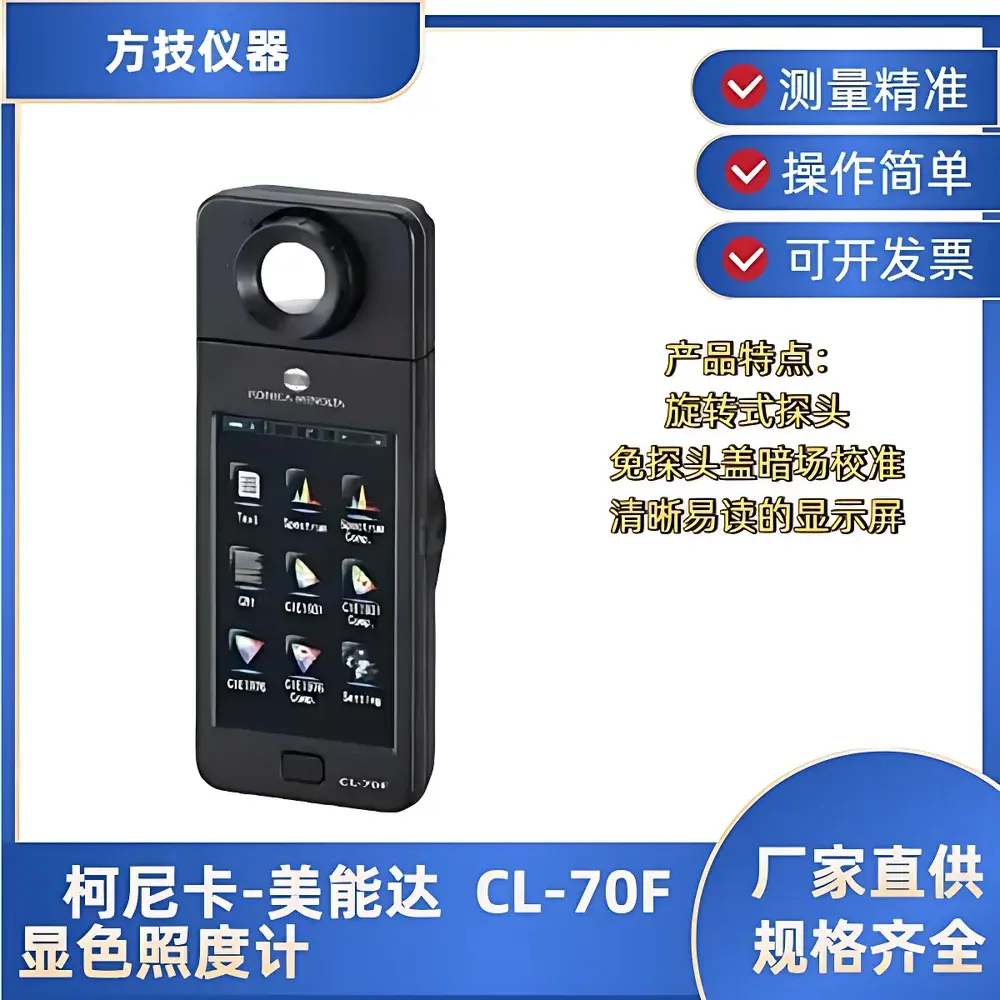
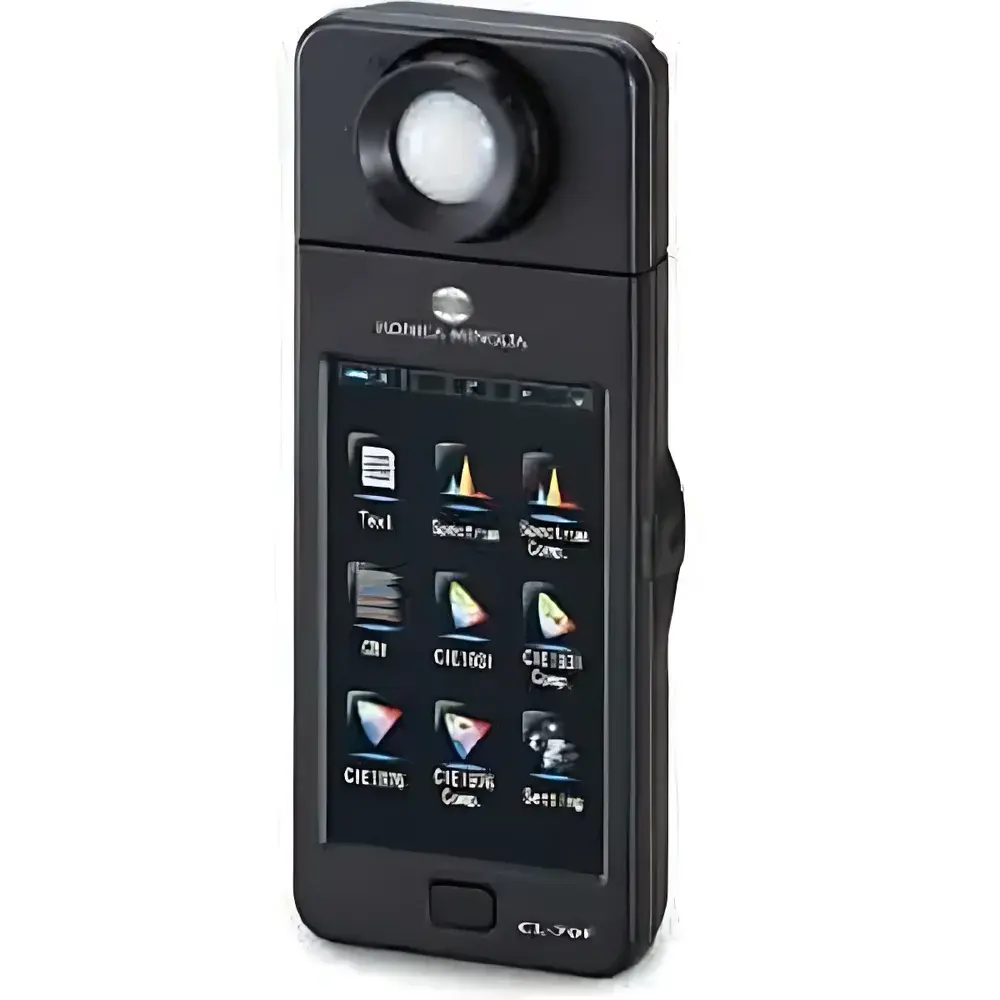
Konica Minolta CL-70F Portable Color Illuminance Meter with Rotatable Probe and UV-Sensitive Measurement Capability
| Brand | Konica Minolta |
|---|---|
| Origin | Japan |
| Model | CL-70F |
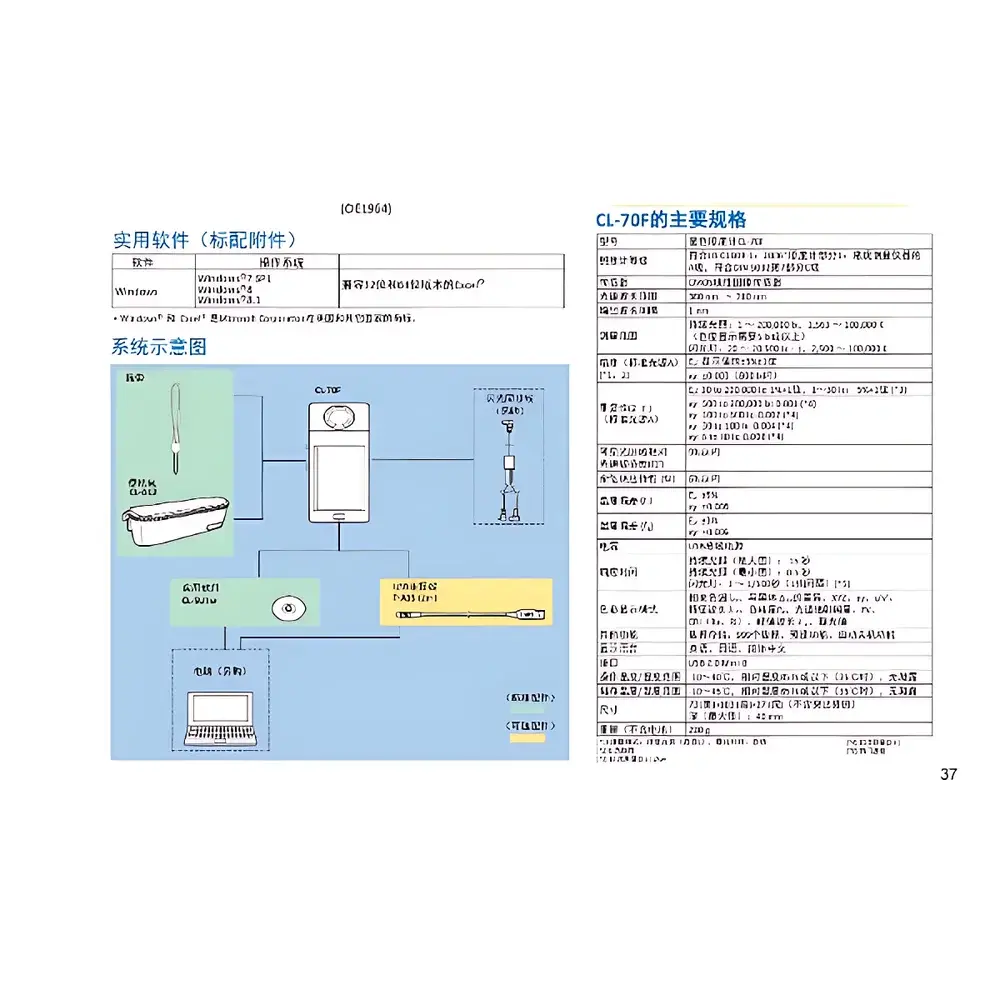
| Illuminance Class | JIS C1609-1:2006 Class A / DIN 5032-7 Class C |
| Spectral Range | 380–780 nm |
| Wavelength Resolution | 1 nm |
| Continuous Illuminance Range | 1–200,000 lx |
| CCT Range | 1,563–100,000 K (≥5 lx for chromaticity) |
| Flash Energy Range | 20–20,500 lx·s |
| Ev Accuracy | ±(1% + 1 digit) from 30–200,000 lx |
| Chromaticity Accuracy (xy) | ±0.003 at 800 lx |
| f1' Spectral Mismatch | ≤9% |
| f2 Cosine Error | ≤6% |
| Operating Temp. | −10 to 40 °C |
| Weight | 230 g |
| Interface | USB 2.0 Mini-B |
| Data Storage | 999 records |
Overview
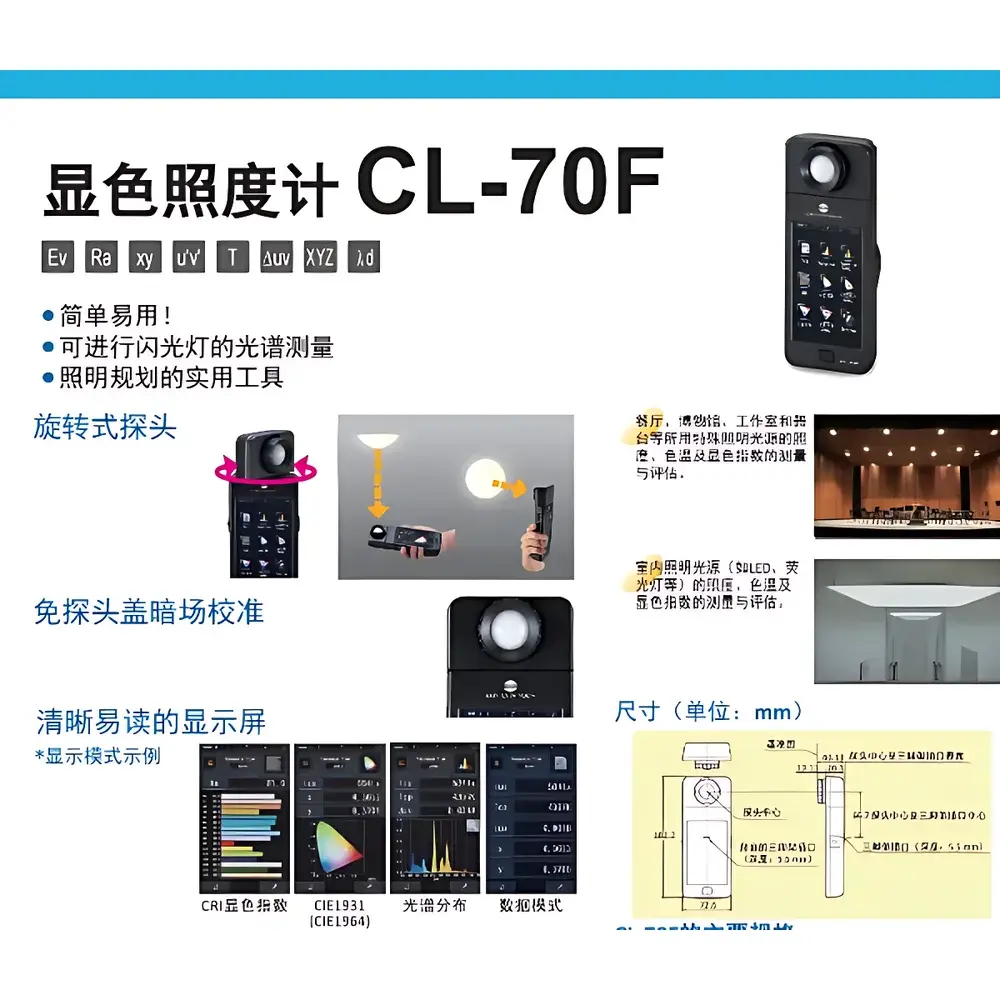
The Konica Minolta CL-70F is a high-precision portable color illuminance meter engineered for metrologically rigorous light measurement in laboratory, production, and field environments. It employs a CMOS linear image sensor coupled with a diffraction-grating-based monochromator to deliver spectrally resolved irradiance data across the visible spectrum (380–780 nm) at 1 nm wavelength intervals. Unlike broadband photometers, the CL-70F performs full spectral radiometric analysis—enabling calculation of photometric (illuminance, EV), colorimetric (CIE 1931 xy, CIE 1976 u’v’, Δuv, dominant wavelength λd, purity Pe), and quality metrics (CRI Ra/Ri, spectral peak λp) in a single acquisition. Its rotatable probe design ensures optimal angular alignment with incident light fields, minimizing cosine error (f2 ≤ 6%) and supporting compliant measurements per JIS C1609-1:2006 Class A and DIN 5032-7 Class C standards. The instrument operates via USB bus power—eliminating battery drift—and supports both continuous (1–200,000 lx) and flash (20–20,500 lx·s) illumination modes with adaptive exposure control.
Key Features
- Rotatable optical probe with precision mechanical detents for repeatable angular positioning and minimized cosine response deviation
- UV-capable spectral sensitivity (down to 380 nm) with calibrated spectral responsivity traceable to NMIJ (National Metrology Institute of Japan)
- Real-time spectral irradiance output (mW/m²·nm) alongside derived photometric and colorimetric quantities
- High-fidelity chromaticity accuracy: ±0.003 in CIE xy at 800 lx; ±0.001 from 500–200,000 lx (standard illuminant A)
- Integrated flash synchronization capability (via optional CL-A12 sync cable) for stroboscopic and pulsed-light characterization
- On-device storage of up to 999 measurement records with timestamp, CCT, CRI, and spectral snapshot metadata
- Multi-language UI (English, Japanese, Simplified Chinese) and USB 2.0 Mini-B interface compatible with Windows® 7 SP1 through Windows® 10/11 (32-/64-bit)
Sample Compatibility & Compliance
The CL-70F is validated for use across diverse light sources—including LED arrays, OLED panels, fluorescent tubes, HID lamps, xenon flashes, and daylight-simulating sources—without requiring source-specific calibration factors. Its spectral mismatch error (f1′ ≤ 9%) meets the stringent requirements for Class A illuminance meters under JIS C1609-1:2006 and aligns with the performance envelope defined in DIN 5032-7 for Class C instruments. While not intrinsically certified for FDA 21 CFR Part 11 or ISO/IEC 17025, the device supports GLP/GMP-aligned workflows when used with the CL-SU1w software: audit trails, user-access controls, and exportable .csv/.xlsx reports (via Microsoft Excel® integration) facilitate documentation for regulated lighting validation protocols. Environmental operation is specified from −10 °C to 40 °C at ≤85% RH (non-condensing), ensuring stability during on-site commissioning of architectural, display, or medical lighting systems.
Software & Data Management
The included CL-SU1w application provides full instrument control, real-time spectral visualization, batch analysis, and compliance reporting. It supports automated data logging synchronized with external triggers (e.g., shutter release or PLC pulse), enabling time-resolved studies of dynamic light sources. All raw spectral data (301-point spectra) are retained in native format and can be exported as ASCII text or Excel-compatible tables containing wavelength-indexed irradiance values, CIE XYZ tristimulus values, and calculated indices (Ra, R1–R15, TM-30 fidelity/saturation). The software enforces version-controlled configuration files, permits user-defined measurement templates (e.g., “LED binning protocol” or “display white-point verification”), and generates PDF summary reports with embedded spectral plots and pass/fail flags against user-set tolerances. No cloud dependency or subscription model is required—data remain fully under local administrative control.
Applications
- Photometric validation of backlight units (BLUs) and emissive displays per IEC 62341-6-3 and VESA DisplayHDR™ test specifications
- Color consistency auditing in LED manufacturing lines, including binning verification using Δuv and CRI thresholds
- Architectural lighting design verification—measuring horizontal/vertical illuminance, uniformity ratios (U1/U2), and spatial CCT distribution
- Medical device lighting compliance testing (e.g., surgical headlight output per IEC 60601-2-41)
- Photobiological safety pre-screening (IEC 62471) via spectral irradiance integration in UV-A (315–400 nm) and blue-light hazard (400–500 nm) bands
- Calibration transfer between integrating spheres and reference-grade spectroradiometers in metrology labs
FAQ
Does the CL-70F require annual recalibration to maintain stated accuracy?
Yes. Konica Minolta recommends traceable recalibration every 12 months at an authorized service center using NMIJ-traceable standards. Drift in spectral responsivity—particularly in the UV edge (<400 nm)—can exceed specification limits without periodic verification.
Can the CL-70F measure pulsed LEDs with duty cycles below 1%?
It supports flash mode down to 1/500 s exposure (2 ms), but accurate energy integration requires stable pulse profiles. For sub-millisecond or irregular pulses, a dedicated flash photometer (e.g., CL-500A with high-speed trigger) is advised.
Is spectral data export compatible with third-party analysis tools like MATLAB or Python?
Yes. Raw .csv exports contain wavelength (nm) and spectral irradiance (µW/cm²·nm) columns with header metadata—directly ingestible by NumPy, Pandas, or MATLAB’s readmatrix().
What is the minimum illuminance required to compute CRI values?
Chromaticity calculations require ≥5 lx for stable xy coordinates; CRI computation is only enabled above 30 lx due to signal-to-noise constraints in the violet/blue region.
Does the rotatable probe affect measurement repeatability?
No—the probe’s rotation mechanism uses hardened steel detents with <0.5° angular hysteresis. Repeatability studies per ISO 5725-2 confirm <0.2% inter-position variation in Ev and <0.0005 in xy across five probe orientations at fixed geometry.




