
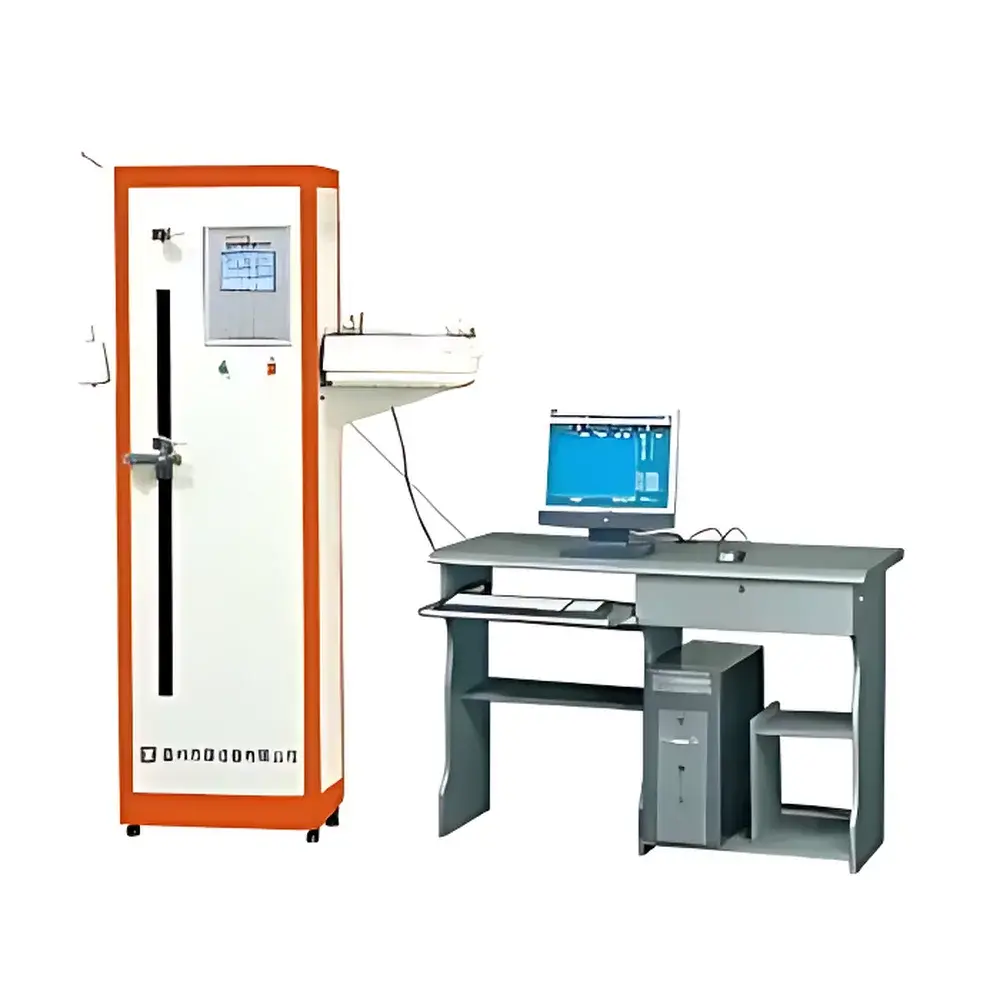
Fangyuan Instruments YG021PC Electronic Single-Yarn Tensile Tester
| Brand | Fangyuan Instruments |
|---|---|
| Origin | Zhejiang, China |
| Manufacturer Type | Authorized Distributor |
| Country of Manufacture | China |
| Model | YG021PC |
| Price | Upon Request |
| Load Capacity | 0–50000 cN |
| Load Resolution | 1/50000 F.S. |
| Load Accuracy | ≤ ±0.05% F.S. |
| Force Measurement Accuracy | ±0.5% of reading (at 1–100% of sensor range) |
| Data Sampling Rate | ≥800 Hz |
| Tensile Speed | 10–1200 mm/min (adjustable) |
| Return Speed | 10–1200 mm/min (adjustable) |
| Elongation Resolution | 0.01 mm |
| Maximum Stroke | 900 mm |
| Gauge Length Setting Range | 0–500 mm (digital input) |
| Pre-tension Range | 0–150 cN |
| Data Storage Capacity | ≥4000 test records |
| Dimensions (L×W×H) | 670×450×1660 mm |
| Weight | ≈85 kg |
Overview
The Fangyuan Instruments YG021PC Electronic Single-Yarn Tensile Tester is a precision electromechanical instrument engineered for standardized mechanical property evaluation of filamentary and spun yarns under uniaxial tension. It operates on the principle of controlled displacement-driven tensile testing, where force and elongation are simultaneously measured via high-fidelity load cell transduction and optical encoder-based position tracking. Designed in accordance with international textile testing standards—including ISO 2062, ASTM D2256, GB/T 3916, and BS EN ISO 2062—the YG021PC delivers repeatable, traceable, and auditable results essential for quality assurance in spinning mills, R&D laboratories, and third-party textile certification bodies. Its architecture integrates real-time dynamic acquisition, digital signal conditioning, and dual-mode operation (standalone LCD panel or PC-linked software), ensuring compliance with GLP-aligned workflows and supporting full audit trails for regulated environments.
Key Features
- High-speed data acquisition at ≥800 Hz—capturing up to 800 synchronized force-elongation data points per second—minimizing peak-force omission and preserving true mechanical response characteristics.
- Sharp blue-backlit LCD control panel with intuitive Chinese-language menu navigation; eliminates operator error through context-sensitive prompts and real-time parameter feedback.
- Full-digital tactile keypad interface with industrial-grade durability and extended service life (>1 million actuations).
- Mitsubishi 16-bit microcontroller core paired with a dedicated 16-bit A/D converter—enhancing noise immunity, signal integrity, and data throughput stability in electrically noisy factory or lab settings.
- Integrated real-time clock for timestamped test logging, enabling chronological traceability across batches and shifts.
- On-screen statistical reporting: automatic calculation and display of mean, standard deviation, maximum, minimum, coefficient of variation (CV%), and other ISO-compliant summary metrics per test sequence.
- User-definable pre-tension threshold (0–150 cN) and initial trigger force—critical for evaluating low-modulus elastomeric fibers such as spandex, covered yarns, and stretch knits.
- Multi-unit force display (cN, N, kgf, lbf, ozf) with seamless on-the-fly conversion—supporting global reporting requirements without manual recalculations.
- Dual operational mode: fully functional standalone operation via embedded firmware and LCD interface—including direct thermal printout—or synchronized PC-based control and analysis using bundled Windows-compatible software.
Sample Compatibility & Compliance
The YG021PC accommodates a broad spectrum of single-yarn specimens, including natural fibers (cotton, wool, silk, linen), synthetic filaments (polyester, nylon, acrylic), blended yarns (cotton/polyester, wool/nylon), core-spun structures (e.g., spandex-core covered yarns), and technical textiles (elastic webbing, narrow fabrics, braided cords). It supports specialized test protocols beyond basic tensile rupture—such as cyclic loading/unloading for elastic recovery assessment, creep testing under constant load, and peel/adhesion strength evaluation for laminated substrates (e.g., fusible interlinings). All test methods align with ISO 13934-1 (tensile properties), ISO 2062 (single-yarn testing procedure), ASTM D2256 (tensile properties of yarns), and GB/T 3916 (Chinese national standard for yarn strength). The system’s mechanical design and calibration traceability support regulatory readiness for ISO/IEC 17025-accredited labs and GMP-aligned textile manufacturing QA/QC departments.
Software & Data Management
The included Windows-based software provides comprehensive test configuration, real-time graphical monitoring (force vs. elongation, stress-strain), automated report generation (PDF/CSV), and Excel-compatible export (.XLSX) for archival, cross-departmental sharing, or statistical process control (SPC) integration. Raw data files retain full-resolution time-series records—including timestamps, environmental metadata (if external sensors are connected), and operator ID—for forensic-level reanalysis. Software features include curve overlay comparison, point-wise cursor interrogation, selectable smoothing algorithms, and customizable report templates compliant with internal SOPs or external client specifications. Audit trail functionality logs all user actions—including method edits, calibration events, and data deletions—with immutable timestamps—meeting FDA 21 CFR Part 11 expectations for electronic records when deployed in regulated textile supply chains.
Applications
- Break strength and elongation-at-break measurement of staple and filament yarns per ISO 2062 and ASTM D2256.
- Elastic recovery, set retention, and hysteresis analysis of spandex-containing yarns, covered elastane, and stretch knits.
- Tensile performance evaluation of technical yarns used in medical textiles, geotextiles, and protective apparel.
- Peel strength testing of bonded interlinings and laminated composites per ISO 1973.
- Transverse tensile (burst) testing of hosiery and fine-knit fabrics using custom fixtures.
- Quality conformance verification during incoming raw material inspection, in-process spinning control, and final product release.
FAQ
What standards does the YG021PC comply with for yarn tensile testing?
It supports ISO 2062, ASTM D2256, GB/T 3916, BS EN ISO 2062, and ISO 13934-1, with configurable test parameters to match each standard’s specified gauge length, speed, and preconditioning requirements.
Can the instrument perform cyclic or creep tests?
Yes—via programmable multi-stage test profiles in the PC software, users can define sequential loading/unloading cycles or sustained-load dwell periods to assess viscoelastic behavior.
Is calibration traceable to national metrology institutes?
The load cell is supplied with a factory calibration certificate traceable to CNAS-accredited standards; optional UKAS/NIST-traceable recalibration services are available upon request.
Does the system support networked data transfer or LIMS integration?
Raw data exports in CSV/XLSX formats enable seamless import into LIMS, MES, or statistical analysis platforms; API access is not natively supported but may be enabled via custom DLL integration upon technical consultation.
What maintenance is required for long-term accuracy?
Annual verification of load cell linearity, encoder resolution, and mechanical alignment is recommended; routine cleaning of guide rails and periodic lubrication of the lead screw ensure consistent stroke fidelity over 10+ years of typical lab use.






